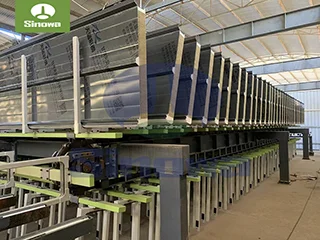
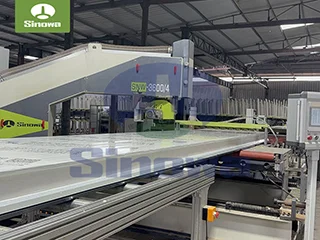
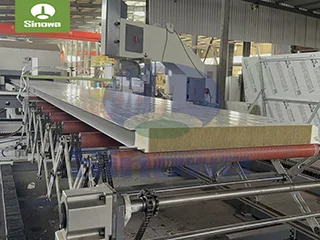
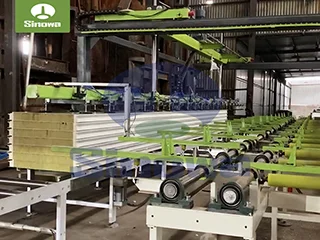
sandwich panel line
The glass wool sandwich panel production line is usually composed of several parts, including raw material preparation area, mixing area, melting and forming area, curing and cooling area, cutting and packaging area, etc. Each area is equipped with specialized equipment and processes to ensure smooth production processes and stable product quality.
Raw materials: The main raw materials for glass wool sandwich panels include quartz sand or recycled glass, resin glue, and auxiliary materials (such as silicates, phosphates, etc.). These raw materials are precisely proportioned and mixed before entering the production line for processing.
Process: After the raw materials are mixed evenly, they are sent to a high-temperature kiln for melting. The melted liquid is spun into silk by a centrifuge, and resin glue and a small amount of water are added for bonding. The formed glass wool is compressed by hot air and then enters the curing furnace for curing treatment. After curing, the board can be cut and packaged to become a finished product.
Characteristic
High degree of automation: The glass wool sandwich panel production line adopts advanced automation control technology, which can achieve the full process automation production from raw material feeding to finished product output. This greatly improves production efficiency and reduces labor costs.
Stable product quality: The continuous glass wool sandwich panel production line ensures stable quality and excellent performance of the produced glass wool sandwich panels by precisely controlling the parameters of each production process, such as melting temperature, centrifuge speed, curing time, etc.
Energy saving and environmental protection: The automatic production line for glass wool sandwich panels adopts high-efficiency and energy-saving equipment and technology, such as high-power and low-energy consuming motors, hot air recovery systems, etc., which reduces energy consumption and emissions and meets environmental protection requirements.
Strong adaptability: The continuous production line of glass wool sandwich panels can produce glass wool sandwich panels of different specifications and properties according to customer needs, such as different thicknesses, densities, fire ratings, etc.
Glass wool sandwich panels have been widely used in the construction industry due to their excellent insulation, thermal insulation, fire resistance, and other properties. It can be used for wall and roof enclosure structures in industrial plants, cold storage rooms, purification rooms, and other buildings, as well as for equipment manufacturing and insulation needs in industries such as power construction, petrochemicals, and pharmaceuticals.
With the continuous development of the construction industry and the increasing demand for energy conservation and environmental protection, the production line of glass wool sandwich panels is also constantly upgrading and improving. In the future, production lines will become more intelligent, automated, and environmentally friendly to adapt to changes in market demand and the diversification of customer needs.
The glass wool sandwich panel production line is an efficient, energy-saving, and environmentally friendly production equipment with broad application prospects and development potential.
The glass wool sandwich panel production line stands as a sophisticated and integrated automated manufacturing system specially designed for the continuous and standardized fabrication of composite glass wool sandwich panels, a type of high-efficiency building composite material widely favored in modern construction and industrial insulation fields. This professional production system integrates mechanical transmission, material composite processing, automatic forming, continuous bonding and fixed-size cutting processes into one unified operating flow, realizing the whole-process automated production from raw material feeding of metal surface sheets and glass wool core materials to finished panel molding, trimming and final discharging. Different from traditional intermittent manual or semi-mechanical processing methods for building insulation panels, the glass wool sandwich panel production line adopts a modular overall structural design concept, which enables all functional mechanical components to be flexibly integrated, combined and adjusted according to different production demands, effectively meeting the customized manufacturing requirements of sandwich panels with different thickness specifications, surface structural forms and application functional orientations. The core operational logic of the entire production line focuses on maintaining the structural integrity of each composite layer of the sandwich panel, ensuring stable and lasting bonding performance between the metal outer skin and the glass wool inner core, and synchronously realizing the unified shaping of panel appearance size and the solidification of comprehensive physical properties, so that each batch of produced glass wool sandwich panels can maintain consistent structural stability and functional reliability in various complex application environments. With the continuous upgrading of modern construction engineering requirements for building energy conservation, fire safety, sound insulation and structural lightweight, the optimization and iteration of glass wool sandwich panel production line structure and manufacturing technology have been continuously promoted, making this production equipment not only a core carrier for mass production of high-performance insulation building materials, but also an important basic guarantee for promoting the standardized assembly and green development of modern construction projects.
The overall structural composition of the glass wool sandwich panel production line is scientifically layered and functionally partitioned, with each functional unit closely connected and coordinated with each other to form a closed-loop continuous production operation system without redundant links and process interruptions. The initial starting part of the entire production line is the automatic unwinding and pretreatment system for metal surface materials, which is responsible for the orderly unwinding, tension balancing and surface leveling of coiled metal sheets used as the upper and lower outer skins of the sandwich panels. This core structural unit is equipped with hydraulic automatic tensioning devices and precise automatic centering auxiliary structures, which can effectively avoid surface scratches, wrinkles and offset deviation of metal coils during the unwinding process, ensuring that the subsequent composite processing of metal surface materials can maintain flatness and dimensional accuracy. After the metal sheet is unwound and leveled, it will enter the surface fine treatment and gluing linkage structure, where the surface of the metal sheet will be subjected to uniform dedusting and roughening treatment to enhance the adhesion between the metal surface and the adhesive, and then the special environmental-friendly composite adhesive will be evenly coated on the inner surface of the upper and lower metal sheets through an automatic quantitative gluing device. The gluing structure of the production line adopts a precise control design for glue application amount and gluing uniformity, which can avoid the quality problems of insufficient bonding strength caused by too little glue and panel bulging and deformation caused by too much glue overflow, laying a solid foundation for the firm composite connection between the metal outer layer and the glass wool core material in the later stage.
Following the gluing process link, the glass wool core material automatic feeding and positioning assembly structure becomes the key intermediate core part of the entire production line, undertaking the core work of conveying, arranging and precise positioning of glass wool raw materials. The glass wool raw materials used for production are mostly fiber-assembled wool blocks with uniform density and standardized thickness, and this structural unit can automatically arrange and combine glass wool raw materials according to the preset thickness and width parameters of the finished sandwich panels, ensuring that the internal core material structure of each panel is uniform and consistent without gaps and uneven density distribution. In order to further improve the overall structural compactness of the composite panels, the production line is equipped with a core material vertical shaping and pressing auxiliary structure, which can adjust the arrangement direction and compactness of glass wool fibers, making the internal fiber structure of the core material more orderly, thereby effectively enhancing the thermal insulation, sound absorption and overall compression resistance of the finished sandwich panels. After the glass wool core material is accurately positioned and arranged, it will be automatically compounded with the upper and lower glued metal sheets under the action of the automatic conveying and pressing structure of the production line, realizing the initial fitting and bonding of the three-layer composite structure of metal surface, adhesive layer and glass wool core.
The middle and rear sections of the glass wool sandwich panel production line are equipped with constant-temperature composite pressing, curing and integral shaping structures, which are the core functional components to determine the final bonding firmness and structural flatness of the sandwich panels. The constant-temperature pressing structure adopts a multi-group roller pressing design with adjustable pressure and temperature, which can apply uniform and stable pressing force to the initially compounded sandwich panels, and maintain a reasonable constant-temperature environment inside the pressing area to accelerate the rapid curing and solidification of the composite adhesive. This structural design can ensure that the adhesive fully reacts and forms a stable bonding layer between the metal sheet and the glass wool core material, avoiding the quality defects of delamination, peeling and hollowing of the composite panels in subsequent use. After constant-temperature pressing and curing, the preliminary formed sandwich panels will enter the edge trimming, shaping and surface finishing structure of the production line, where the irregular edges and excess residual materials on both sides and ends of the panels will be automatically trimmed and polished to ensure that the overall dimensional specification and edge flatness of each sandwich panel meet unified production standards. The final functional structure of the entire production line is the fixed-size cutting and automatic discharging system, which can accurately cut the continuously produced long-strip composite panels into finished products of different lengths according to the actual engineering use requirements, and automatically transport the cut finished glass wool sandwich panels to the finished product stacking area through the discharging and conveying device, realizing the whole-process automated production without manual intervention from raw material input to finished product output.
The structural performance of the glass wool sandwich panel production line directly determines the comprehensive quality, service stability and production efficiency of the produced glass wool sandwich panels, and its core performance advantages are reflected in mechanical operation stability, production parameter adjustability, product composite uniformity and long-term continuous production reliability in multiple dimensions. In terms of mechanical operation performance, the entire production line adopts integrated bus linkage control technology, and all functional structural units can realize synchronous coordinated operation and accurate parameter adjustment, effectively avoiding production pause and product quality fluctuation caused by asynchronous operation of different equipment parts. The transmission structure of the production line is made of high-strength wear-resistant materials, which can maintain stable operating state under long-term high-load continuous working conditions, reduce equipment failure rate and maintenance frequency, and ensure the continuity and efficiency of batch production. In terms of production adaptability performance, the modular structural design of the production line enables it to quickly switch production parameters and process configurations, and flexibly adjust the thickness of glass wool core materials, the type and thickness of metal surface sheets, and the overall external dimensions of sandwich panels, so as to produce diversified sandwich panel products matching different building structural parts and use scenarios without replacing a large number of equipment components.
In terms of product composite forming performance, the precise gluing and constant-temperature pressing performance of the production line ensures that each composite layer of the glass wool sandwich panel can form an integrated stable structure, with excellent overall structural compression resistance, bending resistance and impact resistance of the finished panel products. The production line can effectively control the internal bonding stress and structural uniformity of the panels, so that the sandwich panels will not be easily deformed, cracked or delaminated under the action of external wind pressure, building structural load and temperature difference change in the later application process. In terms of thermal insulation and sound insulation performance retention, the professional core material feeding and shaping structure of the production line can maintain the complete and uniform fiber porous structure of the glass wool core material without excessive compression and damage to the internal fiber gaps, so that the finished sandwich panels can maintain low thermal conductivity and excellent sound absorption and noise reduction effects. The thermal insulation performance of the panels produced by this professional production line is far better than that of traditional single-layer building wall and roof materials, and the internal porous fiber structure of glass wool can effectively block heat transfer and weaken sound wave propagation, realizing dual functions of building energy conservation and environmental noise reduction. In addition, the production line also has good environmental protection production performance, the whole production process does not produce harmful waste gas and waste residue, the used composite adhesives are all low-carbon and environmental-friendly materials, and the production process meets the green production requirements of modern building material manufacturing industry, without causing adverse impact on the production environment and surrounding ecological environment.
According to different production process configurations, structural combination forms and final product functional characteristics, the products manufactured by the glass wool sandwich panel production line can be divided into multiple diverse types, each with unique structural design characteristics and targeted performance advantages to adapt to different complex construction and industrial use demands. The first mainstream type is glass wool sandwich panels for building roof application, which are produced by the production line through adjusting the core material thickness and surface metal sheet structural strength parameters, adopting a reinforced edge sealing and overall anti-pressure structural design. This type of panel has excellent external pressure resistance, wind load resistance and rainwater seepage prevention performance, and the production line specially strengthens the pressing and edge trimming process in the production process, making the roof sandwich panels have good overall structural sealing performance and weather resistance, suitable for various large-span factory buildings, warehouse buildings and public building roof enclosure structures. The second common type is glass wool sandwich panels for building wall partition, which features lightweight overall structure and flexible specification adjustment, produced by the production line with relatively thin glass wool core material and optimized flexible bonding process. This type of wall panel has moderate structural strength and excellent sound insulation and heat preservation effects, convenient for on-site assembly and installation, and is mainly used for internal partition walls, external maintenance walls and temporary building enclosure structures of various industrial and commercial buildings.
The third important category is glass wool sandwich panels with edge sealing reinforced structure, which adopt special edge sealing composite forming process on the glass wool sandwich panel production line, adding reinforced composite structure at the edge of the panels to enhance the overall structural firmness and assembly connection performance of the panels. This type of panel effectively solves the problem of easy damage and deformation of the edge of ordinary glass wool sandwich panels during transportation and installation, and has better structural stability and assembly sealing performance after installation, suitable for clean rooms, precision workshop spaces and building parts with high requirements for structural sealing and sanitation. The fourth type is special sound insulation and noise reduction glass wool sandwich panels, the production line of which adopts vertical fiber arrangement and high-density glass wool core material filling process in the production process, optimizing the internal core material structural arrangement to greatly improve the sound absorption and noise reduction performance of the panels. This type of panel is specially designed for building environments with high noise control requirements, effectively isolating external noise interference and improving the internal environmental comfort of buildings. In addition, according to different surface treatment forms of metal outer sheets, the production line can also produce glass wool sandwich panels with different surface anti-corrosion and anti-aging structures, adapting to different climatic environments and outdoor long-term use conditions, realizing diversified product differentiation production.
Glass wool sandwich panels produced by professional glass wool sandwich panel production lines have extremely wide application ranges, covering industrial construction, commercial buildings, public facilities, prefabricated buildings and multiple industrial supporting fields, and play an irreplaceable important role in improving building performance, reducing building energy consumption and accelerating building construction progress. In the field of industrial construction engineering, such as various large industrial factory buildings, logistics warehouses and production workshop buildings, these sandwich panels are widely used as roof and wall enclosure materials. The lightweight structural characteristics of the panels can reduce the overall self-weight of the building steel structure, reduce the structural load-bearing pressure of the building foundation and main body, and the excellent thermal insulation and fire resistance can meet the production environment temperature control and building safety protection requirements of industrial production workshops. At the same time, the rapid assembly and installation characteristics of the sandwich panels can greatly shorten the construction cycle of industrial buildings and improve the construction efficiency of industrial projects.
In the field of commercial and public buildings, including shopping malls, exhibition halls, office buildings and comprehensive public service facilities, glass wool sandwich panels are mainly used for internal partition walls, ceiling structures and local external wall thermal insulation enclosure parts. The good sound insulation performance of the panels can isolate the noise interference between different functional areas of commercial buildings, create a quiet and comfortable internal business and office environment, and the excellent thermal insulation effect can effectively reduce the energy consumption of building air conditioning and heating operation, realizing the energy-saving and low-carbon operation of commercial buildings. In the field of prefabricated temporary buildings and mobile housing projects, such as construction site temporary dormitories, field operation activity rooms and emergency resettlement prefab houses, glass wool sandwich panels become the preferred building enclosure materials by virtue of their lightweight, easy transportation, quick assembly and good thermal insulation and wind resistance performance. The panels produced by the professional production line have stable quality and convenient splicing and installation, which can quickly build safe and comfortable temporary living and working spaces.
In the professional fields of clean workshop production and HVAC pipeline insulation engineering, glass wool sandwich panels also show excellent application value, used for clean room partition enclosure and ventilation and air conditioning duct insulation and sound insulation protection structures. The compact composite structure and stable performance of the panels can ensure the internal sanitation and dust-free requirements of clean production workshops, and effectively reduce the energy loss of ventilation and air conditioning systems and the noise generated by pipeline operation. In addition, in the fields of transportation auxiliary facilities and special storage buildings, such as insulated logistics containers and special material storage warehouses, glass wool sandwich panels can also play a good role in thermal insulation, temperature stabilization and structural protection, meeting the special environmental control and structural safety use requirements of different professional scenarios. With the continuous development of the construction industry towards greenization, assembly and energy conservation, the market demand for glass wool sandwich panels produced by high-quality production lines will continue to expand, and the continuous optimization and upgrading of production line structure and manufacturing technology will further expand the application scope of such panels, providing more reliable basic material support for the high-quality development of modern construction and related industrial fields.
https://www.cnsinowa.com/sandwich-panel-machines/glass-wool-sandwich-panel-production-line.html