sandwich panel line
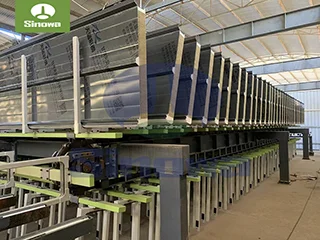
The composition of an automatic rock wool sandwich panel machine follows a sequential production logic, and each functional module is closely connected to form an integrated closed-loop production system. The whole line can be divided into raw material processing unit, fiber forming and laying unit, pressing and curing unit, trimming and cutting unit, surface composite unit, automatic stacking unit and central control regulation unit. Every unit has independent mechanical execution components and coordinated sensing detection parts, realizing synchronous operation and linkage adjustment between modules. The raw material processing unit is the starting link of the entire production line, which is mainly responsible for the crushing, screening and precise proportioning of raw rock wool materials. Natural mineral raw materials with stable texture are transported into the processing equipment through automated conveying structures. After multi-stage crushing, the raw materials are processed into granular raw materials with uniform particle size. Impurities and heterogeneous particles mixed in the raw materials are screened out through vibration screening structures, ensuring the purity of subsequent fiber raw materials. In this link, the conveying speed and crushing strength are dynamically adjusted by the intelligent sensing system to avoid raw material accumulation or excessive crushing, which can maintain the stability of raw material physical properties and create favorable preconditions for subsequent fiber spinning molding.
After the completion of raw material pretreatment, the materials are sent to the high-temperature melting and fiber forming area. In this working area, the granular mineral raw materials are heated to a molten state in a closed high-temperature heating space. The constant temperature control structure keeps the internal temperature in a stable range, so that the raw materials can be fully melted into homogeneous liquid melt without local overheating and carbonization. The molten liquid is evenly thrown out through a high-speed rotating centrifugal structure. Under the combined action of air flow traction and gravity, the melt is stretched into slender and continuous rock wool fibers. Different from the simple settlement molding method adopted by traditional production equipment, the automatic rockwool sandwich panel production line adopts optimized pendulum fiber laying technology. The dispersed rock wool fibers are evenly distributed on the conveying base belt through the reciprocating swing of the pendulum structure. This fiber laying mode changes the single-plane distribution state of fibers in the settlement process, forms a three-dimensional staggered fiber structure, and significantly improves the interlayer bonding strength and overall compression resistance of the rock wool blank. In the fiber laying process, the thickness of the fiber layer is monitored in real time by laser sensing components. Once the thickness deviation exceeds the preset range, the system will automatically adjust the swing frequency of the pendulum structure and the conveying speed of the base belt to ensure that the thickness of the fiber blank remains uniform in the continuous advancing direction.
The loose rock wool fiber blank formed after fiber laying needs to go through bonding spraying and constant temperature curing processes to realize permanent molding. The automatic spraying structure installed in the sandwich panel production line evenly sprays environmental water-based adhesive on the surface and inner gap of the fiber blank. The spraying flow and atomization pressure are precisely controlled to avoid excessive adhesive accumulation or local spraying deficiency. The adhesive can effectively bond the staggered rock wool fibers into an integrated structure, enhancing the structural compactness and tensile resistance of the plate. Subsequently, the fiber blank covered with adhesive is sent to the sealed curing furnace through the conveying system. The internal space of the curing furnace is divided into multiple independent constant temperature areas. The gradient temperature setting mode is adopted to realize gradual drying and curing of the blank. In the low-temperature preheating area, the moisture in the adhesive evaporates slowly to prevent the plate from deforming due to rapid moisture loss. In the high-temperature curing area, the adhesive undergoes chemical cross-linking reaction to form a stable bonding structure. The internal circulating air system of the furnace keeps the air flow evenly distributed, so that each position of the rock wool blank can receive consistent temperature treatment, avoiding the quality difference caused by uneven heating. After curing, the rock wool blank changes from loose fiber state to rigid plate structure, with stable external shape and preliminary mechanical properties.
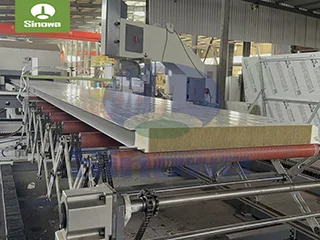
The pressing and shaping process is a key step to optimize the flatness and density uniformity of rock wool panels. The cured rock wool blank passes through multi-group pressure roller structures with adjustable spacing. The servo motor provides stable power output for the pressure rollers, and the encoding control technology accurately controls the pressing gap between the upper and lower pressure rollers. According to the production requirements of different plate specifications, the system can automatically adjust the pressing pressure and roller spacing to realize precise control of plate density. In the pressing process, the redundant gaps inside the fiber blank are squeezed and eliminated, the fiber arrangement is more compact, and the surface of the plate becomes smooth and flat. At the same time, the parallel arrangement of multiple groups of pressure rollers ensures that the stress on each section of the plate is uniform during the pressing process, preventing warping and bending deformation caused by unilateral stress. The temperature of the pressure roller surface is kept within a reasonable range by the circulating heat conduction structure, which can assist in secondary shaping of the plate surface and further improve the surface finish of the rock wool panel.
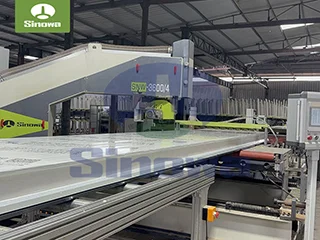
In order to meet the unified size requirements of engineering construction, the continuous long plate blank after pressing needs to go through automatic trimming and fixed-length cutting processing. The trimming unit is equipped with high-speed rotating cutting blades made of high-strength alloy materials. The blades are arranged symmetrically on both sides of the conveying track to cut off the irregular rough edges on both sides of the plate. The edge cutting width can be adjusted according to the production standard, and the cut plate edge is smooth without burrs and fiber falling off. The fixed-length cutting module uses intelligent positioning and sensing components to record the conveying distance of the plate in real time. When the plate reaches the preset cutting length, the hydraulic driving structure drives the cutting tool to complete vertical rapid cutting. The cutting speed is matched with the plate conveying speed to avoid plate displacement and section inclination during cutting. All the waste materials generated in the trimming and cutting process are collected by the automatic recovery pipeline, and the waste materials are crushed again and sent back to the raw material processing link for secondary utilization. This cyclic processing mode effectively reduces raw material waste and improves the comprehensive utilization rate of production resources.
Many rock wool panels used in building exterior walls and industrial purification projects need to be compounded with surface protective layers to enhance weather resistance and decorative performance. The automatic rock wool sandwich panel line is equipped with an integrated surface composite module, which can complete the laminating processing of metal plates, inorganic protective plates and other flat materials. Before composite processing, the plate surface pretreatment structure carries out dust removal and polishing treatment on the surface of the rock wool substrate and the composite panel. The automatic dust removal device uses high-pressure air flow to remove floating fibers and dust on the plate surface, and the fine polishing structure optimizes the flatness of the bonding surface to increase the bonding firmness between layers. The gluing system adopts micro-spray gluing technology to evenly coat the high-viscosity composite adhesive on the bonding surface. The gluing amount is accurately controlled according to the plate area to avoid glue overflow and bonding hollowing. After the plate is accurately aligned and laminated, the constant-pressure composite structure applies uniform pressure to the composite plate. Under the action of pressure and constant temperature, the adhesive solidifies rapidly to form an integrated composite rock wool panel with stable interlayer bonding force.
The automatic stacking and discharging unit is the final processing link of the entire production line. The processed finished rock wool panels are transported to the stacking station through the finishing conveying track. The stacking unit is driven by a high-precision servo control system, with an automatic alignment device and a flexible grabbing structure. The grabbing components made of anti-slip flexible materials can stably adsorb and transport the plates without damaging the smooth surface of the finished plates. In the stacking process, the system calculates the falling position of each plate through dynamic data calculation, and realizes accurate stacking by correcting the placement angle in real time. The stacked plates are arranged neatly with consistent spacing, which can directly meet the packaging and storage standards without manual secondary sorting. The adjustable stacking structure can adapt to plates of different sizes and thicknesses, realizing flexible switching of production specifications. After stacking to the preset number of layers, the finished plate stacks are transported out of the production line through the automatic discharging trolley, and the empty stacking station automatically moves to the designated position to receive subsequent plates, realizing uninterrupted cyclic production.
The central control system is the core brain of the entire automatic rock wool sandwich panel production line, which undertakes the functions of parameter setting, operation monitoring, fault diagnosis and linkage regulation. The system adopts programmable logic control technology, and the intuitive touch screen operation interface integrates all production parameter adjustment buttons and real-time data display modules. Production personnel can complete the setting of plate thickness, length, density, production speed and other parameters through simple touch operation. During the continuous production process, temperature sensors, pressure sensors, speed sensors and other sensing components distributed in each module transmit the operating data to the central control terminal in real time. The system analyzes and compares the collected data with the preset standard values. Once abnormal fluctuations such as excessive temperature, insufficient pressure and blocked material conveying are found, the system will automatically trigger the early warning mechanism and display the abnormal position and fault type on the interface. For minor abnormal conditions, the system can complete self-adjustment and parameter correction without manual intervention; for serious faults affecting production safety, the equipment will automatically stop running to avoid mechanical damage and production accidents. In addition, the central control system has an operation data storage function, which can record the daily production output, parameter changes and fault records, providing data support for subsequent production optimization and equipment maintenance.
Compared with traditional semi-automatic production equipment, the automatic rock wool panel line has prominent technical advantages in production stability and operational flexibility. In terms of production consistency, the whole line realizes closed automated production from raw material input to finished product output. The artificial intervention links are minimized, avoiding product quality differences caused by manual operation errors. The precise sensing and regulation system keeps the key parameters such as fiber density, curing temperature and pressing pressure in a constant state, so that the thermal insulation performance, mechanical strength and external size of each batch of rock wool panels maintain high consistency. In terms of production efficiency, the integrated assembly line structure realizes seamless connection between processes. There is no waiting interval between adjacent processing links, and the continuous conveying mode greatly improves the hourly output of plates. The optimized mechanical structure reduces the downtime caused by equipment jitter and blockage, ensuring long-term stable operation of the production line.
In terms of operational flexibility, the automatic rock wool panel line has a wide range of specification adaptability. By adjusting the operating parameters of each module, the production line can process rock wool panels with different thicknesses, widths and densities, covering the material needs of different application scenarios such as building exterior wall thermal insulation, industrial pipeline insulation, indoor sound insulation and fire partition. The quick switching design of the production module shortens the specification adjustment time. The whole line can complete the parameter replacement and equipment debugging in a short time, realizing flexible switching of multiple products. In terms of energy consumption control, the production line adopts optimized energy-saving structures. The circulating heating system reduces heat loss in the curing process, and the frequency conversion motor adjusts the power output according to the production load, avoiding unnecessary energy consumption in the idling state. The sealed production space also reduces dust overflow and raw material scattering, which not only improves the utilization rate of raw materials, but also maintains the cleanliness of the production environment.
The mechanical structure design of the automatic rock wool panel line fully considers the convenience of daily maintenance and long-term stable operation. The key moving parts such as transmission gears and rotating bearings are equipped with closed lubrication structures to reduce wear caused by long-term friction. The detachable module design facilitates the disassembly, cleaning and replacement of vulnerable parts. The external protective shell of the equipment adopts anti-corrosion and wear-resistant metal materials, which can resist the erosion of dust and humid gas in the production workshop and extend the service life of the equipment. The equipment is equipped with a humanized safety protection mechanism. The infrared induction devices are installed at the feeding port, cutting area and stacking area. When foreign objects or personnel accidentally approach the dangerous operating area, the equipment will immediately pause operation to ensure the safety of on-site operators. The simple and reasonable mechanical layout reduces the difficulty of daily cleaning. The residual fibers and dust on the equipment surface can be quickly removed through the matching dust cleaning tools, maintaining the operating stability of the mechanical structure.
With the continuous deepening of the concept of green building and sustainable industrial development, the market demand for high-performance and environmentally friendly rock wool panels continues to grow, which also promotes the continuous technological iteration of automatic rock wool board production line. At present, the mainstream production lines are developing in the direction of intelligent upgrading, energy saving optimization and environmental protection improvement. The intelligent monitoring technology based on big data can realize real-time prediction of equipment failure. By analyzing the historical operation data of the equipment, the system can judge the aging degree of vulnerable parts and remind maintenance personnel to carry out preventive maintenance, reducing the failure rate of the production line. The optimized heating structure uses new thermal insulation materials to reduce the heat dissipation of the curing furnace, further reducing energy consumption per unit product. In terms of environmental protection, the closed dust removal and waste gas recovery system realizes centralized treatment of production dust and volatile gas, avoiding environmental pollution caused by production emissions.
In the application market, the high-quality rock wool panels produced by automatic production lines have covered many fields of modern construction and industrial manufacturing. In civil building engineering, the panels are used for exterior wall thermal insulation and internal partition decoration, relying on excellent thermal insulation performance to reduce building energy consumption and improve indoor living comfort. In industrial plant construction, the fire resistance and sound absorption characteristics of rock wool panels meet the safety production standards of factories, and the neat plate appearance simplifies the on-site construction process. In special engineering fields such as cold storage and chemical industry, the panels resist corrosion and temperature change, maintaining stable structural performance in complex working environments. The standardized production mode of the automatic sandwich panel production line ensures that the plates can adapt to mechanized on-site construction, shorten the engineering construction cycle, and reduce the comprehensive construction cost of the project.
In the future development process, the automatic rock wool sandwich panel manufacturing line will further integrate artificial intelligence technology and automated logistics system to build a fully unmanned intelligent production workshop. The intelligent raw material distribution system will realize automatic storage and proportioning of raw materials, and the intelligent sorting robot will complete the classification and storage of finished plates. The interconnection technology between production lines will realize data sharing and collaborative production among multiple sets of equipment, improving the overall production capacity of the production workshop. At the same time, combined with the performance optimization demand of new building materials, the production line will be upgraded in the fiber forming and composite processing links to develop rock wool composite plates with higher strength, better weather resistance and lighter weight, meeting the diversified material demand of the future construction industry. Driven by technological innovation, the automatic rock wool panel line will continue to empower the building thermal insulation material industry, promote the industry to develop towards standardization, intelligence and greening, and provide more high-quality material solutions for modern urban construction and industrial upgrading.
https://www.cnsinowa.com/sandwich-panel-machines/automatic-rock-wool-panel-line.html