 sandwich panel machine
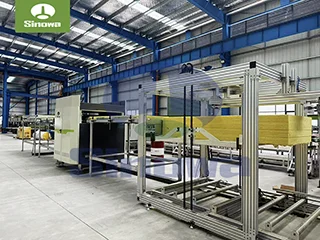
The polyurethane rock wool sandwich panel machine is a full-chain automated continuous production system integrating metal plate cold roll forming, rock wool core material automatic arrangement, high-pressure polyurethane foaming and pouring, synchronous constant-pressure composite curing, dynamic fixed-length cutting and automatic finished product stacking. Different from intermittent split production equipment that relies heavily on manual auxiliary operation and segmented processing, this integrated production line realizes uninterrupted one-line operation from raw material feeding to finished panel output, eliminating intermediate manual handling, secondary gluing and manual edge trimming procedures that are common in traditional panel production processes. The whole continuous sandwich panel production line adopts modular integrated mechanical design and synchronous electrical linkage control technology, with all functional units operating at matched conveying speed, heating temperature, pressing pressure and material supply flow. Every processing procedure is closely connected without idle waiting time, which fundamentally improves overall production continuity and finished product consistency. The complete equipment system can be divided into six interlinked core functional modules according to production sequence: metal plate unwinding and pretreatment module, continuous roll forming module, rock wool core material carding and automatic laying module, high-pressure polyurethane metering and foaming injection module, double-belt synchronous pressing and constant-temperature curing module, as well as post-process cutting, correcting and automatic stacking module. All modules share a unified central intelligent control system, which supports synchronous parameter adjustment, real-time operating data monitoring and automatic abnormal early warning, ensuring stable and standardized operation of the whole line under different production environments and different panel production specifications.
The front-end raw material pretreatment and metal plate forming section lays a solid foundation for seamless follow-up composite processing. Coiled metal base plates stored in raw material areas are stably released by hydraulic unwinding devices, avoiding unstable feeding problems such as plate jitter and irregular discharging caused by manual unwinding. After unwinding, multiple groups of precision leveling rollers act on the surface of metal plates to eliminate internal stress generated during coil winding, transportation and long-term storage, removing surface wrinkles, slight warpage and uneven tension. Fully flattened upper and lower metal plates can fit closely with intermediate core materials in subsequent composite procedures without residual gaps, preventing hollow layers and local bonding failure inside finished panels. After leveling, metal plates enter the continuous roll forming unit, where segmented roller groups conduct gradual edge bending, groove pressing and profile shaping according to the structural requirements of wall panels or roof panels. The reserved grooves on both sides of formed metal plates are specially designed for polyurethane edge sealing foaming, which can accurately accommodate polyurethane foam materials injected later to form fully enclosed edge structures. The roll forming system supports independent fine adjustment of feeding speed for upper and lower plates, adapting to metal plates with different thicknesses and avoiding tensile deformation or surface damage of thin plates during high-speed continuous operation. Meanwhile, the system is equipped with automatic deviation correction sensors on both sides of the conveying track to prevent lateral offset of metal plates during long-distance transmission, ensuring consistent overall dimensions of semi-finished plates entering the composite section.
Following metal plate forming, the rock wool core material processing and automatic laying module undertakes the key task of guaranteeing the fire resistance and overall structural rigidity of finished sandwich panels. Raw rock wool materials delivered to the continuous sandwich panel manufacturing line often have compacted fiber blocks, disordered internal fiber arrangement and inconsistent bulk density due to packaging and transportation extrusion. Direct laying of untreated rock wool will lead to uneven core density of finished panels, resulting in inconsistent fire resistance and compression resistance across different parts of a single panel. For this reason, the sandwich panel machine is equipped with professional rock wool carding and splitting equipment specially optimized for continuous production. Compacted rock wool blocks are mechanically combed and dispersed into uniform fluffy fiber layers with stable density, and then cut into fixed-width core strips matching metal plate profiles through longitudinal and transverse cutting devices. The servo-driven automatic laying equipment arranges rock wool core strips stably and accurately between lower formed metal plates, and cooperative deviation correction devices keep the rock wool core layer centered during high-speed conveying. Uniform and ordered rock wool core arrangement ensures that the finished panel maintains stable fire resistance performance throughout the whole panel, effectively avoiding potential safety hazards such as local fire penetration and insufficient bearing capacity caused by uneven core material distribution. In addition, a matched dust collection system is installed around the rock wool processing area to collect floating fine fibers generated during carding and cutting, maintaining a clean production workshop environment and preventing rock wool fibers from adhering to the surface of metal plates or polyurethane injection nozzles to affect composite quality.
The high-pressure polyurethane foaming and injection system is the most innovative core component that distinguishes polyurethane rock wool sandwich panel production line from ordinary rock wool panel production equipment, solving the long-standing edge failure pain point of traditional rock wool sandwich panels. Traditional rock wool panels adopt dry splicing or simple manual gluing for edge treatment, leaving open fiber gaps at panel cross sections. Humid air, rainwater and external moisture can easily penetrate into rock wool core layers from these gaps, causing rock wool fibers to absorb moisture and deteriorate. Moisture accumulation will not only reduce the thermal insulation performance of rock wool permanently, but also accelerate interlayer delamination between rock wool cores and metal plates, shortening the overall service life of panels. Moreover, exposed fiber gaps form obvious thermal bridges at panel splicing positions after building installation, increasing overall heat transfer efficiency of building enclosure structures and raising long-term building energy consumption. The polyurethane foaming system equipped on this machine adopts dual-component independent metering and high-speed mixing technology. Two polyurethane raw material components are transported to the sealed mixing head through independent precision metering pumps, with real-time closed-loop flow control to maintain the optimal chemical reaction ratio required for foaming. After instantaneous high-pressure homogeneous mixing inside the mixing head, liquid polyurethane materials are evenly and continuously injected into reserved edge grooves on both sides of rock wool core layers through mobile linear nozzles. The injection speed is completely synchronized with the linear conveying speed of the whole continuous sandwich panel line, realizing seamless full-length edge sealing for panels without intermittent joints.
Stable temperature and pressure control runs through the entire polyurethane foaming reaction process to guarantee reliable edge sealing quality. The material conveying pipelines and mixing heads are equipped with circulating constant-temperature heating systems to stabilize the reaction temperature of polyurethane raw materials all year round, eliminating incomplete foaming in low-temperature working environments and foam shrinkage and cracking caused by excessive temperature in high-temperature workshops. After injection, liquid polyurethane completes rapid foaming, expansion, filling and curing within a few seconds, closely wrapping the end faces of rock wool core layers to form fully closed waterproof and thermal insulation edge structures. Besides edge sealing, the equipment can also spray a thin layer of polyurethane adhesive evenly on the upper and lower surfaces of rock wool cores according to actual production demands, enhancing the bonding force between rock wool core layers and metal surface plates. This integrated composite structure avoids interlayer separation caused by long-term alternating temperature changes, wind pressure load and building structural vibration in actual building use scenarios. Compared with post-edge-filling processes used in traditional equipment, synchronous online polyurethane edge sealing integrated with panel composite molding achieves one-piece molding without secondary processing, improving edge sealing compactness while simplifying production procedures and reducing material waste caused by secondary trimming.
After finishing core material laying and polyurethane injection, semi-finished composite panels enter the double-belt synchronous pressing and constant-temperature curing module for overall shaping and structural curing. Upper and lower circulating steel belts clamp multi-layer composite materials synchronously and provide stable and uniform static pressing force throughout the curing process. Unlike intermittent roller pressing equipment that generates periodic pressure fluctuation, continuous double-belt pressing maintains consistent pressure acting on the panel surface all the time, avoiding internal bubble generation, interlayer dislocation and surface unevenness caused by pressure changes. The internal circulating heating system inside the pressing section provides stable curing temperature, accelerating the polymerization and curing reaction of polyurethane foam and adhesive components. The length of the pressing and curing section is scientifically matched with the operating speed of the sandwich panel production line, ensuring that polyurethane materials complete sufficient curing reaction before panels exit the pressing unit. This design prevents panel edge collapse, surface deformation and bonding failure in subsequent cutting, transportation and stacking processes. The whole pressing and curing process requires no manual intervention, and the central control system can adjust pressing pressure, curing temperature and curing time in real time according to panel thickness, polyurethane formula and production speed, adapting to diversified production demands of panels with different specifications.
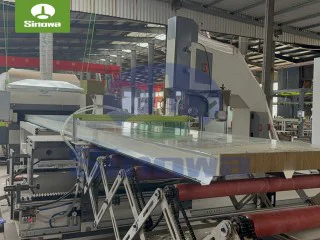
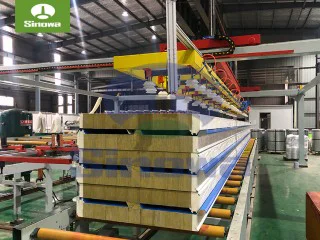
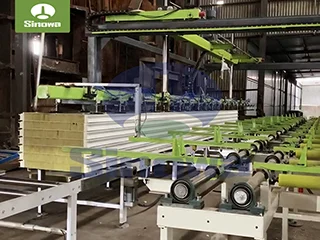
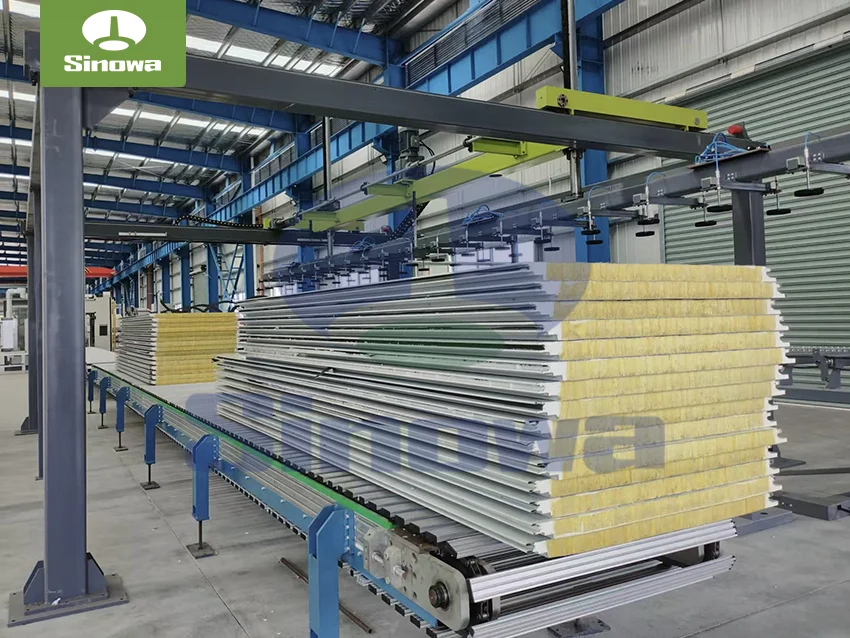
The final post-processing stage consists of dynamic flying saw cutting and automatic finished product stacking, realizing efficient and unmanned finished panel output. Different from traditional static cutting that needs to stop the whole sandwich panel line, the servo-driven flying saw cutting system follows the moving track of panels dynamically and completes fixed-length cutting without line shutdown. This non-stop cutting mode greatly improves overall production efficiency and avoids production efficiency loss caused by frequent start and stop of mechanical equipment. Operators can set arbitrary cutting lengths through the central control terminal to meet customized length demands of different construction projects, and the high-precision servo control system ensures extremely small cutting dimension errors with smooth and burr-free cutting sections. After cutting, qualified finished panels are conveyed to the automatic stacking platform, where mechanical arms complete automatic arrangement, position correction and layer-by-layer stacking. The whole post-processing process cancels manual carrying and manual stacking work, cutting workshop labor input significantly, and avoiding panel surface scratches, corner damage and overall structural deformation caused by irregular manual operation.
Compared with traditional separate rock wool panel production lines and ordinary polyurethane panel production lines, polyurethane rock wool sandwich panel line has comprehensive advantages in production performance, finished panel quality, operational cost and environmental protection performance. In terms of finished product quality optimization, the integrated polyurethane edge sealing structure reduces the water absorption rate of panel edges by more than 90%, completely blocking moisture penetration channels and enabling panels to maintain stable thermal insulation performance for more than 20 years in high-humidity environments such as coastal buildings, cold storage and humid workshops. The closed edge structure eliminates thermal bridge effects at panel joints, reducing overall heat transfer coefficient of building enclosure systems and effectively lowering building heating and cooling energy consumption in long-term operation. Meanwhile, the seamless edge structure prevents sound wave leakage from splicing gaps, improving the overall sound insulation performance of panels and creating quieter indoor working environments for industrial workshops and public buildings. In terms of fire safety performance, the equipment retains the non-combustible fireproof advantage of inorganic rock wool core materials, while adopting flame-retardant modified polyurethane raw materials for edge sealing parts. The composite panels will not produce molten dripping substances during high-temperature combustion, avoiding secondary fire risks and meeting high-standard fire protection requirements for industrial warehouses, pharmaceutical clean workshops and large public transportation buildings.
In terms of production operation and cost control, the full-process automated linkage design minimizes manual participation. Only a small number of operators are required to monitor operating parameters, conduct routine inspection and complete daily equipment maintenance, which greatly reduces long-term labor costs for panel manufacturers. The precision polyurethane metering system realizes accurate raw material supply according to actual production demands, avoiding raw material waste caused by excessive glue spraying and foaming in traditional production processes. The integrated one-step molding process eliminates leftover materials generated by secondary edge trimming and post-processing, improving overall raw material utilization rate. From the perspective of equipment maintenance, the modular structural design makes key functional components independent and interchangeable. Maintenance personnel can quickly disassemble, replace and repair single modules without affecting other normal operating units, reducing equipment maintenance difficulty and shortening production line downtime. Equipped with a built-in fault self-diagnosis system, the sandwich panel machinery can automatically detect abnormal conditions such as blocked polyurethane pipelines, mismatched conveying speed, insufficient pressing pressure and abnormal heating temperature, and send real-time alarm prompts to help operators locate and eliminate faults rapidly.
Reasonable daily operation specification and regular scientific maintenance are critical to prolonging the service life of polyurethane rockwool sandwich panel making machine and maintaining long-term stable production efficiency. Before daily startup, operators need to inspect the tightness of transmission chains, the cleanliness of polyurethane injection nozzles, the operating state of temperature sensors and the flatness of circulating pressing belts, removing residual rock wool fibers and cured polyurethane impurities accumulated during previous production. During formal production, operators only need to monitor real-time data on the central control screen, including line operating speed, material supply flow, curing temperature and pressing pressure, without adjusting core parameters arbitrarily. After daily production ends, the polyurethane mixing system and injection pipelines need to be cleaned thoroughly to prevent residual polyurethane materials from curing inside pipelines and causing nozzle blockage. Regular weekly maintenance focuses on lubricating all transmission bearings and roller shafts to reduce mechanical wear during high-frequency operation. Quarterly comprehensive maintenance includes overall calibration of cutting positioning system, detection of electrical circuit stability and inspection of heating system working efficiency. Annual systematic overhaul covers overall debugging of all linkage modules and replacement of severely worn vulnerable parts, ensuring that the equipment maintains consistent operating performance in long-term continuous industrial production.
Driven by global carbon neutrality goals and continuous upgrading of building energy-saving and fire safety standards, the market demand for high-performance composite sandwich panels keeps rising steadily, which puts forward higher requirements for the intelligent, energy-saving and flexible production capacity of sandwich panel manufacturing equipment. The future upgrading direction of polyurethane rock wool sandwich panel production machine will focus on three core dimensions. Firstly, deep intelligent digital transformation will be realized by combining digital twin technology to build a full-process virtual simulation production system. Operators can preview overall production effects in advance, remotely adjust operating parameters and realize full-line unmanned automatic operation, further eliminating human operation errors and achieving refined intelligent manufacturing. Secondly, waste heat recovery systems will be added to the pressing curing section and polyurethane reaction section to recycle residual heat generated by chemical reaction and circulating heating, reducing overall power consumption of the whole sandwich panel manufacturing line and improving energy utilization rate to adapt to higher industrial energy-saving standards. Thirdly, flexible production capacity will be upgraded to realize rapid switching between wall panels, roof panels and special-shaped joint panels without replacing roller molds, meeting the growing personalized and customized demands of modern modular construction projects.
In conclusion, polyurethane rock wool sandwich panel manufacturing machine perfectly integrate the fireproof advantage of inorganic rock wool materials and the waterproof, thermal insulation and structural bonding strengths of organic polyurethane foam materials through innovative synchronous edge sealing composite technology and full-process automated production logic. This advanced production equipment solves the core performance bottlenecks of traditional single-type sandwich panels, optimizes the whole panel manufacturing process, improves production efficiency and finished product qualification rate, and reduces comprehensive production and operation costs for panel manufacturers. The high-performance panels produced by this equipment have been widely applied in industrial steel structure workshops, cold chain logistics warehouses, clean laboratories, large transportation hubs, stadiums, hospital and school building enclosure systems. As global green building standards become more rigorous and modular construction modes gain wider popularity, PU and rockwool sandwich panel production machinery will become standard core equipment for medium and high-end composite panel manufacturers worldwide, continuously promoting technological progress in the building composite material industry and supporting the sustainable and low-carbon development of the global construction field.
https://www.cnsinowa.com/sandwich-panel-machines/polyurethane-rock-wool-sandwich-panel-machine.html