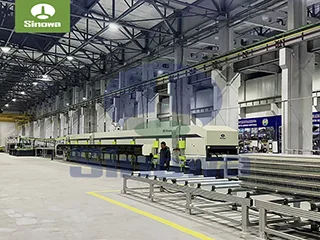
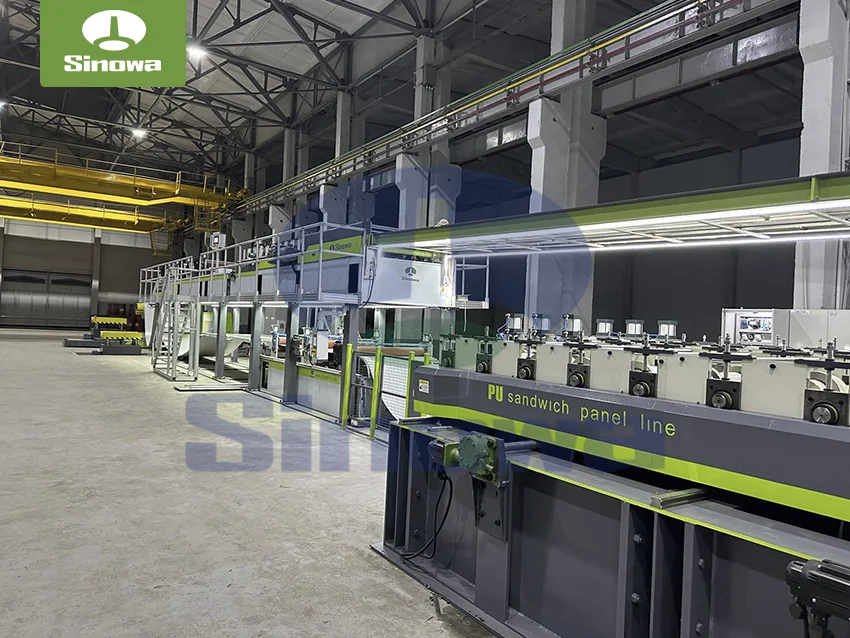
 sandwich panel machine
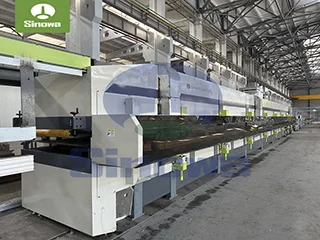
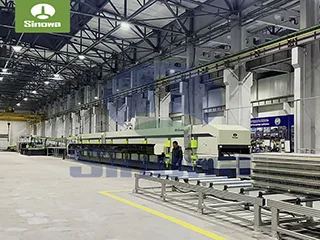
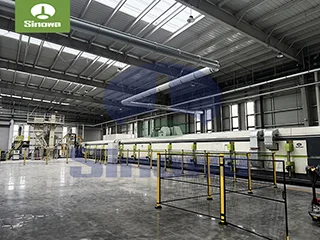
The overall structural design of polyurethane flame retardant foam sandwich panel machine follows the concept of modular integration and full-process automation, eliminating manual intervention in core production links to avoid unstable product quality caused by human operation errors. The whole polyurethane sandwich panel production line can be divided into six interconnected functional units operating synchronously: surface material unwinding and pre-forming unit, surface material preheating and surface treatment unit, high-pressure precise metering and mixing foaming unit, double-belt constant pressure laminating curing unit, post-trimming and fixed-length cutting unit, as well as finished product automatic conveying and stacking unit. All functional units are linked by a centralized integrated control system, which realizes synchronous speed matching, real-time parameter monitoring and automatic fault early warning throughout the line. Compared with intermittent batch production equipment, continuous integrated production mode greatly improves production continuity, reduces material loss in start-stop processes, and maintains consistent foam density, bonding strength and flame retardant uniformity of each batch of finished panels. Meanwhile, the mechanical structure of the equipment is optimized for the viscosity change characteristics of flame retardant polyurethane combined materials. Since the addition of flame retardant additives will appropriately increase the viscosity of polyol and isocyanate mixed materials, the equipment upgrades the internal runner structure of the mixing head and optimizes the stirring frequency of high-speed mixing modules to ensure full and uniform mixing of flame retardant components and polyurethane base materials, avoiding local uneven flame retardant effect or incomplete foaming inside the panel core.
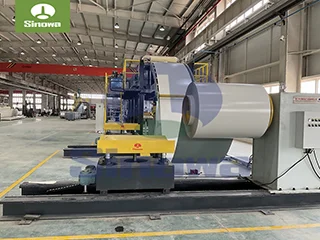
The initial production stage starts from the automatic unwinding and pre-forming of upper and lower surface base materials. The equipment supports multiple types of surface materials matching different application scenarios, including color-coated metal steel sheets, aluminum alloy sheets, glass fiber reinforced plastic plates and other rigid decorative and protective surface materials. The double-station unwinding device adopts servo tension closed-loop control technology, which can automatically adjust the feeding tension according to the operating speed of the subsequent production line, preventing surface material deviation, wrinkling or stretching deformation during high-speed continuous conveying. After unwinding, flat surface materials enter the roller forming module, which carries out continuous rolling and profiling according to the preset panel edge sealing and splicing structure requirements. Profiled grooves and buckling structures processed in this stage can realize seamless assembly between adjacent sandwich panels during on-site building installation, effectively improving the overall airtightness and thermal insulation effect of building enclosure structures. After profiling, all surface materials enter the independent preheating module, which is a necessary pre-process specially configured for flame retardant foam composite production. Appropriate preheating treatment can eliminate surface moisture of base materials, improve the surface activity of metal and non-metal base plates, and significantly enhance the bonding force between flame retardant polyurethane foam core and upper and lower surface layers. Insufficient preheating will lead to delamination between foam core and surface plates in later use, while excessive temperature will affect the stability of flame retardant additives on the foam surface. The equipment adopts segmented constant temperature heating technology to realize gradient temperature adjustment according to different surface material types, maintaining the best bonding reaction environment all the time.
The high-pressure metering and mixing foaming unit is the core functional module that determines the flame retardant performance, thermal insulation performance and structural stability of finished sandwich panels, and also the most upgraded part compared with ordinary polyurethane sandwich panel machine. Ordinary polyurethane foaming equipment only needs to match the fixed ratio of polyol and isocyanate, while flame retardant foam production requires synchronous and accurate addition of multiple functional additives including halogen-free flame retardants, smoke suppressants, catalysts and foam stabilizers. The equipment is equipped with multi-group independent closed-loop metering pumps with high precision, which can independently control the flow rate of each raw material component with ultra-high accuracy, avoiding proportional deviation caused by raw material viscosity changes. All raw material pipelines are equipped with constant temperature insulation jackets to keep the temperature of polyurethane combined materials stable within the optimal reaction temperature range throughout the conveying process, preventing temperature fluctuation from affecting foaming speed and flame retardant component activity. After accurate metering, all raw materials are transported to the high-pressure impact mixing head, where materials complete instantaneous high-speed collision and uniform mixing. The traversing spreading mechanism matched with the mixing head moves horizontally at a stable speed above the lower surface plate, realizing uniform linear distribution of mixed flame retardant polyurethane materials on the surface of the moving base plate. This dynamic spreading mode ensures that the foam raw materials are evenly covered on the base plate without material accumulation or missing coating, laying a foundation for consistent thickness and uniform internal structure of the subsequent foam core layer.
Immediately after raw material spreading, the upper profiled surface plate is accurately closed synchronously through the automatic laminating guide mechanism, and the integrated three-layer composite structure composed of upper surface plate, flame retardant polyurethane foam raw material and lower surface plate enters the double-belt constant pressure laminating curing system. This long-distance closed curing channel is equipped with circulating hot air constant temperature modules and upper and lower synchronous pressure adjustment devices. During the natural foaming and expansion process of polyurethane materials, the equipment maintains stable and uniform vertical pressure to restrict the expansion range of foam materials, so as to control the overall thickness of sandwich panels within the set range. At the same time, the constant temperature curing environment inside the channel reasonably prolongs the slow curing reaction time of flame retardant polyurethane materials. Different from ordinary polyurethane foam, flame retardant modified foam has a slower complete curing reaction speed, and insufficient curing time will lead to insufficient overall hardness of the panel core and poor compression resistance. The equipment dynamically matches the line speed, curing temperature and curing channel length according to different flame retardant formula systems, ensuring that the foam completes full foaming, cross-linking curing and stable bonding with double-sided surface plates inside the channel. In this process, the internal foam forms a fine and closed porous structure. The closed pore rate of the core layer can be stably maintained at a high level, which not only retains excellent thermal insulation and waterproof and moisture-proof performance of polyurethane foam, but also makes flame retardant components solidified inside foam pore walls to form an integrated fire-resistant protection structure. When encountering open fire or high temperature radiation, the foam core can rapidly form a dense carbonization layer on the surface, blocking heat conduction and flame spread, and suppressing the generation of toxic smoke gas during combustion.
After completing full curing and molding in the laminating channel, continuous long-strip sandwich panels enter the post-processing unit for finishing and sizing treatment. Firstly, the automatic edge trimming device cuts off excess foam and surface material residues on both sides of the panel to ensure consistent width of finished panels and neat and smooth cross-section structure, avoiding exposed foam cores that are prone to fire risks during later use. Then, the photoelectric tracking fixed-length cutting system performs non-stop dynamic cutting according to customized length requirements. The cutting tool adopts high-speed cold cutting technology, which will not generate high temperature during cutting, so it will not damage the flame retardant structure of the panel cross-section or cause local foam melting. After cutting, finished panels are automatically conveyed to the final stacking platform, and the equipment realizes automatic layered stacking and orderly arrangement of finished products without manual carrying. The whole post-processing process operates synchronously with the front-end production line without line shutdown, which maximizes the overall production efficiency of the continuous line and ensures the continuity of the whole manufacturing process.
In actual industrial production applications, flame retardant foam PU sandwich panel machine shows prominent comprehensive advantages in production stability, product performance compatibility and production cost control. Firstly, the equipment realizes one-step integrated molding of flame retardant composite panels, completing surface material molding, foam composite, curing molding and cutting finishing in one continuous flow. Compared with segmented manual composite production processes adopted by small intermittent equipment, it effectively avoids secondary bonding gaps between core layers and surface plates, improves the overall structural tightness of panels, and further optimizes the overall fire resistance and thermal insulation stability of finished products. Secondly, the intelligent centralized control system supports one-click storage and switching of multiple production formulas. Production personnel can quickly switch production parameters corresponding to different flame retardant grades, panel thicknesses and surface material types through the human-computer interaction interface, realizing flexible switching of multiple product types on one production line and meeting diversified customized order demands in the building materials market. In addition, the equipment optimizes the power consumption structure of heating, stirring and transmission modules, adopting variable frequency energy-saving driving components for all motors. It effectively reduces no-load energy consumption during equipment operation, lowers overall production energy consumption per square meter of panel, and fits the current development trend of energy-saving and low-carbon manufacturing in the building materials machinery industry.
The finished panels manufactured by this professional equipment have complementary advantages in fire safety, thermal insulation, mechanical performance and construction applicability, and are widely used in multiple high-fire-demand building scenarios that ordinary polyurethane sandwich panels cannot adapt to. In large industrial workshops, logistics warehouses and storage workshops with dense goods distribution, flame retardant sandwich panels can effectively prevent fire spread caused by electrical short circuit or external fire sources, reducing overall building fire hazards while maintaining long-term stable thermal insulation effect and reducing building air conditioning energy consumption. In cold chain storage and refrigerated logistics buildings requiring strict constant temperature environments and high fire prevention standards, the panels maintain ultra-low thermal conductivity to reduce cold air loss, and their stable flame retardant structure avoids fire risks brought by refrigeration equipment operation. In public building spaces such as exhibition halls, airport terminal buildings and large shopping malls with large pedestrian flow and high public fire safety requirements, these composite panels serve as wall and roof enclosure materials, balancing lightweight installation efficiency, beautiful decorative appearance and reliable fire protection performance. Besides conventional building enclosure fields, the panels produced by this equipment are also applied to modular emergency buildings, container mobile houses and clean workshop partitions, providing safe and efficient material solutions for temporary buildings and special functional spaces with high fire prevention requirements.
Daily standardized maintenance and scientific operation management are critical to keeping polyurethane flame retardant foam sandwich panel machinery in long-term stable operating state and maintaining consistent product quality. Different from ordinary panel production equipment, the mixing head and internal runners of this equipment are more likely to have residual cured materials due to the special composition of flame retardant polyurethane raw materials. Therefore, regular automatic high-pressure cleaning of the mixing system is required after daily production to prevent residual materials from blocking runners and affecting mixing uniformity in the next production process. Operators need to regularly calibrate the metering pump accuracy and real-time temperature detection modules to ensure that raw material ratio and reaction temperature are always controlled within the optimal range suitable for flame retardant foam reaction. Meanwhile, regular inspection of conveyor belt tension in the laminating curing channel and synchronous debugging of the speed of each unit can avoid panel thickness deviation and surface scratching problems during long-term high-speed operation. Scientific daily maintenance can not only extend the overall service life of mechanical and electrical components of the polyurethane sandwich panel line, but also keep the flame retardant performance of finished panels stable for a long time, avoiding product performance fluctuation caused by equipment aging.
Looking ahead to the future development trend of construction machinery and building energy-saving materials industry, polyurethane flame retardant foam sandwich panel making machine will further develop in three core directions: higher intelligent unmanned operation level, more environmentally friendly foam raw material adaptation capability, and higher integration of multi-functional composite production. Firstly, artificial intelligence algorithm modules will be embedded into the equipment control system to realize automatic real-time adjustment of production parameters according to ambient temperature and humidity changes and raw material batch difference, as well as automatic early warning and intelligent diagnosis of mechanical faults, further reducing dependence on on-site operating personnel and realizing full unmanned workshop production. Secondly, with the global promotion of environmental protection requirements for building materials, the equipment will be further upgraded to adapt to new halogen-free low-smoke and non-toxic flame retardant polyurethane raw materials, matching greener foaming agents, to reduce harmful gas release during panel combustion and realize full-life cycle environmental protection from equipment production to finished panel use. Thirdly, the PU sandwich panel production line will expand composite functions to support integrated composite production of polyurethane flame retardant foam with inorganic fire-resistant core materials, producing composite sandwich panels with higher comprehensive fire resistance, further expanding the application boundary of equipment and finished panels in ultra-high fire-risk building scenarios.
In conclusion, polyurethane flame retardant foam sandwich panel production machine is professional customized automated production equipment developed targeting the dual core demands of building energy conservation and building fire safety. Through targeted optimization of foaming reaction control, raw material metering precision and laminating curing process, the equipment makes up for the fire performance defect of traditional polyurethane foam sandwich panels while retaining all advantages of polyurethane materials such as high-efficiency thermal insulation, lightweight structure and convenient rapid construction. As global building fire safety standards continue to improve and the prefabricated construction industry continues to expand, this type of professional sandwich panel production machinery will become more indispensable core equipment in the building composite materials manufacturing industry. It not only provides reliable high-performance enclosure materials for modern safe and low-carbon buildings, but also promotes the iterative upgrading of the whole polyurethane foam building materials manufacturing industry, driving the coordinated development of building energy conservation, construction efficiency improvement and building fire safety protection in the global construction field.
https://www.cnsinowa.com/sandwich-panel-machines/polyurethane-flame-retardant-foam-sandwich-panel-machine.html