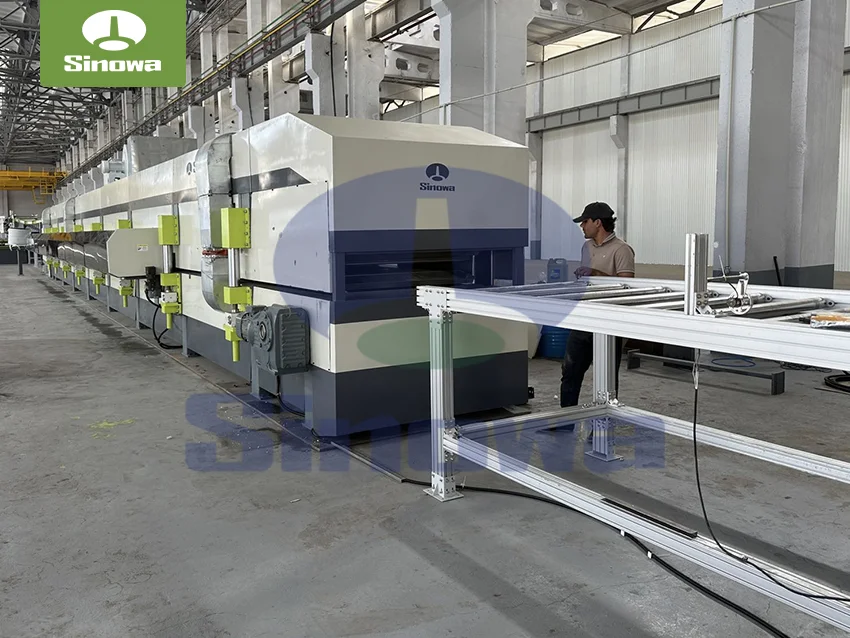
 sandwich panel line
The operational logic of the automatic sandwich panel production line follows a rigorous linear processing sequence, with each functional module operating in precise synchronization to ensure the continuity and stability of mass production. The whole production process starts with the automatic feeding and pretreatment of surface metal materials. Coiled steel sheets, the primary surface raw material for sandwich panels, are mounted on hydraulic uncoiling devices that achieve steady and tension-controllable material output. This uncoiling process is designed to avoid material deviation and stretching deformation caused by uneven feeding speed, which is crucial for maintaining the dimensional consistency of subsequent formed panels. After uncoiling, the metal sheets pass through multi-group leveling roller sets, which eliminate surface warping, indentations, and internal stress generated during coil storage and transportation. The leveling treatment ensures the flatness of the metal base material, laying a solid foundation for accurate roll forming and tight lamination with core materials in later stages.
Following the material pretreatment stage is the precision roll forming process, a key link that determines the structural morphology and installation adaptability of finished sandwich panels. The roll forming system consists of upper and lower multi-stage roller groups arranged in an orderly sequence, with each group of rollers undertaking specific pressing and shaping tasks. As the flat metal sheet passes through the progressive roller sets, it is gradually pressed into customized groove, waveform, or edge-locking structures according to the preset panel design standards. The servo-driven transmission structure of the roll forming system ensures synchronous operation of all roller units, effectively avoiding dimensional errors such as uneven plate width and inconsistent groove depth that often occur in low-precision forming equipment. This incremental forming method not only protects the structural integrity of the metal sheet surface but also enables flexible adjustment of panel profiles to meet the diverse structural requirements of different building scenarios, including roof panels, wall panels, and partition panels for industrial plants and public buildings.
While the surface metal material undergoes forming processing, the continuous sandwich panel line completes the automatic conveying and arrangement of core insulation materials through an independent auxiliary feeding system. Common core materials used in the production process include porous thermal insulation and sound insulation materials with excellent structural stability and environmental adaptability. The core material conveying mechanism adopts variable-frequency speed regulation to match the operating speed of the main metal forming line, ensuring synchronous feeding of surface and core materials. During the conveying process, the built-in vibration leveling structure arranges the loose core materials evenly, eliminates internal voids and uneven accumulation, and optimizes the compactness and uniformity of the intermediate insulation layer. This subtle pretreatment effectively enhances the overall thermal insulation, sound insulation, and structural bearing performance of the finished sandwich panels, avoiding quality defects such as local hollowing and inconsistent insulation effect in finished products.
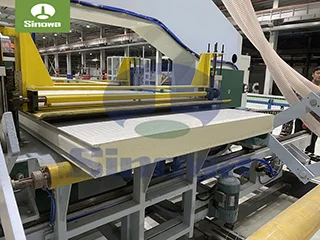
The glue coating and composite lamination stage is the core process that determines the bonding strength and overall structural stability of sandwich panels. The foam core sandwich panel line is equipped with a high-precision automatic glue spraying system, which can evenly coat environmentally friendly adhesive materials on the inner surface of formed metal sheets and the upper and lower surfaces of core materials. The glue spraying volume and spraying range can be intelligently adjusted according to the thickness and type of raw materials, realizing quantitative and uniform gluing while avoiding adhesive waste and local glue accumulation or missing coating problems. The evenly coated adhesive forms a uniform bonding layer between the metal surface layer and the core insulation layer, creating conditions for tight integration of multi-layer materials. After the completion of glue coating, the metal sheets and core materials are automatically sent to the composite pressing area, where upper and lower pressing roller groups apply stable and balanced pressure to the composite structure.
The pressure control system of the composite pressing unit has high sensitivity and adjustability, which can fine-tune the pressing force in real time according to the hardness of core materials, the thickness of metal sheets, and the overall design thickness of panels. This adjustable pressure control effectively prevents two common production defects: excessive pressure crushing the porous core material and destroying its insulation structure, and insufficient pressure leading to weak lamination and delamination between layers. Under the action of continuous and stable mechanical pressure, the metal surface layer and core material are closely fitted, and the preliminary composite shaping of the sandwich panel structure is completed. The entire lamination process maintains a constant feeding speed and pressing state, ensuring consistent bonding tightness for each section of the continuously produced panels and realizing standardized composite molding.
To further solidify the bonding effect and improve the structural stability of composite panels, the continuous sandwich panel production line is equipped with a sealed constant-temperature heating and curing system. Most high-performance adhesives used in sandwich panel production require a specific constant-temperature environment to complete chemical cross-linking and curing reactions, which transforms the initial viscous bonding state into a permanent solid bonding state. The closed curing bin adopts uniform temperature distribution design, which eliminates local temperature difference in the heating area and ensures that all parts of the composite panel receive consistent heat treatment. The intelligent temperature control module can adjust the curing temperature and heating duration according to different adhesive characteristics and panel specifications, realizing accurate control of the curing process. After constant-temperature curing, the bonding strength between layers is significantly improved, the overall structural rigidity of the panel is enhanced, and the problems of layer separation, edge warping, and structural deformation in long-term use are effectively avoided.
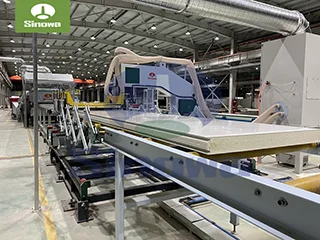
After the curing and shaping process, the continuous long-strip panel semi-finished products enter the cooling and trimming stage. The natural air cooling zone arranged behind the curing bin gradually reduces the surface and internal temperature of the panels, eliminating internal thermal stress generated during high-temperature curing. Slow and uniform cooling can effectively improve the flatness and dimensional stability of finished panels, preventing structural deformation caused by rapid temperature change. Subsequently, the automated trimming mechanism carries out fine trimming on the edges of the panels, removing excess residual materials and irregular burrs generated in the composite process. The high-precision trimming structure ensures neat and smooth panel edges, making the subsequent on-site assembly and splicing of panels more seamless and improving the overall sealing and aesthetic effect of building enclosure structures.
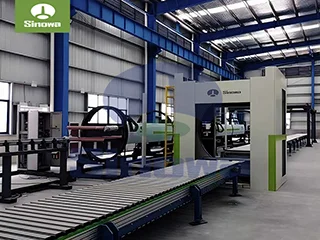
The fixed-length cutting system is the final molding link of panel production, which realizes precise cutting of continuous strip panels according to customized length requirements. Driven by a high-response servo positioning system, the cutting unit can complete fixed-length positioning and instantaneous cutting efficiently, with extremely high cutting accuracy. The automatic cutting mode replaces traditional manual measurement and cutting, completely avoiding dimensional errors caused by human operation. The cutting tool adopts high-hardness structural design, which can maintain stable cutting accuracy and smooth cutting sections during long-term continuous operation, ensuring that each finished panel has consistent length specifications and regular end faces. After cutting, the finished panels are automatically conveyed to the output platform, completing the entire closed-loop production process from raw material input to finished product output.
The full-automatic operation mode of the continuous sandwich panel manufacturing line brings remarkable advantages in production efficiency and product consistency compared with traditional production equipment. The entire production process realizes continuous cycle operation with minimal manual intervention. Workers only need to set production parameters such as panel thickness, length, and production speed through the central control system at the initial stage of production, and the equipment can automatically complete all subsequent processes including feeding, forming, gluing, pressing, curing, and cutting. This highly automated operation mode greatly reduces labor input, lowers the risk of product quality fluctuations caused by manual operation differences, and realizes standardized and normalized production. The continuous production mode breaks the batch production limit of semi-automatic equipment, effectively improving unit-time output and meeting the large-scale production demand of modern building material enterprises.
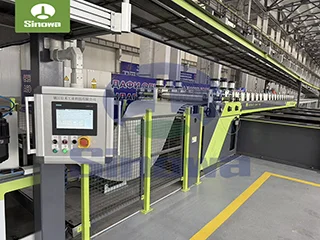
In terms of product quality control, the automatic steel structure sandwich panel machine is equipped with a complete real-time monitoring and feedback system. Multiple groups of precision sensors are arranged in key links such as feeding speed, forming dimension, glue spraying volume, pressing pressure, and curing temperature, which can collect operational data of the equipment in real time and transmit it to the central control terminal. Once the operational parameters deviate from the preset standard range, the system will automatically trigger fine-tuning instructions to adjust the operating state of each functional module in real time, ensuring that all production links are always in a standardized state. This real-time closed-loop control mode fundamentally guarantees the consistency of panel thickness, flatness, bonding strength, and overall dimensional accuracy, making the physical properties and structural indicators of each batch of finished panels highly uniform.
In terms of structural adaptability and production flexibility, the automatic steel structure sandwich panel production line has strong multi-specification production capacity. By adjusting the operating parameters of the roller forming system, pressing system, and cutting system, the equipment can produce sandwich panels with different thicknesses, widths, and profile structures, covering the mainstream specification requirements of steel structure building enclosure panels. Whether it is thin lightweight panels for temporary buildings or thick high-insulation panels for industrial cold storage and constant-temperature workshops, the production line can complete efficient switching production. The flexible parameter adjustment function enables the equipment to adapt to diversified and personalized market demand, improving the comprehensive utilization rate of production equipment and reducing the equipment update cost for production enterprises.
From the perspective of production cost and energy consumption optimization, the integrated design of the automatic steel structure sandwich panel procution machinery realizes scientific matching of energy supply and mechanical operation. The frequency conversion speed regulation technology adopted by each transmission module can automatically adjust power output according to production speed, avoiding invalid energy consumption caused by no-load and overload operation. The intelligent glue spraying system realizes quantitative glue supply, which effectively reduces adhesive waste compared with traditional manual glue coating and irregular mechanical gluing. In addition, the continuous production process reduces intermediate material transfer links, lowers the loss rate of raw materials such as metal sheets and core materials in the production process, and further optimizes the overall production cost of finished products. The sealed curing structure also improves energy utilization efficiency, avoiding heat loss in the heating process and realizing energy-saving and environmentally friendly production.
The finished sandwich panels produced by this automatic sandwich panel line have excellent comprehensive performance, with outstanding advantages in structural stability, thermal insulation, sound insulation, and weather resistance. The tight composite structure formed by precise pressing and high-temperature curing enables the panels to bear certain external pressure and impact, with good structural rigidity and deformation resistance, adapting to complex outdoor building environments. The uniform and dense core insulation layer endows the panels with excellent heat preservation and heat insulation performance, which can effectively reduce the energy consumption of building temperature regulation and meet the energy-saving design requirements of modern green buildings. At the same time, the compact internal structure can block the transmission of sound waves, achieving good sound insulation and noise reduction effects, improving the comfort of indoor building space.
In the application field, the high-quality sandwich panels produced by the automatic sandwich panel production machine are widely used in various steel structure building scenarios. They serve as the main wall and roof enclosure materials for industrial plants, logistics warehouses, and large-scale exhibition venues, providing stable and reliable enclosure protection for large-span steel structure buildings. In the field of special functional buildings, such as constant-temperature workshops, cold storage buildings, and environmental protection purification workshops, the excellent thermal insulation and sealing performance of the panels can meet the strict environmental control requirements of special production spaces. In addition, the panels are also applicable to temporary prefabricated buildings, municipal engineering enclosure facilities, and agricultural greenhouse supporting buildings, with extremely wide market adaptability.
With the continuous development of prefabricated building industry, the automatic steel structure sandwich panel production line is gradually evolving towards higher intelligence, higher efficiency, and more environmentally friendly production. The continuous upgrading of automatic control technology makes the equipment parameter adjustment more accurate and operation more stable; the optimized mechanical structure design further improves production speed and product precision; the application of environmentally friendly adhesive materials and energy-saving heating systems makes the production process more in line with the development trend of green industrial production. As a key equipment supporting the industrialization and standardization of steel structure buildings, it will continue to promote the iterative upgrading of building enclosure material manufacturing technology, provide high-quality and high-efficiency material support for the construction of modern green buildings, and inject continuous power into the high-quality development of the construction industry.
https://www.cnsinowa.com/sandwich-panel-machines/automatic-steel-structure-sandwich-panel-production-line.html