 sandwich panel machine
Cold chain logistics infrastructure differs significantly from conventional construction environments, as it requires building envelopes that can minimize cold air loss, resist temperature fluctuation, and maintain stable internal humidity throughout year-round operation. Traditional building panels often fail to meet these rigorous demands due to uneven insulation performance, weak structural adhesion, or poor resistance to low-temperature aging. The PU sandwich panel machine addresses these industry pain points through a fully integrated and precision-controlled production workflow, which optimizes every production link specifically for the functional needs of cold chain facilities. Unlike general-purpose sandwich panel manufacturing equipment, this specialized machine focuses on enhancing the compactness, thermal insulation uniformity, and structural firmness of finished panels, ensuring each produced panel can adapt to long-term low-temperature, high-humidity, and frequent temperature-switching working conditions in cold chain scenarios.
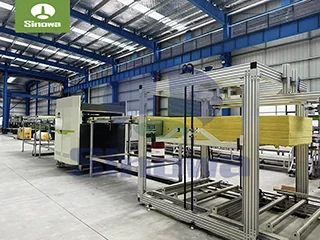
The entire production process of cold chain-oriented PU sandwich panels relies on the coordinated operation of multiple functional modules of the machine, achieving seamless automation from raw material pretreatment to finished product output. The workflow initiates with the feeding and pretreatment of surface facing materials, the outer protective layer of sandwich panels. Common facing materials for cold chain panels include corrosion-resistant metal sheets with excellent weather resistance, which are suitable for long-term indoor and outdoor use in cold chain logistics bases. The machine’s automatic uncoiling and leveling system steadily releases coiled raw materials, eliminating material wrinkles, uneven flatness, and residual deformation that may occur during coiling and storage. This pretreatment step is fundamental to ensuring the flatness and overall consistency of finished panels, as uneven surface materials will directly lead to inconsistent core material thickness and weakened local insulation performance in subsequent processes. After leveling, the surface materials undergo uniform preheating treatment, which removes surface moisture and stabilizes material toughness, effectively improving the bonding tightness between the surface layer and the polyurethane core material in the later stage.
As the core functional unit of the entire sandwich panel equipment, the PU foaming and injection system determines the thermal insulation performance and structural quality of cold chain sandwich panels. Polyurethane foam, as the core insulation material of cold chain panels, features a dense closed-cell structure that endows the panels with ultra-low thermal conductivity, which is the key to reducing cold energy consumption in cold chain facilities. The machine is equipped with a high-precision raw material conveying and metering system that accurately proportionates the two main chemical components of polyurethane foam as well as auxiliary materials that adjust foam stability and environmental adaptability. Strict proportional control is implemented throughout the material mixing process to avoid quality defects such as excessive cell porosity, uneven foam density, or insufficient curing strength caused by inaccurate material ratios. The high-pressure mixing device fully stirs and reacts the raw materials in a closed environment, then evenly injects the foaming material between the upper and lower surface layers at a stable flow rate and speed. This uniform injection mode ensures that the polyurethane raw materials can fully fill the entire gap of the panel, forming a continuous and gap-free insulation core layer without empty drums, delamination, or local thin layers that commonly appear in inferior panels.
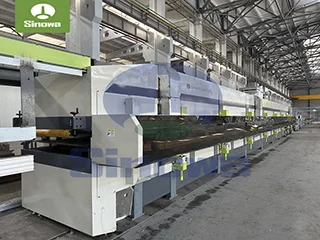
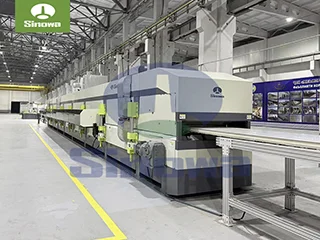
Following the foaming injection process, the panel enters the constant-temperature and constant-pressure curing and forming system, another critical module tailored for cold chain panel production. The performance stability of PU sandwich panels in long-term low-temperature environments depends largely on the sufficient curing and integrated forming of the core material and surface layer. The machine's double-belt conveying and pressure maintaining system provides a stable closed curing environment for initially formed panels, maintaining constant pressure and temperature throughout the curing process. This precise environment control enables the polyurethane foam to complete full expansion, solidification, and molecular structural stabilization, while achieving micro-level seamless bonding between the core material and surface layers. For cold chain logistics facilities, the integrated structure of panels is extremely vital—weak bonding or incomplete curing will lead to panel delamination under long-term temperature alternation, which destroys the overall insulation structure and causes cold air leakage. The continuous curing design of the equipment effectively avoids residual stress inside the panels, ensuring that finished products maintain stable structural strength and insulation performance even after years of low-temperature operation, high-frequency cleaning, and environmental humidity changes.
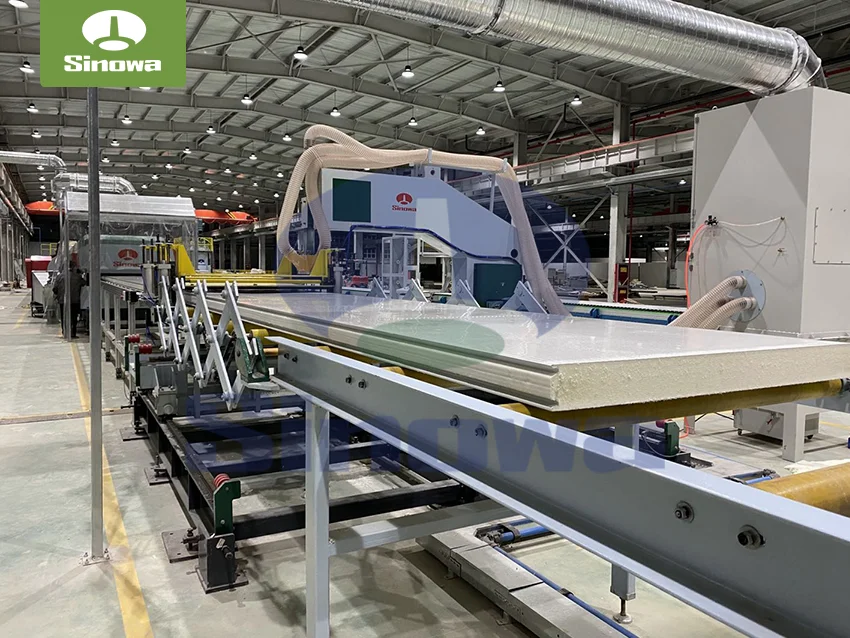
After completing curing and forming, the panels enter the fixed-length cutting and finishing stage. The continuous PU sandwich panel line intelligent flying saw cutting system performs precise fixed-length cutting according to customized size requirements for cold chain facilities. Different cold chain scenarios, including large-scale cold storage warehouses, modular cold chain transfer stations, and vehicle-mounted refrigerated compartments, require panels of different lengths and widths. The automated cutting system achieves high-precision size control, ensuring uniform specifications of each batch of panels and facilitating standardized assembly and construction of cold chain infrastructure. Meanwhile, the equipment is equipped with edge trimming and surface finishing functions to smooth panel edges and remove residual burrs and excess foam materials. This fine processing not only improves the overall appearance of panels but also ensures tight splicing between adjacent panels during on-site installation, eliminating assembly gaps that may cause cold air penetration and heat exchange. The finished panel stacking system realizes automatic collection and arrangement of finished products, avoiding secondary deformation and surface damage caused by manual handling, and maintaining the integrity of panel insulation and structural performance.
The unique structural design and process optimization of the polyurethane sandwich panel production line bring multiple core advantages for cold chain logistics infrastructure construction. First, the equipment achieves ultra-high consistency in finished panel quality. Through fully automated parameter control, all key indicators including core material density, cell structure uniformity, panel thickness deviation, and bonding strength are kept within a stable range. Consistent panel quality ensures that the overall insulation performance of cold chain facilities is uniform, avoiding local heat leakage points that may lead to increased energy consumption or partial temperature instability. For cold chain logistics, stable and uniform temperature environments are essential for preserving the freshness and quality of food, pharmaceutical, and special temperature-sensitive goods, and high-quality PU panels produced by professional equipment provide a solid material foundation for precise temperature control.
Second, the production process optimized for cold chain scenarios significantly enhances the low-temperature resistance and aging resistance of finished panels. The polyurethane sandwich panel line precise foaming and curing process enables the polyurethane core to form a highly stable closed-cell structure, which effectively resists molecular structure changes under long-term low-temperature conditions. ordinary panels are prone to foam shrinkage, cell cracking, and insulation performance degradation in continuous low-temperature environments, while panels produced by this professional equipment can maintain stable thermal insulation and structural toughness in long-term low-temperature and high-humidity cold chain working conditions. Additionally, the integrated composite structure formed by high-pressure bonding enhances the panel’s compression resistance and impact resistance, enabling it to withstand external pressure during warehouse storage, equipment operation, and logistics handling, and extending the service life of cold chain facility envelopes.
Third, the automated continuous production mode of the sandwich panel production equipment greatly improves production efficiency and meets the large-scale construction demand of modern cold chain logistics. With the rapid development of the cold chain industry, the construction speed of cold storage facilities and logistics transfer hubs continues to accelerate, requiring panel manufacturing equipment to have efficient continuous production capacity. This machine realizes uninterrupted operation from raw material input to finished product output, with highly synchronized coordination of each functional module, effectively shortening the single-panel production cycle and improving overall output efficiency. While ensuring high efficiency, the equipment reduces manual intervention links, lowers the quality fluctuation risk caused by human operation errors, and realizes high-efficiency and high-quality batch production. For large cold chain infrastructure projects, this efficient production mode can shorten the material supply cycle, accelerate project construction progress, and help cold chain facilities be put into operation faster to meet market logistics demand.
In terms of energy-saving performance, the advantages of panels produced by professional PU sandwich panel manufacturing machine also perfectly fit the energy conservation and emission reduction goals of modern cold chain logistics. Cold chain facilities belong to high energy-consuming buildings, as refrigeration equipment needs to operate continuously to maintain low-temperature environments, and building envelope heat loss is the main cause of high energy consumption. The precise foaming technology of the equipment enables the polyurethane core material to form a compact closed-cell structure with extremely low thermal conductivity, which can effectively block external heat transfer and reduce cold air loss inside the facility. The excellent thermal insulation performance of the panels significantly reduces the operating load of refrigeration systems, cuts down long-term energy consumption and operation costs of cold chain facilities, and improves the economic benefits of cold chain logistics operations. At the same time, the stable structural performance of the panels avoids frequent maintenance and replacement caused by performance degradation, reducing the later operation and maintenance costs of cold chain infrastructure.
The equipment also has flexible customization capabilities to adapt to the diversified construction needs of segmented cold chain logistics scenarios. Modern cold chain logistics covers multiple links such as fixed cold storage, mobile refrigerated transportation, and temporary cold chain transfer warehouses, with differentiated requirements for panel thickness, strength, and surface performance. The machine can adjust key production parameters such as foaming density, curing time, and panel thickness according to actual application scenarios, producing customized panels suitable for different low-temperature environments. For ultra-low-temperature cold storage used for frozen food storage, the polyurethane sandwich panel machine can produce thickened high-insulation panels with higher core density; for mobile refrigerated logistics equipment, it can produce lightweight and high-strength composite panels to reduce load while ensuring insulation performance. This flexible production feature enables the equipment to cover the full-scene material demand of cold chain logistics and provide targeted material solutions for different cold chain links.
With the continuous upgrading of the cold chain logistics industry towards intelligence, high efficiency, and green environmental protection, the technical iteration of PU sandwich panel machinery is also advancing synchronously. Modern equipment is gradually integrating more intelligent control technologies to realize real-time monitoring and automatic adjustment of production parameters such as foaming temperature, material ratio, and curing pressure. The intelligent control system can automatically correct parameter deviations during production, further improving the stability and precision of panel production. Meanwhile, the equipment’s environmental protection performance is continuously optimized, adopting low-pollution raw material matching and closed production processes to reduce material waste and harmful substance volatilization during production, which conforms to the green development trend of the modern logistics industry.
In summary, the PU sandwich panel production line specialized for cold chain logistics is a key core equipment supporting the high-quality development of the cold chain infrastructure industry. Through precise process control, integrated automated production, and scenario-oriented performance optimization, it manufactures high-insulation, high-stability, and long-service-life composite panels, solving the pain points of poor thermal insulation, unstable structure, and short service life of traditional cold chain building materials. As the global cold chain logistics system becomes more complete and the demand for temperature-controlled logistics continues to grow, this professional production equipment will play an increasingly important role in cold storage construction, cold chain facility upgrading, and logistics infrastructure iteration. It provides reliable material and technical support for improving the operational efficiency, energy-saving level, and service quality of the cold chain logistics industry, and promotes the standardized and high-quality development of the entire cold chain infrastructure field.
https://www.cnsinowa.com/sandwich-panel-machines/pu-sandwich-panel-machine-for-cold-chain-logistics.html