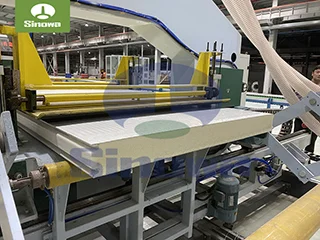
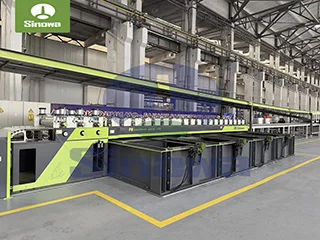
sandwich panel line
The overall structural design of the multifunctional insulation board production line follows the logic of raw material input-process molding-post-processing-finished product output, and the whole line is divided into six interconnected core functional sections operating in synchronous coordination, including raw material pretreatment and batching system, continuous mixing and foaming system, double-belt laminating and pressing system, constant temperature curing system, fixed-size cutting and trimming system, and automated finished product conveying and stacking system. Each functional module supports independent parameter adjustment without affecting the normal operation of other units, which is the core structural advantage supporting the multi-product production capacity of the whole line. The raw material pretreatment and batching system serves as the starting link of the entire production flow, responsible for centralized storage, impurity removal, screening and precise proportional dosing of all base materials and auxiliary materials required for insulation board production. Common production raw materials cover polymer foam substrates, inorganic fiber core materials, lightweight aggregate fillers and environmental-friendly adhesive components, and the system is equipped with closed conveying pipelines to avoid material dust overflow during feeding and transmission. Different from fixed-proportion batching devices of traditional production lines, the batching unit of this multifunctional line supports real-time modification of raw material matching ratios through electronic control terminals, enabling rapid switching between organic insulation core materials, inorganic fireproof core materials and composite sandwich core materials. All raw material feeding volumes are monitored by high-precision sensing components, which automatically correct feeding errors in real time to ensure consistent raw material composition of each batch of insulation boards, laying a solid foundation for stable physical performance of finished products.
After completing accurate batching, raw materials are automatically transported to the continuous mixing and foaming system, the core functional unit that determines the internal pore structure, thermal insulation performance and overall density of insulation boards. This system adopts dynamic high-speed mixing technology to realize uniform fusion of base materials, flame retardant additives, foaming agents and bonding components within a fixed time cycle. The mixing speed, mixing duration and working temperature of the mixing chamber can be adjusted according to different material characteristics: for rapid foaming polymer raw materials, low-speed uniform mixing and short-time foaming processes are adopted to avoid excessive pore expansion and structural collapse; for slow-curing inorganic composite raw materials, graded heating and segmented mixing modes are applied to ensure full fusion of materials and eliminate internal layering defects of semi-finished boards. The integrated foaming structure eliminates the need for separate pre-foaming equipment required by traditional sandwich panel production line, shortening the overall production flow and reducing the occupied space of the entire production workshop. During the foaming process, the system maintains stable internal pressure throughout the reaction stage to form fine and closed uniform pores inside the insulation board core layer, which directly improves the thermal resistance, moisture resistance and compressive strength of finished boards. Meanwhile, the sealed mixing and foaming cavity avoids volatilization of trace auxiliary materials during material reaction, optimizing the overall working environment of the production workshop and reducing unnecessary raw material loss.
Subsequently, the uniformly mixed foamed semi-finished core materials are automatically conveyed to the double-belt laminating and pressing system, which realizes composite molding of insulation core layers and surface protective panels. This system supports matching with multiple types of surface materials, including flexible waterproof facings, rigid inorganic protective panels and decorative integrated surface layers, realizing integrated molding of single-layer insulation boards, double-sided composite insulation boards and multi-layer functional composite boards on the same production line. The upper and lower pressing belts run synchronously with adjustable pressing pressure, running speed and gap height, so that the sandwich panel line can produce insulation boards with thickness ranging from thin decorative insulation sheets to thick engineering thermal insulation boards without replacing pressing molds. The laminating process adopts gradual pressure applying mode instead of one-time high-pressure extrusion, which prevents damage to the internal closed pore structure of the foamed core layer and ensures stable thermal insulation performance of finished products. In addition, the laminating unit is equipped with surface preheating modules, which properly heat the surface materials before compounding to enhance the bonding force between surface panels and insulation core layers, avoiding delamination, warping and peeling problems of composite boards in long-term outdoor service scenarios. The synchronous transmission design between the pressing system and the previous foaming system ensures consistent moving speed of semi-finished products in the whole process, eliminating board stretching, deformation and uneven thickness caused by speed mismatch between front and rear equipment.
The constant temperature curing system undertakes the task of stabilizing the internal structure of initially molded insulation boards, which is an indispensable link to improve the dimensional stability and mechanical durability of finished products. The curing section adopts segmented independent temperature control design, setting low-temperature preliminary curing area, medium-temperature deep curing area and natural slow cooling area in sequence according to material curing characteristics. Different insulation board materials have different curing reaction requirements: organic foam insulation boards require mild curing temperature to prevent thermal decomposition of internal foam structures, while inorganic composite insulation boards need relatively higher curing temperature to accelerate the solidification reaction of bonding components. The electronic control system of the sandwich panel machine can one-click switch curing temperature curves and cooling time curves corresponding to different board types, realizing rapid adaptation to material changes without manual adjustment of heating equipment one by one. The fully enclosed curing channel reduces heat loss during temperature maintenance, improving overall energy utilization efficiency compared with open curing equipment. After graded curing and slow cooling, the internal molecular structure of insulation boards is completely stabilized, effectively reducing later shrinkage, deformation and cracking risks of finished boards during storage and application, and extending the overall service life of insulation materials in building and industrial projects.
The fixed-size cutting and trimming system is responsible for precise sizing and edge finishing of cured continuous board blanks, meeting the unified dimensional requirements of downstream construction and industrial application scenarios. Equipped with longitudinal edge trimming units and transverse fixed-length cutting units, the system can automatically remove uneven residual edges on both sides of continuous boards and cut long board blanks into standard sizes. The cutting position and cutting length support stepless electronic adjustment, covering customized size demands of different engineering projects. All cutting tools adopt wear-resistant structural design, and the system is matched with automatic dust and debris collection devices to collect cutting residues generated during processing in a centralized manner. Collected clean waste materials can be reintroduced into the raw material batching link after simple crushing treatment, realizing cyclic reuse of production waste and improving overall resource utilization rate of the sandwich panel making machine. Compared with offline manual cutting equipment, the online integrated cutting mode avoids secondary positioning errors caused by transferring semi-finished boards, improves the dimensional accuracy of finished insulation boards, and reduces intermediate handling processes to further boost overall production efficiency.
The final automated conveying and stacking system completes finished board sorting, conveying and orderly stacking. Finished insulation boards after cutting are automatically detected by thickness and flatness sensing devices, and unqualified products with dimensional deviation or surface defects are automatically screened out from the insulation panel production line, while qualified finished boards are conveyed to the stacking area by roller transmission devices. The stacking manipulator adjusts stacking height and spacing according to board thickness and hardness to avoid surface extrusion damage of finished boards. The whole stacking process operates fully automatically without manual palletizing, reducing labor input in the final production stage and improving the neatness and uniformity of finished product stacks for convenient subsequent storage and transportation. All transmission rollers in the whole production line adopt anti-slip and anti-scratch surface treatment, protecting the surface integrity of composite insulation boards and decorative surface insulation boards in the whole conveying process.
The core competitiveness of the multifunctional insulation sandwich panel machine stems from its intelligent centralized control system, which integrates all functional modules of the whole line into one unified operation terminal. Operators can complete parameter setting, operation status monitoring, fault diagnosis and production mode switching of all equipment through a single human-machine interaction interface. The system stores preset production programs corresponding to dozens of common insulation board specifications, and workers can complete rapid switching of production varieties within several minutes by calling built-in programs, realizing seamless switching between exterior wall insulation boards, roof fireproof insulation boards, cold chain warehouse insulation boards and industrial equipment sound insulation and heat preservation boards. Real-time data monitoring screens display operating parameters including material feeding speed, mixing temperature, pressing pressure, curing temperature and line running speed in real time. Once abnormal parameter fluctuations occur in any equipment unit, the system will send early warning prompts automatically and conduct adaptive fine adjustment of relevant operating parameters to ensure uninterrupted continuous production. For minor equipment operation faults, the control system can complete self-inspection and automatic repair; for major faults requiring manual maintenance, the system can automatically lock upstream and downstream equipment to prevent fault expansion and reduce production loss caused by equipment abnormalities.
In terms of energy consumption and environmental protection performance, the optimized structural design of the multifunctional thermal insulation panel production line achieves obvious advantages over traditional discrete production lines. The whole production process cancels high-temperature high-pressure reaction links, reducing overall power consumption of heating and pressure maintaining equipment. The closed design adopted by all material processing units effectively inhibits volatile gas leakage and dust diffusion during production, complying with global increasingly strict industrial environmental protection production standards. In addition to the cyclic reuse of cutting waste materials mentioned above, the production line also optimizes the matching proportion of auxiliary materials to reduce the usage of chemical additives that are harmful to the environment, and the produced insulation boards have no harmful substance volatilization during long-term use, matching the development trend of green building materials. From the perspective of production cost control, one-line multi-product design eliminates the need for enterprises to purchase multiple single-function production lines, reducing early equipment investment, workshop space occupation and daily equipment maintenance costs. The highly automated operation mode cuts down post workers required for production, and continuous uninterrupted production improves unit time output, helping material manufacturing enterprises cope with fluctuating market orders flexibly and enhance market competitiveness in the fierce building material industry.
In practical industrial application scenarios, this multifunctional sandwich panel manufacturing line has covered diverse downstream demands across civil construction, industrial manufacturing and cold chain logistics fields. In residential and commercial building exterior wall thermal insulation projects, it can produce lightweight composite insulation boards with excellent heat preservation and fire resistance to reduce building overall energy consumption for heating and cooling; in industrial plant roof and wall enclosure projects, high-strength pressure-resistant insulation boards adapted to harsh outdoor weather can be produced to resist wind pressure, rainwater erosion and temperature difference changes; in cold chain logistics warehouses and low-temperature storage projects, low thermal conductivity and low water absorption insulation boards are manufactured to reduce cold air loss and improve energy-saving effect of refrigeration equipment; in industrial pipeline and equipment insulation fields, customized thin insulation boards with good sound insulation and heat insulation performance can be produced to reduce heat loss of mechanical equipment and improve working environment stability of production workshops. The strong product adaptation capability enables the production line to serve different downstream industries without equipment modification, bringing higher operational flexibility for insulation board manufacturers.
Looking ahead to the future development trend of thermal insulation building material manufacturing equipment, the multifunctional insulation board manufacturing line will further develop towards higher intelligent automation, lower carbon energy consumption and stronger product customization capability. Upgraded sensing and artificial intelligence algorithms will realize full autonomous adjustment of production parameters according to real-time raw material quality changes, further reducing manual participation in the whole production process. Waste recycling systems will be further optimized to realize full closed-loop reuse of all production residues, achieving nearly zero waste discharge in the production process. Meanwhile, the production line will reserve more functional expansion interfaces, which can be connected with surface coating, groove processing and other extended processing units according to market demands, realizing one-stop integrated production from raw materials to finished insulation boards with surface finishing. As global energy conservation and emission reduction policies continue to be promoted and the demand for green and diversified building materials continues to rise, multifunctional integrated insulation sandwich panel production equipment will gradually replace traditional single-function production lines and become the mainstream manufacturing equipment in the global thermal insulation building material industry, promoting the overall upgrading of the insulation material manufacturing industry and supporting the high-quality development of green construction and low-carbon industrial manufacturing fields worldwide.
https://www.cnsinowa.com/sandwich-panel-machines/multifunctional-insulation-board-production-line.html