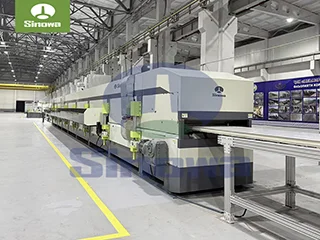
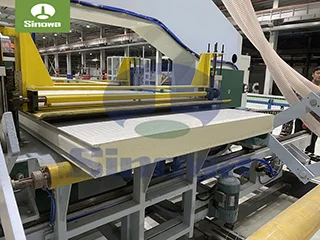
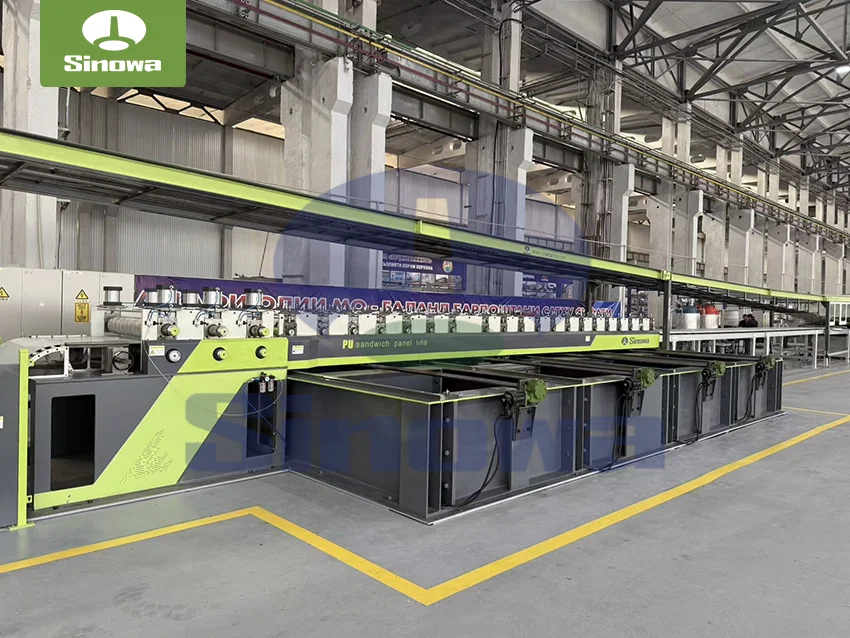
 sandwich panel machine
Unlike conventional sandwich panel production equipment that directly proceeds with foaming and lamination after simple material feeding, the pre-heating integrated automatic PIR sandwich panel machine incorporates a systematic temperature regulation module at the front end of the production process, which fundamentally optimizes the physical and chemical reaction conditions of PIR foam molding and interface bonding. The entire production workflow operates in a fully automated closed-loop manner, covering raw material unwinding, surface pretreatment, constant-temperature pre-heating, precise material distribution, high-pressure foaming, continuous lamination, constant-temperature curing, fixed-length cutting, and automatic conveying, eliminating manual intervention in core production links and ensuring consistent production standards for each batch of panels. The core value of the pre-heating system lies in its ability to adjust the temperature of surface facing materials and auxiliary materials to the optimal reaction range before foaming and compounding, creating a stable and uniform temperature field for the subsequent PIR chemical foaming and interface adhesion reactions.
In the initial production stage, the sandwich panel production machinery starts with the automatic feeding and leveling of surface facing materials, which are mostly high-strength metal sheets with smooth surfaces and stable mechanical properties. The hydraulic uncoiling unit steadily releases coiled sheet materials, and the precision leveling system corrects tiny deformations and surface undulations generated during coil storage and transportation, ensuring that the incoming sheets maintain a flat and uniform state. Before entering the pre-heating module, the built-in surface pretreatment device performs comprehensive cleaning on the inner side of the facing materials, removing surface dust, oil stains, and oxide layers that may hinder bonding. These tiny impurities are key factors leading to weak adhesion and local delamination of panels in later use, and the automatic cleaning process lays a solid foundation for high-strength composite molding of panels.
Following the pretreatment process, the materials are smoothly transported to the core pre-heating system through a synchronous roller conveying mechanism. This system adopts a circulating hot air heating mode with stepless temperature adjustment, featuring high temperature control accuracy and uniform heat distribution across the entire material surface. Different from simple local heating devices, the integrated pre-heating structure realizes omnidirectional and consistent heating for both upper and lower facing materials, avoiding the temperature difference between the edge and the middle of the sheets. The pre-heating process is not a simple high-temperature baking but a precise low-temperature constant-temperature warming treatment, which slowly raises the surface temperature of the facing materials to the preset optimal temperature range matching PIR foaming reaction. This mild heating method can effectively activate the molecular activity of the adhesive coated on the inner surface of the materials, while eliminating the low-temperature stress of the metal sheets and avoiding structural deformation caused by sudden temperature changes during subsequent high-temperature foaming and curing.
The importance of precise pre-heating is particularly prominent in PIR foam molding, as PIR polycondensation and foaming reactions have extremely strict temperature threshold requirements. When the temperature of the facing materials is too low, the liquid PIR raw materials injected between the upper and lower sheets will experience rapid heat loss instantly, resulting in incomplete foaming reaction, uneven internal cell distribution, and a large number of closed-cell defects. Such defective core structures will greatly reduce the thermal insulation performance and compressive strength of the panels, and are prone to shrinkage and cracking in long-term use. On the contrary, with the support of the pre-heating system, the temperature difference between the facing materials and the PIR mixed raw materials is minimized, enabling the foaming reaction to proceed stably and fully in a constant-temperature environment. The generated PIR foam core presents a dense, uniform, and complete closed-cell structure, which significantly improves the thermal insulation efficiency, structural compactness, and overall stability of the finished panels.
After completing the constant-temperature pre-heating treatment, the facing materials are synchronously sent to the automatic foaming and composite lamination area. At this stage, the high-precision raw material mixing system automatically proportions PIR polyether, isocyanate, and functional additives according to fixed process parameters, achieving uniform mixing of raw materials without component stratification. The mixed liquid raw materials are evenly injected between the pre-heated upper and lower facing materials through a high-pressure spraying device. Benefiting from the pre-activated adhesive on the material surface and the stable temperature field, the liquid PIR materials rapidly expand, fill the entire gap between the sheets evenly, and produce continuous chemical cross-linking reactions with the adhesive layer and the material surface molecules.
The continuous double-belt pressing system provides stable and constant pressure for the composite molding process, cooperating with the temperature foundation laid by the pre-heating system to complete integrated curing and molding. In the traditional production process without pre-heating, the inconsistent temperature of the upper and lower sheets often leads to asymmetric foaming speed of the PIR core layer, resulting in unbalanced internal stress of the panel, warping deformation of the finished product, and inconsistent thickness. The matching operation of the pre-heating system and the constant-pressure lamination system completely solves these problems. The uniform temperature field ensures synchronous foaming and curing of the entire PIR core layer, making the thickness of the panel consistent, the internal stress balanced, and the bonding interface between the core layer and the facing materials tighter and more integrated. The composite panels formed in this way have excellent overall structural integrity, no hollow layers or local separation, and greatly improved mechanical load-bearing capacity and weather resistance.
The automated control system of the PIR sandwich panel production line realizes intelligent linkage of the pre-heating module, feeding module, foaming module, and lamination module, ensuring the coordination and consistency of each production link. The system can automatically adjust the pre-heating temperature, material conveying speed, and foaming injection volume according to different panel thickness specifications and production environment temperatures, realizing adaptive production of multiple product specifications. Real-time temperature monitoring devices are installed inside the pre-heating system, which can feed back the surface temperature of the materials to the central control system in real time. Once the temperature deviates from the preset range, the system will automatically adjust the heating power and hot air circulation speed to maintain a constant and stable heating state throughout the production process.
In terms of production efficiency, the pre-heating system optimizes the reaction efficiency of PIR foaming and curing, effectively shortening the molding cycle of a single panel. In traditional production lines, insufficient preheating leads to slow curing speed of the PIR core layer, which not only restricts production speed but also easily causes incomplete curing of the core layer and reduces product qualification rate. The optimized temperature environment provided by the pre-heating system accelerates the cross-linking and curing reaction of PIR materials, enables the panels to reach the set structural strength and stability in a shorter time, and supports the continuous and uninterrupted high-speed operation of the production line. While improving production capacity, it effectively reduces the defective rate caused by insufficient curing and unstable bonding, greatly lowering the comprehensive production cost of enterprises.
The finished PIR sandwich panels produced by this pre-heating equipped automatic machine have far superior comprehensive performance compared with traditional products. The uniform closed-cell PIR core structure brings ultra-low thermal conductivity, enabling the panels to achieve excellent thermal insulation and heat preservation effects, which can effectively reduce the energy consumption of building temperature regulation and meet the high-standard energy-saving requirements of modern green buildings. The tight and integrated composite structure between the core layer and the facing materials endows the panels with strong wind pressure resistance, bending resistance, and impact resistance, ensuring stable structural performance in long-term outdoor and complex working environments. In addition, the sufficient and uniform foaming reaction optimizes the fire resistance and flame retardancy of the PIR core layer, making the panels have good fire-proof and smoke-suppression performance, adapting to the safety construction standards of public buildings, industrial facilities, and special environmental projects.
The equipment also has excellent operational stability and low maintenance characteristics in long-term industrial production. The pre-heating system adopts a durable hot air circulation structure, which avoids local overheating damage to materials and equipment caused by traditional heating methods, and reduces the wear and failure rate of heating components. The fully automated integrated design reduces manual operation links, lowers the operational error rate caused by human factors, and ensures the long-term continuous and stable operation of the PIR sandwich panel line. Meanwhile, the modular structural design facilitates daily inspection, maintenance, and parameter adjustment of each functional module, effectively improving the operational efficiency of the production line and extending the service life of the equipment.
In the context of the booming global energy-saving building and prefabricated construction industry, the market demand for high-performance, high-consistency, and high-stability PIR sandwich panels continues to grow, which puts forward higher requirements for the precision, automation, and intelligence of panel production equipment. The automatic PIR sandwich panel making machine with pre-heating system caters to the development trend of the industry by solving the core pain points of traditional production technology. Its unique pre-heating temperature control technology optimizes the physical and chemical molding mechanism of PIR panels from the source, realizing qualitative leaps in product quality stability, production efficiency, and product performance.
With the continuous upgrading of building energy-saving standards and prefabricated construction technology, this automated production equipment will become the mainstream configuration of high-end PIR sandwich panel production line. It not only helps manufacturing enterprises improve product competitiveness and market adaptability but also provides reliable equipment support for the high-quality development of the modern building insulation material industry and the popularization of green energy-saving buildings. The perfect combination of automatic continuous production technology and precise pre-heating temperature control technology marks the mature development of PIR sandwich panel manufacturing technology, laying a solid foundation for the large-scale, standardized, and high-quality production of high-performance building insulation composite panels.
https://www.cnsinowa.com/sandwich-panel-machines/automatic-pir-sandwich-panel-making-machine-with-pre-heating-system.html