sandwich panel line
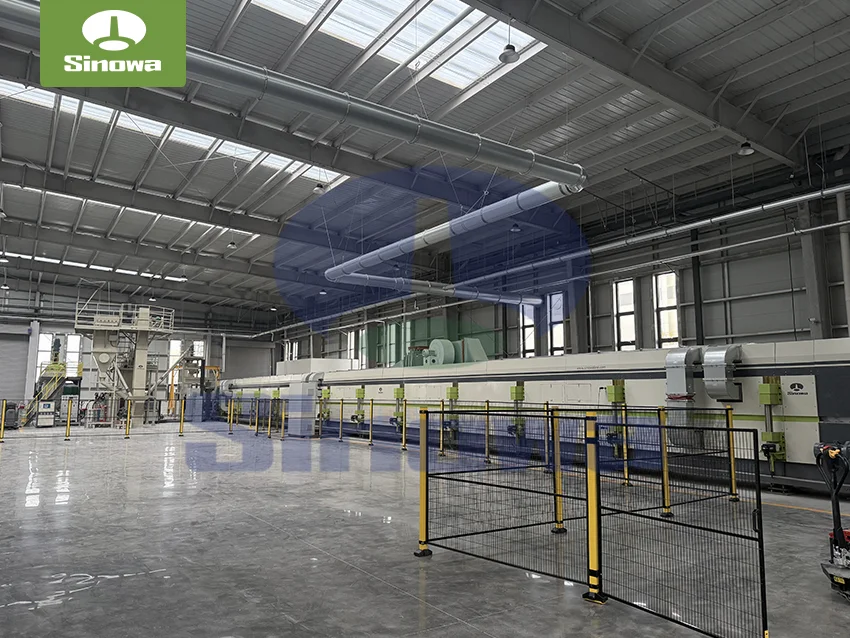
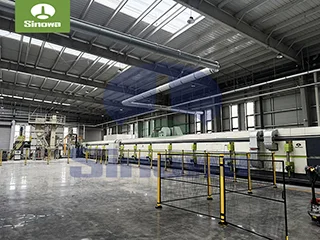
The overall structural design of a mature sandwich panel line follows the principles of modularization, continuity, and stability, covering a complete closed-loop production system from raw material pretreatment, automatic feeding, adhesive coating, core material laying, composite pressing, trimming shaping, to final conveying and stacking. Each functional module is closely connected through intelligent transmission equipment, realizing seamless docking of processes and synchronous coordination of mechanical actions. Unlike discrete production equipment that can only complete single processing steps, the assembly line integrates mechanical transmission, automatic control, pneumatic pressure regulation, and precision positioning technologies, enabling the entire production process to operate in a continuous cycle. The layout of the assembly line is scientifically planned according to production logic and space utilization requirements, with front-end raw material processing areas, middle-end core assembly and composite molding areas, and back-end finishing and storage areas distributed in an orderly manner, which not only optimizes the production rhythm but also reduces the space occupation of production equipment and improves the overall utilization rate of the production workshop.
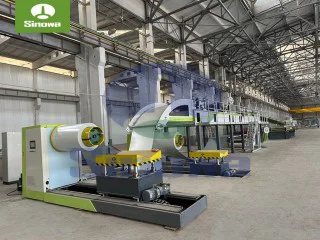
Raw material pretreatment and automatic feeding are the initial and foundational links of the entire sandwich board assembly process, determining the flatness and bonding accuracy of subsequent composite processes. The raw materials involved in production mainly include metal or non-metal outer panels and porous or solid core materials, all of which need to undergo strict pretreatment before entering the assembly process. For outer surface panels, the pretreatment process includes surface cleaning, deburring, and flatness calibration. During long-term storage and transportation, surface panels are prone to dust adhesion, edge burrs, and slight bending deformation, which will directly affect the bonding tightness and surface flatness of finished products. The automatic feeding module of the assembly line is equipped with special feeding racks and vacuum adsorption feeding devices. The vacuum adsorption structure can stably pick up single surface panels from the material stack, avoiding scratch and extrusion deformation caused by manual handling. At the same time, the feeding system is matched with a deviation correction mechanism, which can automatically identify the offset of the panel position during transmission and complete real-time position adjustment through servo motor fine-tuning, ensuring that each panel is conveyed to the next process in a horizontal and accurate state.
The core material feeding process is set synchronously with the surface panel feeding process to ensure the synchronization of the front and rear production rhythms. Common core materials include foam materials, rock wool, glass wool, and honeycomb structural materials, which have different physical characteristics such as softness, porosity, and thickness. Therefore, the assembly line adopts adaptive feeding structures for different core material types. For flexible fibrous core materials, the feeding module is equipped with tension adjustment equipment to avoid material stretching, wrinkling, or uneven cutting during transmission. For rigid plate-shaped core materials, a roller conveying and positioning limiting structure is used to ensure stable and orderly material advancement. Before formal assembly, the core materials will undergo fixed-length cutting and shaping according to production specifications. The precision cutting device on the assembly line can complete accurate cutting according to preset size parameters, ensuring that the length, width, and edge flatness of the core materials match the outer panels, eliminating the size deviation caused by manual cutting in traditional processes and laying a foundation for the precise composite of subsequent boards.
Adhesive coating is a key process affecting the bonding strength and service life of sandwich boards, and the assembly line realizes fully automatic, uniform, and quantitative adhesive coating through professional gluing equipment. The quality of adhesive coating directly determines the overall structural stability of the sandwich board. Uneven glue application, excessive or insufficient glue amount will lead to problems such as local debonding, hollowing, and insufficient structural strength of the finished board. The automatic gluing system of the assembly line adopts multi-nozzle synchronous coating technology, and the glue output speed and coating thickness are intelligently adjusted according to the material type and production speed. During the operation, the system maintains stable glue pressure, ensuring that the adhesive is evenly covered on the bonding surface of the outer panel without missing coating or accumulation. Meanwhile, the gluing process is equipped with a dust isolation device to prevent floating dust in the air from adhering to the adhesive surface, which would affect the bonding effect. After the completion of glue coating, the assembly line will carry out short-term leveling treatment on the adhesive layer to make the glue surface more flat and uniform, further optimizing the subsequent composite bonding effect.
The core material laying and preliminary composite positioning process is the central link of sandwich board assembly. After the outer panel completes adhesive coating and leveling, it is stably conveyed to the core material laying station through the transmission roller table. At this station, the assembly line adopts automatic alignment and laying equipment to accurately fit the pretreated core material on the adhesive surface of the outer panel. The high-precision visual positioning system installed on the equipment can capture the edge contour and position coordinates of the outer panel and core material in real time, transmit the data to the central control system, and adjust the laying position of the core material in real time, ensuring that the core material is completely aligned with the outer panel without offset or deviation. For large-area sandwich boards, the assembly line is equipped with multi-point pressing and fixing structures, which can perform temporary positioning and pressure fixing on the laid core material to prevent position deviation or warping of the core material during the transmission process to the pressing station. This automatic laying and positioning mode greatly improves the assembly accuracy compared with manual laying, effectively avoiding product defects such as core material deviation and uneven edge gaps, and ensuring the consistency of the overall size of batch products.
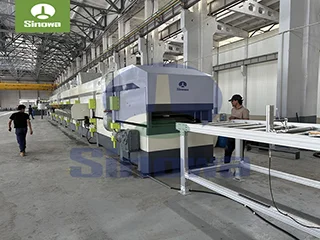
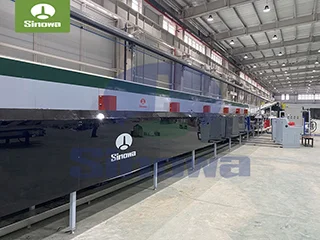
Hot pressing composite molding is the core process to realize the integral bonding and shaping of sandwich boards, and it is also the key link to determine the structural strength and molding effect of finished products. The assembly line is equipped with a large-scale constant-temperature pressing machine, which adopts segmented temperature control and graded pressure regulation technology to carry out integrated hot pressing treatment on the preliminarily composited boards. Different core materials and adhesive types correspond to different optimal pressing temperatures, pressures, and holding times. The intelligent control system of the assembly line can preset corresponding process parameters according to product specifications, and realize automatic adjustment and precise control of pressing conditions during production. In the hot pressing stage, the equipment applies uniform and stable pressure on the surface of the sandwich board, and the constant-temperature heating environment promotes the rapid curing and bonding of the adhesive, making the outer panel and core material closely integrated into a unified whole. The segmented pressing design can effectively avoid the problems of local pressure imbalance, board deformation, and adhesive overflow caused by one-time high-pressure pressing. After the completion of hot pressing and curing, the assembly line will perform natural cooling and shaping treatment on the boards through the constant-temperature cooling channel, eliminating internal stress generated during hot pressing and ensuring the flatness and structural stability of the boards after molding.
Trimming and finishing processes are important links to optimize the appearance quality and dimensional accuracy of finished sandwich boards. After hot pressing and cooling molding, the edges of the sandwich board will have a small amount of adhesive overflow, material burrs, and dimensional errors. The assembly line is equipped with automatic edge trimming, trimming and polishing integrated equipment, which can complete synchronous finishing of four sides of the board in one process. The high-speed cutting tool adopts precise sizing design, which can accurately cut off the excess edge materials and overflow adhesive, ensuring that the overall size of the finished board meets the preset standard parameters. After trimming, the fine polishing device will polish the board edges and surface slightly to remove tiny burrs and scratches generated during processing, making the board surface smoother and the edges more neat. For products requiring special surface flatness, the assembly line is also equipped with surface flaw detection and fine adjustment devices, which can identify tiny uneven areas on the board surface and complete micro-pressure shaping correction, further improving the overall appearance quality of the product.
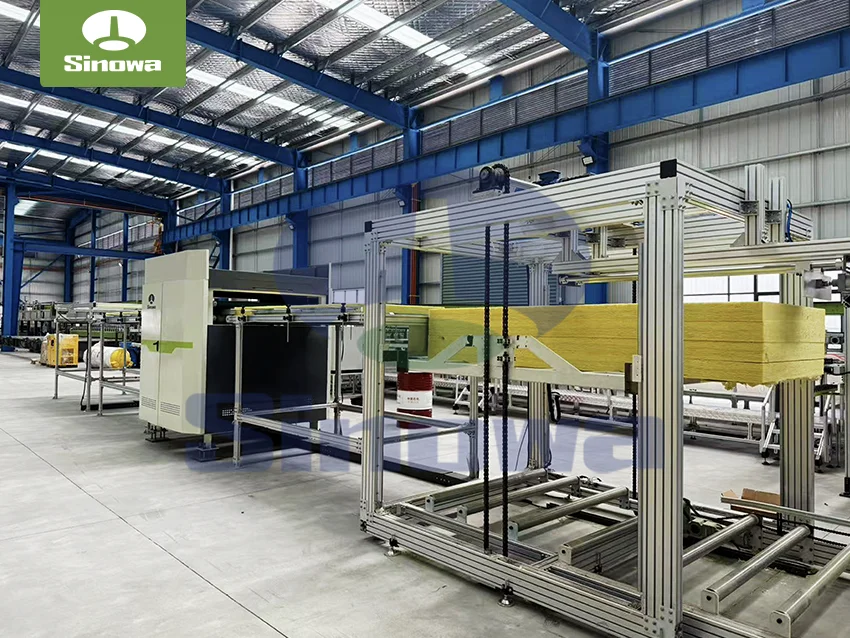
The final conveying, detection and stacking processes realize the final quality control and standardized storage of finished products. The finished sandwich boards after finishing are stably conveyed to the quality inspection station through the automatic transmission system. The assembly line is equipped with multi-dimensional automatic detection equipment, which can complete real-time detection of board flatness, bonding tightness, dimensional accuracy, and surface integrity. Through high-precision sensing and scanning technology, the system can automatically identify unqualified products with defects such as debonding, deformation, and dimensional deviation, and classify and screen qualified and unqualified products through the automatic sorting mechanism. Qualified finished products are continuously conveyed to the stacking station, and the automatic stacking equipment adopts mechanical arm adsorption and stacking technology, which can neatly stack the finished boards according to fixed specifications and heights. The stacking process maintains uniform spacing and stable placement of products, avoiding extrusion damage between boards, and providing convenient conditions for subsequent packaging, transportation and warehouse storage. The entire post-processing process realizes unmanned automatic operation, which not only improves production efficiency but also avoids product damage and quality errors caused by manual handling and stacking.
The intelligent control system runs through the entire operation process of the sandwich panel assembly line, which is the core brain to ensure the stable operation of the equipment and consistent product quality. The system adopts modular program control technology, which can integrate and coordinate the operation rhythm of all stations such as feeding, gluing, laying, pressing, trimming and stacking. Before production, operators only need to input product specification parameters and process requirements into the control terminal, and the system will automatically match the corresponding operation programs, realize one-click start and automatic cycle operation of the entire assembly line. During the production process, the real-time monitoring module of the system can collect the operating data of each equipment unit, including transmission speed, gluing volume, pressing temperature, pressure holding time, and processing size, and display the operating status of the assembly line in real time through the visual interface. Once abnormal conditions such as equipment jitter, parameter deviation, and process stagnation occur, the system will automatically trigger an alarm prompt and perform self-correction or emergency stop protection according to the fault level, effectively avoiding large-scale unqualified product output and equipment failure damage.
In terms of production efficiency and resource optimization, the automated operation mode of the sandwich panel production line has obvious advantages over traditional production modes. The continuous cyclic production of the assembly line realizes the seamless connection of each process link, eliminates the waiting and handling time between discrete processes, and greatly improves the hourly output and daily production capacity of products. At the same time, the precise parameter control of the intelligent system realizes the refined utilization of raw materials. The quantitative gluing technology avoids adhesive waste caused by excessive coating, and the precise cutting and positioning technology reduces the scrap rate of surface panels and core materials. In terms of labor cost control, the highly automated assembly line reduces the dependence on manual operation. A complete assembly line only needs a small number of operators to complete equipment monitoring, parameter adjustment and auxiliary feeding work, which greatly reduces labor input and production management costs. In addition, the standardized production process makes the quality parameters of each batch of products highly consistent, reducing the quality fluctuation and rework rate caused by human factors, and improving the overall yield of products.
The operational stability and daily maintenance of the sandwich panel manufacturing line are crucial to long-term efficient production. The mechanical structure of the assembly line is designed with high-strength and wear-resistant materials, and the key transmission parts and processing components adopt optimized structural technology, which can adapt to long-term continuous industrial production and reduce the frequency of equipment wear and failure. The equipment is equipped with a regular self-inspection and lubrication reminder system, which can monitor the wear degree of transmission rollers, cutting tools, and pneumatic components in real time, and remind maintenance personnel to complete lubrication, replacement and debugging work in a timely manner. Daily maintenance work mainly includes cleaning the surface dust and residual materials of each station, checking the tightness of mechanical connections, calibrating the precision of positioning and cutting devices, and testing the sensitivity of the control system and alarm device. Regular standardized maintenance can effectively extend the service life of the assembly line, maintain the stability of production parameters, and ensure the long-term consistent production quality and efficiency.
With the continuous upgrading of industrial manufacturing technology, the sandwich panel machine is also developing in the direction of higher intelligence, higher precision and stronger adaptability. The traditional assembly line can only adapt to single or few specifications of product production, while the new generation of intelligent assembly line realizes flexible production through program switching and structural adjustment. It can quickly adapt to the production needs of different thicknesses, sizes and material combinations of sandwich boards, and complete fast switching of production processes without large-scale equipment adjustment, greatly improving the flexible production capacity of the production line. At the same time, with the application of digital twin technology, the assembly line can realize virtual simulation of the production process, predict production bottlenecks and equipment failure risks in advance, and further optimize production scheduling and process parameters. In addition, the energy-saving and environmental protection design of the new assembly line is becoming more and more perfect. Through optimized temperature control, frequency conversion speed regulation and waste recycling technology, it reduces energy consumption and material waste in the production process, and meets the development requirements of green and low-carbon manufacturing in the modern industry.
The application and popularization of advanced sandwich panel machinery has important practical significance for the upgrading of the composite material manufacturing industry. In the field of architectural decoration and industrial manufacturing, the stable and high-quality production capacity of the assembly line ensures the structural stability and service performance of sandwich board products, providing reliable material support for high-standard engineering construction and industrial equipment manufacturing. The standardized and automated production mode promotes the standardized development of the sandwich board industry, unifies the production process and quality evaluation standards of products, and solves the problem of uneven product quality in the scattered small-scale production mode. At the same time, the high-efficiency and low-consumption production characteristics of the assembly line effectively reduce the comprehensive production cost of products, improve the market competitiveness of composite board products, and promote the wide application and popularization of lightweight energy-saving composite materials in more industrial fields.
In the future, with the continuous progress of artificial intelligence, precision machinery and digital manufacturing technology, the sandwich board assembly line will realize further technological innovation and functional upgrading. The degree of intelligent autonomy of the equipment will be further improved, realizing full-process unmanned operation, automatic fault diagnosis and intelligent process optimization. The processing precision and production flexibility of the assembly line will be continuously improved, which can meet the personalized and customized production needs of the market. In addition, the integration of the assembly line with the factory's digital management system will be more in-depth, realizing the integrated management of production scheduling, quality monitoring, data statistics and equipment maintenance, helping the composite material manufacturing industry realize intelligent, efficient and green industrial upgrading, and continuously inject new impetus into the development of modern manufacturing industry.
https://www.cnsinowa.com/sandwich-panel-machines/sandwich-board-assembly-line.html