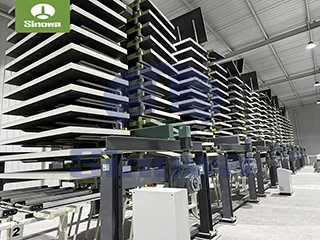
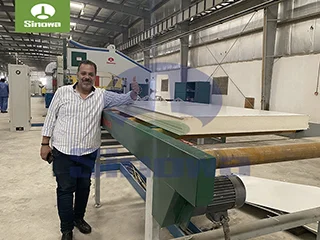
sandwich panel machine
Sandwich duct panel machine is a specialized equipment used for producing sandwich duct panels. This machine uses automated and intelligent production methods to composite different materials of air duct panels, forming sandwich air duct panels with excellent insulation, sound insulation, fire resistance, and other properties. These air duct panels are widely used in various fields such as construction, transportation, energy, and environmental protection, providing a solid foundation for the construction of various ventilation systems.
From a technical perspective, the Sandwich Duct Panel Machine adopts advanced automation control system and precision machining technology. Through preset programs, the machine can automatically complete a series of process flows such as cutting, compounding, and forming of sheet metal, greatly improving production efficiency and product quality. At the same time, the machine also has high flexibility and can be customized for production according to the actual needs of customers, meeting the application requirements in different fields and scenarios.
In terms of application, sandwich duct panels produced by sandwich duct panel machines have many advantages. Firstly, its excellent insulation performance can effectively reduce energy consumption and improve energy utilization efficiency. Secondly, the sound insulation effect is good, which can provide people with a quieter and more comfortable living environment. In addition, sandwich air duct panels also have excellent fire resistance, which can effectively prevent the spread of fire and ensure the safety of people's lives and property in the event of a fire.
With the continuous advancement of technology and the continuous development of the market, Sandwich Duct Panel Machines are also constantly innovating and improving. The future Sandwich Duct Panel Machines will be more intelligent and automated, enabling more efficient and precise production and processing. At the same time, with people's increasing attention to environmental protection, energy conservation and other issues, Sandwich Duct Panel Machines will also pay more attention to the application of environmentally friendly materials and the research and development of energy-saving technologies, contributing to the sustainable development of society.
As an innovative work in modern industry, Sandwich Duct Panel Machines have become indispensable and important equipment in the market due to their unique technological advantages and wide application fields. In the future, with the continuous advancement of technology and the continuous development of the market, Sandwich Duct Panel Machines will surely usher in a broader development prospect.
The rapid advancement of modern ventilation, air conditioning, and thermal insulation engineering across industrial production, commercial construction, public infrastructure, and special environmental projects has created a growing and sophisticated demand for high-efficiency, durable, and energy-saving air duct components. Sandwich duct panels have gradually replaced traditional single-layer metal ducts and simple composite duct materials due to their integrated advantages of thermal insulation, sound absorption, airtightness, and structural stability, becoming the core basic material for centralized ventilation and temperature control systems in various construction and industrial fields. At the heart of the standardized and large-scale production of these professional composite duct panels lies the sandwich duct panel machine, a specialized integrated mechanical and electrical processing equipment designed exclusively for the continuous compounding, forming, bonding, and fixed-length cutting of multi-layer sandwich structural duct substrates. This type of equipment integrates mechanical transmission, precise pressure regulation, constant temperature curing, automatic material conveying, and precision cutting technologies, realizing the whole-process automated processing from raw material feeding of surface and core materials to the output of finished sandwich duct panels. Its internal structural design directly determines the overall forming quality, bonding firmness, dimensional accuracy, and long-term service stability of produced duct panels, while different structural configurations and performance parameter settings derive multiple equipment types adapted to diverse core materials and engineering application needs, covering almost all application scenarios of insulated ventilation ducts from ordinary civil buildings to heavy-duty industrial production environments.
The overall structural design of a standard sandwich duct panel machine follows a modular integrated manufacturing concept, with each functional module independently designed for professional production links and closely connected and coordinated in the actual production operation process to ensure the continuity and stability of the entire production line. The complete equipment structure can be divided into several core functional parts, including the raw material unwinding and feeding system, sheet leveling and pre-forming system, automatic glue coating and composite positioning system, thermal pressure bonding and constant temperature curing system, fixed-length sizing and precision cutting system, as well as finished product conveying and automatic stacking system. Each structural part undertakes irreplaceable core functions, and the matching precision and operating coordination between different modules directly affect the structural performance and finished product qualification rate of the final sandwich duct panels. The raw material unwinding and feeding system is the starting link of the entire production process, mainly responsible for the stable unwinding and continuous conveying of upper and lower surface base materials of the sandwich duct panel. Most of these surface materials are flexible coiled materials such as galvanized steel sheets, aluminum alloy sheets, and glass fiber reinforced composite cloths, which require the unwinding structure to be equipped with precise tension control components. This structural design can effectively avoid material deviation, surface scratches, and uneven feeding speed during the unwinding process, ensuring that the surface materials maintain flat and stable conveying status in the subsequent processing links and laying a foundation for the consistent thickness and regular structure of the finished duct panels.
The sheet leveling and pre-forming system is set behind the unwinding structure, composed of multiple groups of high-precision roller sets and progressive shaping components, which is one of the key structures to ensure the flatness and structural regularity of the duct panel surface. After long-term coiling, the surface base material often has internal stress and local bending deformation, and the leveling roller sets in this system can carry out multi-pass extrusion and straightening of the coiled material to eliminate internal material stress and ensure the flatness of the surface material meets the production processing standards. On this basis, the pre-forming roller sets carry out gradual micro-bending and edge shaping of the surface material according to the structural size requirements of different duct panels, preliminarily processing the flat sheet into the basic contour required for duct panel assembly. The structural design of the pre-forming roller sets adopts progressive deformation technology, avoiding one-time excessive bending that causes material damage or surface cracking, effectively protecting the structural integrity of the surface material and ensuring that the subsequent composite bonding process can be carried out in a stable fit state. This part of the structural performance directly determines the appearance flatness and edge dimensional accuracy of the finished sandwich duct panels, and is an indispensable structural part for improving the assembly compatibility of subsequent duct engineering installation.
The automatic glue coating and composite positioning system is the core structural unit that realizes the permanent bonding of the surface material and the intermediate thermal insulation core material of the sandwich duct panel, and its structural rationality and working stability directly determine the bonding strength and overall structural firmness of the sandwich panel. The system is equipped with a double-sided uniform glue coating device, which can evenly coat high-performance adhesive on the inner surfaces of the upper and lower surface materials according to the set glue application amount and coating range, avoiding problems such as local glue shortage, glue accumulation, and uneven bonding that easily occur in manual glue application. While completing the glue coating operation, the core material automatic conveying and positioning mechanism synchronously transports lightweight thermal insulation core materials such as polyurethane foam, phenolic foam, rock wool, and glass wool to the middle position between the upper and lower surface materials, and realizes precise limit positioning through a special guiding structure. This composite positioning structure can ensure that the surface material and the core material are completely aligned without deviation in the horizontal and vertical directions, maintaining consistent core material thickness and uniform stress distribution of the entire sandwich panel. The excellent structural design of this system enables the surface material and core material to form an integrated preliminary composite structure, avoiding delamination and dislocation of internal materials in the subsequent thermal pressure curing process, and greatly improving the overall structural durability of the duct panel.
The thermal pressure bonding and constant temperature curing system is the key structural part to realize permanent solid bonding between materials and shape the overall stable performance of the sandwich duct panel, and it is also the core functional area that reflects the core performance advantages of the entire equipment. This system mainly consists of a pre-press preliminary fixing mechanism and a hot-press integrated forming mechanism, adopting zoned temperature control and uniform pressure distribution design. After the preliminary composite positioning of the surface material and core material is completed, the pre-press mechanism first applies gentle and uniform pressure to preliminarily fix the relative positions of all layers of materials, preventing material displacement and dislocation during the subsequent high-temperature curing process. Then the materials enter the hot-press forming area, where the hot-press structure maintains precise and stable temperature and pressure values according to the characteristics of different adhesives and core materials. The constant temperature curing environment provided by the hot-press structure can accelerate the chemical reaction and curing forming of the adhesive, making the bond between the surface material and the core material tighter and more reliable, while the continuous and uniform pressure ensures that the internal structure of the core material is evenly compressed without local deformation or collapse. The structural performance of this system directly affects the thermal insulation performance, structural compression resistance, and bonding stability of the finished sandwich duct panels; equipment with excellent thermal pressure structural design can produce duct panels with no internal gaps, stable overall structure, and strong resistance to external pressure and environmental temperature changes.
The fixed-length sizing and precision cutting system and the finished product conveying and stacking system are the final processing links of the equipment, undertaking the finishing and automatic collection of finished sandwich duct panels. The fixed-length cutting structure adopts servo drive and precision positioning technology, which can accurately cut continuous composite formed sandwich panels according to the engineering required size, with extremely high cutting accuracy and smooth cutting sections, avoiding burrs, edge damage, and dimensional errors that affect subsequent duct installation and assembly. The finished product conveying structure stably transports the cut finished duct panels to the stacking area, and the automatic stacking mechanism neatly arranges the finished products to facilitate subsequent transportation, storage, and centralized delivery. The structural design of these two parts focuses on improving production automation efficiency and finished product appearance quality, reducing manual intervention in the production process, lowering labor operation errors and production costs, and improving the overall production continuity and production capacity of the equipment.
In terms of core structural performance, sandwich duct panel machines have multiple key performance indicators formed by the coordination of various functional structures, which determine the production adaptability and finished product quality level of the equipment in different engineering scenarios. First of all, the structural operation stability is the basic core performance of the equipment. The modular integrated overall structure design enables each functional module to operate independently without mutual interference, and the matching transmission and control system ensures long-term continuous and stable operation of the equipment, low failure rate, and no frequent shutdown maintenance during high-load continuous production. This stable structural performance enables the equipment to adapt to long-term uninterrupted production needs of large-scale duct panel processing enterprises and ensures the continuity and efficiency of production work. Secondly, the precise forming and bonding performance is the core performance advantage of the equipment. Through the precise coordination of the leveling, pre-forming, glue coating, and thermal pressure structures, the equipment can produce sandwich duct panels with uniform overall thickness, regular structural dimensions, and firm internal bonding. The produced duct panels have good overall structural integrity, no delamination, bulging, and cracking problems in long-term use, and can maintain stable structural performance under different external environmental conditions such as temperature change, air pressure fluctuation, and external slight extrusion.
Thirdly, the material adaptation performance is an important structural performance characteristic of sandwich duct panel machines. The adjustable design of each functional structure inside the equipment enables it to adapt to the production and processing of various surface materials and core materials. Whether it is thin aluminum foil surface materials for light-duty ventilation ducts, thick metal steel plate surface materials for industrial heavy-duty ducts, or different thermal insulation core materials such as organic foam and inorganic fiber cotton, the equipment can complete efficient composite forming by adjusting process parameters such as glue application amount, hot-press temperature, working pressure, and conveying speed. This excellent material adaptation performance makes the equipment not limited to a single product production, but can switch production according to market and engineering demand changes, producing diversified sandwich duct panels suitable for different working conditions. In addition, the equipment also has good energy-saving and environmental protection structural performance. The optimized design of the thermal pressure curing structure reduces heat loss in the production process, the precise glue coating structure avoids excessive adhesive waste, and the closed production operation structure reduces dust and material debris pollution during the production process, meeting the green production requirements of modern industrial processing and reducing the energy consumption and environmental protection pressure of production enterprises.
According to different structural configuration forms, working operation modes, and production process characteristics, sandwich duct panel machines can be divided into three main types, each with unique structural characteristics, performance focuses, and targeted production positioning, adapting to different production scales and engineering application needs. The first type is the intermittent batch-type sandwich duct panel machine, which is a relatively basic and traditional equipment type with a relatively simple overall structural composition and no continuous assembly line layout. Each functional structure of this equipment operates relatively independently, requiring manual auxiliary cooperation in the feeding, composite positioning, and discharging links, with discontinuous production processes and batch processing of single panels. The structural advantage of this type of equipment is that the overall structure is simple, the equipment investment cost is low, the floor space is small, and the operation and maintenance are convenient. It is very suitable for small processing enterprises, engineering construction sites with temporary processing needs, and small-batch and diversified customized duct panel production. Although the production efficiency of intermittent batch-type equipment is relatively low, and the automation level is not as good as that of continuous assembly line equipment, its flexible structural adjustability enables it to adapt to special-sized and special-material sandwich duct panels that are difficult to produce by large-scale assembly lines, meeting the personalized production needs of some special engineering projects.
The second type is the semi-continuous automatic sandwich duct panel machine, which is an upgraded and optimized equipment type based on the intermittent structure, realizing semi-automated continuous operation of most production links. The feeding, glue coating, thermal pressure curing, and cutting links of this equipment are automatically completed by mechanical structures, only requiring manual auxiliary intervention in individual material switching and finished product sorting links. The overall structural continuity of the equipment is stronger than that of the intermittent type, the production efficiency is significantly improved, and the dimensional consistency and bonding quality of finished duct panels are more stable. The structural performance of semi-continuous equipment balances production efficiency and equipment cost, with moderate floor space and flexible production adjustment performance. It is suitable for medium-sized processing enterprises with stable production demand, and can meet the standardized production needs of conventional specification sandwich duct panels for most commercial buildings and general industrial ventilation projects. This type of equipment is the most widely used mainstream type in the current market, with good market applicability and comprehensive cost performance.
The third type is the full-continuous automated sandwich duct panel production line, which is a high-end integrated equipment with the most advanced structural design and the highest automation level. The whole equipment adopts an integrated assembly line modular structure, realizing full automation from raw material unwinding, automatic feeding, intelligent glue coating, continuous thermal pressure composite, fixed-length cutting, to automatic stacking and finished product output, with no manual intervention required in the entire production process. The internal structural coordination precision of the full-continuous production line is extremely high, with intelligent linkage control among all functional modules, realizing high-speed and continuous batch production of sandwich duct panels. The core performance advantages of this type of equipment lie in ultra-high production efficiency, stable and consistent finished product quality, high production standardization degree, and low long-term labor and maintenance costs. Its structural design is mainly oriented to large-scale professional duct panel manufacturing enterprises, specializing in mass production of standardized conventional sandwich duct panels, meeting the large-volume and unified quality supply needs of large-scale construction projects, industrial park supporting projects, and national infrastructure ventilation engineering.
Sandwich duct panel machines and the sandwich duct panels produced by them have extremely wide application ranges, covering almost all fields involving building ventilation, air conditioning temperature control, industrial exhaust and air supply, and special environmental ventilation engineering, providing core material support for the stable operation and energy-saving optimization of various ventilation systems. In the field of commercial and civil construction engineering, sandwich duct panels produced by this equipment are widely used in shopping malls, office buildings, hotels, residential communities, schools, hospitals, and other public and civil buildings, applied to central air conditioning ventilation systems, indoor fresh air supply and exhaust systems, and building smoke exhaust ventilation systems. The sandwich duct panels produced by professional equipment have excellent thermal insulation and heat preservation performance, which can effectively reduce the cold and heat loss of air conditioning and fresh air in the ventilation duct transmission process, reduce the energy consumption of building air conditioning and ventilation equipment, and achieve the effect of building energy saving and consumption reduction. At the same time, the good sound absorption and noise reduction performance of the duct panels can reduce the airflow noise and mechanical vibration noise inside the ventilation ducts, improving the indoor living and office environment comfort of buildings. In addition, the integrated structural stability of the duct panels ensures that the ventilation ducts will not be deformed, damaged, or leaked during long-term use, reducing the later maintenance cost of building ventilation systems and improving the long-term operation reliability of the system.
In the field of industrial production and factory supporting engineering, the application of sandwich duct panel machines and their products is more extensive and professional, adapting to the special ventilation needs of different industrial production environments. In industrial factories, production workshops, warehousing and logistics warehouses, cold storage and refrigeration workshops, chemical production plants, and mechanical processing workshops, ventilation ducts need to have not only basic thermal insulation and air transmission functions, but also special performance characteristics such as corrosion resistance, high temperature resistance, moisture resistance, and dust prevention. Sandwich duct panels produced by professional equipment through adjusting surface materials and core material configurations can meet the performance needs of different industrial working conditions, and are used for industrial production air supply and exhaust, workshop dust removal and ventilation, cold storage low-temperature air transmission, chemical workshop corrosive gas discharge, and other systems. The stable structural performance of the duct panels can adapt to harsh industrial environments such as high temperature, high humidity, and corrosive gas erosion, avoiding the problems of rapid corrosion, structural damage, and short service life of traditional metal ducts, reducing the replacement and maintenance frequency of industrial ventilation equipment, and ensuring the stable and safe operation of industrial production ventilation systems.
In the field of special infrastructure and professional engineering projects, sandwich duct panel machines also play an irreplaceable important role. In transportation infrastructure such as subway tunnels, highway tunnels, and railway stations, as well as special engineering such as underground pipe galleries and environmental protection sewage treatment projects, the ventilation ducts need to have high structural safety, fire resistance, moisture resistance, and long service life. The sandwich duct panels produced by high-performance equipment have excellent comprehensive structural performance, meeting the strict engineering quality standards of special infrastructure ventilation systems, and are used for tunnel ventilation and smoke exhaust, underground space fresh air exchange, environmental protection engineering waste gas transmission, and other work. In addition, in temporary construction projects, mobile engineering facilities, and emergency rescue supporting projects, the lightweight and easy-to-install characteristics of sandwich duct panels make them the preferred ventilation duct materials, and the flexible production characteristics of sandwich duct panel machines can quickly produce duct panels of required specifications to meet the rapid construction and short-term use needs of temporary projects.
With the continuous upgrading of building energy-saving standards, the continuous development of industrial ventilation engineering towards high efficiency, environmental protection, and safety, and the increasing diversification and specialization of ventilation duct demand, the structural design and performance optimization of sandwich duct panel machines are also constantly progressing and improving. The future development direction of such equipment will focus on higher automation and intelligence level, more flexible material adaptation performance, more energy-saving and environmentally friendly production processes, and more precise finished product processing quality. Through continuous structural optimization and technological upgrading, sandwich duct panel machines will further improve production efficiency and product quality, expand more application scenarios in emerging engineering fields, and provide more reliable and high-quality core equipment support for the high-quality development of modern ventilation and air conditioning engineering, building energy conservation, and industrial supporting facilities. As the key core equipment of the ventilation duct material manufacturing industry, sandwich duct panel machines will always accompany the development of construction and industrial fields, continuously meeting the diversified and upgraded market demand with excellent structural performance, rich product types, and wide application value.
https://www.cnsinowa.com/sandwich-panel-machines/sandwich-duct-panel-machine.html