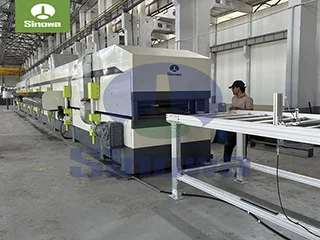
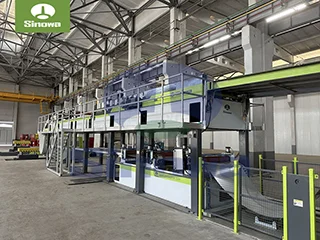
sandwich panel machine
The structure of insulation board production machinery is a systematic combination of functional modules, each responsible for a specific link in the production process, and the coordination between modules directly determines the stability and efficiency of the entire production line. Generally, the basic structural components include a raw material processing system, molding system, curing system, cutting system, and auxiliary systems, with variations based on the production technology of different insulation materials. The raw material processing system is the starting point of production, mainly composed of mixers, dryers, and metering devices. Mixers are used to uniformly blend raw materials with additives such as foaming agents, binders, and flame retardants, ensuring the consistency of the material properties; dryers remove excess moisture from raw materials to prevent defects such as bubbles and cracks in the finished products; metering devices accurately control the proportion of each component, which is critical for maintaining the mechanical and thermal insulation performance of insulation boards. For example, in the production of polystyrene insulation boards, the raw material processing system also includes a pre-foaming unit that initially expands the polystyrene beads under steam action, laying the foundation for subsequent molding.
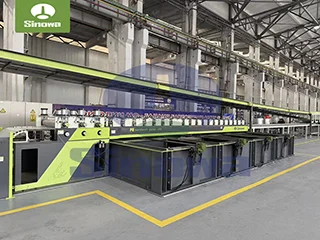
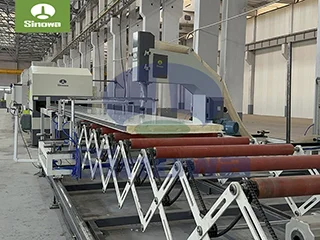
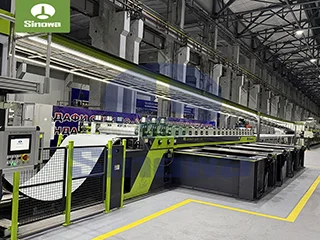
The molding system is the core part of the machinery, responsible for shaping the processed raw materials into the desired board shape and size. The structure of this system varies significantly depending on the molding process. For extrusion molding, common in extruded polystyrene (XPS) and rubber-plastic insulation board production, the molding system includes an extruder (usually a twin-screw extruder), a die, and a calibration table. The extruder melts, mixes, and conveys the raw materials under high temperature and pressure; the die determines the width and basic thickness of the board; the calibration table with vacuum cooling function cools and shapes the molten material, ensuring precise control of board thickness, flatness, and surface finish. For lamination molding, used in polyurethane (PU) sandwich panel production, the molding system consists of uncoilers, panel forming machines, foaming platforms, and double-track presses. Uncoilers unfold and connect metal panel coils; panel forming machines press metal panels into the required wave shape or board type; foaming platforms inject mixed PU materials between the upper and lower panels for foaming; double-track presses control board thickness and density while promoting curing to ensure flatness. For mineral wool insulation board production, the molding system includes fiber-forming equipment, cotton collectors, and pendulum machines: fiber-forming equipment converts molten raw materials into fibers, cotton collectors gather fibers to form primary felt, and pendulum machines make fibers distribute crosswise in multiple layers to improve product strength and reduce delamination.
The curing system is used to stabilize the structure of the molded semi-finished products, enhancing their mechanical strength and thermal insulation performance. The structure of this system depends on the material's curing characteristics. For thermosetting materials such as PU, phenolic resin, and mineral wool, the curing system mainly includes curing furnaces and cooling sections. Curing furnaces heat semi-finished products at a specific temperature to promote the curing reaction of binders or resin materials; cooling sections cool the cured products to room temperature to avoid deformation. For EPS insulation boards, the curing system includes aging silos and drying rooms: aging silos stabilize and dry pre-foamed beads to an appropriate molding state, while drying rooms remove excess moisture from the formed boards to stabilize dimensions. The cutting system is responsible for cutting the continuous finished products or semi-finished products into the required specifications, consisting of edge trimmers, transverse cutting machines, and longitudinal cutting machines. Edge trimmers cut off excess foam or fibers on both sides of the board; transverse cutting machines (such as flying saws or synchronous saws) cut the board to the set length; longitudinal cutting machines adjust the board width. For complex shape processing, computer-controlled contour cutting machines or wire cutting machines are also used, especially for EPS board processing.
Auxiliary systems are indispensable for ensuring the smooth operation of the production line and improving product quality, including dust removal systems, waste gas treatment systems, recycling systems, and electrical control systems. Dust removal systems collect dust generated during raw material processing and cutting to protect the environment and operator health; waste gas treatment systems purify harmful gases produced during foaming and curing to meet environmental protection requirements; recycling systems process leftover materials (such as XPS and EPS edge trims) into reusable raw materials, reducing waste; electrical control systems integrate sensors, controllers, and operation panels to realize automatic control and monitoring of the entire production line, enabling parameter adjustment (such as temperature, pressure, and production speed) and fault alarm, improving production automation and reducing human error.
The performance of insulation board production machinery directly affects production efficiency, product quality, and operational stability, with core performance indicators including production efficiency, precision control, stability, energy efficiency, and environmental friendliness. Production efficiency refers to the output of the machinery per unit time, which is determined by the speed of each process module and their coordination. High-efficiency production lines can achieve continuous operation, significantly increasing output—for example, advanced continuous PU sandwich panel production lines can reach a production capacity of thousands of square meters per hour, while traditional manual or semi-automatic equipment has much lower efficiency, suitable for small-batch production. Precision control is reflected in the accuracy of board thickness, size, density, and surface finish. With the development of automation technology, modern production machinery adopts computer numerical control (CNC) systems, laser positioning, and pressure sensors to achieve precise control of key parameters. For example, the thickness control accuracy of high-precision calibration tables can reach within ±0.1mm, ensuring consistent product specifications; density control systems adjust foaming agent dosage and pressure in real time to maintain stable product density, which is crucial for thermal insulation performance.
Stability is an important indicator of long-term operation of the machinery, related to the service life of components, the rationality of structural design, and the reliability of the control system. High-stability machinery has fewer failures during long-term continuous operation, reducing maintenance costs and production downtime. This is achieved through the use of high-wear-resistant materials for key components (such as extruder screws and die heads), optimized structural design to reduce vibration, and reliable electrical control systems to avoid misoperation. Energy efficiency is increasingly valued under the background of global energy conservation and emission reduction, referring to the energy consumption per unit output. Advanced machinery adopts energy-saving technologies such as variable-frequency motors, heat recovery systems, and efficient heating elements: variable-frequency motors adjust speed according to production load to reduce idle energy consumption; heat recovery systems recycle waste heat from curing furnaces and extruders for preheating raw materials or heating production workshops; efficient heating elements improve heat utilization rate, reducing overall energy consumption. Environmental friendliness is reflected in the reduction of waste gas, dust, and noise pollution. Dust removal systems and waste gas treatment systems ensure that emissions meet environmental standards; low-noise motors and sound insulation covers reduce noise pollution, creating a safe and environmentally friendly production environment.
The types of insulation board production machinery are mainly classified according to the type of insulation material produced, as different materials require distinct production processes and equipment structures. The most common types include machinery for polystyrene insulation boards, polyurethane insulation boards, mineral wool insulation boards, phenolic insulation boards, and rubber-plastic insulation boards. Polystyrene insulation board production machinery is divided into two categories: EPS (expanded polystyrene) and XPS (extruded polystyrene) production equipment. EPS production equipment includes pre-foaming machines, aging silos, board forming machines, drying rooms, and cutting machines. The production process involves pre-foaming EPS beads, aging, molding, drying, and cutting to form finished boards, which are widely used in building exterior insulation and interior decoration due to their lightweight and good thermal insulation performance. XPS production equipment is mainly an extrusion production line, including raw material processing systems, twin-screw extruders, foaming agent injection systems, dies, calibration tables, traction machines, and cutting machines. XPS boards produced by this equipment have high density, good compression resistance, and water resistance, suitable for floor insulation, roof insulation, and cold storage insulation.
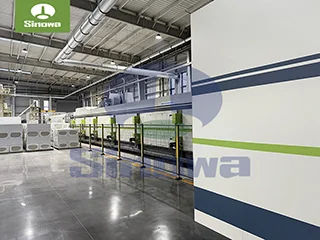
Polyurethane insulation board production machinery is mainly used to produce PU sandwich panels, including continuous and intermittent production lines. Continuous production lines integrate uncoiling, panel forming, foaming, curing, cutting, and stacking into one, suitable for large-batch production; intermittent production lines are suitable for small-batch or customized production. The core equipment includes high-pressure PU foaming machines, metering systems, foaming platforms, double-track presses, and automatic stacking machines. PU sandwich panels have excellent thermal insulation, sound insulation, and fire resistance, widely used in industrial workshops, cold storage, and high-rise building exterior walls. Mineral wool insulation board production machinery, also known as rock wool production lines, includes melting furnaces (cupolas or electric furnaces), fiber-forming equipment (four-roll centrifuges), cotton collectors, pendulum machines, curing furnaces, and cutting machines. The production process involves melting basalt, slag, and other raw materials at high temperature, forming fibers, adding binders and water repellents, collecting fibers to form felt, curing, and cutting. Mineral wool insulation boards have excellent fire resistance, heat insulation, and sound absorption, suitable for high-temperature industrial pipelines, building exterior walls, and fire partitions.
Phenolic insulation board production machinery is similar to PU sandwich panel production lines, including continuous lamination production lines and compression molding foaming production lines. Continuous lamination production lines inject phenolic resin mixtures between panels for foaming and curing, while compression molding production lines inject mixed materials into molds for hot-press curing and molding, then cut into finished products. Phenolic insulation boards have excellent fire resistance and low smoke emission, suitable for high-temperature and fire-prone environments such as chemical plants and tunnels. Rubber-plastic insulation board production machinery is an extrusion foaming production line, including internal mixers/open mixers, extruders, foaming agent injection systems, dies, shaping and cooling devices, and traction machines. Internal mixers/open mixers knead raw materials; extruders melt and convey materials; foaming agent injection systems inject foaming agents at high pressure; shaping and cooling devices stabilize the board shape. Rubber-plastic insulation boards have good flexibility, water resistance, and corrosion resistance, suitable for pipeline insulation in refrigeration equipment, air conditioning systems, and marine engineering.
In addition to classification by product material, insulation board production machinery can also be divided into manual, semi-automatic, and fully automatic types according to automation level. Manual machinery requires a lot of manual operation in raw material feeding, molding, and cutting, with low efficiency and poor product consistency, suitable for small-scale workshops or trial production. Semi-automatic machinery automates key processes such as molding and cutting, while retaining manual operation for auxiliary processes such as raw material feeding and product stacking, balancing efficiency and cost, suitable for medium-batch production. Fully automatic machinery integrates all processes from raw material feeding to product packaging into automatic operation, controlled by CNC systems, with high production efficiency, good product consistency, and low labor intensity, suitable for large-scale industrial production. With the development of intelligent technology, some advanced fully automatic production lines also integrate Internet of Things (IoT) technology, realizing remote monitoring, parameter adjustment, and fault diagnosis, further improving production management efficiency.
The application of insulation board production machinery is closely linked to the application fields of insulation boards, covering construction, industrial, cold chain, and other industries, and its development is driven by the increasing demand for energy conservation and environmental protection. In the construction industry, which is the largest application field, insulation board production machinery is used to produce exterior wall insulation boards, roof insulation boards, floor insulation boards, and interior partition boards. These insulation boards reduce building energy consumption by blocking heat transfer, improving indoor thermal comfort, and meeting the requirements of green building standards. For example, EPS and XPS insulation boards are widely used in residential and commercial building exterior insulation due to their lightweight, low thermal conductivity, and easy construction; PU sandwich panels are used in prefabricated buildings due to their high strength and good thermal insulation, accelerating construction progress; mineral wool insulation boards are used in high-rise buildings and public buildings due to their fire resistance, ensuring building safety. In addition, insulation boards produced by related machinery are also used in building sound insulation, such as interior partition boards and ceiling boards, reducing noise pollution.
In the industrial field, insulation board production machinery serves the insulation needs of industrial equipment, pipelines, and workshops. High-temperature industrial pipelines (such as chemical, power, and metallurgical pipelines) require insulation boards with good high-temperature resistance, and mineral wool and ceramic fiber insulation boards produced by specialized machinery are widely used to reduce heat loss and improve energy utilization. Low-temperature industrial equipment (such as refrigeration equipment and cryogenic storage tanks) use PU and rubber-plastic insulation boards to maintain low temperatures and reduce energy consumption of refrigeration systems. Industrial workshops, especially those with high temperature or noise, use insulation boards for wall and roof insulation and sound absorption, improving the working environment of operators. In addition, insulation boards are also used in industrial kilns and thermal insulation layers of power equipment, playing a role in energy conservation and equipment protection.
The cold chain logistics industry is another important application field of insulation board production machinery. With the development of the cold chain industry, the demand for insulation equipment such as cold storage, refrigerated vehicles, and insulated containers is increasing, and these equipment rely on high-performance insulation boards for heat preservation. PU and XPS insulation boards produced by professional machinery are widely used in cold storage walls, roofs, and door panels due to their low thermal conductivity and good water resistance, ensuring stable low-temperature environments in cold storage and reducing energy consumption of refrigeration systems. Refrigerated vehicles use lightweight and high-strength insulation boards (such as PU sandwich panels) to reduce vehicle weight while ensuring insulation effect, extending the transportation distance of perishable goods. Insulated containers use insulation boards with good corrosion resistance and impact resistance to adapt to long-distance transportation and harsh environmental conditions, ensuring the quality of refrigerated goods.
Other application fields include agricultural greenhouses, marine engineering, and aerospace. Agricultural greenhouses use insulation boards to maintain indoor temperature, extend the planting cycle, and improve crop yield and quality; EPS and PU insulation boards are commonly used due to their lightweight and good thermal insulation. Marine engineering requires insulation boards with good corrosion resistance and water resistance to adapt to the marine environment, and rubber-plastic and PU insulation boards are used in ship pipelines, cabins, and other parts for insulation and corrosion protection. The aerospace industry has high requirements for insulation materials, requiring lightweight, high-temperature resistance, and low thermal conductivity, and specialized insulation board production machinery is used to produce high-performance insulation boards for aircraft cabins and equipment insulation.
The development trend of insulation board production machinery is closely related to technological progress, environmental protection policies, and market demand. In terms of automation and intelligence, machinery will further integrate IoT, big data, and artificial intelligence technologies, realizing more precise parameter control, intelligent fault prediction, and automated production scheduling, improving production efficiency and product quality. In terms of energy conservation and environmental protection, machinery will adopt more efficient energy-saving technologies to reduce energy consumption, and optimize waste gas and waste treatment systems to meet stricter environmental protection standards; at the same time, machinery for producing environmentally friendly insulation materials (such as bio-based foam materials and recycled material insulation boards) will be developed to promote the green development of the industry. In terms of versatility, multi-functional machinery that can produce multiple types of insulation boards or adjust product specifications flexibly will be more popular, helping enterprises reduce equipment investment and adapt to diversified market demands. In terms of precision, with the improvement of market requirements for insulation board quality, machinery will further improve size and performance control accuracy, meeting the application needs of high-end fields.
In conclusion, insulation board production machinery is a key equipment in the insulation material industry, with its structure, performance, and types adapting to different production materials and application scenarios. From raw material processing to product forming, each structural module works together to ensure production efficiency and product quality; core performance indicators such as precision, stability, and energy efficiency determine the application scope and market competitiveness of the machinery; diverse types meet the production needs of different insulation materials, while wide applications cover construction, industrial, cold chain, and other fields. With the deepening of global energy conservation and environmental protection concepts and the continuous progress of technology, insulation board production machinery will develop towards more intelligent, energy-saving, and versatile directions, providing strong support for the sustainable development of the insulation material industry and the promotion of green energy conservation projects.
https://www.cnsinowa.com/sandwich-panel-machines/insulation-board-production-machinery.html