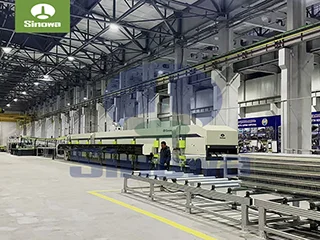
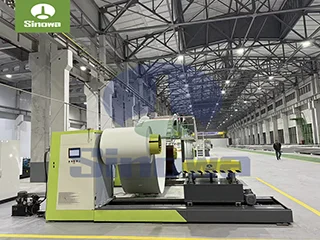
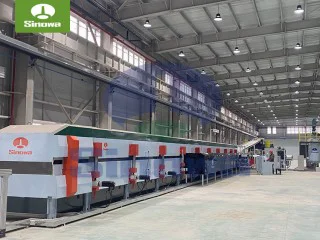
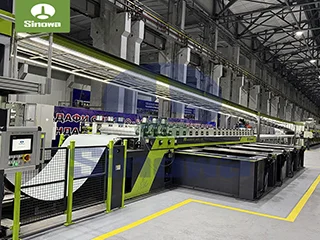
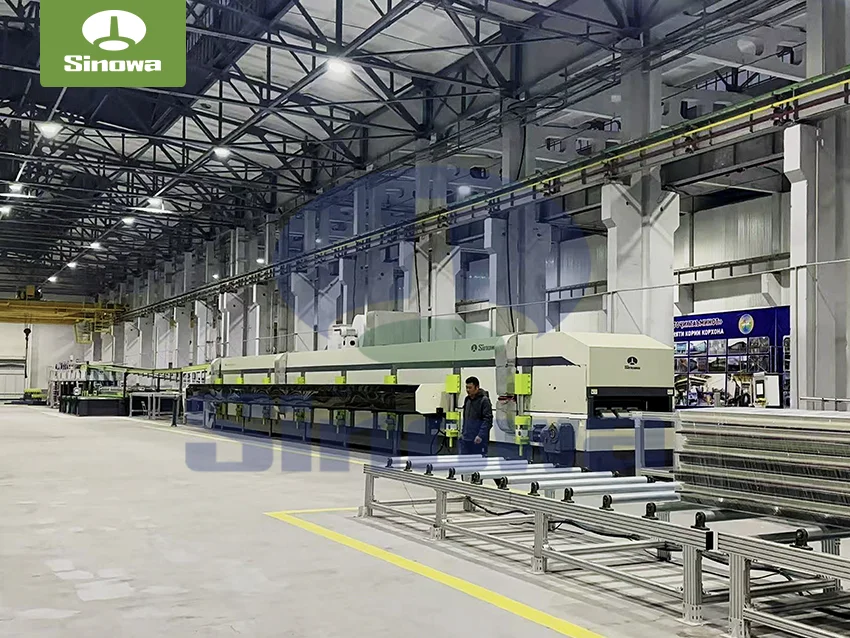
 sandwich panel line
At the core of this PU sandwich panel production line lies the integrated automatic thickness adjustment system, a mechatronic module that integrates real-time detection, data analysis, and dynamic parameter correction. Unlike traditional production equipment that adopts fixed mechanical spacing for panel forming, the automatic thickness adjustment structure abandons cumbersome manual calibration and outdated hydraulic positioning modes, relying on high-precision servo drive mechanisms and intelligent data control units to realize stepless and real-time spacing adjustment of the upper and lower forming platforms. The entire adjustment process is based on real-time dimensional data collected by high-sensitivity detection components installed at key forming stations, which continuously monitor the gap between the double-belt conveyor and forming roller sets during panel production. Once minor deviations between the actual forming thickness and the preset standard range are detected, the system immediately generates adjustment instructions, driving the servo lifting structure to fine-tune the operating spacing of the forming components without interrupting the continuous production workflow.
The working logic of the automatic thickness adjustment system follows a closed-loop control mechanism that covers the entire panel forming process. Before formal production starts, operators only need to input the target thickness parameters of the required PU sandwich panels through the central control platform, and the system will automatically complete the initial positioning and self-calibration of all forming structures within a short period. This pre-production automatic calibration effectively eliminates systematic errors caused by mechanical vibration, equipment temperature variation, and component wear during long-term operation, laying a foundation for high-precision batch production. During continuous operation, the detection system performs full-cycle scanning and data recording of panel thickness, capturing subtle dimensional changes that are difficult to identify with manual inspection. These real-time data are transmitted to the central processing unit for rapid comparison and analysis, and any offset from the set tolerance range will trigger micro-adjustment actions instantly. The whole correction process is highly responsive and does not require human intervention, ensuring that every section of the continuously produced panel maintains consistent thickness dimensions.
The integration of automatic thickness adjustment technology optimizes the entire production flow of PU sandwich panels, covering raw material unwinding, surface layer forming, PU foaming and filling, composite pressing, fixed-length cutting, and final shaping. In the raw material preparation stage, the unwinding system steadily conveys upper and lower surface materials of uniform flatness to the forming area, providing a stable base for subsequent thickness control. When the mixed polyurethane raw materials are evenly injected between the two surface layers, the double-belt conveyor system works in tandem with the automatic thickness adjustment module to maintain a constant forming gap. The precise spacing control ensures that the PU foam expands and fills the entire composite space evenly during the curing process, avoiding common quality defects such as local hollowing, uneven core material density, and inconsistent surface flatness that often occur in traditional production. Uniform foam filling and stable thickness dimensions further optimize the structural compactness and thermal insulation performance of finished panels, enabling the products to maintain stable physical properties in complex application environments.
One of the most prominent practical values of the automatic thickness adjustment function is the significant improvement in production flexibility and batch conversion efficiency. In traditional production modes, switching between panel thickness specifications requires manual shutdown, mechanical loosening, spacing measurement, and repeated calibration, a process that consumes a large amount of production time and often leads to unstable product quality in the initial stage of production restart. With the intelligent adjustment system, the polyurethane sandwich panel production line can complete parameter switching and precision resetting through one-click parameter input, realizing rapid conversion between different thickness specifications. This capability enables manufacturers to respond quickly to diversified order demands, switching production between thin decorative insulation panels for building exterior walls, medium-thickness enclosure panels for industrial plants, and thick thermal insulation panels for cold storage facilities without large-scale equipment debugging or production downtime. The greatly shortened specification conversion cycle effectively improves the overall equipment operation rate and production flexibility, helping production enterprises adapt to the personalized and small-batch diversified order trends in the modern composite material market.
In terms of production quality control, the automatic thickness adjustment system achieves unprecedented dimensional accuracy and batch consistency for PU sandwich panels. Manual adjustment and fixed mechanical forming are inevitably affected by human operation errors and mechanical fatigue, resulting in thickness deviations of finished products that fluctuate within a large range, leading to inconsistent structural strength and thermal insulation performance of different panel batches. The intelligent closed-loop adjustment system eliminates human interference factors entirely, relying on digital precision control to lock the panel forming dimensions within an extremely accurate tolerance range. The real-time dynamic correction function can also offset the impact of subtle mechanical deformation and temperature changes during long-term continuous operation, ensuring that the dimensional accuracy of products remains stable during long-hour batch production. Uniform panel thickness not only enhances the overall aesthetic consistency of finished products but also optimizes the assembly matching degree in on-site construction, reducing the trimming and modification work required during installation and improving the overall construction efficiency of engineering projects.
This advanced PU sandwich panel line also brings significant improvements in production cost control and raw material utilization efficiency. Unstable thickness control in traditional production often leads to excessive material consumption in partial panels or unqualified products due to insufficient thickness, resulting in raw material waste and increased production costs. The precise automatic thickness adjustment ensures that each panel is produced in strict accordance with the target dimensional standard, avoiding material waste caused by over-thick forming and reducing the generation of defective products caused by dimensional deviation. Meanwhile, the stable forming state optimizes the foaming ratio and curing effect of polyurethane materials, enabling the PU core material to give full play to its excellent thermal insulation, shock resistance, and bonding performance under the optimal thickness state. The improvement of product qualification rate and raw material utilization rate effectively reduces the unit production cost of products, improving the economic benefits of production operations while reducing resource waste, which conforms to the energy-saving and efficient development trend of modern manufacturing industry.
In terms of sandwich panel equipment operation and maintenance, the automatic thickness adjustment structure adopts a non-hydraulic servo driving design, which avoids common problems such as hydraulic oil leakage, pipeline aging, and frequent component maintenance existing in traditional hydraulic adjustment systems. The simplified mechanical structure and intelligent control mode reduce the daily maintenance workload of the equipment, lower the failure rate of the thickness control module during long-term operation, and extend the stable service cycle of the polyurethane sandwich panel line. The central control platform is equipped with a data self-diagnosis function, which can monitor the operating state of the thickness adjustment system in real time, record operating parameters and subtle abnormal data, and provide early warning of potential equipment faults. This intelligent monitoring method enables maintenance personnel to accurately grasp the equipment operating status, carry out targeted maintenance and debugging work, avoid sudden equipment shutdown failures, and further improve the stability and continuity of production operations.
The technical advantages of the PU sandwich panel machine with automatic thickness adjustment are fully reflected in the wide adaptability of product applications. The adjustable thickness range covers almost all mainstream specifications of civilian and industrial composite insulation panels, and the produced panels can be widely used in modular prefabricated buildings, large industrial factory enclosures, low-temperature cold storage and logistics warehouses, agricultural constant-temperature greenhouses, and special environmental insulation projects. Panels with stable and accurate thickness maintain consistent thermal resistance and structural bearing capacity, ensuring reliable energy-saving insulation effects for building envelopes and stable structural performance for long-term use. In prefabricated construction projects with high requirements for component standardization, the high dimensional consistency of products provides a solid foundation for standardized assembly construction, promoting the standardized and industrialized development of modern green building materials.
With the continuous upgrading of the global green building and advanced manufacturing industry, the market demand for high-precision, high-consistency, and customizable composite insulation panels is constantly escalating, which puts forward higher requirements for the technical level of sandwich panel production equipment. The automatic thickness adjustment technology, as a key intelligent upgrade of continuous PU sandwich panel production line, solves the core pain points of traditional production in precision control, flexible production, and cost management. It not only improves the intrinsic quality and production efficiency of products but also endows the production line with stronger market adaptability and technical competitiveness. In the future, with the further integration of industrial internet and intelligent manufacturing technology, the automatic thickness adjustment system will develop toward more intelligent linkage and remote precise control, realizing synchronous optimization of multiple parameters such as thickness, density, and flatness in the production process, further promoting the technological upgrading and industrial iteration of the PU sandwich panel manufacturing industry.
https://www.cnsinowa.com/sandwich-panel-machines/pu-sandwich-panel-line-with-automatic-thickness-adjustment.html