 sandwich panel machine
The overall operation logic of the PU sandwich panel production line with an auto stacker is based on integrated mechanical, electrical, hydraulic, and pneumatic control technologies, realizing seamless connection of every production link without frequent manual intervention. The entire production workflow starts with the raw material feeding stage, where metal coil sheets for panel surfaces are steadily and continuously released through precision unwinding structures. These sheet materials undergo surface cleaning, leveling, and film covering treatment after unwinding, removing surface impurities and ensuring the flatness and cleanliness of the panel surface, which lays a solid foundation for subsequent firm bonding with PU foam layers. The precision leveling structure effectively eliminates the bending and deformation of metal coils caused by long-term storage and transportation, ensuring that the surface sheets of each batch of panels maintain consistent flatness and dimensional accuracy.
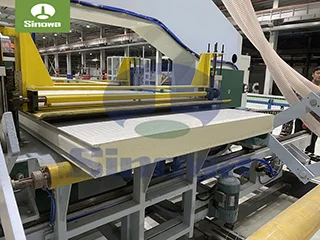
After surface pretreatment, the metal sheets enter the roll forming system, where multi-group precision forming rollers carry out gradual cold bending molding according to preset panel specification parameters. Whether it is flat wall panels or corrugated roof panels, the equipment can complete precise molding through parameter adjustment, realizing flexible production of diversified panel styles. The roll forming process adopts segmented pressure control to avoid excessive extrusion damage to metal sheets or insufficient molding accuracy caused by uneven pressure, ensuring that the edge dimensions, groove shapes, and overall flatness of molded panels remain highly unified in long-term continuous production. This stable molding performance fundamentally avoids the batch difference problems that are prone to occur in traditional manual-assisted molding processes.
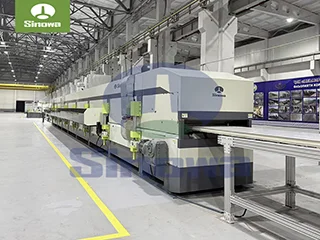
The foaming and compounding stage is the core link that determines the core performance of PU sandwich panels, and the automated production system realizes highly precise control of the entire foaming reaction process. The polyurethane raw materials are accurately proportioned and evenly sprayed between the upper and lower metal sheets through a high-precision dispensing system. The polyurethane sandwich panel production line adopts dynamic flow regulation technology to adjust the raw material output according to different panel thickness and density requirements, ensuring that the PU foam fills the entire gap between the surface sheets uniformly and without dead angles. In the closed double-belt curing system, the foaming raw materials complete expansion, curing, and bonding reactions under constant temperature and stable pressure environments. The precise temperature and pressure control system maintains the best reaction conditions for polyurethane foaming, enabling the foam layer to form a fine and uniform cellular structure, which endows the finished panels with stable thermal insulation performance and excellent overall structural strength. The firm composite integration between the foam core layer and metal surface sheets also effectively avoids delamination, cracking, and other quality defects in subsequent use.
After the completion of curing and compounding, the continuous integrated panel enters the automatic cutting stage. The high-precision cutting system adopts real-time positioning and tracking technology, which can automatically identify the production length and complete fixed-length cutting according to preset parameter settings. The cutting process is stable and efficient, with smooth and neat cutting sections, no burrs or edge warping, and no damage to the surface coating and internal foam structure of the panel. More importantly, the cutting system can realize stepless switching of cutting specifications during continuous operation without stopping the polyurethane sandwich panel line, which greatly improves the flexibility of production arrangement and meets the mixed production needs of multiple specifications in a single production batch. The optimized cutting path design also minimizes material loss in the cutting process, effectively improving the comprehensive material utilization rate of production.
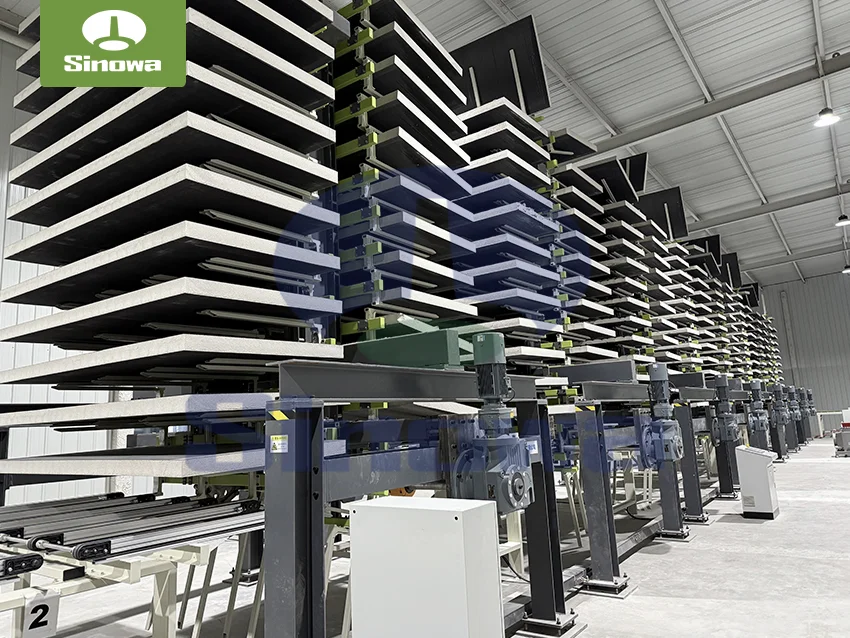
As the key terminal automation module of the entire PU sandwich panel line, the automatic stacker system undertakes the finishing work of finished panel collection, arrangement, and stacking, and is the core module that distinguishes high-end fully automatic production lines from traditional semi-automatic equipment. After the cut finished panels are transported to the stacking station through the conveying platform, the auto stacker quickly and accurately completes panel picking, positioning, and stacking through stable mechanical transmission and intelligent sensing systems. The stacker is equipped with flexible protection structures to avoid scratch, extrusion, and impact damage to the panel surface and edges during the stacking process, fully protecting the appearance integrity and structural performance of finished products. For different types of panels such as flat panels and corrugated panels, the stacker can automatically adjust the stacking mode and spacing, realizing orderly cross stacking or flat stacking according to product characteristics, which is convenient for subsequent packaging, transportation, and warehouse storage.
The integration of the automatic stacker fundamentally solves the various pain points of traditional manual stacking operations. In the traditional production mode, stacking work requires a large number of workers to be on duty for a long time, which not only leads to high labor costs but also makes it difficult to ensure the uniformity of stacking arrangement. Manual stacking is easily affected by human factors such as operational proficiency and working state, resulting in messy stacking, inconsistent batch height, and occasional panel damage caused by improper handling. In addition, manual stacking efficiency is limited and cannot match the high-speed continuous production rhythm of the front-end production process, which easily causes panel accumulation at the terminal of the production line, restricts the overall production speed, and even affects the continuity of the entire production operation. The automatic stacker operates stably and continuously according to fixed procedures, with consistent stacking accuracy and efficiency, completely eliminating the uncertainty caused by manual operations, and enabling the production rhythm of the entire line to reach a fully balanced and efficient state.
In terms of overall equipment performance, the polyurethane sandwich panel machine with an auto stacker adopts a high-strength integrated steel frame structure, which has good shock resistance and load-bearing capacity, and can maintain stable operating performance under long-term high-load continuous production conditions. All key transmission and operating components are optimized for wear resistance and durability, reducing equipment wear and failure rates in long-term operation, and extending the overall service life of the equipment. The supporting intelligent control system adopts an intuitive touch-screen operation interface, integrating parameter setting, operation monitoring, fault diagnosis, and data statistics functions. Operators can complete the switching of production specifications, adjustment of operating parameters, and real-time monitoring of production status through simple operations, and the equipment can automatically identify and alarm common abnormal conditions, realizing efficient and convenient production management.
The highly automated design of the sandwich panel production equipment brings significant comprehensive benefits to panel manufacturing enterprises in actual production and operation. In terms of production efficiency, the full-process unmanned operation from feeding to stacking realizes non-stop continuous production, greatly improving the hourly output and daily production capacity of the production line. Compared with semi-automatic production lines that require manual cooperation in multiple links, the overall production efficiency is significantly improved, which can quickly respond to large-scale order demands and shorten the production cycle of bulk orders. In terms of product quality control, the whole production process is completed by mechanical and intelligent precise control, eliminating product quality differences caused by manual operation errors. The unified production parameters and stable operation process ensure that the thickness, density, bonding strength, and dimensional accuracy of each panel in the batch remain highly consistent, effectively improving the overall qualification rate of products and enhancing the market competitiveness of products.
In terms of production cost control, the equipment greatly reduces the number of on-site operators required for production, realizing the optimization of labor allocation and significantly reducing long-term labor costs for enterprises. At the same time, the precise raw material proportioning system and optimized cutting and stacking process reduce raw material waste and product damage rate, further reducing the comprehensive production cost. In addition, the stable and reliable operation performance of the sandwich panel machinery reduces the frequency of equipment failure and downtime maintenance, improves the effective operating rate of the production line, and avoids production delays and cost losses caused by equipment shutdown, bringing stable and sustainable economic benefits for manufacturing enterprises.
In terms of production safety and site management, the automated stacking system avoids the safety risks of manual handling and stacking of heavy panels, reducing the occurrence of on-site operation accidents. The orderly automatic stacking makes the finished product area of the production workshop neat and standardized, which is convenient for unified management of finished products, improves the overall cleanliness and orderliness of the production site, and lays a foundation for standardized and large-scale factory production. The continuous PU sandwich panel line is also designed with multiple safety protection mechanisms in the operation process, which can automatically stop operation and trigger alarm prompts in case of abnormal operation, ensuring the safety of equipment operation and on-site production.
The application scope of panels produced by this automated production line covers multiple high-demand fields in modern construction and industrial manufacturing. The stable thermal insulation and energy-saving performance of PU sandwich panels make them the preferred material for cold storage, constant-temperature workshops, and energy-saving building envelopes, which can effectively reduce building energy consumption and maintain indoor temperature stability. The excellent structural strength and weather resistance enable the panels to adapt to various complex building environments, suitable for industrial factory buildings, warehouse buildings, stadiums, and large public facility projects. At the same time, the standardized and consistent product quality brought by automated production also meets the strict material requirements of high-end architectural projects and special industrial projects, providing reliable material support for the construction industry's upgrading of energy-saving and high-quality development.
In terms of equipment maintenance and daily operation, the modular design of the PU sandwich panel manufacturing machine with an auto stacker makes daily maintenance and fault inspection more convenient. Each functional module is relatively independent, which is convenient for targeted inspection, maintenance, and replacement of worn parts, reducing the difficulty and time cost of equipment maintenance. The intelligent system can record the equipment operation data in real time, summarize the operation status and wear rules of key components, help enterprises formulate scientific and reasonable maintenance plans, realize preventive maintenance of equipment, and avoid equipment failure caused by long-term neglect of maintenance. The simple and easy-to-learn operation mode also reduces the training cost of enterprise operators, and workers can master the core operation and daily maintenance skills in a short time, realizing efficient docking of equipment and production teams.
With the continuous upgrading of the construction industry's energy-saving standards and industrial manufacturing's intelligent production requirements, the market demand for automated and high-efficiency sandwich panel production equipment is constantly increasing. The PU sandwich panel machine equipped with an automatic stacker perfectly adapts to the development trend of industrial production automation, intelligence, and high efficiency. It not only solves the efficiency bottleneck and quality instability problems of traditional production equipment but also helps panel manufacturing enterprises realize standardized, large-scale, and refined production. In the future, with the continuous optimization of mechanical structure and intelligent control technology, such automated production equipment will further improve production accuracy and operational flexibility, adapt to more diversified and personalized panel production needs, and continue to empower the high-quality development of the modern building materials industry.
https://www.cnsinowa.com/sandwich-panel-machines/pu-sandwich-panel-machine-with-auto-stacker.html