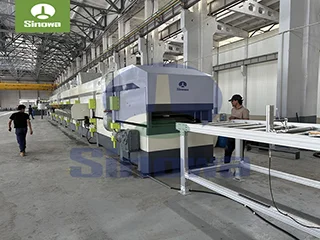
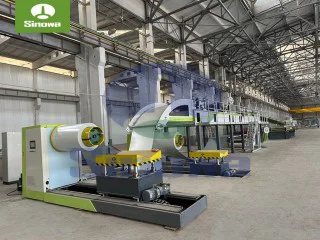
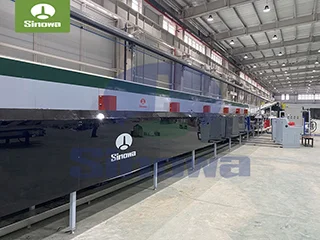
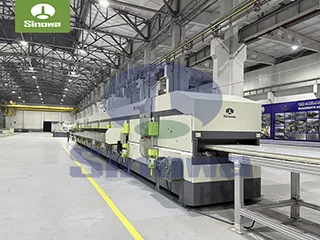
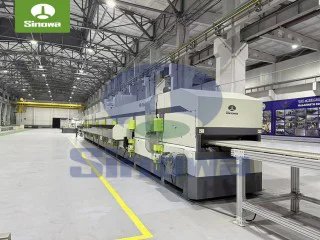
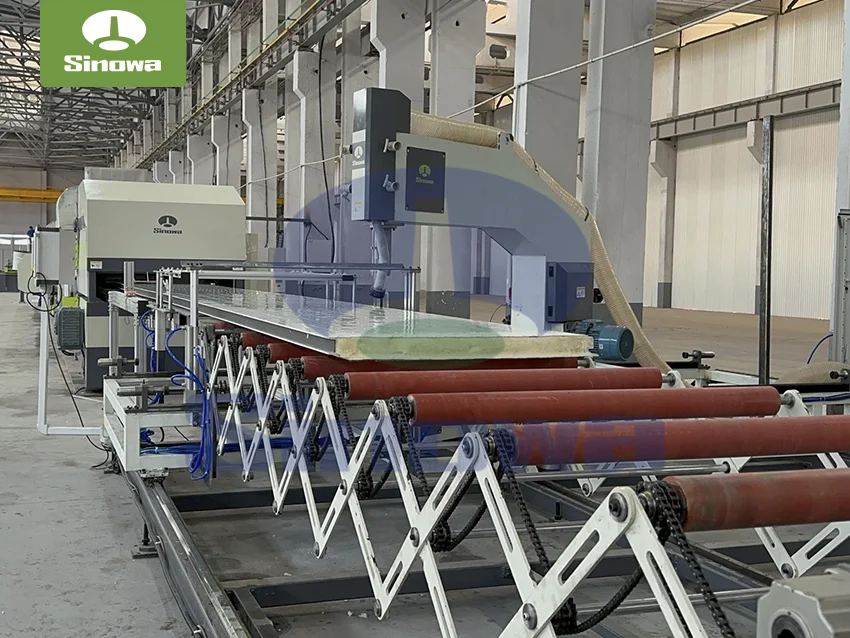
 sandwich panel line
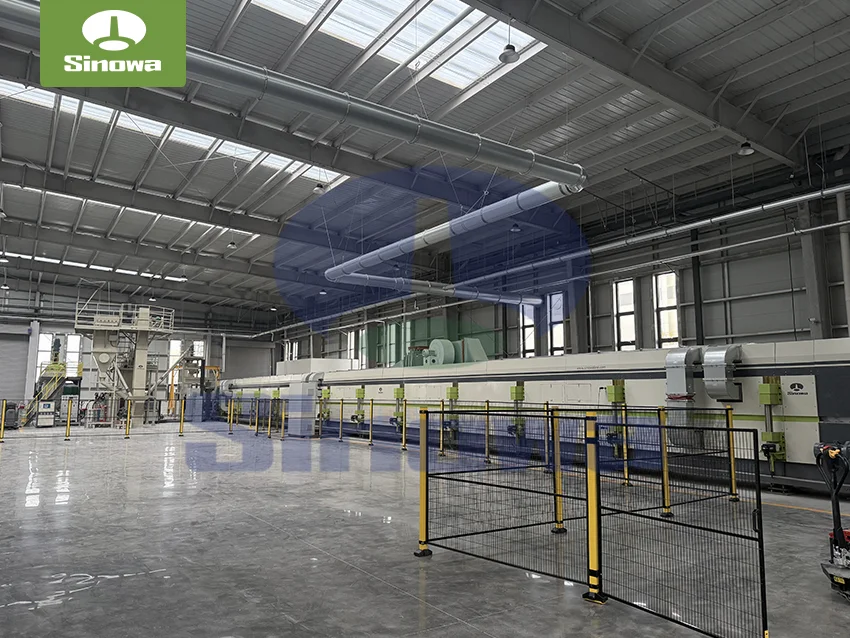
The foundational operational logic of the industrial PU sandwich panel production line lies in the organic combination of rigid metal outer panels and high-performance polyurethane foam core materials. Metal sheets, as the outer protective and structural layer of the sandwich panel, provide mechanical strength, impact resistance and surface flatness, while the closed-cell PU foam core undertakes thermal insulation, sound absorption and shock buffering functions. The automated production process perfectly bonds the two materials into an integrated composite structure, overcoming the defects of poor overall adhesion, uneven core density and inconsistent structural size that are common in traditional manual and semi-automatic production modes. For mass production scenarios, this integrated molding mode fundamentally optimizes production stability, enabling the production line to maintain long-term continuous operation without frequent shutdowns for parameter adjustment or equipment debugging, which is crucial for improving overall production capacity and reducing unit production costs.
The front-end processing module of the polyurethane sandwich panel production line is the key to ensuring the surface quality and subsequent bonding performance of raw materials. Before formal molding, all metal coil raw materials need to go through complete pretreatment procedures, including surface cleaning, oil stain removal, dust elimination and flatness correction. In high-volume production, tiny impurities or uneven flatness on the metal sheet surface will lead to insufficient bonding between the metal layer and PU foam, resulting in product delamination, local hollowing and reduced service life. The industrial-grade pretreatment system adopts continuous rolling and cleaning structures, which can efficiently remove all kinds of surface contaminants in the fast-moving state of metal coils, and complete precise leveling and trimming of sheet edges to ensure consistent width and flatness of each raw material sheet entering the molding process. This standardized pretreatment process eliminates individual differences in raw material processing, laying a unified foundation for large-scale batch production and ensuring that the basic specifications of raw materials remain consistent throughout long-term production cycles.
Following the pretreatment stage is the precision roll forming process, which shapes flat metal coils into various required panel profiles through multi-station rolling groups. Industrial mass production-oriented roll forming units are equipped with dense forming stations and intelligent tension control systems, which can maintain stable rolling speed and pressure during high-speed operation. The system can adapt to metal sheets of different conventional thicknesses and widths, realizing one-time continuous molding of various groove and rib structures on the panel surface. The built-in synchronous calibration function can automatically fine-tune the rolling gap and pressure in real time according to the operating state, avoiding dimensional deviation caused by equipment vibration or material tension fluctuation during long-hour continuous operation. This real-time precision control capability ensures that the structural size, surface radian and groove position of each molded metal panel remain highly consistent, effectively reducing the defective rate of finished products in mass production and improving the overall yield of the production line.
The foam mixing and pouring module is the core functional unit that determines the insulation performance and structural stability of PU sandwich panels, and it is also the most critical link reflecting the industrial production level. The system adopts high-pressure dynamic mixing technology to fully blend polyol and isocyanate, the two core raw materials of PU foam, with auxiliary foaming agents and stabilizers in accurate proportions. In mass production, the precise proportional control of raw materials is extremely important; slight proportion errors will lead to fluctuations in foam density, resulting in inconsistent thermal insulation performance and structural hardness of different panels. The industrial-grade mixing and pouring system is equipped with independent raw material metering and conveying devices, which can realize constant-pressure and constant-flow raw material supply, and complete instantaneous uniform mixing through high-speed rotating mixing heads. The mixed foam material is evenly poured between the upper and lower metal panels through distributed pouring ports, forming a continuous and uniform foam layer without local accumulation or voids.
Different from intermittent pouring of small equipment, the continuous pouring mode of industrial polyurethane sandwich panel line matches the linear operating speed of the entire production line, realizing synchronous advancement of sheet conveying and foam molding. The foam material completes rapid foaming and filling in the closed cavity formed by the upper and lower metal panels, and closely fits with the metal inner surface under stable pressure, forming an integrated composite structure after curing. The closed-cell structure formed by precise foaming control endows the sandwich panel with excellent low thermal conductivity, effectively blocking heat transfer and achieving efficient thermal insulation effect. At the same time, the uniform foam density distribution ensures that the overall mechanical bearing capacity and compression resistance of the panel are balanced, avoiding local stress concentration and structural damage in the service process, which greatly improves the durability and application reliability of mass-produced panels.
The continuous lamination and constant-temperature curing process further optimizes the bonding strength and structural stability of the composite panel. After foam pouring, the semi-finished panel enters the multi-layer lamination pressing unit, which applies uniform and stable pressing force to the panel through flexible roller sets. The lamination system maintains consistent pressing pressure and spacing throughout the operation process, ensuring that the thickness of each panel is uniform and the bonding interface between metal and foam is completely compact. Equipped with an intelligent constant-temperature curing system, the production line can adjust the curing temperature and heating area according to the production speed and material characteristics, providing a stable temperature environment for foam curing and adhesive cross-linking reaction. Sufficient and constant-temperature curing enables the PU foam to complete structural stabilization and tight bonding with the metal layer in the shortest cycle, avoiding quality problems such as incomplete curing, insufficient bonding strength and easy peeling caused by rapid production in high-speed operation.
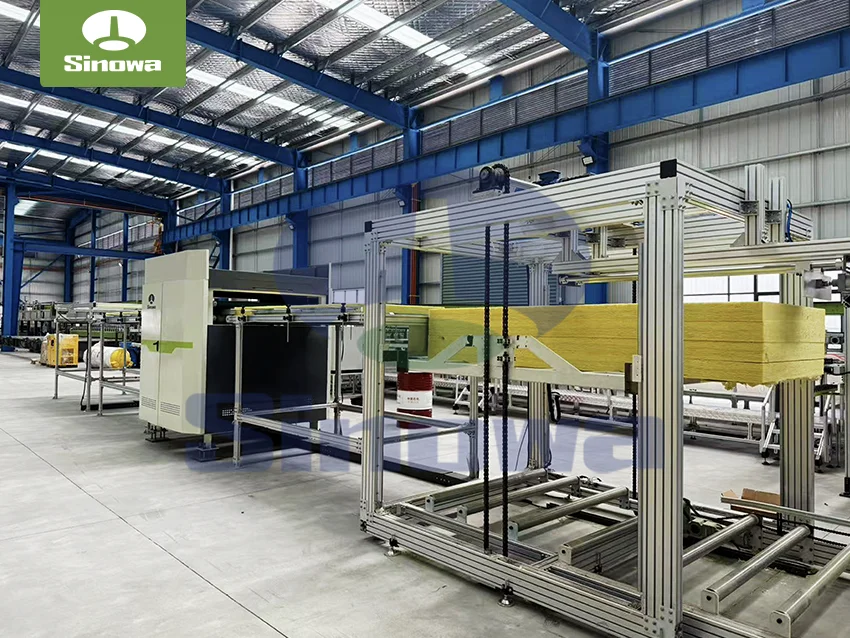
The rear-end fixed-length cutting and automatic sorting system realizes the final sizing and finished product sorting of mass-produced panels. The high-precision tracking cutting device can automatically identify the panel operating position and complete fixed-length cutting in synchronous motion with the production line, without stopping or reducing speed during the cutting process, ensuring the continuity of production. The cutting tool maintains high flatness and sharpness for a long time, ensuring smooth and burr-free panel cuts, avoiding secondary trimming procedures, and greatly improving production efficiency. The cut finished panels are automatically conveyed to the sorting platform through the roller table system, and the intelligent sensing device completes preliminary quality screening and classification of panel size, flatness and surface quality, realizing automatic stacking and discharging of qualified products. The whole process eliminates manual measurement and cutting errors, ensures the unified specification of batch products, and greatly reduces labor investment and human error risks in the production link.
The outstanding advantages of industrial-grade PU sandwich panel line in mass production are mainly reflected in production efficiency, quality stability and operational economy. In terms of production efficiency, the fully continuous automated production mode enables the equipment to operate stably for a long time, with no frequent shutdown intervals in the production process, and the single-line continuous output capacity far exceeds that of semi-automatic and small batch production equipment. The streamlined process connection from raw material input to finished product output realizes zero waiting in each link, greatly shortens the single-panel production cycle, and can efficiently respond to large-order centralized production demands. For manufacturing enterprises, this efficient continuous production mode can effectively shorten the order delivery cycle, improve market response capability, and support large-scale batch order production tasks.
In terms of quality control, the full-process automated parameter control replaces manual operation experience, realizing digital and standardized management of all production links including raw material proportioning, foaming pressure, curing temperature, lamination pressure and cutting size. All production parameters are kept constant during mass production, avoiding product quality fluctuations caused by manual operation differences, equipment parameter drift and process adjustment errors. The uniformly formed PU foam core has stable density and closed-cell rate, and the overall bonding performance and structural strength of the panel are consistent, making the batch-produced panels have unified thermal insulation, sound insulation and mechanical properties. This high-quality consistency is essential for large-scale engineering applications, as it ensures the overall performance uniformity and construction standardization of building enclosure structures, cold storage insulation systems and industrial facility walls.
In terms of operational economy, industrial mass production lines realize high-efficiency utilization of raw materials. The precise metering and pouring system can accurately control the consumption of PU raw materials, avoiding raw material waste caused by excessive pouring in traditional production. The continuous molding process reduces the generation of defective products and leftover materials, improving the comprehensive utilization rate of metal coils and foam raw materials. At the same time, the high degree of automation reduces the demand for on-site operating personnel, realizing centralized control of the entire production line by a small number of staff, greatly reducing labor costs in long-term continuous production. In addition, the stable operating performance of industrial-grade equipment reduces equipment failure rates and maintenance frequency, lowers downtime loss and maintenance costs, and further optimizes the unit production cost of finished panels, bringing significant economic benefits for large-scale standardized production.
In terms of equipment adaptability, modern industrial PU sandwich panel machine has flexible production adjustment capabilities on the premise of meeting mass production. The system can quickly switch production parameters through the control terminal, adapt to the production of panels with different thicknesses, widths and surface profiles, and can meet the diversified product demands of different application scenarios while ensuring large-scale output. Whether it is thin-wall decorative insulation panels for civil buildings, thick high-insulation panels for cold storage and logistics warehouses, or high-strength structural insulation panels for industrial factory buildings, the production line can complete standardized mass production through parameter adjustment. This flexible and efficient production characteristic makes the equipment widely applicable in multiple fields such as construction engineering, cold chain logistics, industrial manufacturing and commercial facility construction.
The structural design of the polyurethane sandwich panel machine fully considers the durability and stability of long-term industrial operation. The main frame and transmission components are made of high-strength structural materials, which can withstand long-term high-load continuous operation without structural deformation or performance attenuation. The transmission system adopts synchronous driving technology to ensure the synchronization of the operating speed of each module of the entire production line, avoid process dislocation and product quality problems caused by speed difference. The equipment is equipped with perfect operation monitoring and fault early warning functions, which can monitor the operating state of each key component in real time, and feed back abnormal parameters in time to realize pre-maintenance and fault avoidance. This reliable industrial-grade design ensures that the equipment can maintain stable operation for a long time in high-intensity mass production environments, reduce production interruption caused by equipment faults, and ensure the continuity and stability of production tasks.
With the continuous upgrading of the building materials industry and the continuous improvement of market requirements for energy-saving and environmental protection building components, the application demand for high-performance PU sandwich panels in industrial and civil fields is increasing year by year. As the core equipment for mass production of such panels, industrial-grade continuous PU sandwich panel line is promoting the standardized and large-scale development of the sandwich panel industry with their high efficiency, stability and intelligence. The continuous optimized production process not only improves the comprehensive performance of finished panels, making them have better thermal insulation, energy saving, weather resistance and structural stability, but also realizes low-cost and high-quality batch manufacturing, providing reliable product support for energy-saving transformation of buildings and construction of high-standard industrial facilities.
In the future, with the further development of automated manufacturing and intelligent production technology, industrial PU sandwich panel production line will develop towards higher intelligence, higher efficiency and more energy-saving operation. The continuous innovation of production technology and process control technology will further improve the precision of product molding and the utilization rate of raw materials, reduce energy consumption in the production process, and realize more green and efficient mass production. As an important supporting equipment in the field of new building materials, industrial-grade PU sandwich panel making lines will continue to play a key role in promoting the iterative upgrading of the building materials industry and meeting the growing market demand for high-performance insulation composite panels.
https://www.cnsinowa.com/sandwich-panel-machines/industrial-grade-pu-sandwich-panel-making-line-for-mass-production.html