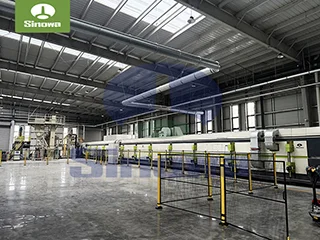
sandwich panel line
The initial stage of the production process focuses on precise feeding and pre-forming of surface materials, which lays a solid foundation for subsequent composite molding and accurate cutting. The PU sandwich panel production line is equipped with automatic unwinding units that continuously release coiled metal sheets or other decorative surface materials. These surface materials are first sent to the surface cleaning and film covering mechanism to remove surface dust and impurities, while attaching protective films to prevent surface scratches and oxidation during subsequent processing. After surface pretreatment, the materials enter the roll forming system with multi-group forming stations, which gradually bends and presses the flat coiled materials into standardized panel profiles through orderly arranged forming rollers. The roll forming process is precisely calibrated in terms of roller spacing, pressing depth and operating speed, ensuring that the surface plates maintain uniform thickness, smooth lines and consistent structural dimensions, avoiding uneven deformation that may affect the later cutting effect. Before formal compounding, the pre-heating unit raises the temperature of the upper and lower surface plates to a stable range, which effectively enhances the bonding activity between the surface material and the PU foam core, improving the overall structural compactness of the composite panel.
The core composite molding process of PU sandwich panels relies on a high-pressure foaming and continuous compounding system, which is the key to forming the integrated insulation structure of the panels. The PU foaming system stores and proportionally mixes two core chemical raw materials through sealed storage tanks and precision metering pumps. The two liquid components are transported to the dynamic mixing chamber at a fixed and accurate ratio, where they undergo full stirring and uniform mixing to initiate a stable foaming reaction. The mixed foaming liquid is continuously and evenly injected into the gap between the pre-formed upper and lower surface plates. As the surface plates move forward with the conveyor system, the foaming liquid gradually expands, fills the entire composite cavity, and completes bonding with the inner surface of the plates. Subsequently, the semi-finished panels enter the double-belt constant temperature curing system, where constant temperature and slight pressure environment is maintained to ensure that the PU foam fully cures and forms a dense and uniform porous insulation structure. This continuous curing process eliminates internal bubbles and hollow gaps, greatly improving the thermal insulation performance, compressive strength and structural stability of the finished panels. The operating speed of the curing system is dynamically matched with the foaming and feeding speed to ensure that each section of the panel completes sufficient curing reaction and achieves optimal structural state before entering the cutting process.
As the core terminal unit of the PU sandwich panel line, the hydraulic cutting machine undertakes the fixed-length cutting and shaping of continuously cured sandwich panels, and its operating performance directly determines the qualification rate and finished product quality of panel products. Different from traditional saw-type cutting equipment that produces burrs, dust and uneven notches, the hydraulic cutting system adopts a hydraulic-driven blade pressing and cutting structure, which relies on stable hydraulic power to complete instantaneous and smooth cutting of integral composite panels. The cutting system is equipped with a high-precision length detection and automatic positioning module, which can set arbitrary cutting length parameters according to production requirements. In the continuous production state, the detection unit tracks the conveying speed and moving distance of the panel in real time, and transmits accurate data to the hydraulic control system. When the panel reaches the preset length, the system automatically triggers the cutting action without stopping the overall sandwich panel production line, realizing dynamic flying cutting and effectively improving continuous production efficiency.
The structural design and working principle of the hydraulic cutting machine endow it with unique advantages in adapting to PU sandwich panel processing characteristics. The hydraulic power system adopts a closed-loop pressure regulation structure, which can maintain stable cutting pressure during long-term continuous operation, avoiding cutting defects such as incomplete cutting, inclined sections and panel deformation caused by insufficient or fluctuating power. For sandwich panels with different thicknesses and surface material hardness, the hydraulic system can automatically adjust the output pressure and cutting stroke to adapt to diversified production specifications. The cutting blade is made of high-strength wear-resistant materials, with precise edge processing, which can keep the cutting surface flat and smooth after long-term high-frequency use, without secondary trimming. At the same time, the hydraulic cutting mechanism is equipped with a stable pressing and fixing device. Before cutting, the pressing structure tightly fixes the front and rear sections of the panel to prevent displacement or vibration during the cutting process, further ensuring the flatness and dimensional accuracy of the cutting section.
The cooperative operation of the hydraulic cutting system and other functional units of the production line realizes the high-precision and high-efficiency full-process manufacturing of PU sandwich panels. After the composite cured panel enters the cutting station stably, the photoelectric sensing device of the cutting system quickly identifies the panel position and feeds back real-time signals to the central control system. The hydraulic cylinder drives the cutting tool to move vertically at a constant speed, completing the cutting operation in a short time. The whole cutting process is stable and efficient, with no impact on the continuous conveying of the front-end foaming and compounding process. After cutting, the finished panels are transported to the cooling and sorting station through the rear conveyor system. The residual temperature on the surface of the newly cut panels is gradually dissipated through the circulating cooling device, which avoids structural deformation caused by rapid temperature change and further stabilizes the physical properties of the panels. The cooled panels are automatically sorted and stacked by the stacking device, with neat placement and consistent spacing, which is convenient for subsequent packaging, transportation and storage.
In terms of production performance and product quality control, the integration of hydraulic cutting equipment greatly optimizes the comprehensive performance of the polyurethane sandwich panel production line. In terms of dimensional accuracy, the hydraulic fixed-length cutting mode effectively controls the length error of finished panels within a tiny range, ensuring that the dimensional parameters of each batch of products are highly consistent and meeting the precise assembly requirements of engineering construction. In terms of product appearance, the hydraulic extrusion cutting mode avoids the sawtooth edges, metal burrs and foam debris generated by traditional mechanical cutting, and the cutting section is smooth and neat, which improves the overall appearance grade of the panels and eliminates the need for manual trimming procedures, saving production labor costs. In terms of production stability, the hydraulic system has strong anti-interference ability, can adapt to long-term uninterrupted industrial operation, and is less affected by external temperature and load changes, maintaining consistent cutting accuracy and operating efficiency in different production environments.
The structural optimization of the hydraulic cutting system also brings significant improvements in production energy consumption and operational safety. The modern hydraulic cutting mechanism adopts energy-saving hydraulic loop design, which can automatically adjust power output according to the actual cutting load, avoid invalid energy consumption in idle operation, and effectively reduce the overall energy consumption of the polyurethane sandwich panel line. At the same time, the system is equipped with perfect safety protection devices, including overload protection, position limit protection and emergency stop response functions. When abnormal conditions such as excessive cutting load and equipment position deviation occur, the system will automatically trigger the protection mechanism to stop the action and avoid equipment damage and production safety accidents. The fully enclosed cutting structure also reduces the scattering of foam debris and metal dust generated during production, improving the cleanliness of the production environment and realizing green and clean production.
PU sandwich panels produced by production lines equipped with hydraulic cutting machines have excellent comprehensive performance and are widely used in industrial plant construction, cold storage insulation, commercial building enclosure, temporary building facilities and other fields. The precise cutting process ensures that the panels have good assembly matching, which can realize rapid splicing and installation on the construction site, greatly improving the construction efficiency of enclosure and insulation projects. The smooth and flat cutting section ensures the tightness of panel assembly, effectively avoiding air leakage and heat loss at the splicing gap, and giving full play to the excellent thermal insulation and energy-saving performance of PU foam core materials. In addition, the stable cutting quality ensures the overall structural uniformity of the panels, enabling the products to maintain stable mechanical strength and insulation effect in long-term use, and improving the service life and application reliability of the products.
With the continuous upgrading of building material manufacturing technology and the gradual improvement of market requirements for panel precision and production efficiency, the PU sandwich panel machine equipped with hydraulic cutting technology has become the mainstream development trend of the industry. Compared with traditional production lines, the integrated equipment integrates feeding, forming, foaming, curing, hydraulic cutting and stacking functions, realizing a high degree of automation and integration of the production process. The efficient and stable hydraulic cutting system solves many pain points in traditional panel production, such as low cutting accuracy, poor product consistency and low production efficiency. In actual industrial production, this type of production line can adapt to the processing and production of multiple specifications of PU sandwich panels, with strong production flexibility, which can meet the personalized and diversified production needs of different application scenarios.
In conclusion, the hydraulic cutting machine is an indispensable core component of the modern high-performance continuous PU sandwich panel line. Its stable hydraulic power output, precise fixed-length cutting function and efficient continuous operation mode comprehensively improve the production level of PU sandwich panels in terms of dimensional accuracy, appearance quality, production efficiency and operational stability. The perfect coordination between the hydraulic cutting system and the front-end foaming composite and curing process realizes the seamless connection of the whole production process, creating high-quality sandwich panel products with uniform structure, stable performance and high assembly accuracy. With the continuous progress of mechanical automation and hydraulic control technology, the performance of PU sandwich panel production lines with hydraulic cutting systems will be further optimized, providing more reliable technical support for the high-quality development of the building insulation material industry and meeting the increasingly stringent application requirements of modern construction engineering.
https://www.cnsinowa.com/sandwich-panel-machines/pu-sandwich-panel-line-with-hydraulic-cutting-machine.html