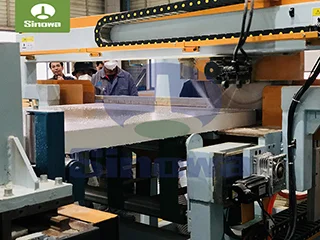
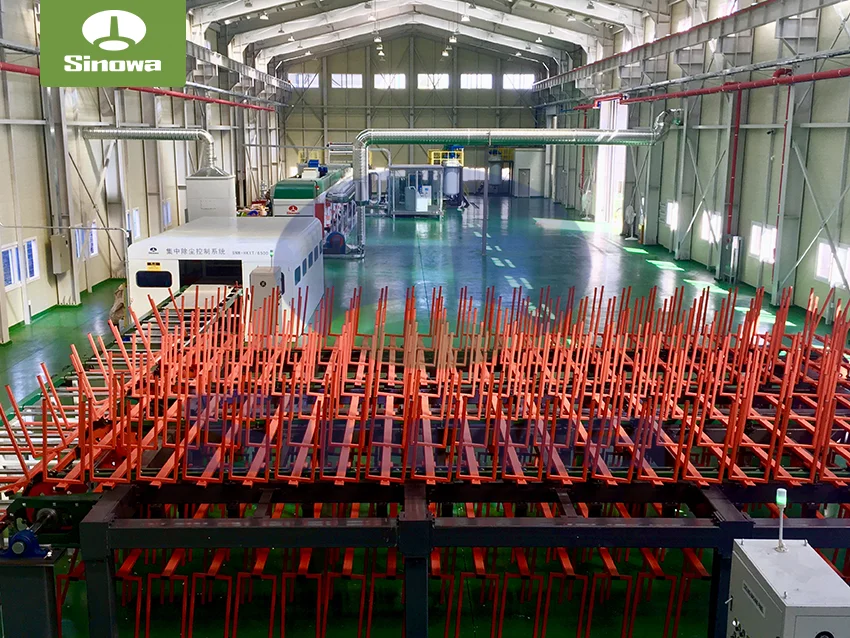
 sandwich panel line
The entire production workflow starts with the feeding and pretreatment of surface facing materials, a foundational stage that directly determines the overall bonding quality and dimensional stability of finished phenolic core panels. The sandwich panel line is equipped with synchronized unwinding and leveling units that handle continuous coil feeding of various surface substrates, including metal sheets and composite flat sheets. During operation, the coiled raw materials are steadily released at a controllable constant speed, eliminating material wrinkles, edge warping, and internal stress through multi-stage leveling treatment. To achieve reliable adhesion between the surface substrate and phenolic core material, the system incorporates comprehensive surface pretreatment processes, covering surface cleaning, degreasing, and uniform preheating. These procedures remove dust, oil stains, and oxide layers on the material surface, while raising the substrate temperature to a stable range that matches the subsequent phenolic foaming and bonding process. This pretreatment mechanism effectively avoids incomplete bonding, hollow layers, or peeling issues that often occur due to uneven surface conditions, laying a solid foundation for the long-term structural integrity of composite panels.
Following surface material pretreatment, the production process enters the core material preparation and precise mixing stage, the most critical link that differentiates phenolic core panel production from ordinary PU sandwich panel manufacturing. Phenolic foam raw materials require strict proportional control of polyol components, curing agents, foaming additives, and auxiliary surfactants, as the chemical reaction rate and foaming expansion ratio of phenolic materials are far more sensitive to ratio changes and environmental temperature than conventional polyurethane materials. The phenolic panel production line adopts high-precision metering and circulating mixing systems to ensure uniform fusion of all raw material components, avoiding local concentration deviations that may cause inconsistent foam density or incomplete curing. The fully enclosed mixing structure prevents external air impurities from mixing into the raw materials, effectively reducing bubble defects and density fluctuations in the phenolic core layer. Meanwhile, the system maintains constant temperature and pressure during the mixing process, stabilizing the viscosity and activity of the phenolic mixed solution to ensure consistent foaming performance in subsequent continuous production.
The continuous pouring and in-line foaming process constitutes the core functional stage of the phenolic insulation board production line. The uniformly mixed phenolic raw material solution is evenly poured between the upper and lower pretreated surface substrates through a multi-point continuous pouring mechanism. The pouring speed and material output are dynamically synchronized with the running speed of the entire production line, ensuring uniform material distribution across the entire panel width and length. As the phenolic solution contacts the preheated surface substrates, it initiates a controllable foaming and expansion reaction. Different from free foaming in open environments, the production line adopts a closed constrained foaming structure, where the upper and lower conveyor belts of the laminating system apply stable and uniform limiting pressure to restrict excessive expansion of the phenolic foam. This constrained foaming mode enables the phenolic core layer to form a fine, uniform, and closed-cell structure, effectively enhancing the thermal insulation, sound insulation, and compressive resistance of the core material. The close integration between the foaming core layer and surface substrates is initially completed in this stage, forming a preliminary integrated composite structure.
Subsequently, the semi-finished panels enter the continuous lamination and constant-temperature curing system for structural shaping and performance stabilization. The long-span laminating unit of the polyurethane sandwich panel production line maintains consistent pressure and linear operating speed throughout the process, ensuring that the overall thickness of the sandwich panel remains uniform without local deviation. The internal heating system of the laminating section provides graded constant-temperature heating, adapting to the stepwise curing characteristics of phenolic foam. Phenolic core materials undergo preliminary gelation, intermediate curing, and final hardening in different temperature zones within the curing channel, realizing gradual and complete chemical cross-linking reactions. This segmented curing method avoids quality defects such as core layer cracking, brittle texture, or insufficient bonding force caused by rapid high-temperature curing. During the curing process, the micro-molecular structure of the phenolic foam is fully stabilized, forming a rigid three-dimensional network structure that endows the core layer with excellent fire resistance, low thermal conductivity, and dimensional stability. At the same time, the molecular bonding between the phenolic core and surface substrates is further strengthened, achieving integrated composite molding without gaps or detachment.
After completing curing and shaping, the continuous long-panel materials enter the post-processing stage, including edge trimming, fixed-length cutting, and surface finishing. The automated edge trimming device accurately cuts off the irregular foaming edges on both sides of the panel, ensuring consistent edge straightness and uniform width of the finished panel. The intelligent tracking and cutting system precisely controls the cutting length according to production settings, achieving high-precision fixed-length cutting for continuous panels. The cutting mechanism operates smoothly without generating burrs or edge deformation, maintaining the flatness and integrity of the panel section. In the subsequent finishing process, the system conducts preliminary surface inspection and fine trimming to remove residual debris and minor surface flaws generated during production, ensuring the appearance quality and dimensional accuracy of each finished panel. The entire post-processing process is highly automated, with coordinated operation of multiple processes to avoid secondary damage to the cured phenolic core layer and composite structure.
One of the most prominent advantages of the dedicated PU sandwich panel line for phenolic core panels is its excellent production stability and product consistency in continuous operation. The entire production process adopts integrated synchronous control, with all functional units including feeding, pretreatment, pouring, foaming, lamination, curing, and cutting operating in precise coordination. The system automatically adjusts operating parameters such as material metering ratio, line speed, curing temperature, and laminating pressure according to production conditions, effectively eliminating quality fluctuations caused by manual operation errors. For phenolic core materials that are sensitive to process parameters, this precise automated control mode ensures that key indicators such as core layer density, cell uniformity, bonding strength, and panel thickness remain stable in each batch of products. Compared with intermittent production equipment, the continuous production line significantly reduces material waste, improves material utilization efficiency, and realizes large-scale and standardized manufacturing of phenolic core sandwich panels.
In terms of production adaptability, this type of polyurethane sandwich panel line possesses flexible adjustment capabilities to meet the diversified production demands of phenolic core panels. By adjusting the operating parameters of the metering system and laminating unit, the line can produce phenolic core panels with different core layer thicknesses and foam densities, covering multiple application scenarios from lightweight insulation panels to high-strength load-bearing composite panels. The line is compatible with various surface substrate materials and different surface profiling requirements, enabling the production of flat panels and profiled panels with diverse structural specifications. Meanwhile, the modular structural design of the production line facilitates equipment debugging and process optimization. Production parameters can be quickly adjusted according to the formula changes of phenolic raw materials, adapting to the performance optimization and product upgrading of new phenolic composite materials, and maintaining long-term production compatibility and technical advancement.
In terms of operational performance and energy efficiency, the modern phenolic core PU sandwich panel machine is optimized for energy saving and consumption reduction. The closed circulating heating system reduces heat loss during the curing process, achieving efficient utilization of thermal energy. The precise metering and pouring system avoids excessive raw material input, reducing raw material waste and production costs. The low-resistance transmission structure of the conveyor and laminating units reduces mechanical energy consumption during operation. In addition, the fully enclosed production structure effectively controls the volatilization of auxiliary materials during the phenolic foaming reaction, improving the cleanliness of the production environment while ensuring the safety and stability of the production process. These optimized designs not only reduce the comprehensive operating cost of production but also make the manufacturing process more environmentally friendly and in line with the development trend of green building material production.
The finished phenolic core sandwich panels produced by this professional production line exhibit far superior comprehensive performance compared with ordinary polyurethane sandwich panels, relying on the precise control of each production link. The highly uniform closed-cell phenolic core layer provides ultra-low thermal conductivity, excellent thermal insulation effect, and outstanding high-temperature resistance. The unique chemical structure of phenolic foam endows the panels with excellent fire retardancy, smoke suppression, and high-temperature structural stability, avoiding melting and dripping under high-temperature conditions. Meanwhile, the integrated composite structure formed by professional lamination and curing process ensures high bonding strength between the core layer and surface substrates, enabling the panels to maintain stable structural performance under long-term external force and temperature change environments, with excellent aging resistance and weather resistance. These superior performances make phenolic core sandwich panels irreplaceable in high-standard building insulation, fireproof enclosure, and special industrial insulation fields.
With the continuous upgrading of the building energy conservation and fire safety industry, the market demand for high-performance phenolic core composite panels continues to grow, driving the continuous technical iteration of supporting PU sandwich panel production line. Modern production lines are evolving toward higher automation intelligence, more precise process control, and stronger production flexibility. Through real-time monitoring of production data such as foaming temperature, material ratio, line speed, and curing time, the system realizes intelligent early warning and automatic adjustment of production abnormalities, further improving production yield and product stability. The continuous optimization of the production process also enables phenolic core panels to achieve a more balanced performance in terms of lightweight, thermal insulation, fire resistance, and structural strength, providing more reliable material support for high-quality construction and industrial manufacturing.
In summary, the specialized polyurethane sandwich panel machine for phenolic core panels is a highly professional, efficient, and intelligent composite material manufacturing system tailored to the characteristics of phenolic foam materials. It realizes standardized, large-scale, and high-quality production of phenolic core sandwich panels through precise control of raw material processing, foaming reaction, lamination curing, and post-processing processes. Its unique process adaptation capability and stable production performance solve many quality and efficiency problems existing in the traditional production of phenolic composite panels. As a key core equipment in the field of high-performance building insulation materials, this production line plays a vital role in promoting the technical upgrading and market popularization of phenolic core sandwich panels, and provides solid technical support for the development of green, safe, and energy-saving building material industries.
https://www.cnsinowa.com/sandwich-panel-machines/pu-sandwich-panel-line-for-phenolic-core-panels.html