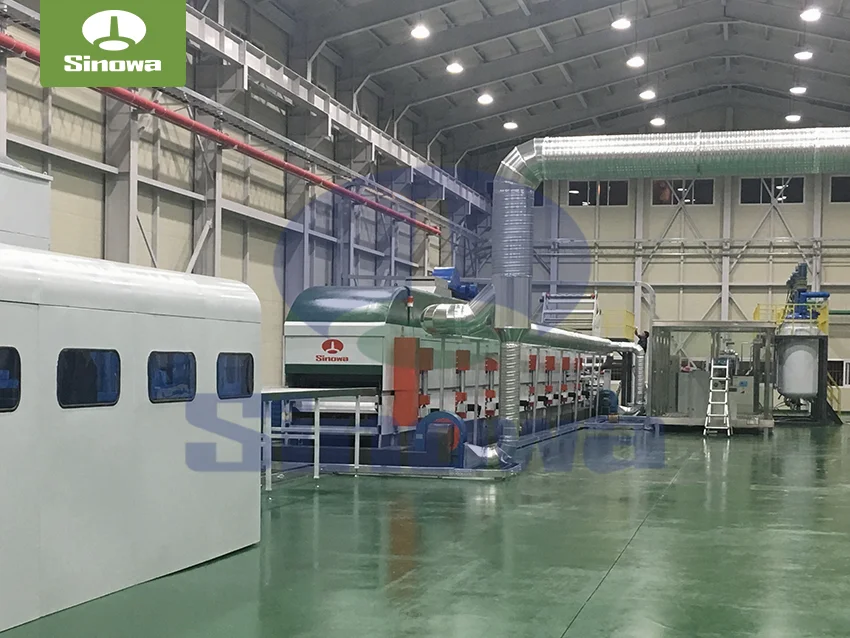
 sandwich panel line
The overall structural design of the roof phenolic insulation board production line adopts a modular integrated layout, with all functional units closely connected and operating in a collaborative linkage manner, covering the entire production process from raw material pretreatment to finished product stacking. The complete equipment system mainly includes raw material metering and conveying unit, high-speed mixing and foaming unit, continuous lamination and molding unit, gradient temperature curing unit, precision cutting and trimming unit, and automatic finishing and conveying unit. Each functional module is independently adjustable in process parameters while maintaining overall operational coordination, enabling the production line to adapt to different board thicknesses, densities, and structural specifications of roof phenolic insulation boards. The whole production process realizes continuous assembly line operation, which not only eliminates the efficiency bottlenecks of intermittent production modes but also ensures the consistency and uniformity of product performance in large-batch production, laying a solid foundation for the standardized application of roof insulation materials.
Raw material pretreatment and accurate proportioning are the primary links to determine the basic performance of phenolic insulation boards, and the sandwich panel production line is equipped with a high-precision raw material metering and conveying system to complete this core preparation work. The main raw materials involved in production include phenolic resin as the base material, foaming agents, surfactants, curing agents, and functional modifiers. Different from ordinary insulation board production, the raw material proportioning of roof-specific phenolic boards needs to focus on improving the material’s compression resistance and outdoor weather resistance, so the production line adopts independent metering and separate conveying design for different raw materials. Liquid raw materials are transported through sealed pipelines with constant-pressure pumping equipment, while powdered modifiers are delivered by quantitative spiral conveying devices, avoiding raw material stratification or proportion deviation caused by traditional mixed feeding methods. All metering links support micro-adjustment of parameters, realizing precise matching of raw material ratios according to different production formulas. Before formal mixing, the system will complete pre-stirring and homogenization of composite raw materials to fully fuse various functional additives with phenolic resin, eliminate tiny particle agglomerations, and ensure the stability and uniformity of the subsequent foaming reaction base, which is a key prerequisite for avoiding uneven cell structure and inconsistent performance of finished boards.
The high-speed mixing and dynamic foaming unit is the core functional section that shapes the porous structure of phenolic insulation boards and determines thermal insulation performance. The pretreated composite raw materials and curing agents are transported to the high-speed mixing head in strict proportion, where high-speed rotating rotor components drive instantaneous and uniform mixing of all materials. The mixing process is completed in a closed environment to avoid external air interference and impurity mixing, ensuring the stability of the chemical reaction environment. With the continuous injection of materials, the mixed raw materials undergo mild and controllable foaming reaction under set temperature and pressure conditions. Different from the rapid foaming mode of other foam materials, the phenolic foaming process adopted by the production line is slow and uniform, with the foaming speed and expansion range accurately regulated by linkage parameters of temperature, pressure, and material feeding speed. This precise control mode can form a dense and uniform closed-cell structure inside the material, which directly endows the roof insulation board with low thermal conductivity and high structural compactness. The closed-cell structure can effectively lock static air, block heat conduction and convection, and significantly improve the thermal insulation effect of the material. Meanwhile, the uniform cell distribution avoids local hollowing or loose structure, ensuring that the board can maintain stable thermal insulation performance and mechanical strength under long-term outdoor roof service conditions.
The continuous lamination and integrated molding unit is specially optimized for the structural characteristics of roof phenolic insulation boards, realizing composite molding of core foam material and surface protective layers. Roof insulation boards need to have good surface flatness and structural integrity to adapt to roof waterproofing and anti-pressure construction requirements, so the production line is equipped with a flexible unwinding and composite pressing system. The surface protective materials are continuously and stably unwound through the automatic unwinding device, with functions of deviation correction and tension adjustment to ensure flat and tight laying of surface materials without wrinkles or deviations. The uniformly foamed phenolic core material is evenly injected between the upper and lower surface layers, and then passes through the group of composite pressing rollers with adjustable spacing. The pressing system adopts segmented pressure control, with different pressure values set for different board thickness specifications, realizing seamless bonding between the core material and surface layers. The integrated molding process enables the surface layer and foam core to form an integrated structural whole, effectively improving the overall rigidity and anti-stripping performance of the board. This composite structure can resist external wind pressure, rainwater erosion, and construction extrusion in roof engineering, avoiding delamination and damage of the insulation board during long-term use, and greatly improving the service durability of the product.
The gradient temperature curing system is a key unit to realize resin cross-linking and finalize the performance of phenolic insulation boards, and it is also the most distinctive technical link of the roof phenolic board production line. Phenolic resin requires gradual and sufficient cross-linking reaction to form a stable three-dimensional network structure, and unreasonable curing temperature and speed will easily lead to incomplete reaction, surface cracking, or poor dimensional stability of the product. The sandwich panel line is equipped with an extended constant-temperature curing chamber with multi-stage gradient temperature control function, which divides the curing area into low-temperature pre-curing, medium-temperature cross-linking, and high-temperature shaping zones. After composite molding, the semi-finished boards enter the curing chamber and move forward synchronously with the conveyor system, completing staged temperature reaction in different temperature zones. The low-temperature pre-curing stage stabilizes the preliminary foaming structure to prevent thermal shock from high temperature from damaging the cell structure; the medium-temperature cross-linking stage promotes full polymerization and cross-linking of phenolic resin molecules to form a stable rigid structure; the high-temperature shaping stage eliminates internal stress of the material and fixes the overall dimensional accuracy of the board. The whole curing process is carried out under continuous and stable temperature conditions, avoiding the defects of uneven curing and inconsistent hardness caused by traditional single-temperature curing. After gradient curing, the phenolic board realizes complete chemical reaction, with significantly improved compressive strength, dimensional stability, and flame retardancy, fully meeting the long-term stable use requirements of roof building components.
The precision cutting and post-processing unit undertakes the final shaping and finishing work of finished products, ensuring that the dimensional accuracy and surface quality of the insulation boards meet engineering application standards. After being discharged from the curing system, the continuous board blanks have larger overall dimensions and irregular edges, so they need to be processed by professional cutting and trimming equipment. The sandwich panel machine is equipped with high-precision fixed-length cutting devices and edge trimming systems, which can automatically identify and calibrate the board position through intelligent positioning components. According to the preset specification parameters, the equipment completes fixed-length transverse cutting and longitudinal edge trimming, removing irregular edge materials to ensure that the length, width, and straightness of the finished boards meet unified standards. The cutting tool adopts high-hardness blades with smooth cutting tracks, which can ensure flat and neat cutting sections without burrs, cracks, or cell collapse. In addition, the post-processing unit is also equipped with surface finishing components, which can finely polish the board surface and cutting sections to eliminate tiny defects generated in the production process, further improving the flatness and appearance quality of the products. The whole post-processing process is automated and continuous, with high processing accuracy and stable efficiency, which can effectively reduce product dimensional errors and ensure the interchangeability and construction convenience of finished insulation boards in actual engineering applications.
In actual production operation, the roof phenolic panel production line realizes intelligent linkage control of the whole process, and all core process parameters can be dynamically adjusted according to production demands. The centralized control system monitors the operating status of each unit in real time, including raw material feeding speed, mixing rotating speed, foaming temperature, curing zone temperature, conveyor running speed, and cutting size parameters. When the production environment or formula parameters need to be adjusted, the system can realize synchronous parameter matching of each link, avoiding product performance fluctuations caused by single parameter change. The whole production process is highly automated, reducing manual intervention links, not only improving production efficiency but also effectively reducing product quality differences caused by human operation errors. Meanwhile, the production line is designed with a closed material circulation structure, which can collect and reuse a small amount of leftover materials generated in the cutting process, reducing material waste and realizing efficient utilization of production resources. The equipment runs stably with low vibration and low noise, meeting the environmental protection production requirements of modern industrial workshops.
The products manufactured by this professional insulation panel production line have comprehensive and superior performance advantages, which are highly compatible with the harsh service environment of building roofs. In terms of thermal insulation performance, the uniform closed-cell structure endows the product with extremely low thermal conductivity, which can effectively block indoor and outdoor heat transfer, reduce building heating and cooling energy consumption, and achieve remarkable energy-saving effects. In terms of fire safety, the fully cross-linked phenolic resin structure has good high-temperature resistance and non-combustible characteristics, without melting and dripping in high-temperature environments, and can effectively inhibit flame spread, providing reliable fire protection guarantees for building roofs. In terms of structural performance, the integrated composite structure and sufficient curing reaction make the board have high compressive strength and strong deformation resistance, which can resist the pressure of roof pavement and long-term wind and rain erosion, maintaining stable structural performance for a long time. In addition, the product has excellent weather resistance, low water absorption, and good anti-aging performance, and can adapt to extreme temperature changes and humid outdoor environments, avoiding performance attenuation caused by moisture absorption and aging, greatly extending the service life of roof insulation layers.
With the continuous improvement of building energy-saving standards and the increasing emphasis on building safety in the construction industry, high-performance roof phenolic insulation boards have broader market application prospects, and the technical level of supporting production lines is also constantly upgraded and optimized. Modern roof phenolic insulation board production line is developing towards higher automation, more precise parameter control, and more diversified product adaptation. By optimizing the foaming formula and curing process, the equipment can produce insulation boards with different densities and strengths to meet the differentiated needs of flat roofs, sloped roofs, and special-shaped building roofs. At the same time, the continuous improvement of intelligent control technology enables the production line to realize real-time monitoring and data analysis of product quality, trace production process parameters of each batch of products, and provide reliable technical support for product quality stability and subsequent process optimization. As a key equipment in the field of building energy-saving material manufacturing, the roof phenolic insulation board production line not only promotes the large-scale and standardized production of high-performance phenolic insulation materials but also provides solid technical and equipment support for the upgrading of modern building thermal insulation and fire safety systems, playing an important role in promoting the high-quality development of the construction industry and building energy conservation cause.
https://www.cnsinowa.com/sandwich-panel-machines/roof-phenolic-insulation-board-production-line.html






