 sandwich panel machine
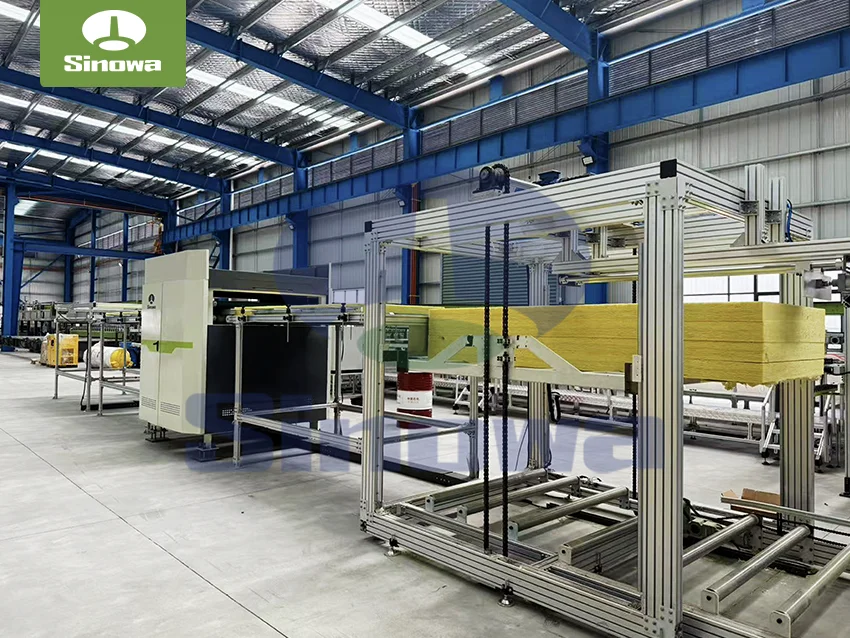
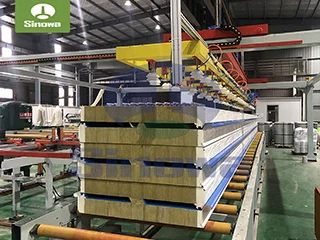
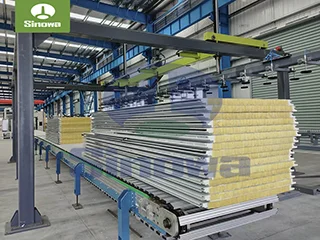
The overall structural design of the composite rock wool sandwich panel machine follows the concept of integrated modularization and synchronous linkage operation, and the whole production line is composed of multiple interconnected functional units with independent operation logic and synchronous coordination functions. The front-end raw material feeding unit is responsible for the automatic unwinding and leveling of metal surface materials, including coated steel plates and galvanized steel plates commonly used for building enclosure panels. This unit is equipped with precision leveling mechanisms to eliminate the bending and deformation stress of coiled materials during winding and storage, ensuring that the surface materials maintain flat and uniform structural performance in the subsequent forming and compounding processes. Meanwhile, the supporting core material feeding mechanism can realize continuous and orderly arrangement and conveying of rock wool strips, effectively avoiding the problems of material dislocation, gap residue and uneven thickness of rock wool core materials in the composite process, and laying a foundation for the overall structural uniformity of finished panels.
The adhesive coating and composite bonding unit is the core functional part that determines the bonding strength and service stability of rock wool composite panels. This unit adopts an automatic proportional adhesive spraying system, which can accurately control the mixing ratio and spraying dosage of composite adhesives through precision metering components. The uniform and fine adhesive layer formed by high-pressure spraying can fully cover the bonding surface between metal surface plates and rock wool core materials, avoiding local missing glue or excessive glue accumulation that may cause degumming and bulging of panels in later use. Different from ordinary bonding equipment, the composite system of this machine is optimized according to the physical characteristics of rock wool materials. Rock wool has porous and fibrous structural features, so the adhesive spraying process parameters are adjusted appropriately to ensure that the adhesive can moderately infiltrate the surface fiber structure of rock wool, form a mechanical anchoring effect, and significantly improve the bonding fastness between the core material and the surface layer. In the composite fitting stage, the equipment uses a flexible pre-pressing structure to realize preliminary fitting of materials, which can effectively correct the tiny position deviation of surface materials and core materials in the conveying process and ensure the alignment accuracy of the whole panel structure.
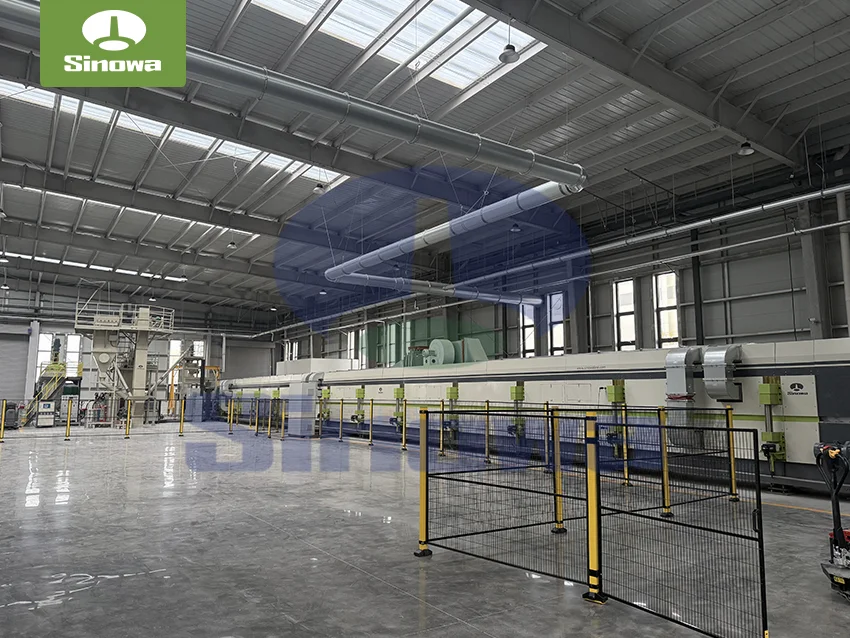
The constant-temperature pressing and curing unit is a key link to shape the structural strength and dimensional stability of composite panels. After preliminary composite fitting, the semi-finished panels enter the closed pressing and curing area, where stable pressure and constant-temperature heating environments are maintained. The matching design of the pressing and curing zone length and the production line operating speed ensures that each panel can obtain sufficient curing time in the equipment, so that the adhesive can complete the chemical curing reaction stably. This process can fully release the internal stress generated in the composite bonding process, eliminate the hidden danger of panel delamination and deformation caused by incomplete curing, and enable the finished panels to have stable structural strength and anti-peeling performance after leaving the equipment. The operating parameters of temperature and pressure in the curing process can be flexibly adjusted according to different adhesive types and rock wool core material densities, which can meet the production and processing requirements of composite panels with different specifications and performance grades, and realize the balance between production efficiency and product quality.
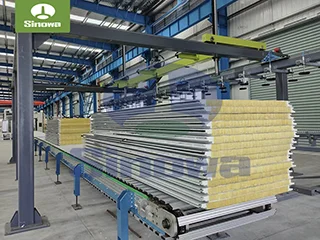
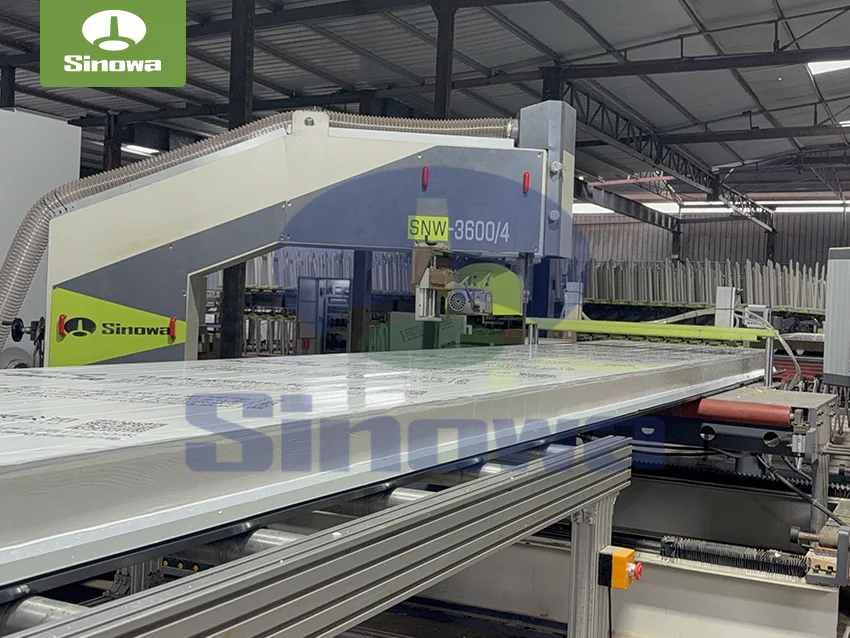
The post-processing and precision cutting unit undertakes the final shaping and finishing work of continuous composite panels. The long strip-shaped continuous panels formed by continuous compounding and curing are conveyed stably to the cutting station, and the intelligent flying saw cutting system conducts fixed-length cutting according to the preset dimensional parameters. The cutting mechanism has high positioning accuracy and fast response speed, which can complete instantaneous cutting in the continuous conveying state of panels, avoiding the size error and section deformation caused by traditional static cutting. At the same time, the equipment is equipped with a matched dust removal and cleaning device, which adopts a negative pressure suction structure to timely collect the rock wool debris and adhesive residues generated in the cutting process. This not only ensures the flatness and cleanliness of the panel cutting section and improves the appearance quality of finished products, but also maintains the cleanliness of the production environment, reduces material waste and meets the standardized production requirements of modern factories.
The whole rockwool sandwich panel production line is equipped with an intelligent linkage control system, which takes the programmable control module as the core to realize synchronous scheduling and automatic operation of all functional units. The system can uniformly coordinate the operating speed of feeding, forming, spraying, pressing, curing, cutting and other links, and automatically adjust the operating parameters of each unit according to the production rhythm, so as to avoid the production quality problems such as material accumulation, incomplete processing and inconsistent panel thickness caused by asynchronous operation of each link. In the actual production process, the control system can monitor the operating state of the equipment in real time, including operating temperature, working pressure, conveying speed and material feeding state. Once abnormal parameters or equipment faults are detected, the system will automatically trigger early warning and protection mechanisms, timely stop abnormal operation and lock the fault location, which greatly reduces the failure rate of the production line and the loss of defective products. The human-computer interaction interface is simple and intuitive, which is convenient for operators to set production parameters, adjust processing procedures and view production data, reducing the difficulty of equipment operation and manual intervention cost.
Compared with traditional manual and semi-automatic panel production modes, the composite rock wool sandwich panel production line has prominent technical and production advantages in terms of production efficiency, product quality consistency and production safety. In terms of production efficiency, the continuous assembly line operation mode completely breaks the processing limitation of single-panel discrete production. All links from raw material input to finished product output are completed in one continuous process, which greatly shortens the production cycle of a single panel and realizes large-scale and batch continuous production. In terms of product quality, the full-automatic mechanical processing mode avoids the quality fluctuation caused by manual operation differences. The precise control of adhesive dosage, bonding pressure, curing temperature and cutting size ensures that the thickness, bonding strength, dimensional accuracy and surface flatness of each batch of composite panels maintain a high consistency, effectively improving the overall qualification rate of products.
In terms of production safety and environmental protection, the equipment has carried out systematic optimization design. The fully closed processing structure reduces the overflow of dust and harmful substances in the production process, and the matched dust removal system realizes centralized collection and treatment of production waste, which conforms to the environmental protection production standards of modern manufacturing industry. The mechanical automatic feeding and composite processing replace manual high-intensity operation, reduce the safety risks of personnel contacting mechanical moving parts and dust pollution in the production process, and improve the overall safety level of the production workshop. In addition, the equipment has good structural stability and durability, the key load-bearing and operating components adopt optimized structural design and high-strength processing technology, which can adapt to long-term continuous high-load operation, reduce equipment wear and failure frequency, and lower the later maintenance and operation cost of the production line.
The composite rock wool panels produced by this professional equipment have excellent comprehensive performance, and thus are widely used in multiple fields of modern construction and industrial engineering. In the field of public building construction, the panels are applied to the enclosure structures of commercial buildings, office buildings and public service facilities, relying on the excellent fire resistance and thermal insulation performance of rock wool core materials, effectively improving the fire safety level and energy-saving effect of buildings. In the field of industrial plants and steel structure buildings, the lightweight and high-strength structural characteristics of rock wool composite panels can reduce the self-weight of building enclosure systems, shorten the construction cycle of steel structure projects, and meet the functional requirements of thermal insulation, heat preservation and fire prevention of industrial production workshops. In the fields of cold storage, constant temperature warehouses and special industrial workshops, the stable thermal insulation performance of the panels can effectively reduce the energy consumption of temperature regulation and maintain the stability of internal environmental temperature.
Moreover, with the rapid development of modular prefabricated buildings, rock wool composite panels processed by automated equipment have become the preferred enclosure materials for prefabricated houses, temporary engineering facilities and integrated purification workshops. The standardized size and stable performance of machine-made panels can perfectly match the modular assembly construction mode, realize rapid on-site assembly and installation, and greatly improve the construction efficiency of prefabricated buildings. In addition, the panels also have good sound insulation, shock resistance and weather resistance, which can adapt to different climatic environments and building use scenarios, and have long service life and low later maintenance cost, bringing good economic and practical value to engineering construction projects.
With the continuous upgrading of the building energy-saving industry and the gradual improvement of national environmental protection and building safety standards, the market has put forward higher requirements for the performance, precision and production intelligence level of rock wool composite panels, which also promotes the continuous technological iteration and structural optimization of composite rock wool panel machines. Modern equipment research and development and manufacturing are gradually developing towards higher intelligence, more precise control, more energy-saving operation and stronger adaptive capacity. The upgraded equipment can realize more refined parameter adjustment, meet the production requirements of high-precision and special-shaped composite panels, and further improve the anti-aging performance, bonding stability and surface finish of finished panels. At the same time, the equipment is optimized in terms of energy consumption control, adopting more efficient heating and power transmission structures to reduce invalid energy consumption in the production process and realize energy-saving and low-carbon production.
In the future, with the in-depth promotion of green building and prefabricated building policies, the market demand for high-performance fireproof and thermal insulation composite panels will continue to grow steadily, and the application scope of composite rock wool panel machines will be further expanded. As a key equipment connecting building material production and modern construction engineering, it will continue to play an important role in promoting the standardized production of building energy-saving materials, improving the quality level of building enclosure structures, and promoting the upgrading of the whole building material manufacturing industry. Through continuous technological innovation and process optimization, this type of equipment will further break through the limitations of traditional processing technology, provide more efficient, stable and environmentally friendly production solutions for the rock wool composite panel industry, and inject continuous power into the high-quality development of green building and prefabricated construction industries.
https://www.cnsinowa.com/sandwich-panel-machines/composite-rock-wool-panel-machine.html