 sandwich panel machine
To comprehensively understand the operational logic and industrial value of the mineral wool sandwich panel machine, it is essential to first clarify the basic structural composition and material characteristics of mineral wool sandwich panels. A qualified mineral wool sandwich panel adopts a three-layer composite structure, consisting of upper and lower metal surface layers and a middle mineral wool core layer. The metal surface layers are usually made of high-toughness metal sheets with smooth surface texture and strong compression resistance, which can effectively resist external mechanical impact and avoid surface deformation during transportation and installation. The mineral wool core layer, processed from natural inorganic mineral raw materials through high-temperature melting and fiber forming, features porous fibrous structures that endow the panel with superior thermal insulation and sound absorption capabilities. Unlike organic foam core materials, mineral wool raw materials have inherent non-combustible characteristics, enabling the finished sandwich panels to maintain stable performance in high-temperature environments without releasing harmful toxic substances. The reliable comprehensive performance of mineral wool sandwich panels puts forward strict technical requirements for production equipment, and every functional module of the mineral wool sandwich panel making machine is precisely designed to ensure the stable combination of the three-layer structure and the consistency of finished product quality.
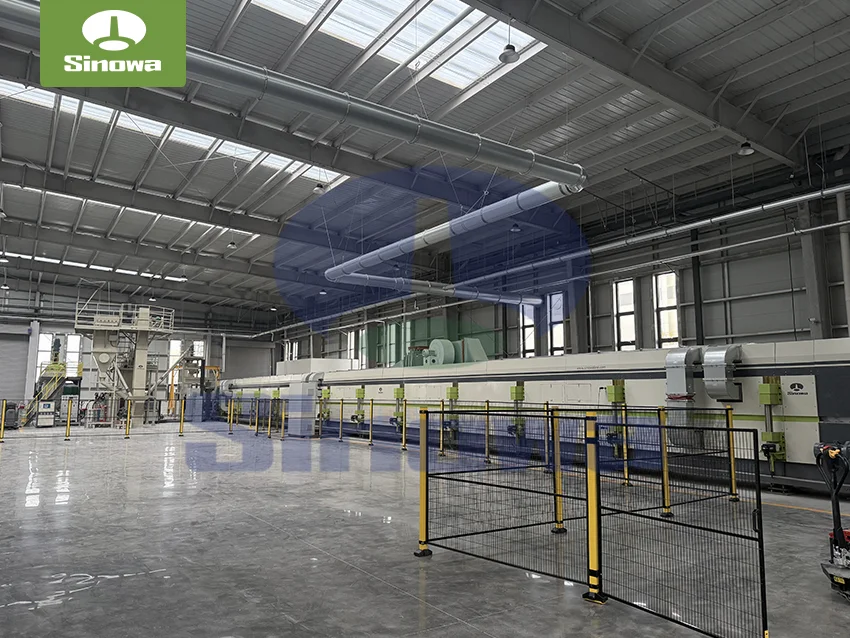
The overall structural layout of a complete mineral wool sandwich panel making machine follows a linear production logic, with multiple functional modules arranged in sequence to form an uninterrupted production assembly line. Each module is independent in function but closely connected in mechanical coordination, realizing the seamless transition from raw material feeding to finished product output. The main mechanical components include raw material unwinding devices, surface sheet leveling and forming mechanisms, automatic glue coating systems, mineral wool core material arranging and conveying structures, constant-temperature composite pressing devices, traction transmission units, fixed-length cutting mechanisms, and finished product stacking equipment. All modules are linked by synchronous transmission systems, and the operating speed of each part maintains dynamic matching to avoid production defects such as material deviation, glue layer unevenness, and composite dislocation caused by asynchronous operation. The mechanical framework of the equipment is made of high-strength alloy steel materials, which undergo anti-rust and anti-corrosion treatments to adapt to complex production environments with temperature and humidity changes, effectively reducing equipment wear and prolonging the overall service life of the production line.
The raw material unwinding device is the starting unit of the entire production line, responsible for placing coiled metal sheets and realizing stable continuous feeding. This device is equipped with damping adjustment components to control the unwinding tension of metal coils, preventing sheet deformation, wrinkling, or excessive stretching during the unwinding process. In actual production, different types of metal coiled materials can be placed on the unwinding mechanism according to production demands, and the adjustable limiting structure on the device can fix coiled materials of different widths to meet the production requirements of panels with various dimensional specifications. Beneath the unwinding device, a deviation correction sensing structure is installed. When the metal sheet shifts laterally during transmission, the sensing component can capture the offset signal in real time and feed it back to the control system, which automatically adjusts the feeding angle to ensure the linear transmission of the sheet and lay a foundation for the subsequent precise composite processing.
After completing the unwinding operation, the metal sheets enter the leveling and forming mechanism to eliminate internal stress and realize surface shaping. The metal coils inevitably produce subtle bending and indentation during storage and transportation, and the multi-group parallel leveling rollers inside the mechanism can perform repeated rolling correction on the sheets to make the surface flat and smooth. For panels requiring special surface textures or edge structures, the forming mechanism is equipped with replaceable rolling dies. Through the pressure extrusion of different dies, the metal sheets can be processed into customized shapes such as corrugated surfaces and folded edges, enhancing the structural rigidity and installation convenience of the finished panels. The rolling speed of the leveling and forming rollers is synchronized with the unwinding speed, and the gap between the rollers can be mechanically adjusted according to the thickness of the metal sheets to avoid excessive pressure crushing the sheets or insufficient pressure leading to incomplete leveling.
The automatic glue coating system is a key functional module to ensure the bonding strength between metal sheets and mineral wool core materials, directly determining the structural stability and service life of finished sandwich panels. This system includes glue storage containers, quantitative glue supply pumps, circulating conveying pipelines, and uniform gluing nozzles. Before composite processing, the cleaned and shaped metal sheets pass through the gluing area, and the nozzles evenly spray high-strength adhesive on the inner surface of the sheets. The quantitative control unit in the system can accurately adjust the glue output per unit area according to the material density and production speed, avoiding product quality problems such as hollow bonding and glue overflow caused by uneven glue application. In order to maintain the activity of the adhesive, the glue storage container is equipped with a constant-temperature heating component, which keeps the adhesive in an optimal flowing state within a stable temperature range and prevents glue condensation and agglutination from affecting the gluing uniformity. Moreover, the circulating pipeline structure can realize the recycling of excess adhesive, reducing raw material waste and improving the economic efficiency of production.
While the metal sheets are undergoing gluing treatment, the mineral wool core material arranging and conveying mechanism operates synchronously to complete the pretreatment and ordered arrangement of core materials. Bulk mineral wool raw materials need to be processed into uniform strip-shaped core materials in advance, and the arranging mechanism adopts ordered stacking technology to place mineral wool strips in a vertical fiber orientation. This laying method enables the fiber structure of the mineral wool core to be perpendicular to the metal surface layer, which significantly improves the compression resistance and shear resistance of the finished panel compared with the horizontal fiber laying mode. The conveying mechanism is equipped with anti-slip limit baffles to fix the arrangement position of mineral wool strips, preventing material scattering and dislocation during high-speed transmission. At the same time, the vibration screening component inside the mechanism can remove fine impurities and residual slag balls mixed in mineral wool, ensuring the internal uniformity of the core material and avoiding local performance differences of the panel caused by impurity accumulation.
The constant-temperature composite pressing device is the core processing unit of the entire production line, undertaking the task of integrating metal sheets and mineral wool core materials into an integral structure. The composite pressing area consists of upper and lower pressing roller sets and a sealed constant-temperature heating chamber. The glued metal sheets and arranged mineral wool core materials enter the heating chamber synchronously, and under the dual action of constant temperature and mechanical pressure, the adhesive undergoes physical curing and chemical bonding reactions. The internal temperature of the heating chamber can be adjusted within a reasonable range according to the adhesive type and production speed, forming a stable temperature gradient to ensure that the heat uniformly penetrates the bonding interface. The pressing rollers adopt hydraulic pressure control, which can provide continuous and uniform pressing force. The pressure value is adaptively adjusted according to the thickness of the composite panel to avoid excessive pressure crushing the mineral wool core or insufficient pressure leading to weak bonding. After thermal pressing treatment, the bonding interface between the metal sheet and the core material forms a compact integrated structure, which effectively enhances the overall structural tightness and mechanical stability of the sandwich panel.
The traction transmission unit acts as the power transmission hub of the production line, connecting all functional modules to maintain synchronous and stable operation of the equipment. This unit adopts servo motor driving technology with high control precision and stable output power. The servo motor cooperates with the encoding control component to record the transmission speed and displacement data of materials in real time, and dynamically corrects the operating parameters according to the production state. The traction roller group is made of wear-resistant rubber materials with high surface friction, which can firmly clamp the composite plates without damaging the surface metal layer. In the production process, the traction speed maintains a matching relationship with the gluing speed and heating time to ensure that each processing link has sufficient reaction time. The intelligent speed regulation function can realize stepless speed switching, adapting to low-speed high-precision production of customized panels and high-speed mass production of standard panels, greatly improving the production flexibility of the equipment.
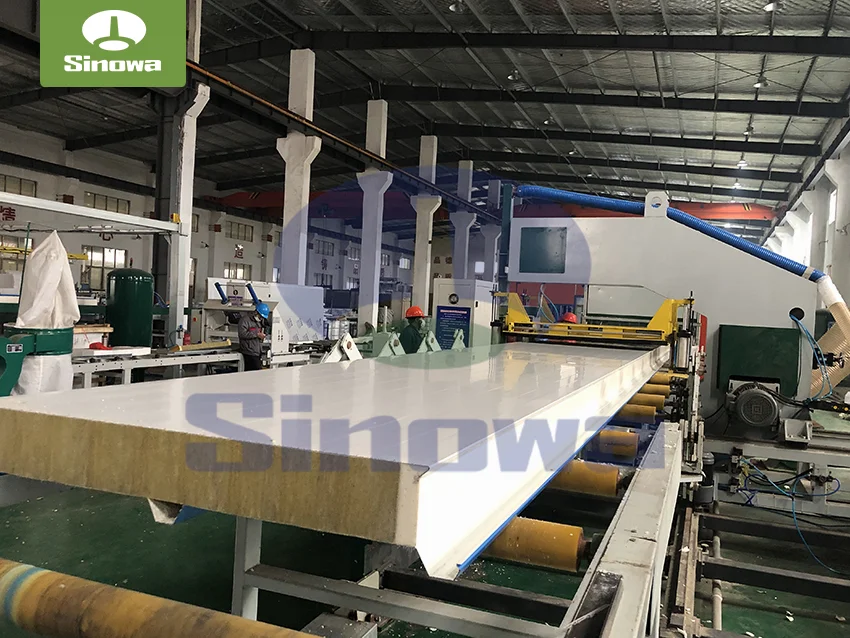
After composite molding, the continuous long-strip panels are transported to the fixed-length cutting mechanism for precise sizing and cutting. This mechanism is equipped with high-hardness alloy cutting blades and intelligent length calculation components. Operators can preset the cutting size parameters through the control terminal, and the encoding system automatically records the transmission distance of the plates. When the plates reach the preset length, the cutting mechanism triggers the cutting action instantly. The cutting process adopts vertical pressure cutting technology, which can complete the cutting operation in a short time to avoid plate displacement caused by prolonged cutting vibration. In order to ensure the flatness of the cutting section, a positioning pressing device is installed on both sides of the cutting area to fix the plates tightly during cutting. The cut edge of the finished panel processed by this mechanism is smooth and flat without burrs, cracks, and indentations, eliminating the need for secondary trimming and simplifying the subsequent processing procedures.
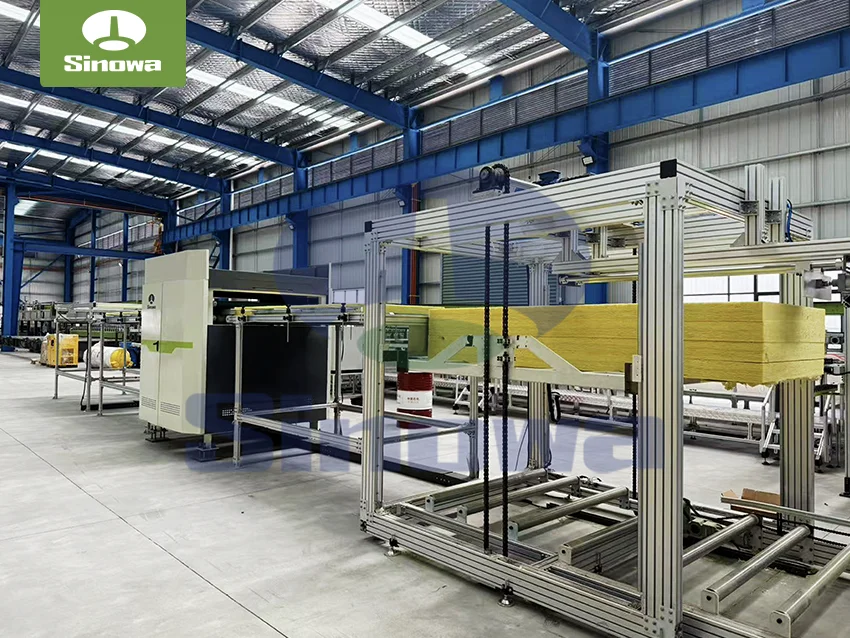
The finished product stacking equipment is the terminal module of the production line, responsible for automatically collecting and neatly stacking the cut qualified panels. This equipment is equipped with a mechanical grabbing structure and a movable stacking platform. After the cutting operation is completed, the finished panels are transported to the stacking area through the conveying track, and the servo-driven mechanical arm accurately grabs the panels and places them in a fixed stacking position. The intelligent alignment system can dynamically correct the placement angle of each panel to ensure that the upper and lower panels are completely overlapped, forming neat and standardized finished product stacks. The height of the stacking platform can be automatically adjusted according to the stacking quantity, which effectively reduces the labor intensity of manual carrying and avoids panel surface scratches and deformation caused by manual handling. In addition, the stacking equipment is equipped with a safety induction device, which automatically pauses the stacking action when foreign objects enter the working area to ensure the operational safety of the production environment.
In terms of control system configuration, modern mineral wool sandwich panel making machines adopt integrated intelligent control terminals to realize centralized management of all production links. The control interface displays real-time operating data including equipment operating speed, internal temperature of the heating chamber, gluing flow, pressing pressure, and material transmission displacement. Operators can modify production parameters through simple touch operations to adapt to different production processes and product specifications. The built-in fault diagnosis system can monitor the operating state of each mechanical module in real time. When abnormal conditions such as material blockage, insufficient glue supply, and motor overload occur, the system will automatically trigger an alarm prompt and display the fault location and cause on the interface. Meanwhile, the emergency protection mechanism will cut off the power supply of the faulty module to prevent equipment damage caused by continuous abnormal operation. The intelligent control mode simplifies the operation threshold of the equipment, reduces the dependence on professional operating technicians, and improves the overall production stability.
The technological advantages of the mineral wool sandwich panel making machine in industrial production are reflected in multiple dimensions such as production efficiency, product quality, and resource utilization. In terms of production efficiency, the integrated assembly line design realizes uninterrupted continuous production, and the synchronous operation of each functional module greatly shortens the single-panel production cycle. Compared with decentralized manual processing equipment, the automated production mode reduces intermediate handling links and effectively improves the output efficiency. In terms of product quality control, the mechanical quantitative processing mode replaces manual operation errors, realizing precise control of material feeding amount, gluing thickness, pressing pressure, and cutting size. The finished panels produced by the equipment have consistent thickness, uniform internal structure, and stable bonding strength, which can meet the unified quality standards of large-scale engineering projects. In terms of resource utilization, the circulating glue supply system and accurate material cutting technology reduce the waste of adhesive and raw metal materials. The energy-saving heating structure optimizes heat conduction efficiency, lowering the energy consumption required for unit product production.
In actual industrial application scenarios, the mineral wool sandwich panel making machine shows strong production adaptability and can meet the manufacturing requirements of panels for different usage scenarios. For building exterior wall thermal insulation panels, the equipment can adjust the mineral wool core density and metal sheet thickness to enhance the outdoor weather resistance of the panels, enabling the products to resist temperature changes, rain erosion, and ultraviolet radiation. For indoor partition panels, the equipment can optimize the internal fiber arrangement density to improve the sound absorption and noise reduction performance of the panels, creating a quiet indoor space environment. For special industrial facilities such as chemical plants and power stations, the production parameters can be modified to produce high-fire-resistance panels, which can maintain structural integrity in extreme high-temperature environments and block the spread of flames. The flexible parameter adjustment function enables a single production line to complete the manufacturing of diversified products, reducing the equipment procurement cost for production enterprises and improving the market adaptation ability of production lines.
Daily maintenance and scientific maintenance are crucial to prolonging the service life and maintaining stable working performance of the mineral wool sandwich panel making machine. The daily maintenance work mainly includes surface cleaning, component lubrication, and pipeline inspection. After the daily production work is completed, the residual adhesive, mineral wool debris, and metal dust attached to the equipment surface need to be cleaned to prevent corrosive substances from eroding the mechanical structure. The rotating parts such as transmission bearings and rolling rollers should be regularly coated with high-temperature resistant lubricating oil to reduce mechanical friction loss and avoid abnormal noise and jamming during operation. The glue supply pipelines and heating circuits need to be inspected periodically to check for pipeline blockage, liquid leakage, and circuit aging, and replace damaged accessories in a timely manner. In addition, the precision sensing components such as deviation correction sensors and length encoders need regular calibration to ensure the accuracy of data detection and parameter adjustment.
In addition to conventional maintenance, regular deep maintenance and parameter debugging are also essential for long-term operation of the equipment. The internal pressure of the hydraulic pressing system should be detected every fixed production cycle to ensure that the pressure output is stable within the standard range and avoid pressure deviation affecting the composite bonding effect. The cutting blades need regular sharpening treatment to keep the blade sharp and ensure the flatness of the cutting section. The connection gaps between various transmission modules should be adjusted to prevent material deviation caused by excessive gaps during transmission. For the electrical control system, dust cleaning and circuit inspection should be carried out regularly to avoid short circuit faults caused by dust accumulation and moisture condensation. Scientific maintenance management can effectively reduce the failure rate of the equipment, shorten the downtime caused by faults, and create a stable and continuous production state for the production line.
With the continuous progress of industrial manufacturing technology, the development trend of mineral wool sandwich panel making machines presents obvious characteristics of intelligence, environmental protection, and high integration. In terms of intelligent upgrading, the equipment will be combined with data collection and cloud analysis technology to record production data for a long time, analyze the correlation between production parameters and product quality, and realize automatic parameter optimization. The intelligent sensing system will further improve the fault prediction ability, judge the aging degree of vulnerable parts through data changes, and remind maintenance personnel to replace accessories in advance. In terms of environmental protection optimization, the equipment will add waste gas collection and purification structures to treat the trace volatile gas generated during adhesive curing, reducing the impact on the production environment. The optimized mechanical structure will reduce vibration and noise during operation, realizing low-noise production. In terms of structural integration, the volume of single functional modules will be further compressed, and the spatial layout of the production line will be optimized to reduce the floor area of the equipment and improve the space utilization rate of the production workshop.
From the perspective of industrial chain development, the popularization and upgrading of mineral wool sandwich panel making machines have an important driving effect on the upstream and downstream industries of the building material sector. Upstream raw material suppliers of mineral wool, metal sheets, and adhesives need to continuously optimize material performance to match the high-precision production requirements of automated equipment, promoting the iterative upgrading of raw material processing technology. Downstream construction engineering, cold storage manufacturing, and factory construction industries can obtain high-quality and low-cost composite panels, which simplifies the on-site construction process, shortens the engineering construction cycle, and reduces the overall project investment cost. As a bridge connecting raw material processing and engineering application, the mineral wool sandwich panel making machine undertakes the important task of standardized production of composite building materials, and its technical level directly affects the development speed and quality of the entire building thermal insulation material industry.
In conclusion, the mineral wool sandwich panel making machine is a comprehensive automated mechanical system integrating mechanical transmission, thermal processing, chemical bonding, and intelligent control technologies. Its scientific structural layout, perfect production process, and flexible parameter adjustment capabilities enable it to efficiently complete the standardized production of high-performance mineral wool sandwich panels. Each functional module of the equipment cooperates closely to realize the whole-process automated processing from raw material feeding to finished product stacking, which not only improves production efficiency and product qualification rate but also reduces manual production costs and resource waste. With the continuous improvement of energy-saving and environmental protection requirements in the global construction industry, mineral wool sandwich panels will have broader market application space, and the supporting production equipment will also continue to carry out technological innovation and structural optimization. In the future, such automated composite panel production machines will develop toward higher intelligence, lower energy consumption, and stronger compatibility, providing more reliable mechanical support for the high-quality development of the modern building material manufacturing industry and making important contributions to the upgrading of energy-saving and environmentally friendly construction engineering.
https://www.cnsinowa.com/sandwich-panel-machines/mineral-wool-sandwich-panel-making-machine.html