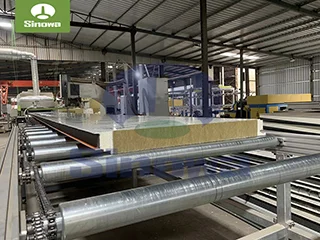
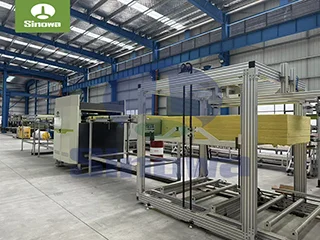
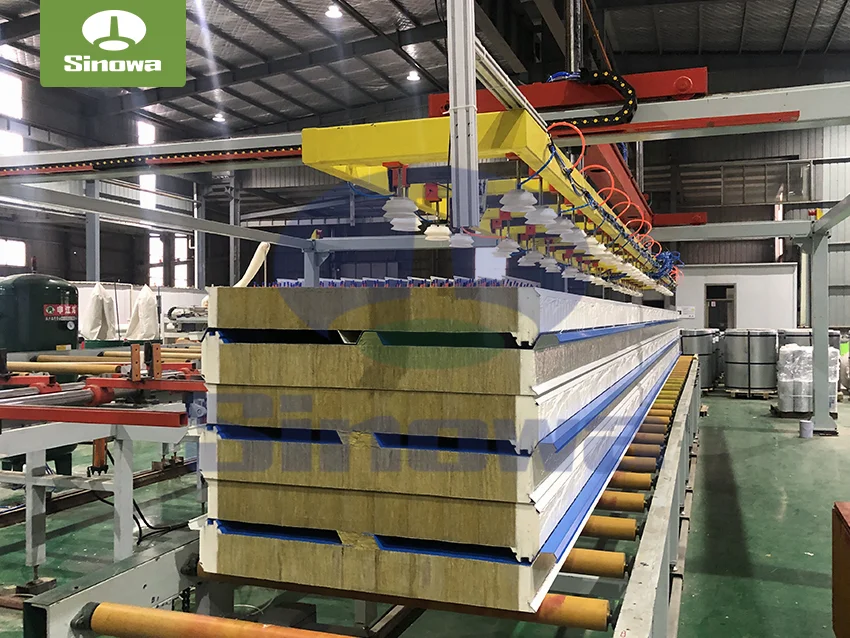
 sandwich panel line
Raw material pretreatment constitutes the initial core link of the entire rock wool panel line, and the quality of raw material processing directly determines the basic physical properties of subsequent rock wool products. The main raw materials applied in the production line are natural volcanic rocks and various auxiliary mineral raw materials, which possess stable chemical composition and excellent high-temperature resistance. Before entering the melting stage, all raw materials need to go through strict crushing, screening and homogenization treatment. Special crushing equipment in the production line crushes bulk raw ores into uniform granular materials, and the screening device further filters out impurity particles and oversized raw material blocks to ensure the consistency of raw material particle size. After screening, the qualified granular raw materials are transported to the sealed storage silos through automated conveying structures, and the central control system accurately controls the feeding proportion of different raw materials according to the preset production parameters. In this process, the raw material drying and dehumidification device continuously removes the internal moisture of mineral raw materials, avoiding the adverse effects of moisture on high-temperature melting efficiency and fiber molding quality. The closed raw material pretreatment space effectively reduces dust diffusion during material processing, realizing clean production while maintaining the purity of raw materials. The standardized pretreatment process eliminates the raw material quality differences caused by mineral origin and batch fluctuation, laying a solid foundation for the stable operation of subsequent melting and fiber forming processes.
The high-temperature melting unit is the core thermal processing section of the rock wool sandwich panel line, undertaking the key task of converting solid mineral raw materials into homogeneous molten liquid. The melting equipment adopts a vertical structural design with excellent thermal insulation performance, which can continuously provide stable high-temperature combustion conditions required for raw material melting. After being accurately measured by the feeding system, the mixed granular raw materials are evenly transported from the top of the melting furnace to the internal melting chamber, and gradually melt into flowing molten magma under the continuous action of high temperature. The internal temperature field of the melting furnace is precisely regulated by an intelligent temperature control system, which maintains a constant temperature range suitable for mineral raw material melting, ensuring that the raw materials are completely melted without excessive high-temperature decomposition of internal effective components. The internal airflow circulation structure of the furnace optimizes the heat distribution path, improves the utilization rate of combustion heat energy, and avoids local overheating or insufficient melting of raw materials. During the melting process, the impurity separation device automatically screens and removes heavy impurities and non-molten residues in the magma to ensure the uniformity and purity of the molten liquid. The sealed furnace body structure effectively isolates the external air, reduces heat loss, and meanwhile avoids the oxidation reaction between high-temperature magma and air, maintaining the stable chemical properties of the molten liquid. The continuously output homogeneous molten magma provides qualified raw materials for the subsequent fiber stretching process, which is a key prerequisite for forming fine and uniform rock wool fibers.
Fiber forming is a critical processing link that determines the internal fiber structure of rock wool panels, and the centrifugal fiber forming equipment in the production line completes the rapid conversion from molten magma to mineral fibers. The high-temperature molten magma flows evenly into the high-speed rotating centrifugal equipment, and the strong centrifugal force generated by the rotating structure tears the magma into slender fibrous filaments instantly. The internal air flow guiding device of the centrifugal equipment sprays stable cold air flow around the fiber filaments, which rapidly cools and shapes the high-temperature fibers to form amorphous rock wool fibers with soft texture and uniform diameter. By adjusting the rotating speed of the centrifugal structure and the air flow pressure of the cooling system, the production line can flexibly control the fiber diameter and length to meet the performance requirements of rock wool panels in different application scenarios. Compared with traditional fiber forming processes, the centrifugal forming technology adopted by modern rock wool panel lines has higher fiber forming efficiency, and the produced fibers have smoother surface and more uniform thickness. In the fiber forming stage, quantitative adhesive additives are evenly sprayed on the surface of loose fibers through the automatic spraying system. These adhesives can enhance the bonding tightness between fibers, and effectively improve the overall structural strength and compression resistance of subsequent rock wool panels. Meanwhile, functional auxiliary agents such as water repellents and dustproof agents are mixed and sprayed synchronously to endow the fibers with excellent moisture resistance and dust suppression performance, optimizing the practical application performance of finished products.
Cotton collection and laying treatment realizes the orderly accumulation and preliminary molding of dispersed rock wool fibers, which connects the fiber forming link and the subsequent curing molding link in the production line. The dispersed fibers after spraying additives are transported to the sealed settling chamber through the air conveying system, and the internal stable air flow environment makes the fibers slowly settle on the circulating conveyor belt in a fluffy state. The traditional single settling process has the defect of disordered fiber arrangement and uneven thickness, so most advanced production lines adopt pendulum cotton laying technology for optimization. The reciprocating swinging pendulum structure repeatedly spreads the fluffy fibers on the conveyor belt, forming a multi-layer stacked fiber wool layer with uniform thickness and three-dimensional staggered fiber distribution. This three-dimensional laying mode effectively solves the problem of poor interlayer bonding strength caused by planar fiber distribution, and significantly improves the overall compression resistance and structural stability of rock wool panels. During the cotton laying process, the thickness monitoring sensor in real time detects the thickness of the fiber wool layer on the conveyor belt, and feeds the data back to the central control system. The system automatically adjusts the operating frequency of the pendulum structure and the conveying speed of the conveyor belt to ensure that the thickness error of the wool layer is controlled within a tiny range. The pre-pressing device installed behind the cotton laying mechanism carries out gentle compression treatment on the fluffy wool layer to discharge the internal redundant gap, preliminarily fix the fiber stacking structure, and facilitate the subsequent high-temperature curing processing.
High-temperature curing is an essential thermal processing procedure to stabilize the internal structure of rock wool panels, and the curing furnace in the production line provides a constant-temperature high-temperature environment for adhesive curing and fiber bonding. The pre-pressed fiber wool layer is continuously sent into the sealed curing furnace by the conveyor device, and the internal stable high-temperature environment promotes the rapid curing reaction of the adhesive attached to the fiber surface. Under the dual action of constant temperature and slight pressure, the adjacent fibers are tightly bonded together to form an integrated porous fiber structure, which completely changes the loose state of raw fibers and forms a solid rock wool board blank. The internal heating structure of the curing furnace adopts uniform heat radiation layout, which ensures that all parts of the board blank receive consistent heat, avoiding uneven curing and local soft deformation of the board body. The intelligent temperature adjustment module dynamically adjusts the internal temperature of the furnace according to the thickness and density of the board blank, matching the optimal curing temperature parameters for different types of products. Meanwhile, the airflow circulation system inside the furnace discharges the volatile gas generated during adhesive curing in time, maintaining the purity of the internal curing environment and preventing gas residue from affecting the product performance. After continuous curing for a fixed period, the board blank is gradually cooled down to room temperature through the slow cooling area at the tail of the curing furnace, which relieves the internal thermal stress of the board body and enhances the structural toughness of the finished rock wool panel.
Precision cutting and shaping processing realizes the dimensional standardization of rock wool panels, enabling the finished products to meet the unified size requirements of industrial transportation and engineering construction. The cooled integrated rock wool board blank is stably transported to the cutting processing area along the conveyor line, and the production line is equipped with multi-group high-speed cutting saws with precise positioning functions to complete longitudinal and transverse cutting operations respectively. The longitudinal cutting equipment cuts the wide board blank into strip boards with fixed width according to the preset size parameters, removing the irregular edge parts on both sides of the board body to ensure smooth and neat edges. Subsequently, the transverse cutting device controlled by the microcomputer system completes fixed-length cutting, dividing the long strip rock wool boards into finished panels with standard length specifications. The cutting equipment adopts high-hardness cutting blades and stable transmission structures, which can complete high-speed cutting without causing fiber scattering or edge cracking of the board body. The real-time positioning sensor monitors the cutting position and feeding accuracy throughout the whole process, and automatically corrects the feeding deviation to control the dimensional error of the finished panel within an extremely small range. For rock wool panels with special-shaped structural requirements, the production line can be equipped with customized trimming and grooving components to process assembly grooves and connecting structures on the board body, facilitating the rapid assembly and installation of panels in actual engineering applications. The waste materials generated during the cutting process are automatically collected by the sealed recovery device, and the recycled waste materials are reprocessed and put into production after crushing, realizing the cyclic utilization of production resources.
Surface treatment and finished product packaging are the final processing links of the rock wool sandwich panel production line, which optimize the surface quality of products and ensure the safety of storage and transportation. After cutting and shaping, the surface of rock wool panels is cleaned by the automatic dust removal device to remove residual floating fibers and tiny impurities on the surface, making the board surface smooth and clean. For panels used in special application scenarios, the production line can complete surface composite treatment such as waterproof coating and anti-corrosion film pasting through the auxiliary composite mechanism, further enhancing the environmental adaptability of the products. The qualified rock wool panels after surface treatment are transported to the intelligent packaging area, and the stacking equipment automatically stacks the panels in a fixed number according to the packaging specifications. The automatic wrapping machine adopts flexible packaging materials to carry out overall sealing and wrapping of stacked panels, which can effectively prevent fiber scattering, moisture absorption and surface abrasion during storage and transportation. At the same time, the binding device reinforces the packaged products to avoid structural loosening caused by extrusion during handling. The packaged finished products are transported to the finished product storage area by the outbound conveyor device, and the intelligent sorting system classifies and stores products according to size, density and performance parameters, realizing standardized management of finished products. The fully automated packaging process reduces manual intervention, improves packaging efficiency, and ensures the consistent packaging quality of each batch of products.
The intelligent control system serves as the brain of the entire rock wool panel line, coordinating the collaborative operation of all functional units and realizing automated and intelligent production management. The central control platform integrates data collection, parameter adjustment, fault monitoring and operation recording functions, and collects real-time operating data of temperature, pressure, rotating speed and feeding volume of each equipment through multiple high-precision sensors arranged in various links of the production line. The system analyzes and compares the collected data with the preset standard parameters, and automatically adjusts the operating state of each equipment to keep the production process in an optimal stable state. The human-computer interaction interface displays the overall operation flow of the production line in real time, and operators can manually modify the production parameters according to the production demand to quickly switch product specifications. The built-in fault diagnosis module can automatically identify abnormal phenomena such as equipment jamming, temperature fluctuation and material blockage in the production process, and send early warning signals while starting the emergency protection program to stop the abnormal operation link, avoiding equipment damage and product quality defects. In addition, the system records all production data in real time, including raw material consumption, equipment operation time and product output, providing accurate data support for production cost accounting and production process optimization. The intelligent control mode effectively reduces the dependence on manual operation, lowers the human error rate in the production process, and significantly improves the production stability and product qualification rate of the production line.
The auxiliary supporting system of the rock wool panel line includes waste gas treatment, cooling circulation and power supply guarantee modules, which jointly maintain the safe, environmentally friendly and stable operation of the production line. In the high-temperature melting and curing links, a certain amount of waste gas and volatile gas will be generated. The sealed waste gas collection system collects these harmful gases uniformly, and removes dust and harmful components through multi-stage filtration and purification processes. The purified gas meets the emission standards and is discharged into the atmosphere, which effectively reduces the impact of production on the surrounding environment. The cooling circulation system provides circulating cooling water for high-temperature equipment such as melting furnaces and centrifugal forming machines. The low-temperature circulating water continuously takes away the waste heat generated by equipment operation, maintaining the stable working temperature of mechanical components and avoiding equipment aging and damage caused by long-term high-temperature operation. The power supply guarantee module adopts stable voltage regulation and power distribution structure, which reasonably distributes electric energy for each equipment unit, avoids voltage fluctuation caused by simultaneous operation of multiple devices, and ensures the stable power demand of high-precision control equipment. In addition, the mechanical lubrication system regularly quantitatively injects lubricating oil into the rotating and transmission parts of the equipment to reduce mechanical friction loss, extend the service life of the production line equipment, and reduce the frequency of equipment maintenance and failure shutdown.
The rock wool panel line has prominent technical advantages in structural design and production logic, which distinguish it from other thermal insulation material production lines. In terms of structural layout, the production line adopts a linear integrated layout, which closely connects all processing links from raw material feeding to finished product packaging. The streamlined conveying mode shortens the material transfer distance between processes, reduces material transportation loss and time consumption, and improves the overall production efficiency. In terms of process technology, the optimized pendulum cotton laying and three-dimensional fiber distribution technology makes the internal fiber structure of rock wool panels more uniform, effectively improving the mechanical strength and thermal insulation performance of the products. Compared with the traditional static settling production process, the products produced by this production line have lower thermal conductivity and better compression resistance, and can maintain stable performance in long-term high-temperature and humid environments. In terms of energy consumption control, the production line adopts energy-saving heating structures and heat recovery devices. The waste heat generated by the curing furnace and melting furnace is recycled and used for raw material preheating and drying, which significantly reduces comprehensive energy consumption. The closed production space also avoids heat loss and dust leakage, realizing energy-saving and environmentally friendly production. In addition, the production line has strong production flexibility, which can adjust product density, thickness and fiber fineness according to market demand, and produce diversified rock wool panels to meet the application requirements of different industries.
The products manufactured by the rock wool panel line have wide application coverage in the construction industry, industrial manufacturing and special engineering fields. In the construction field, rock wool panels are applied to the thermal insulation and fire protection of building exterior walls, roofs and partition walls. The porous fiber structure can effectively block heat conduction and reduce building energy consumption, while the non-combustible mineral raw materials endow the panels with excellent fire resistance, which can prevent the spread of fire and improve building safety. In industrial production, the panels are used for the thermal insulation and noise reduction of industrial kilns, pipelines and mechanical equipment, isolating high-temperature heat source radiation and reducing the noise generated by equipment operation. In cold storage and fresh-keeping engineering, rock wool panels can maintain the internal low-temperature environment, reduce cold air loss, and achieve energy-saving and heat-preservation effects. In addition, in special scenarios such as transportation facilities and municipal engineering, the panels also exert excellent moisture-proof, anti-corrosion and shock-resistant properties, adapting to complex and changeable service environments. With the continuous improvement of global environmental protection and energy-saving standards, the market demand for high-performance rock wool panels continues to grow, which further promotes the iterative upgrading and technological innovation of rock wool panel production lines.
In the actual production operation process, the daily maintenance and parameter optimization of the rock wool panel line are crucial to ensure long-term stable operation and stable product quality. Daily maintenance work includes regular cleaning of residual fibers and impurities inside the equipment, inspection of the tightness of transmission parts and the sensitivity of sensor components, and replacement of aging wearing parts in a timely manner. The internal dust deposition of the melting furnace and curing furnace needs to be cleaned periodically to avoid affecting heat conduction efficiency and internal temperature uniformity. For the adhesive spraying and cotton laying mechanism, the pipeline blockage and material residue should be checked regularly to ensure the uniformity of additive spraying and fiber laying. In terms of production parameter optimization, production personnel need to adjust the melting temperature, curing time and cotton laying density according to the raw material characteristics and product usage scenarios. Through continuous data accumulation and parameter debugging, the production line can always maintain the optimal production state. In addition, regular professional training for operators can standardize operation procedures, reduce misoperation risks, and improve the overall management level of the production line. Scientific maintenance and optimization management can effectively extend the service life of the production line, reduce production costs, and ensure the long-term stable output of high-quality rock wool panels.
Looking at the future development trend, the rock wool panel line will develop towards higher intelligence, lower energy consumption and greener production. With the continuous maturity of industrial Internet and digital twin technology, the future production line will realize full digital simulation of the production process. The system can predict production risks and optimize process parameters in advance through big data analysis, further improving production accuracy and automation level. In terms of energy saving and emission reduction, the production line will adopt more efficient heat recovery materials and clean combustion technologies to reduce fossil energy consumption and waste gas emission. The research and development of new environmentally friendly adhesives and functional additives will further reduce the generation of volatile pollutants in the production process and improve the green production level. In terms of product diversification, the upgraded production line will have stronger customized processing capabilities, which can produce composite rock wool panels with waterproof, anti-corrosion and high-strength characteristics to adapt to more extreme application scenarios. Meanwhile, the intelligent logistics docking function will be added to the production line to realize automatic transportation and intelligent storage of finished products, forming a fully enclosed intelligent production and storage system. Driven by technological progress, the rock wool panel line will continuously break through the limitations of traditional production processes and provide more high-quality and environmentally friendly thermal insulation materials for various industries.
In conclusion, the rock wool panel line is a highly integrated and systematic industrial production equipment, which completes the whole process from raw material pretreatment, high-temperature melting, fiber forming to finished product packaging through the coordinated operation of multiple functional modules. Every production link has rigorous process logic and precise parameter control, and each mechanical unit undertakes independent processing tasks while cooperating with each other to ensure the continuity and stability of the production process. The rock wool panels produced by the production line have excellent thermal insulation, fire resistance, sound absorption and structural stability, and are widely used in various fields such as construction and industry. With the continuous improvement of social energy-saving and environmental protection requirements, the market value of rock wool panels will continue to rise, which will further drive the technological upgrading and structural optimization of production lines. Through scientific operation management, regular equipment maintenance and continuous technological innovation, the rock wool panel line can maintain efficient and stable production capacity, continuously output high-performance thermal insulation materials, and make important contributions to the development of the global energy-saving building industry and modern industrial manufacturing industry. The in-depth research and application promotion of rock wool panel production technology will also lay a solid foundation for the sustainable development of the thermal insulation material industry in the future.
https://www.cnsinowa.com/sandwich-panel-machines/rock-wool-panel-line.html