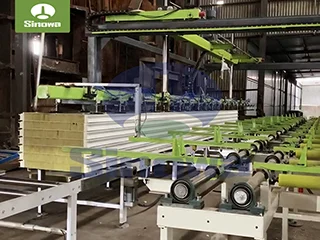
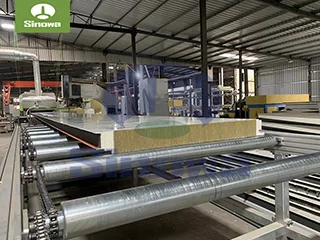
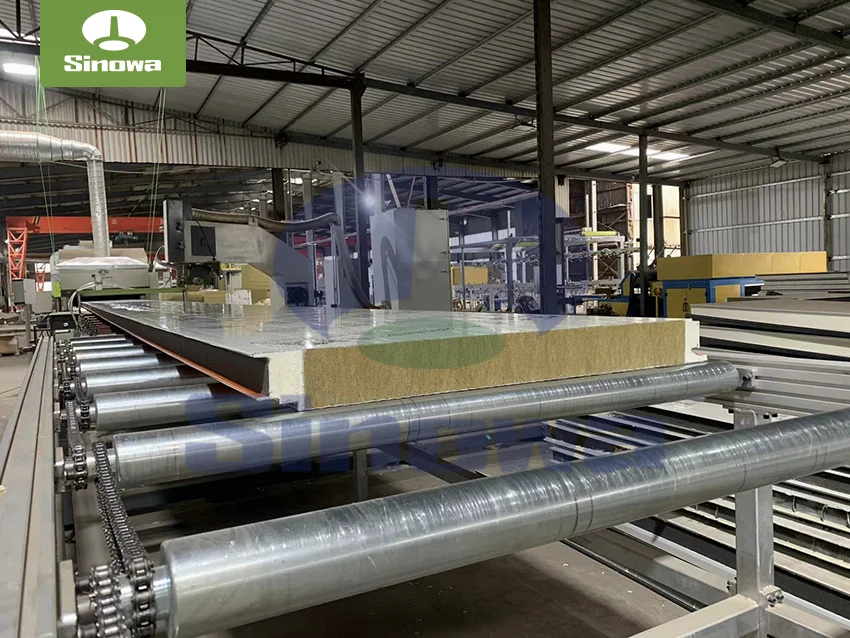
 sandwich panel line
The overall operation logic of the production line follows a continuous sandwich panel assembly line mode, with each processing unit operating in synchronous coordination to avoid intermittent production delays and ensure the consistency of panel quality in batch production. The entire production process can be divided into several core functional stages, including surface material pretreatment, rockwool core material arrangement, polyurethane foam pouring and compounding, constant temperature pressing and curing, shaping and trimming, and finished product sorting. Each stage is equipped with specialized mechanical and transmission structures, and the operating parameters are adjustable according to production requirements, enabling the line to produce panels of different thicknesses, specifications and functional configurations while maintaining stable production status.
The initial stage of production focuses on the pretreatment of metal surface materials, which are the outer protective layers of sandwich panels. The raw metal coil materials are placed on the automatic uncoiling device, which realizes steady and continuous material output through mechanical tension control. This device effectively avoids material deviation and stretching deformation during the unwinding process, laying a foundation for the flatness of subsequent panel surfaces. After uncoiling, the metal sheet enters the leveling unit, where multiple groups of precision rollers perform multi-directional calibration on the sheet to eliminate the internal stress and surface wrinkles generated during coil storage and transportation. The leveled metal sheet achieves uniform thickness and flat surface, ensuring tight lamination with the core materials in the later compounding process.
Following leveling, the surface material undergoes preheating treatment, a key step to enhance the bonding performance between the metal layer and the core composite layer. The preheating system adopts uniform heat conduction design to raise the surface temperature of the metal sheet to a stable range, which can effectively remove surface moisture and tiny impurities, and activate the surface molecular activity of the metal material. This pretreatment significantly improves the adhesion between the metal surface and polyurethane foam as well as rockwool materials, preventing delamination, cracking and other quality problems of finished panels in long-term use. After preheating, the metal sheet enters the edge trimming and forming unit, where precision mechanical structures complete edge cutting, fine trimming and conventional shape forming to ensure the dimensional accuracy of the surface material and match the overall specification of the finished sandwich panel.
While the surface material is being pretreated, the rockwool core material feeding and arrangement system operates synchronously to realize the orderly supply of the fireproof core layer. Rockwool raw materials are transported to the positioning feeding platform through the conveying mechanism, and the automatic arrangement structure sorts and arranges loose rockwool strips into continuous and uniform core layers with consistent thickness and density. The system can adjust the arrangement density and stacking thickness of rockwool according to the production standard of target panels, ensuring that the fireproof and heat-insulating performance of each panel remains stable. In the compounding process, the surface of the arranged rockwool layer is evenly coated with special adhesive through the automatic gluing device, which strengthens the bonding tightness between rockwool and polyurethane foam, and optimizes the overall structural integrity of the composite core layer.
The polyurethane foaming and composite molding stage is the core link of the PU sandwich panel production line, which determines the thermal insulation performance and structural firmness of the finished panel. The high-pressure foaming system of the line accurately mixes polyurethane raw materials in a scientific proportion through a precise metering and mixing structure. The mixed liquid foam material is evenly sprayed and poured on the surface of the rockwool core layer through the high-precision mixing head, realizing full coverage and uniform permeation without local accumulation or missing spraying. The rational proportion of raw materials ensures that the foam can undergo stable chemical foaming reaction in the subsequent environment, forming a dense and uniform microporous foam structure.
After the completion of foam pouring, the upper and lower preformed metal surface materials are precisely aligned and covered with the rockwool-polyurethane composite core layer, and the whole integrated structure is sent into the double-belt pressing and curing unit. This unit is equipped with a constant temperature and constant pressure control system, which maintains stable temperature and pressure environment in the internal curing channel. Under the action of constant temperature, the polyurethane foam continues to expand, gel and solidify, and closely bonds with the rockwool core layer and metal surface layers. The constant pressure state ensures that the overall thickness of the panel is uniform, avoids bulging, depression and uneven surface, and makes the internal structure of the composite layer more compact. The curing time can be dynamically adjusted according to the panel thickness and material formula to ensure complete reaction and sufficient curing of the foam, so as to achieve the best structural strength and thermal insulation effect.
The double-belt pressing structure adopts circulating operation mode, which supports uninterrupted continuous production and greatly improves production efficiency compared with intermittent single-panel molding equipment. The internal temperature zone of the pressing unit is divided into reaction heating zone and cooling shaping zone. The heating zone provides sufficient heat for the foaming and curing reaction of polyurethane, while the cooling zone rapidly stabilizes the molded panel structure through uniform heat dissipation, eliminating the post-expansion phenomenon of foam materials and locking the overall shape and size of the panel. This segmented temperature control design effectively guarantees the molding quality of the panel and reduces the defective rate caused by incomplete curing or unstable shaping.
After completing pressing and curing, the continuous long strip composite panel is transported to the fixed-length cutting and trimming station. The high-precision cutting system automatically identifies the preset panel length specifications and completes synchronous cutting in the running state of the panel, realizing non-stop production and avoiding efficiency loss caused by equipment shutdown. The cutting tool adopts high-hardness precision components, which can complete smooth cutting of composite materials with metal layers and multi-layer core structures, ensuring neat and burr-free cutting sections. Meanwhile, the edge trimming device performs fine processing on the panel edges to remove residual foam and excess adhesive, making the overall dimension of the finished panel more accurate and the appearance more standardized.
Subsequent to cutting and trimming, the finished panels are transported to the final sorting and stacking area through the automatic conveying roller table. The intelligent stacking system automatically arranges and stacks the panels in order according to the set stacking mode and height, realizing neat storage of finished products. The whole stacking process is completed by mechanical automation, which avoids surface scratches, deformation and damage caused by manual handling, and maintains the integrity and appearance quality of finished panels. In addition, the supporting cleaning device of the sandwich panel line can regularly clean the residual materials on the equipment surface and conveying channels to ensure the long-term stable operation of the production line and maintain the cleanliness of the production environment.
The structural design of the entire PU rockwool sandwich panel production line focuses on integration and intelligence, with all functional units connected through synchronous transmission systems to realize coordinated and unified operation. The core transmission components adopt stable mechanical structures, which can maintain low friction and high precision operation during long-term continuous production, reducing equipment wear and failure probability. The adjustable parameter system allows operators to flexibly switch production specifications, realizing one-line multi-purpose production of panels with different thicknesses, widths and functional requirements, which greatly improves the flexibility of production and meets the diversified market demand for building energy-saving materials.
In terms of production performance advantages, this composite sandwich panel production line perfectly integrates the respective advantages of polyurethane foam and rockwool materials through precise process control. The polyurethane foam layer provides excellent thermal insulation and sound insulation performance, effectively reducing the heat transfer efficiency of the panel and achieving good building energy-saving effect, while the rockwool core layer endows the panel with outstanding fire resistance and high-temperature resistance, making up for the insufficient fire performance of single polyurethane foam panels. The composite structure formed by the integrated production process has stronger overall structural stability, with good compression resistance, bending resistance and weather resistance, and can adapt to complex outdoor and indoor building environments for long-term use.
Compared with traditional separate manual or semi-automatic production processes, the fully continuous automated production mode of the sandwich panel machine greatly reduces manual intervention links, effectively reduces human error in production, and significantly improves the consistency and stability of finished product quality. The synchronous operation of each process eliminates the waiting and transfer links between separate processes, greatly shortens the production cycle and improves the unit time output. At the same time, the precise metering and spraying system of polyurethane raw materials avoids raw material waste caused by uneven feeding, realizing efficient utilization of production materials and reducing comprehensive production consumption.
In practical industrial application, the panels produced by this sandwich panel machinery are widely used in the enclosure structures of industrial plants, logistics warehouses, clean workshops, public buildings and other facilities. The composite panels have the dual characteristics of energy-saving insulation and fire safety, and also have the advantages of light weight, convenient installation and beautiful appearance. The standardized and batch production mode supported by the production line can stably supply high-quality building enclosure materials for large-scale construction projects, and the adjustable production specifications can meet the personalized production needs of special engineering scenarios, providing reliable material support for the construction of energy-saving and safe modern buildings.
In terms of equipment operation and maintenance, the polyurethane sandwich panel production line adopts modular structural design, with each functional unit relatively independent and easy to inspect, maintain and replace components. The intelligent monitoring system can track the operating status, operating parameters and production data of each unit in real time, helping operators quickly discover and eliminate potential equipment faults, ensuring the continuous and stable operation of the production line. The optimized mechanical structure reduces the failure rate of vulnerable parts, extends the service life of the equipment, and reduces the daily operation and maintenance cost of the production system.
With the continuous upgrading of the construction industry's requirements for building energy conservation, fire safety and environmental protection, the market demand for high-performance composite sandwich panels is constantly increasing. The PU rockwool foam sandwich panel production line, as a professional equipment for producing high-quality composite energy-saving panels, has outstanding production advantages and product performance adaptability. Its integrated, automated and intelligent production mode conforms to the development trend of modern building material industrialization, and can continuously provide high-quality, high-stability and multi-functional composite panel products for the construction industry, playing an important role in promoting the upgrading of energy-saving building materials and the development of green buildings.
https://www.cnsinowa.com/sandwich-panel-machines/pu-rockwool-foam-sandwich-panel-production-line.html