sandwich panel line
To understand the operational logic and industrial value of the phenolic al duct panel line, it is essential to first clarify the basic structural composition and material characteristics of phenolic aluminum duct panels. The finished duct panel presents a typical three-layer composite structure, with a porous phenolic foam layer serving as the intermediate core substrate and compact aluminum foil layers tightly attached to both the upper and lower surfaces. The phenolic foam substrate is synthesized through the foaming and curing reaction of phenolic resin raw materials. Its internal closed-cell structure forms countless tiny independent air insulation cavities, which effectively restrain the heat conduction and heat convection efficiency of external temperature, laying a solid foundation for the excellent thermal insulation performance of the panel. The aluminum foil layers on both sides adopt embossed processing technology. The smooth and dense metal thin layer can isolate external moisture, dust and corrosive substances, while improving the surface flatness and tensile resistance of the composite panel. The organic combination of the two materials complements each other in performance: phenolic foam makes up for the poor thermal insulation defect of single metal materials, and aluminum foil compensates for the insufficient surface hardness and poor weather resistance of pure phenolic foam. This unique composite structure determines that the production line needs to complete multi-process collaborative processing from raw material pretreatment to composite molding, putting forward high requirements for process sequence, temperature control and bonding accuracy of the production line.
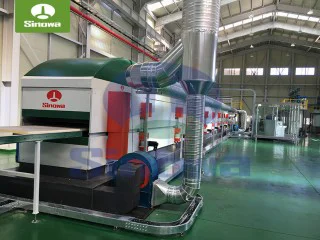
The overall layout and mechanical configuration of a complete phenolic al duct panel line follow the principles of continuous production, stable molding and intelligent control, covering the whole industrial chain links from raw material feeding, pretreatment, mixing foaming, composite lamination to cutting, shaping and finished product collection. Each functional unit in the production line is closely connected, and the operating parameters are synchronously matched to ensure the consistency of material processing standards and the stability of finished product quality. In the initial raw material feeding stage, the production line is equipped with sealed raw material storage and automatic conveying devices. Phenolic resin monomers, curing agents, foaming agents and auxiliary additives are separately stored in sealed tanks to avoid chemical deterioration caused by contact with humid air. The conveying system adopts quantitative feeding components to accurately control the proportion of various raw materials. The precise proportioning design is crucial for the cell structure and curing degree of subsequent phenolic foam, and subtle deviations in raw material ratio will directly lead to changes in panel density, thermal conductivity and mechanical strength. For aluminum foil raw materials, the production line is equipped with special unwinding and deviation correction mechanisms to ensure that the aluminum foil remains flat and tension-balanced during the conveying process, preventing wrinkles, scratches and uneven composite gaps caused by aluminum foil deviation.
The mixing and foaming section is the core functional module of the phenolic al duct panel line, which directly determines the internal microstructure and basic physical properties of the phenolic foam substrate. After being quantitatively conveyed, the phenolic resin and various auxiliary materials are injected into a high-speed stirring mixing device. The internal stirring blades of the device rotate at a constant speed to realize uniform mixing of liquid raw materials. During the stirring process, the production line maintains a constant temperature environment through an intelligent temperature control system. Appropriate temperature can accelerate the molecular fusion reaction between raw materials and avoid local agglomeration of resin components. After full mixing, the mixed liquid is evenly coated on the surface of the lower-layer aluminum foil through a precise pouring system. At this stage, the foaming agent begins to react chemically, and the liquid mixture gradually expands to form a foam structure with uniform closed cells. The foaming speed and expansion multiple are strictly regulated by the production line control system. Excessively fast foaming will cause uneven cell distribution and internal voids, while excessively slow foaming will lead to excessive substrate density and increased material thermal conductivity. The intelligent parameter adjustment function of modern production lines can dynamically optimize foaming conditions according to the set panel thickness standards to ensure that each batch of foam substrates has consistent structural compactness.
The composite lamination and curing section undertakes the key task of bonding the aluminum foil and phenolic foam into an integrated structure, which is an indispensable link to enhance the overall structural stability of the duct panel. After the foam liquid is initially foamed and shaped, the upper-layer aluminum foil is accurately covered on the surface of the foam substrate by the conveying mechanism. The stacked three-layer structure is then sent to a multi-stage rolling composite device. The rolling pressure of the device is linearly adjusted according to the panel thickness and material hardness. Moderate rolling pressure can eliminate the tiny gaps between the aluminum foil and the foam, strengthen the interface adhesion tightness, and avoid delamination and warping of the finished panel during long-term use. After rolling and compounding, the semi-finished panels enter the constant-temperature curing channel. The internal temperature and air circulation speed of the curing channel are precisely controlled to promote the complete cross-linking and curing reaction of phenolic resin molecules. In the curing stage, the foam structure is gradually finalized, the bonding performance between layers tends to be stable, and the panel gradually obtains compressive resistance, bending resistance and structural toughness. Compared with natural curing, the assembly line curing mode shortens the molding cycle, eliminates the influence of external environmental temperature and humidity on the curing effect, and significantly improves the qualification rate of industrial mass production.
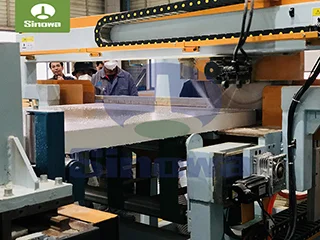
The cutting, shaping and post-processing module is the final processing section of the phenolic al duct panel line, which realizes the transformation from continuous semi-finished coiled materials to standard finished panels. The cured integrated composite materials are conveyed to the precision cutting equipment along the production line. The system presets cutting size parameters according to the market application demands of duct panels, and completes fixed-length transverse cutting and edge trimming through high-speed cutting tools. The edge trimming process can remove the irregular residual materials on both sides of the panel to ensure that the cross-section of the finished panel is flat and neat, avoiding local stress concentration caused by edge burrs during subsequent installation and use. For some application scenarios requiring special surface treatment, the production line is also equipped with surface smoothing and embossing auxiliary devices to optimize the surface texture of aluminum foil, enhance the surface reflection performance and anti-fouling ability of the panel. After the completion of cutting and shaping, the finished panels are automatically sorted, stacked and packaged by the mechanical arm handling system. The whole process realizes unmanned intelligent operation, reduces the error rate and labor cost caused by manual handling, and maintains the flatness of the panels during stacking to prevent extrusion deformation.
The technological advancement of the phenolic al duct panel line is directly reflected in the comprehensive performance optimization of finished duct panels. Relying on standardized and refined production processes, the panels produced by professional production lines have extremely low thermal conductivity. The closed-cell foam structure formed by precise foaming process can effectively block heat transfer. In the actual operation of building ventilation and air conditioning systems, this material can significantly reduce cold and heat loss in the air delivery process, realizing remarkable energy-saving effects. In terms of safety performance, the phenolic foam substrate formed by resin cross-linking and curing has excellent high-temperature resistance. When encountering extreme high-temperature environments, the surface of the material will quickly form a dense carbonized layer. This carbonized structure can isolate oxygen and heat conduction, prevent the material from further combustion, and will not produce molten dripping substances and harmful volatile gases during the reaction process, which is significantly superior to other organic foam composite materials. In terms of environmental adaptability, the double-sided aluminum foil structure produced by the production line can resist external moisture erosion and chemical corrosion. The compact metal layer can block water molecules and acidic and alkaline corrosive media in the air, so the panel can maintain stable physical properties in humid underground spaces, coastal high-salt environments and industrial corrosive workshops.
In addition to core performance advantages, the panels manufactured by the phenolic al duct panel line also have prominent practical application characteristics in engineering construction. The overall density of the composite panel is low, and the lightweight structural design reduces the self-weight of the ventilation duct system. Compared with traditional metal ducts with the same ventilation area, phenolic aluminum duct panels can effectively reduce the load-bearing pressure of building structures, which is suitable for high-rise buildings and complex space construction scenarios with strict load-bearing restrictions. Meanwhile, the integrated composite molding process of the production line makes the panel have good bending resistance and structural toughness. It is not easy to crack and deform during transportation, cutting and on-site assembly, and can adapt to various complex pipeline laying paths. The internal foam structure also has excellent sound absorption and noise reduction functions. During the operation of the ventilation system, the porous cavity can absorb the airflow friction noise and mechanical vibration noise generated in the pipeline, improving the indoor acoustic environment. The smooth aluminum foil inner wall can reduce airflow friction resistance, lower the energy consumption of ventilation equipment, and further amplify the energy-saving advantages of the whole system.
From the perspective of industrial application scenarios, products manufactured by the phenolic al duct panel line cover a wide range of construction and industrial fields. In commercial building projects such as shopping malls, office buildings and hotels, the lightweight and energy-saving characteristics of the panels meet the long-term operation demand of central air conditioning systems. The simple and fast on-site assembly mode can shorten the construction cycle of ventilation projects and reduce the comprehensive construction cost. In public service buildings such as hospitals, schools and subway stations, the non-toxic and harmless raw material formula and flame-retardant performance of the panels ensure the safety and environmental protection of public space ventilation. The corrosion-resistant and dust-proof surface structure is convenient for daily cleaning and maintenance, maintaining the cleanliness of the air delivery pipeline. In industrial production workshops and cold storage facilities, the excellent thermal insulation performance can stabilize the internal temperature of the pipeline, reduce the operating load of refrigeration and heating equipment, and create a stable production and storage environment. In addition, in special scenarios such as underground pipe galleries and tunnel ventilation systems, the panels can adapt to dark, humid and poorly ventilated harsh environments, relying on their moisture-proof and anti-aging advantages to extend the service life of the duct system.
With the continuous development of industrial manufacturing technology, the phenolic al duct panel line is evolving towards intelligence, energy saving and environmental protection. The traditional production line relies on manual monitoring to adjust process parameters, which has the problems of low regulation accuracy and unstable product consistency. The upgraded modern production line introduces an intelligent data monitoring system. Sensors are arranged in each processing link to collect real-time data such as raw material flow, foaming temperature, rolling pressure and cutting size. The central control terminal automatically analyzes and optimizes the parameters to realize closed-loop intelligent production. In terms of energy saving transformation, the production line optimizes the heating and heat preservation structure of the curing channel. Waste heat generated during processing is recycled and reused through the heat exchange system, reducing the energy consumption of mechanical operation. In terms of environmental protection optimization, the production line is equipped with sealed waste gas collection and purification devices to filter and purify trace volatile substances generated during raw material reaction, avoiding air pollution. At the same time, the leftover materials generated in the cutting process are uniformly recycled and reprocessed to improve the utilization rate of raw materials and meet the requirements of green industrial production.
In the field of building material manufacturing, the phenolic al duct panel line also has outstanding economic and industrial promotion value. The integrated continuous production mode simplifies the intermediate links of material processing, realizes batch standardized production, and effectively reduces the comprehensive manufacturing cost of single-panel products. The unified production standards make the performance parameters of finished products consistent, which is convenient for the unified design and construction of engineering projects and improves the standardization level of the ventilation duct industry. Driven by this professional production line, phenolic aluminum duct panels gradually replace traditional galvanized iron sheets and single foam ducts, optimizing the material structure of the ventilation industry. From the perspective of long-term industrial development, the popularization and upgrading of production lines will further reduce the production threshold of high-performance composite duct panels, promote the technological popularization of energy-saving and environmentally friendly building materials, and drive the coordinated development of upstream raw material processing and downstream engineering construction industries.
In the actual production and operation process, the daily maintenance and parameter optimization of the phenolic al duct panel line are crucial to ensure the long-term stable operation of the equipment and the continuous optimization of product quality. Regular cleaning and maintenance of raw material conveying pipelines and mixing components can prevent raw material residue from causing pipeline blockage and mixing inhomogeneity. The tension correction device of the aluminum foil unwinding mechanism needs to be debugged regularly to ensure the flat feeding of aluminum foil and avoid composite defects. The rolling pressure and curing temperature parameters should be dynamically adjusted according to the ambient temperature and humidity changes in the production workshop to adapt to the physical state changes of raw materials in different seasons. In addition, the wear degree of cutting tools and transmission parts should be detected regularly, and worn parts should be replaced in a timely manner to ensure the cutting accuracy and transmission stability of the production line. Scientific maintenance management can not only extend the service life of mechanical equipment but also maintain the high-quality production state of duct panels, reducing the defective rate and production loss.
Looking at the future development trend of the industry, the phenolic al duct panel line will continue to deepen technological innovation in material compatibility, production efficiency and product diversification. On the premise of retaining the basic composite structure, the production line will develop multi-functional adjustable processing modules to produce duct panels with different thicknesses, densities and surface strengths, meeting the personalized material demands of different engineering scenarios. The intelligent linkage technology between equipment will be further optimized to realize automatic switching of production parameters and rapid mold change processing, improving the flexibility of small-batch and multi-type production. In terms of raw material optimization, the production line will be compatible with more environmentally friendly modified phenolic raw materials and high-strength composite metal layers, further improving the fire resistance, weather resistance and recyclability of finished panels. With the continuous improvement of global building energy conservation standards and public space safety requirements, phenolic aluminum duct panels, supported by professional production lines, will have broader market application space and become an essential basic material for green buildings and intelligent ventilation systems.
In conclusion, the phenolic al duct panel line is a systematic and intelligent industrial production system tailored for high-performance composite ventilation duct panels. It completes the whole-process processing from raw material fusion to finished product molding through refined and standardized mechanical processes. The production line not only endows phenolic aluminum duct panels with excellent thermal insulation, fire resistance, corrosion resistance and lightweight structural advantages but also realizes large-scale, low-cost and high-quality industrial production. With the continuous progress of construction technology and the upgrading of environmental protection and energy-saving concepts, this kind of professional production line will keep iterating and optimizing, continuously output high-quality composite duct products for various construction scenarios, and make important contributions to the high-quality development of the building ventilation industry and the popularization of green energy-saving building materials. The deep integration of production line technology and material performance will further consolidate the application status of phenolic aluminum duct panels in the modern building material market and create greater economic and social value for the whole industrial chain.
https://www.cnsinowa.com/sandwich-panel-machines/phenolic-al-duct-panel-line.html