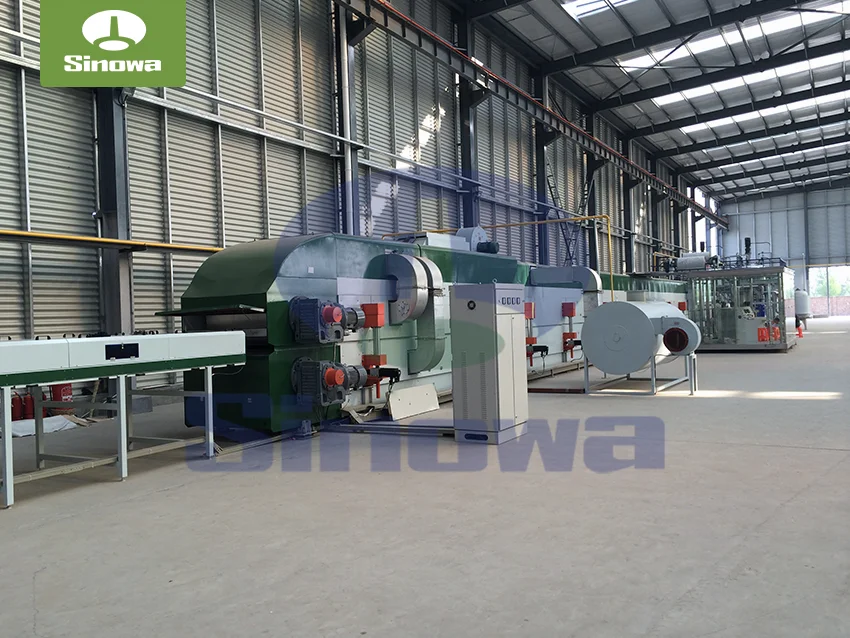
 sandwich panel machine
The overall structural composition of the phenolic sandwich panel machine adopts a modular integrated design concept, with each functional module closely connected and coordinated with each other to complete the whole process flow from raw material feeding, surface material pretreatment, phenolic core material preparation, composite pressing, fixed-size cutting to finished product output in a continuous and uninterrupted operating state. The main body of the equipment is composed of several key core structural parts, including raw material unwinding and conveying structure, surface material leveling and profiling structure, phenolic core material quantitative feeding and paving structure, high-pressure composite bonding pressing structure, constant temperature curing and shaping structure, fixed-length flying cutting structure and finished product automatic conveying and stacking structure. Each structural part is designed with targeted mechanical optimization according to the production characteristics of phenolic sandwich panels, avoiding the common problems such as uneven core material distribution, weak bonding interface and panel deformation that are prone to occur in the production process of composite panels. The raw material unwinding and conveying structure is responsible for the stable release and continuous conveying of metal or non-metal surface substrates, equipped with tension automatic adjustment components to ensure that the surface materials maintain uniform tension and no deviation during long-term high-speed operation, preventing wrinkles, scratches and position offset of the surface materials in the subsequent composite process. The surface material leveling and profiling structure carries out precision leveling and customized shape processing on the conveyed surface materials, adapting to the production requirements of flat, corrugated and special-shaped phenolic sandwich panels, and ensuring the flatness and structural regularity of the outer protective layer of the finished panels.
The phenolic core material quantitative feeding and paving structure is one of the most distinctive core components that distinguish the phenolic insulation sandwich panel machine from other ordinary sandwich panel production equipment. Phenolic foam core materials have unique foaming characteristics and fiber structure characteristics, requiring precise control of feeding volume, paving thickness and uniform distribution state in the production process to ensure that the core layer density of each batch of finished panels is consistent and the internal structure is uniform without hollowing or uneven thickness. This structural part adopts intelligent quantitative feeding and layered uniform paving design, which can accurately adjust the feeding amount and paving range according to the preset thickness and performance parameters of the phenolic sandwich panel, so that the phenolic core material can be evenly laid between the upper and lower surface materials to form a stable intermediate composite base layer. The high-pressure composite bonding pressing structure is the key structure to determine the overall bonding strength and structural compactness of the phenolic sandwich panel. Different from the simple pressing design of ordinary panel machines, this pressing structure adopts multi-stage pressure regulation and uniform force application design, which can apply balanced and stable composite pressure to the integrated structure of surface material and phenolic core material. It can not only ensure the tight bonding between the phenolic core layer and the surface material interface without gaps and degumming, but also avoid damaging the internal foam fiber structure of the phenolic core material due to excessive pressure, so as to maintain the inherent excellent thermal insulation and fire resistance of the phenolic material itself.
The constant temperature curing and shaping structure is set behind the composite pressing link, aiming to accelerate the stable bonding and structural shaping of the composite panel after pressing, so that the bonding adhesive between the core layer and the surface material can quickly reach the optimal curing state, and the overall structural stability of the phenolic sandwich panel can be initially formed in a short time. The internal temperature of the curing structure can be adjusted in a wide range according to the material characteristics and production speed, ensuring that the curing reaction proceeds stably without high-temperature damage to the phenolic core material and surface substrate. The fixed-length flying cutting structure realizes synchronous dynamic cutting according to the required size specifications of the finished panel, adopting high-precision cutting control technology to ensure that the cutting section of the phenolic sandwich panel is flat and smooth without burrs, edge collapse and core material shedding, which facilitates the direct installation and use of the finished panel without secondary trimming processing. The final finished product automatic conveying and stacking structure automatically conveys the cut qualified phenolic sandwich panels to the designated position and completes orderly stacking, realizing automatic collection and arrangement of finished products, reducing manual handling links and improving the overall continuity and automation level of the entire phenolic panel production line. All structural parts of the whole equipment are connected through synchronous transmission systems, realizing coordinated operation of each link, avoiding production pause and panel quality fluctuation caused by asynchronous operation of different structural modules.
In terms of structural performance, the phenolic insulation board production line has outstanding operational stability, production adaptability, molding precision and long-term durability, all of which are core performance advantages formed based on the targeted optimization of the structural characteristics of phenolic composite materials. First of all, the equipment has excellent mechanical operation stability, and the main load-bearing structural parts are made of high-strength and rigid structural materials, which can maintain stable operating state under long-term continuous high-load production conditions, without structural deformation, component wear failure and operational jitter. This stable mechanical operation performance ensures that the production process of phenolic sandwich panels is not affected by long-term operation time, and the structural size and composite quality of each finished panel can maintain high consistency, avoiding batch quality differences caused by equipment operation jitter. Secondly, the equipment has strong production adaptability, which can flexibly adapt to the production and processing of phenolic sandwich panels with different thickness specifications, different surface material types and different structural shapes. It can switch production parameters and structural adjustment states according to different production demands, meeting the diversified production needs of thin-specification panels for interior partition use and thick-specification panels for exterior wall enclosure and special fireproof engineering use.
The molding precision performance of the phenolic sandwich panel line is also a key core performance highlight, and each production link is equipped with precision control and adjustment components to realize accurate control of panel thickness, overall flatness, bonding uniformity and cutting size. The thickness control error of the produced phenolic sandwich panels is kept within a very small range, the surface flatness is good, and the bonding interface between the core layer and the surface material is uniform and firm, which effectively guarantees the overall structural mechanical properties and service safety of the finished panels. In addition, the equipment has good long-term durability and anti-corrosion operation performance. Since phenolic raw materials will produce slight chemical volatility during the foaming and composite bonding process, all internal structural components in contact with raw materials and production environments are treated with special anti-corrosion and wear-resistant protection, which can resist the long-term corrosion impact of phenolic chemical components, reduce component wear and aging speed, extend the overall service life of the equipment, and reduce later maintenance and replacement costs. At the same time, the equipment also has excellent production energy-saving performance, the power consumption of each functional module is reasonably matched, and the heat energy in the curing and pressing links is recycled and utilized, reducing the overall energy consumption in the production process, conforming to the energy-saving and environmental protection development trend of modern building material production industries.
According to different production automation levels, production capacity scales and production process characteristics, phenolic board production machine can be divided into multiple mainstream types, each with distinct structural design characteristics and targeted production application scenarios, meeting the differentiated production needs of different production enterprises and different engineering project supporting demands. The first category is fully automatic continuous phenolic sandwich panel production machine, which belong to large-scale integrated production equipment with a high degree of automation and uninterrupted continuous production capacity. This type of machine integrates all functional structural modules into a complete assembly line, realizing full-process automatic operation from raw material feeding to finished product stacking without manual intervention in the intermediate links. The structural design of the equipment focuses on high production efficiency and large-scale mass production, with fast production speed and large daily output, suitable for large professional building material production enterprises that take phenolic sandwich panels as their core products and need long-term batch supply for large engineering projects. The fully automatic model is equipped with intelligent parameter adjustment and remote monitoring components, which can adjust production parameters in real time according to production demand changes, automatically monitor the operating state of each structural module, and timely early warn and adjust abnormal conditions, ensuring efficient and stable long-term production operation.
The second category is semi-automatic discontinuous phenolic sandwich panel manufacturing machine, which are small and medium-sized flexible production equipment with moderate automation level and flexible production switching characteristics. Different from the continuous production mode of fully automatic equipment, this type of machine adopts intermittent discontinuous production process, with partial feeding and auxiliary operation links requiring manual cooperation and coordination. The overall structural design of the equipment is relatively compact, occupying a small production space, with low equipment investment cost and simple later maintenance operation. It is mainly suitable for small and medium-sized building material processing enterprises and temporary production supporting projects, which have small production demand, many product specification types and frequent switching of production varieties. The semi-automatic discontinuous machine can flexibly adjust production rhythm and product specifications according to market demand and project requirements, with strong production flexibility, and can meet the small-batch and multi-batch production needs of special-shaped phenolic sandwich panels and customized specification panels that are not suitable for large-scale continuous production.
The third category is special customized phenolic sandwich panel processing machines, which are professional equipment specially designed and structurally optimized for phenolic sandwich panels used in special engineering fields and special working environments. This type of machine carries out targeted structural upgrading and functional adjustment on the basis of conventional production equipment according to the special performance requirements of panels in specific application scenarios. For example, the equipment for producing phenolic sandwich panels for clean workshop engineering will optimize the pressing and curing structure to ensure that the surface of the produced panels is smooth and seamless, free of dust and impurities, and meets the cleanliness requirements of clean environment use; the equipment for producing phenolic sandwich panels for offshore and chemical anti-corrosion environments will strengthen the anti-corrosion treatment of the machine structure and optimize the composite bonding process to improve the anti-aging and anti-corrosion performance of the finished panels; the equipment for producing phenolic sandwich panels for high-rise building exterior wall fire protection will adjust the core material paving and pressing parameters to enhance the fire resistance and structural wind resistance of the panels. The special customized phenolic insulation board production line has strong pertinence in structural design and production performance, and can produce phenolic sandwich panels that meet the special harsh use conditions and special engineering performance standards.
The phenolic sandwich panels produced by professional phenolic sandwich panel making machine have excellent comprehensive performance such as light weight, high strength, fire resistance, thermal insulation, sound insulation, corrosion resistance and easy installation, so they have a wide range of practical application values and application coverage in multiple fields such as modern construction engineering, industrial production facilities, special environmental engineering and modular prefabricated buildings. In the field of industrial plant and storage facility construction, phenolic sandwich panels are used for building exterior wall enclosure, roof thermal insulation and internal partition wall construction. The panels produced by professional equipment have stable structural performance and good wind and pressure resistance, which can meet the long-term use needs of industrial plants under different environmental conditions. At the same time, the excellent thermal insulation performance of the panels can effectively reduce the energy consumption of industrial plant temperature regulation, and the good fire resistance can improve the overall fire safety level of industrial production and storage places, avoiding fire safety hazards caused by flammable building enclosure materials.
In the field of cold storage and constant temperature warehouse construction, phenolic sandwich panels are the preferred core thermal insulation and enclosure materials, and the professional production machine ensures that the core layer thermal insulation structure of the panels is uniform and the bonding is firm, so that the panels have extremely low thermal conductivity and stable long-term thermal insulation effect. The application of these panels in cold storage and constant temperature warehouse can effectively reduce the cold and heat loss in the warehouse, maintain the stable low temperature and constant temperature operating environment inside the facility, greatly reduce the operating energy consumption of refrigeration and temperature regulation equipment, and improve the operational efficiency and economic benefits of cold storage and constant temperature storage projects. In the field of clean rooms, medical facilities and food processing workshops, phenolic sandwich panels produced by standardized production machines have smooth surface, no dust accumulation, easy cleaning and disinfection, and good antibacterial and pollution-resistant performance, which can meet the strict environmental cleanliness and hygiene requirements of medical treatment, pharmaceutical production and food processing. The panels are used for internal partition and space enclosure of these facilities, creating a clean, hygienic and safe production and working environment, and ensuring that the production and operation activities in the facilities meet relevant health and safety standards.
In the field of modular prefabricated buildings and temporary construction facilities, phenolic sandwich panels have the advantages of light weight, convenient transportation and fast assembly and disassembly, and the structural size of the panels produced by the sandwich panel machinery is precise and the assembly performance is good, which is very suitable for the rapid construction of prefabricated houses, construction site temporary dormitories, field operation duty rooms and other temporary buildings. The application of the panels can greatly shorten the construction cycle of temporary facilities, reduce labor and construction costs, and the panels can be disassembled and reused many times, with good economic and environmental benefits. In the field of high-rise building exterior wall thermal insulation and fire protection enclosure, as well as ventilation and air conditioning duct insulation engineering, phenolic sandwich panels produced by special customized machines rely on excellent fire resistance and thermal insulation performance to effectively improve the fire safety and energy-saving insulation level of high-rise buildings, and provide reliable insulation and fire protection support for HVAC duct systems. In addition, in special working environments such as chemical plants and offshore engineering facilities, the corrosion-resistant and aging-resistant performance of phenolic sandwich panels gives them stable service capacity in harsh chemical corrosion and marine climate environments, providing long-term reliable structural enclosure and protection for these special engineering facilities.
With the continuous progress of building material production technology and the continuous upgrading of market demand for high-performance composite panels, the structural design and production performance of phenolic sandwich panel machines are also constantly innovating and optimizing towards higher automation, more precise molding, more energy-saving and environmental protection operation and stronger production adaptability. In the future, this type of professional sandwich panel equipment will further integrate intelligent control technology and automatic detection technology, realize full intelligent monitoring and precise adjustment of the whole production process, further improve the production quality consistency and production efficiency of phenolic sandwich panels, and reduce production energy consumption and manual operation costs. As the global construction industry accelerates the transformation to green energy conservation, safety and modularization, the market demand for high-performance phenolic sandwich panels will continue to grow steadily, and the phenolic sandwich panel machine, as the core production guarantee equipment, will play a more important role in promoting the high-quality development of the building material industry and the smooth construction of various high-standard and special engineering projects, continuously providing reliable equipment support for the diversified and high-quality application of phenolic sandwich panels in more industry fields.
https://www.cnsinowa.com/sandwich-panel-machines/phenolic-sandwich-panel-machine.html






