 sandwich panel line
The overall structural design of the integrated phenolic insulation board production line follows modular and collaborative operational concepts, with each functional unit operating independently while maintaining precise synchronous coordination. The entire production system covers raw material storage and precision metering, automatic mixing and foaming, substrate unwinding and preprocessing, continuous lamination and molding, constant-temperature curing and shaping, fixed-size cutting and edge trimming, as well as finished product sorting and stacking. Every functional link is optimized for the structural characteristics and reaction mechanism of phenolic resin materials, ensuring that the chemical foaming reaction and physical molding process of raw materials are completed under the most suitable environmental and process conditions. This highly integrated structural layout not only simplifies the overall production layout of the workshop but also lays a solid foundation for the large-scale and standardized production of phenolic insulation boards.
Raw material pretreatment and precision metering serve as the primary core links of the entire production process, directly determining the basic performance and structural uniformity of finished insulation boards. The main raw materials required for production include phenolic resin matrix, foaming agents, curing agents, flame retardant additives and functional fillers, each of which has strict requirements for storage environment and proportioning accuracy. The production line is equipped with independent temperature-controlled storage units for different raw materials, which can stabilize the activity of phenolic resin and avoid premature curing or performance attenuation caused by temperature fluctuation. The precision metering system adopts automatic flow monitoring and quantitative conveying structures, which can accurately control the proportion of each raw material in real time. Reasonable raw material ratio coordination can form a uniform and fine closed-cell foam structure in the subsequent foaming process, optimizing the thermal insulation and mechanical properties of the board while maintaining the inherent fire resistance and smoke suppression characteristics of phenolic materials. For auxiliary materials such as fiber reinforcements used to enhance board toughness, the system is also equipped with automatic cutting and scattering equipment to ensure the uniform distribution of reinforcing components in the board matrix.
After the completion of raw material proportioning, the fully automatic high-speed mixing and foaming unit starts to work, which is a key procedure to determine the internal cellular structure of phenolic insulation boards. Different from other foam insulation materials, phenolic foam has strict requirements for mixing speed, reaction temperature and foaming pressure, and the integrated production line is optimized in view of the particularity of phenolic material reaction. The closed high-speed mixing equipment realizes instantaneous and uniform mixing of resin and various additives, eliminating local concentration differences of curing agents and foaming agents. During the mixing process, the system maintains a stable reaction temperature range to ensure that the foaming agent undergoes slow and uniform gasification expansion, avoiding the quality defects of large pore size, uneven pore distribution or pore collapse caused by excessive foaming speed. The mixed raw material slurry is continuously and evenly poured on the surface of the lower substrate through a precise pouring device, forming a flat and uniform foam layer blank, which prepares for the subsequent lamination and molding process.
The substrate unwinding and preprocessing unit provides stable surface protection and structural support for phenolic insulation boards. The sandwich panel production line is compatible with multiple flexible and rigid substrate materials, including non-woven fabrics, kraft paper, fiber cloth and other common thermal insulation substrate materials. The automatic unwinding device can realize continuous and stable discharging of coiled substrates, and is matched with a web deviation correction system to ensure the flatness and alignment of substrates in the conveying process. The built-in preheating structure can remove moisture on the substrate surface and adjust the surface tension of the material, effectively improving the bonding firmness between the substrate and the phenolic foam core layer. In the continuous production process, the upper and lower substrate conveying systems operate synchronously with the intermediate foam pouring system, realizing the one-time composite forming of the substrate and the foam core layer, avoiding the delamination and degumming problems easily caused by secondary bonding in traditional production processes.
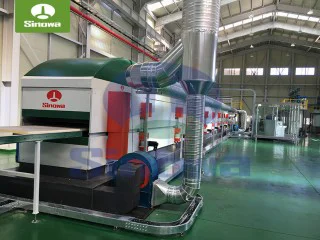
Continuous lamination and constant-temperature curing are the core molding links of phenolic insulation boards, which complete the fixed shaping and structural stabilization of board blanks. The laminated composite unit adopts a double-layer synchronous pressing structure, which can apply uniform and stable pressure to the composite board blank according to the preset process parameters. This uniform pressing mode can make the foam core layer fully fill the molding space, ensure the consistent thickness of the board, and further optimize the compactness of the internal cellular structure. The board after lamination enters the constant-temperature curing channel for segmented heat preservation and curing reaction. The internal temperature of the curing channel is distributed in a gradient manner, which can adapt to the gradual curing process of phenolic resin. The low-temperature pre-curing stage stabilizes the initial foam structure to prevent deformation, and the high-temperature deep-curing stage promotes the complete cross-linking reaction of the resin, so that the board forms stable mechanical structure and excellent physical properties. The integrated design of lamination and curing realizes uninterrupted continuous production, greatly improving production efficiency while ensuring the overall flatness and structural stability of the board.
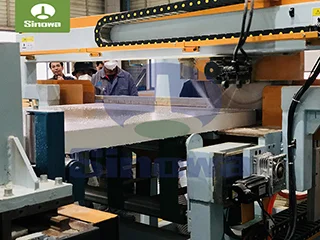
The fixed-size cutting and edge trimming unit is responsible for the finishing and shaping of semi-finished boards to meet unified specification standards. After continuous curing and shaping, the board has stable structural performance and is conveyed to the cutting area through the automatic conveying system. The production line is equipped with intelligent sizing and cutting equipment, which can flexibly adjust the cutting length and width according to production demands, realizing precise fixed-size processing of boards. The high-speed cutting tool adopts optimized structural design to ensure smooth and neat cutting sections without burrs, cracks or material shedding. The edge trimming procedure further polishes the four sides of the board to eliminate irregular edges and residual materials generated in the molding process, ensuring the dimensional accuracy and appearance flatness of each finished board. All cutting and trimming processes are completed automatically by the equipment, with no manual auxiliary operation required, effectively avoiding dimensional errors caused by human factors and improving the yield rate of finished products.
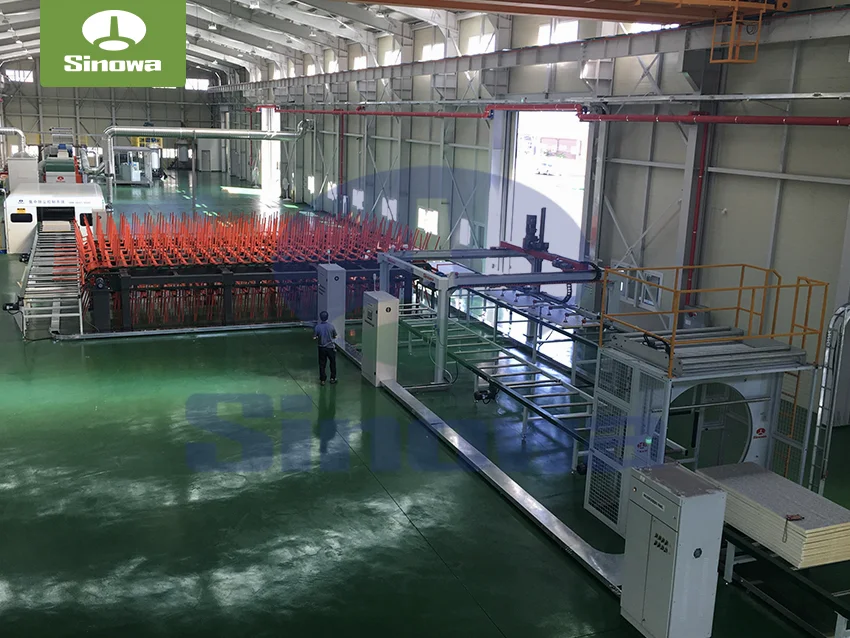
The final finished product sorting, conveying and stacking unit realizes the automatic collection and arrangement of qualified products. The processed phenolic insulation boards are automatically screened by the system through real-time detection of dimensional accuracy and surface flatness. Qualified products are stably conveyed to the stacking area through the conveying platform, and the automatic stacking equipment carries out orderly stacking according to the set arrangement mode and quantity, which is convenient for subsequent centralized storage and transportation. The entire post-processing link is closely connected with the front-end production process, forming a fully closed-loop continuous production mode from raw material input to finished product output, realizing unmanned continuous operation of the whole production line and greatly reducing labor costs and production cycle.
The integrated phenolic panel production line has outstanding technical advantages in process optimization and product performance control. First of all, the full-process integrated collaborative control mode realizes the synchronous matching of material proportioning, foaming, molding and curing parameters, ensuring that the core layer structure, thickness uniformity and surface bonding strength of each batch of boards remain highly consistent. The closed production environment effectively isolates external dust and temperature interference, avoiding the impact of environmental changes on the foaming and curing reaction of phenolic materials, and improving the overall quality stability of products. Secondly, the segmented gradient curing process unique to the production line can fully exert the performance advantages of phenolic resin materials, so that the produced insulation boards have ultra-low thermal conductivity, excellent thermal insulation performance, good structural toughness and compression resistance, and can maintain stable performance in long-term high and low temperature alternating environments.
In terms of production flexibility, the integrated sandwich panel line has strong adaptive adjustment capabilities. By adjusting the operating parameters of the metering system, pressing system and curing system, the equipment can produce phenolic insulation boards with different thicknesses, densities and structural strengths, meeting the differentiated usage requirements of different application scenarios. Whether it is thin decorative insulation boards for building interior walls or thick high-strength insulation boards for industrial equipment and pipeline thermal insulation, the production line can complete efficient and standardized production through simple parameter adjustment. In addition, the modular structural design of the production line facilitates daily maintenance and later process upgrading. Each functional unit is relatively independent, which can realize targeted maintenance and component replacement without affecting the overall operation of the equipment, reducing the failure rate and maintenance cost of the production line.
In actual industrial production applications, the integrated phenolic insulation board production line effectively solves many pain points of traditional intermittent production equipment, such as low production efficiency, large product performance differences and high material waste rate. The precise closed-loop control of raw material proportioning and foaming process greatly reduces the generation of unqualified products, improves the comprehensive utilization rate of raw materials, and realizes energy-saving and efficient production. The continuous automatic production mode can maintain long-term stable operation, greatly improve the daily output of a single production line, and meet the large-scale procurement demand of the market for phenolic insulation materials.
The products produced by the integrated phenolic board production line have broad application value in multiple fields. Relying on the excellent thermal insulation, fire resistance, sound insulation and weather resistance of phenolic foam materials, the finished boards are widely used in building exterior wall thermal insulation, roof energy-saving transformation, interior partition fire protection and thermal insulation, as well as thermal insulation and anti-corrosion of industrial pipelines, equipment and ventilation systems. The stable product performance and standardized dimensional specifications make the boards highly adaptable in engineering construction, which can effectively reduce building energy consumption, improve building fire safety levels, and extend the service life of industrial thermal insulation systems.
With the continuous upgrading of industrial energy-saving and environmental protection requirements, the integrated phenolic sandwich panel machine is also constantly optimized in terms of process technology and equipment performance. Modern production lines pay more attention to the refinement of process control and the improvement of environmental protection performance. The optimized mixing and foaming process reduces the volatilization of auxiliary materials in the production process, and the closed circulating operation mode realizes clean and low-consumption production. At the same time, the intelligent monitoring system of the production line can record and analyze the operating parameters of each link in real time, realize early warning and automatic adjustment of abnormal production conditions, further improve the intelligent level of production, and provide reliable technical support for the long-term stable and high-quality production of phenolic insulation boards.
In summary, the integrated phenolic insulation board production line, with its integrated structural design, automated production process, flexible production capacity and stable product quality control, has become the core equipment for the production of high-performance phenolic insulation materials. It not only improves the industrial production efficiency and product standardization level of phenolic insulation boards, but also gives full play to the performance advantages of phenolic materials, providing high-quality and reliable thermal insulation and fire protection materials for construction, industrial manufacturing and other fields. With the continuous development of energy-saving and environmental protection industries, this type of integrated production line will continue to iterate and upgrade in technology, and its application scope and market value will be further expanded, becoming an important supporting force for the development of the thermal insulation material industry.
https://www.cnsinowa.com/sandwich-panel-machines/integrated-phenolic-insulation-board-production-line.html