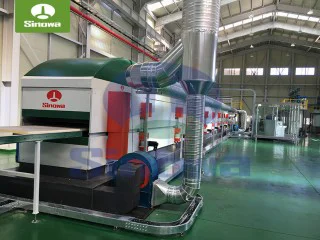
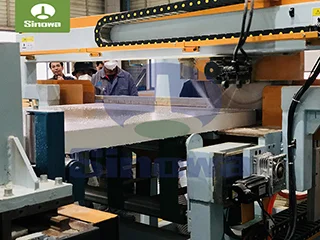
sandwich panel line
Raw material pretreatment serves as the initial and foundational stage of the entire phenolic panel production line, laying a critical foundation for subsequent molding and curing processes. The primary base materials for phenolic panels include natural fiber materials and inorganic filling components, all of which require strict impurity removal and particle size classification before entering the formal production link. In the pretreatment unit, raw materials are first transported to dedicated crushing and screening equipment, where oversized raw materials are crushed into uniform particles, while impurities such as dust and inert particles are eliminated through air separation and gravity sedimentation. This purification process effectively avoids local structural defects caused by foreign impurities in finished panels and ensures consistent material density throughout each panel. Meanwhile, moisture regulation is completed in this stage, as the moisture content of raw materials directly affects the bonding effect of phenolic resin and the thermal compression efficiency in subsequent processes. The production line adopts non-contact real-time monitoring methods to track moisture changes, adjusting drying parameters dynamically to maintain the raw material moisture within the optimal range required for thermosetting reaction. After pretreatment, qualified raw materials are stored in sealed silos to prevent secondary moisture absorption and contamination from the external environment.
Resin preparation and uniform gluing constitute the core technological link that distinguishes phenolic panel production from common board manufacturing. Phenolic resin, as the key adhesive material of the panel, needs to undergo polymerization reaction under precisely controlled temperature and proportion conditions inside dedicated reaction vessels. During the reaction process, raw chemical materials are added into sealed reaction equipment at a constant feeding rate, and the internal temperature and fluid viscosity are monitored in real time to stabilize the polymerization degree of the resin. Circulating cooling systems are deployed inside the reaction vessels to dissipate excess heat generated by chemical reactions, preventing resin aging or performance degradation caused by overheating. Once the resin reaches the ideal viscosity and activity, it is transported to the gluing unit through insulated pipelines to maintain stable chemical properties. In the gluing process, the production line adopts multi-directional spraying and rolling composite gluing technology, which enables the phenolic resin to evenly cover the surface of fiber particles and penetrate into the tiny gaps of raw materials. The intelligent flow regulation system automatically adjusts the resin dosage according to the feeding speed and material thickness, avoiding excessive resin accumulation that leads to increased brittleness or insufficient gluing that causes weak bonding. Uniform resin distribution ensures that every part of the panel maintains consistent hardness and adhesion after curing.
Material paving and blank forming transform the glued raw materials into preliminary panel blanks with fixed structural forms. After the gluing process, the mixed materials are conveyed to the paving unit through automated transmission equipment. The paving system is equipped with symmetrical airflow nozzle components, which disperse raw material particles evenly on the conveyor mesh belt through controllable airflow. This airflow paving method can form a gradient structure with dense surface layers and stable inner layers, optimizing the surface flatness and internal stress balance of the panel blank. During the paving process, the thickness detection device continuously scans the material layer, and the system automatically corrects the paving density to eliminate local thickness deviation. Excess edge materials generated during paving are collected by the circulating recovery system, crushed and screened again, and then sent back to the paving unit for secondary utilization, reducing raw material waste. After paving, continuous panel blanks are cut into specified lengths by precision cutting components, and the cut blanks are steadily transported to the thermal compression unit through synchronous transmission equipment, ensuring uninterrupted connection between production processes.
High-temperature thermal compression is the key molding process that determines the mechanical strength and structural stability of phenolic panels. The thermal compression equipment in the production line adopts a closed pressing structure, which provides stable high temperature and high pressure environment for the thermosetting reaction of phenolic resin. Before the panel blank enters the press, the preheating system raises the blank temperature moderately to reduce the temperature difference between the material and the pressing plate, avoiding internal cracks caused by rapid temperature change. In the pressing stage, the system accurately controls pressure intensity, heating temperature, and pressure holding time according to the material formula and panel thickness. High pressure compacts the loose panel blank to eliminate internal voids, while continuous high temperature accelerates the cross-linking reaction of phenolic resin, forming a stable three-dimensional network structure between raw material particles. The internal circulation heat conduction system of the press ensures uniform temperature distribution on the pressing plate, so that each position of the panel receives consistent heat and pressure. After the pressure holding and curing stage, the pressure is released gradually at a controlled rate to prevent panel deformation caused by instantaneous pressure change. The thermally pressed rough panels have preliminary fixed shapes and basic mechanical properties, completing the transformation from loose materials to integrated solid panels.
Post-molding cooling and conditioning processes are essential to optimize the comprehensive performance of phenolic panels and eliminate internal stress. The high-temperature rough panels discharged from the press are sent to the constant-temperature slow cooling area, where natural heat dissipation is adopted under sealed and ventilated conditions instead of rapid cooling. Gradual temperature reduction can effectively release the internal stress generated during the thermal compression process, preventing panel warping, bending, or cracking in subsequent use. During the conditioning period, the internal molecular structure of the panel tends to be more stable, and the bonding force between resin and base materials is further enhanced. Meanwhile, the ventilation system in the conditioning area gently removes trace volatile substances generated during the thermal curing reaction, improving the surface finish and environmental friendliness of finished panels. The duration of cooling and conditioning is adjusted according to panel thickness and production batch to ensure that each panel achieves balanced temperature and humidity inside and outside, laying a foundation for subsequent finishing processing.
Precision trimming and surface finishing endow phenolic panels with standardized dimensions and smooth surface quality. After cooling, the rough panels are transported to the trimming unit, where multi-axis cutting equipment accurately cuts the four edges of the panels to remove irregular rough edges generated during molding. The cutting speed and tool angle are intelligently adjusted to ensure neat and smooth cutting sections without burrs or chipping. For panels requiring refined surface treatment, the production line is equipped with continuous polishing components, which use fine abrasive tools to polish the panel surface layer by layer, eliminating tiny protrusions and uneven textures. In addition, the surface homogenization process is completed in this link to make the panel surface have consistent gloss and flatness. All waste materials generated during trimming and polishing are collected through a centralized dust removal system, which not only maintains the cleanliness of the production environment but also realizes the recycling of solid waste materials. After finishing, the panels are sorted by size and appearance quality to classify qualified products and defective products, facilitating subsequent targeted packaging and reprocessing.
Automated detection and intelligent control systems run through the entire phenolic insulation board production line, realizing real-time monitoring and dynamic optimization of production parameters. Multiple sensor components are installed in each production unit to collect data such as material temperature, transmission speed, processing pressure, and panel thickness. The central control system integrates all monitoring data, compares it with preset production parameters, and automatically corrects deviations in the production process. For example, when the raw material feeding speed fluctuates, the system synchronously adjusts the gluing flow and paving frequency to maintain production consistency; when the thermal compression temperature drifts, the heating power is automatically calibrated to ensure stable curing effect. Besides conventional physical parameter detection, the system also monitors the operating status of mechanical components, identifying abnormal vibration, temperature rise, or running stagnation of equipment in advance. This intelligent monitoring mode reduces manual intervention frequency, lowers the probability of human operation errors, and improves the overall operational stability of the production line. At the same time, the production data is stored in the system to provide reference for subsequent process optimization and batch production adjustment.
Energy conservation and environmental protection design are indispensable parts of modern phenolic panel line manufacturing concepts. In terms of energy utilization, the production line adopts circulating heat preservation structures in high-temperature links such as resin reaction and thermal compression. Waste heat generated by equipment operation is recovered through heat exchange devices and reused for raw material preheating and workshop temperature regulation, effectively reducing comprehensive energy consumption. All transmission and processing equipment adopt low-noise structural design and shock absorption components to minimize noise pollution during operation. In terms of waste treatment, the production line builds a closed material circulation system: solid waste such as crushed leftover materials and defective panels are re-crushed and put into production again; trace waste gas generated in the resin reaction process is purified through adsorption and filtration devices to meet emission standards. The sealed production space prevents dust diffusion during material processing, maintaining a clean production environment. These energy-saving and environmental protection measures not only reduce resource consumption and production costs but also make the production process conform to sustainable industrial development standards.
The application scalability and technological development potential of PF insulation board production line make them occupy an important position in the modern composite material manufacturing industry. By adjusting raw material formulas and production parameters, the same production line can manufacture phenolic panels with different densities, thicknesses, and functional characteristics, meeting the usage requirements of diverse application scenarios. Panels produced by this type of production line have excellent heat resistance, chemical corrosion resistance, and mechanical compression resistance, which can adapt to complex working environments such as high temperature, humidity, and chemical erosion. With the continuous progress of industrial manufacturing technology, the phenolic panel line is evolving towards higher automation, intelligence, and integration. Upgraded production lines will adopt more precise micro-control technology to realize micron-level adjustment of panel structure, further improving the uniformity and durability of finished products. In addition, the optimization of raw material matching technology will promote the production line to use more renewable and environmentally friendly raw materials, reducing the dependence on non-renewable chemical resources.
In conclusion, the phenolic panel line is a highly integrated industrial production system combining chemical reaction technology, mechanical processing technology, and intelligent control technology. Every production link from raw material pretreatment to finished product sorting has rigorous process logic and technical standards, jointly determining the overall production efficiency and product quality. The efficient material circulation mode, precise parameter control system, and environmentally friendly production design enable the production line to maintain stable operating efficiency in long-term batch production. As the market demand for high-performance composite panels continues to grow, continuous technological optimization and structural upgrading of phenolic panel lines will further expand the application boundary of phenolic panels. Driven by industrial intelligence and green manufacturing concepts, this type of production line will gradually develop in the direction of lower energy consumption, higher precision, and stronger adaptability, providing reliable technical support for the sustainable development of the composite board manufacturing industry.
https://www.cnsinowa.com/sandwich-panel-machines/phenolic-panel-line.html