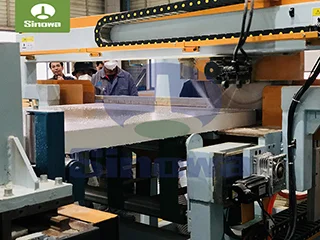
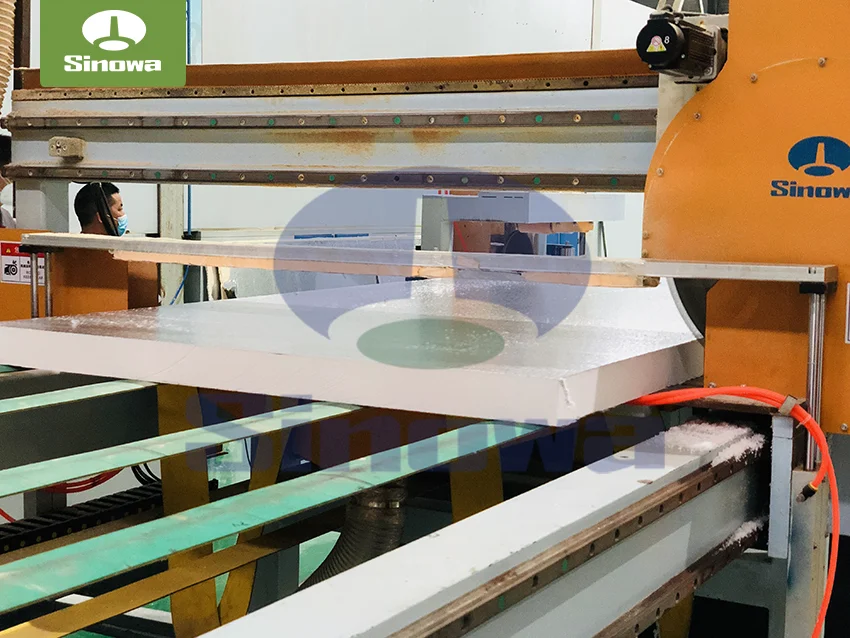
 sandwich panel line
The overall structure of a complete phenolic foam sandwich panel production line can be divided into six interconnected functional modules operating in synchronous linkage, and each module adjusts operating parameters dynamically according to real-time production feedback to match the chemical reaction characteristics of phenolic foam. The first module is the continuous surface material unwinding and leveling unit, which serves as the starting end of the whole production line and undertakes the feeding and pretreatment of upper and lower metal or non-metal surface materials. Coiled surface materials are placed on hydraulic unwinding racks, and the equipment adopts tension closed-loop control to avoid uneven stretching, wrinkling or deviation of surface materials during high-speed forward transmission. After unwinding, multiple groups of leveling rollers eliminate internal stress generated during coil processing, ensuring that the surface materials keep flat and consistent before entering the composite area. Meanwhile, an online surface cleaning device is equipped in this section to remove dust, oil stains and residual impurities on the inner surface of surface materials, which effectively improves the bonding adhesion between surface materials and phenolic foam core layers and avoids interlayer delamination defects in long-term service. Different from production lines for other organic foam sandwich panels, this unit reserves a mild preheating function for surface materials, heating the inner side of surface materials to a constant low temperature range, which prevents the rapid temperature difference between cold metal surfaces and high-temperature foaming raw materials from causing uneven foaming and local hollowing inside the core layer.
The second core module is the phenolic raw material automatic metering and high-pressure mixing unit, which determines the cellular uniformity, curing speed and overall mechanical strength of the foam core layer. Phenolic foam molding relies on irreversible cross-linking chemical reactions between phenolic resin main material, curing agent, foaming agent and auxiliary additives, and the reaction process is extremely sensitive to raw material ratio, mixing speed, material temperature and ambient humidity. This unit adopts independent closed storage tanks for different liquid raw materials, with constant temperature water circulation systems wrapped outside all storage tanks to stabilize the viscosity of liquid materials within a fixed range all day long. High-precision volumetric metering pumps are used for quantitative feeding instead of traditional gravity feeding modes, which eliminates measurement errors caused by changes in liquid material viscosity and liquid level height. All raw materials are transported to a high-speed dynamic mixing head in sealed pipelines without contact with external air, reducing excess air doping inside the mixed materials. Excessive air bubbles inside the foam will form structural defects and reduce the compression resistance and thermal insulation effect of finished panels, so the mixing speed of phenolic insulation board production line is carefully optimized and lower than that of polyurethane foam production lines, matching the slow and steady foaming expansion characteristics of phenolic raw materials. After sufficient homogeneous mixing, the composite liquid material is evenly poured onto the center of the lower surface material through a linear pouring nozzle, and the pouring width and flow rate are automatically synchronized with the running speed of the surface material to ensure consistent thickness distribution of the foam core layer in the transverse direction of the panel.
The third module is the continuous laminating and segmented temperature-controlled curing unit, which is the key link to complete composite molding and chemical curing of sandwich panels. After the liquid phenolic mixture is poured, the upper surface material is automatically closed through a guiding roller frame, and the whole composite plate body enters the double-belt continuous laminating machine. The double-belt laminating machine provides stable and uniform static pressure in the whole curing section, avoiding thickness deviation of panels caused by uneven pressure. The most prominent technical feature of phenolic foam laminating equipment is segmented gradient temperature control, which is completely different from the constant-temperature curing mode adopted by other organic foam production lines. The phenolic foaming reaction is divided into three sequential stages: initial expansion, intermediate cross-linking curing and final structural stabilization. The front section of the laminating area maintains a medium temperature environment to promote full and slow expansion of liquid raw materials to form dense and uniform closed-cell structures; the middle section raises the temperature moderately to accelerate molecular cross-linking reactions and realize rapid bonding between foam core and upper and lower surface materials; the rear section reduces the curing temperature gradually to eliminate internal thermal stress generated during high-temperature reaction. This gradient temperature control strategy effectively solves two common quality problems in phenolic foam panel production: surface cracking caused by excessive rapid foaming and soft core layers caused by incomplete cross-linking reaction. The whole laminating and curing process is completed in continuous linear operation without intermittent pause, which greatly improves overall production efficiency while ensuring stable composite bonding performance between layers.
The fourth module is the fixed-length tracking cutting and edge trimming unit. After completing integrated curing and preliminary shaping in the laminating section, the continuous long composite plate body is transported to the cutting area at a constant speed. The cutting system adopts dynamic tracking cutting technology that runs synchronously with the plate body, instead of static cutting that requires equipment to stop running. Servo motors drive the cutting saw to move forward at the same linear speed as the sandwich panel during cutting, which ensures neat and smooth cutting sections without burrs, plate deformation or core layer collapse. According to actual engineering application demands, the system can freely set arbitrary cutting lengths through the central control system. In addition to fixed-length cutting, automatic edge trimming devices are arranged on both sides of the cutting section to remove irregular foam overflow and uneven edge parts generated during laminating foaming, ensuring consistent width and regular edge structure of each finished panel. All cutting debris generated in this process is collected by a centralized dust suction and residue recovery system, realizing clean production and reducing material waste rate in the manufacturing process.
The fifth module is the forced cooling and post-curing shaping unit. Although the sandwich panel completes basic chemical curing inside the laminating machine, residual internal thermal stress still exists inside the foam core layer immediately after cutting, and incomplete micro cross-linking reactions continue to proceed within the foam. If panels are stacked directly after cutting without cooling treatment, cumulative heat will lead to panel bending, warping and thickness shrinkage in the later storage period. The cooling unit adopts circulating air cooling mode with uniform air volume distribution, avoiding local rapid cooling that causes inconsistent shrinkage of surface materials and foam core layers. After gradient cooling for a set period of time, the internal structure of phenolic foam tends to be completely stable, and all chemical reactions are fully finished. This post-curing process is an indispensable customized design for phenolic insulation panel production line, which is not required for polystyrene sandwich panel production lines with mild foaming reactions and low reaction heat. This targeted process design significantly improves the long-term dimensional stability of finished phenolic foam sandwich panels under changing ambient temperature and humidity conditions.
The sixth terminal module is automatic stacking and conveying unit. Qualified panels after cooling and shaping are automatically classified and stacked according to production specifications through a mechanical arm grabbing system. The stacking height and stacking interval are set uniformly to prevent extrusion damage to panel surfaces and core structures during stacking. The stacked finished products are transported to the finished product storage area through roller conveyors for subsequent storage and delivery. The whole process from raw material feeding to finished product stacking is fully automated, requiring only a small number of on-site operators to monitor the operating state of the central control system and conduct regular routine inspection of mechanical equipment, which minimizes manual operation errors and reduces labor costs in panel manufacturing.
Compared with continuous production lines for polyurethane sandwich panels and rock wool sandwich panels, phenolic sandwich panel production line has unique technical design orientations adapting to material characteristics in mechanical structure and process logic. In terms of reaction control, polyurethane foam features fast foaming speed and short curing cycle, so its production line pursues ultra-high linear operating speed, while phenolic foam requires slow and controllable foaming progress, so the phenolic panel production line focuses more on temperature and pressure accuracy control rather than blind speed improvement. In terms of composite bonding, rock wool sandwich panels belong to inorganic rigid core materials, which rely on additional adhesive coating to realize bonding with surface materials, equipped with independent glue spreading equipment, while phenolic foam completes self-bonding with surface materials during the foaming cross-linking process without extra adhesive materials, simplifying the overall line structure and avoiding aging failure risks of intermediate adhesive layers in long-term use. In terms of environmental adaptation, phenolic foam production lines are equipped with more comprehensive ambient temperature and humidity monitoring modules, because phenolic chemical reactions are more sensitive to external humidity; high air humidity will lead to reduced curing degree and increased water absorption rate of foam core layers, so the production workshop supporting the line needs matched constant humidity ventilation linkage system linked with the line control system.
In actual industrial production operation, optimizing energy consumption and reducing reaction by-product emissions are two core optimization directions of phenolic foaming sandwich panel line in recent years. In terms of energy saving optimization, the waste heat generated by the curing section of the laminating machine is recycled and transmitted to the raw material constant temperature storage tank and the surface material preheating section through a closed heat exchange pipeline, realizing cyclic reuse of production waste heat and reducing overall power consumption of heating equipment by nearly one quarter. All drive motors of the production line adopt frequency conversion synchronous control, and the operating power of each motor automatically matches the real-time production speed, avoiding invalid energy consumption under no-load and low-load operation states. In terms of environmental protection upgrading, the closed design of the whole raw material conveying and mixing system prevents volatile organic components generated during phenolic reaction from diffusing into the workshop air. The collected waste gas is processed by centralized adsorption and decomposition devices before being discharged up to standard. Meanwhile, leftover materials generated by cutting and edge trimming are crushed and recycled as auxiliary filling raw materials for low-density phenolic insulation components, realizing full-cycle utilization of production leftover materials and reducing solid waste discharge in the production process.
Looking into the future development trend of phenolic foam sandwich panel machine, intelligent digital upgrading and multi-functional flexible production will become two major development directions. First, the production line will further realize full-process digital twin monitoring. Real-time operating data including raw material metering ratio, curing temperature of each section, line running speed, panel thickness and bonding strength will be uploaded to the cloud monitoring platform synchronously. The system can automatically predict potential equipment failures and quality fluctuation risks in advance, realize unattended intelligent operation of the production line, and further stabilize product quality consistency. Second, flexible modular transformation will be carried out on the basis of existing fixed-process production lines. By replacing partial pouring nozzles and adjusting laminating pressure and temperature parameters, one single production line can switch between manufacturing standard wall panels, roof panels and special thin ventilation duct phenolic panels without large-scale mechanical modification, improving the equipment utilization rate and adapting to increasingly diversified customized demands in the construction insulation market. In addition, combined with the research and development of new low-carbon phenolic bio-based raw materials, the follow-up production lines will be optimized targeting new environmentally friendly raw material formulas, adjusting mixing parameters and curing curves to match the reaction characteristics of bio-based phenolic materials, further reducing the overall carbon footprint of phenolic foam sandwich panel manufacturing process.
In conclusion, the phenolic foam sandwich panel production line is a professional, refined and highly automated intelligent manufacturing system developed aiming at the unique chemical reaction mechanism and material performance advantages of phenolic foam. Every structural design and process parameter setting of the whole line is tailored to overcome the inherent production difficulties of phenolic materials, including sensitive foaming reaction, easy thermal stress deformation and strict requirements for cellular uniformity. With the global construction industry continuously raising requirements for building fire safety, energy conservation and emission reduction, phenolic foam sandwich panels will gain wider application scenarios in high-rise buildings, public infrastructure, industrial fireproof workshops and cold chain logistics buildings. Accordingly, the continuous iterative upgrading of supporting sandwich panel machinery will further improve production efficiency, reduce manufacturing energy consumption and realize more flexible production modes. The coordinated development of phenolic foam material technology and matched production line equipment will continue to promote the upgrading of the global building thermal insulation industry, providing more reliable and low-carbon composite material solutions for modern green and safe construction systems.
https://www.cnsinowa.com/sandwich-panel-machines/phenolic-foam-sandwich-panel-production-line.html