sandwich panel line
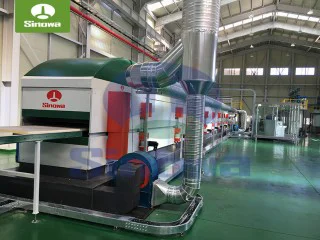
The overall structural design of the phenolic composite duct sandwich panel production line follows modular and integrated manufacturing concepts, with all functional units connected in a continuous production layout to avoid intermittent production gaps and ensure the consistency of product processing standards. The entire system is composed of multiple core functional modules, including raw material conveying and proportioning units, high-speed mixing and foaming units, continuous composite forming units, constant-temperature curing units, fixed-size cutting units, and post-processing finishing units. Each module operates in a coordinated and linked manner, with independent parameter adjustment functions while maintaining overall production synchronization, which effectively reduces manual intervention and improves the overall automation level of production. Different from traditional discrete production equipment, the integrated layout of the production line optimizes the material transmission path, reduces material loss in the production process, and creates stable and controllable production conditions for the preparation of high-quality phenolic foam composite panels.
Raw material pretreatment and precise proportioning constitute the initial and foundational link of the entire production process, which directly determines the basic physical and chemical properties of finished duct panels. The core raw materials of phenolic composite duct panels include phenolic resin base materials, foaming agents, curing agents, and auxiliary functional additives, as well as surface composite protective materials such as aluminum foil and non-woven fabric. In the phenolic insulation board production line raw material processing unit, all raw materials are screened and pretreated first to remove impurities and unqualified particles that may affect product quality. The system adopts automatic quantitative proportioning technology to accurately distribute various raw materials according to preset process parameters, avoiding performance fluctuations caused by artificial proportioning errors. The staged feeding design is adopted in the proportioning process, where different additives are added in sequence according to the reaction sequence of phenolic resin foaming and curing, ensuring that each raw material can fully exert its functional effects and lay a foundation for uniform foaming, dense structure, and stable performance of subsequent phenolic foam layers.
After the completion of raw material proportioning, the materials are transported to the high-speed mixing and stirring unit for homogeneous blending and preliminary foaming treatment. This unit is the key link to ensure the uniformity of the internal structure of phenolic foam. The high-speed stirring equipment realizes full mixing of resin substrates, foaming components, and curing auxiliaries through variable-frequency speed regulation, eliminating local component segregation and uneven material distribution. In the mixing process, the temperature and stirring speed are precisely controlled in real time to match the chemical reaction characteristics of phenolic materials. Appropriate stirring intensity and duration can promote the uniform dispersion of foaming agents in the resin matrix, ensuring that tiny and uniform bubble structures can be formed in the subsequent foaming stage. Meanwhile, the closed mixing environment effectively isolates external dust and temperature interference, preventing impurities from mixing into the materials and avoiding premature local curing or invalid foaming of raw materials, which ensures the activity and stability of the mixed materials entering the forming process.
The continuous composite forming process is the core working stage of the phenolic panel production line, completing the integration of phenolic foam core layer and surface composite materials. The fully mixed phenolic raw materials are evenly coated and laid on the surface of the lower layer composite material through an automatic spreading device. With the continuous advancement of the production line, the upper layer protective composite material is evenly covered on the surface of the phenolic material, forming a three-layer composite structure of surface protective layer, intermediate phenolic foam core layer, and bottom protective layer. In the forming section, the phenolic sandwich panel line adopts constant-pressure and constant-temperature rolling and shaping technology. The adjustable rolling pressure ensures the tight bonding between the phenolic foam layer and the surface composite materials, avoiding delamination, hollowing, or uneven bonding defects. The closed forming cavity maintains a stable temperature environment, which can accurately control the initial foaming speed and molding state of phenolic materials, so that the foam structure expands evenly in all directions and forms a regular and compact cellular structure. The continuous linear forming mode enables the panel thickness and width to be kept within a stable tolerance range, realizing unified specification molding of long-strip composite panels.
The constant-temperature curing unit undertakes the key task of stabilizing the structural performance of composite panels, which is an indispensable process to convert initially formed semi-finished products into structurally stable finished substrates. After composite forming, the semi-finished panels enter the independent curing channel, where a graded temperature control system is adopted to carry out staged curing treatment. The low-temperature pre-curing stage fixes the preliminary molding structure of the foam layer to prevent structural deformation and bubble collapse during subsequent processing. The medium-temperature curing stage promotes the complete cross-linking reaction of phenolic resin, realizing the solidification and hardening of the foam core layer and forming a high-strength and stable three-dimensional network structure. The slow cooling and shaping stage eliminates internal stress generated during the high-temperature forming and curing process, effectively improving the flatness and structural stability of the panels and avoiding warping, bending, and cracking of finished products in long-term use. The fully enclosed curing environment isolates external temperature and humidity changes, ensuring that each batch of panels receives consistent curing treatment and maintaining the stability of product mechanical properties and thermal insulation performance.
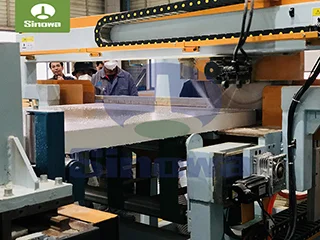
The fixed-size cutting and precision finishing unit realizes the dimensional standardization of finished products and meets diverse application specification requirements. After curing and cooling, the continuous long-strip composite panels are automatically transported to the cutting station, where the system performs fixed-length positioning and cutting according to preset dimensional parameters. The high-precision cutting equipment ensures flat and smooth panel sections without burrs, edge collapse, or uneven cutting, which improves the assembly accuracy of subsequent duct installation. Meanwhile, the edge trimming and finishing device of the phenolic panel production line can polish and trim the panel edges to eliminate tiny structural defects generated in the cutting process, further optimizing the appearance quality and assembly performance of the panels. For different application scenarios, the insulated sandwich panel production line can flexibly adjust cutting parameters to produce duct panels of multiple specifications and sizes, realizing flexible production and meeting the personalized dimensional requirements of different ventilation engineering projects.
The post-processing and finished product sorting unit completes the final quality sorting, stacking, and temporary storage of products. After cutting and finishing, the panels are automatically inspected for flatness, thickness uniformity, and surface integrity through the online detection device of the PF sandwich panel machine. Unqualified products with structural defects or dimensional deviations are automatically screened out, while qualified finished panels are neatly stacked by the automatic stacking device. The orderly stacking mode avoids extrusion deformation of panels during storage and transportation and facilitates subsequent packaging and handling. The whole post-processing process realizes automated operation, which not only improves production efficiency but also avoids secondary damage to products caused by manual handling, effectively ensuring the overall yield of finished products.
The phenolic composite sandwich panel line has prominent technical and production advantages compared with traditional manual and semi-automatic production modes. First of all, the highly automated integrated production mode greatly reduces manual operation links, effectively lowers the impact of human factors on product quality, and realizes long-term stable and continuous production. The modular equipment structure is convenient for daily maintenance and component replacement, reducing equipment failure rates and downtime losses, and improving the overall operation efficiency of the production line. Secondly, the precise parameter control system realizes fine management of raw material proportioning, reaction temperature, forming pressure, and curing time, making the internal foam structure of finished panels more uniform, the bonding between layers firmer, and the product thermal insulation, sound insulation, and structural strength performance more stable.
In terms of production performance, the continuous production mode of the equipment effectively improves production efficiency and output capacity, realizing large-scale batch production while ensuring product consistency. The optimized material transmission and processing structure reduces raw material waste in the production process, improving the utilization rate of production materials and reducing comprehensive production costs. In addition, the composite sandwich panel production line adopts a closed production design in key processing links, which reduces the volatilization of auxiliary materials and dust emission in the production process, making the production process more environmentally friendly and in line with the development requirements of green building material manufacturing.
The products manufactured by the phenolic composite duct panel production machiery have excellent comprehensive performance, which endows them with wide application value in modern building ventilation systems. The uniform and dense phenolic foam core layer gives the panels excellent thermal insulation performance, which can effectively reduce the heat and cold loss of ventilation ducts, improve the energy utilization efficiency of building HVAC systems, and achieve the effect of building energy conservation. The stable cross-linked resin structure makes the panels have good flame retardant and high-temperature resistance, avoiding the spread of fire and heat conduction in case of fire, improving the safety of building ventilation systems. At the same time, the composite structure formed by surface protective materials and phenolic foam layer has good corrosion resistance, moisture resistance, and aging resistance, which can adapt to complex indoor and outdoor ventilation environments and ensure long-term stable service performance of ventilation ducts.
In addition, the finished phenolic composite duct panels have the characteristics of light weight and high strength. The reasonable internal cellular structure and multi-layer composite design enable the panels to maintain stable structural strength and pressure resistance while reducing self-weight, which is convenient for on-site cutting, assembly, and installation of ventilation ducts, shortens the construction cycle of ventilation engineering, and reduces the load of building structures. The smooth and flat surface of the panels can reduce the wind resistance and dust accumulation of the ventilation pipeline, improve the fluency of air circulation, and ensure the cleanliness and stability of the building ventilation environment.
In the actual production and operation process, the stable operation of the phenolic composite duct sandwich panel machinery depends on standardized parameter setting and daily operation maintenance. The production parameters need to be finely adjusted according to the characteristics of different batches of raw materials and environmental changes such as temperature and humidity in the production workshop, so as to ensure that the foaming reaction, composite bonding, and curing molding are always in the optimal process state. Regular maintenance and calibration of mixing equipment, forming rollers, cutting devices, and detection systems can effectively maintain the processing accuracy and operation stability of the equipment, prolong the service life of the production line, and ensure the long-term consistency of product quality.
With the continuous upgrading of modern building energy conservation and environmental protection standards, the market demand for high-performance pre-insulated ventilation duct materials is constantly increasing, which promotes the continuous optimization and upgrading of phenolic composite duct panel production line technology. The future development direction of the production line focuses on higher automation intelligence, more precise process control, lower energy consumption, and more flexible production capacity. Through the optimization of transmission systems, intelligent parameter adjustment modules, and online real-time quality monitoring technology, the PF sandwich panel production equipment can further improve production efficiency and product qualification rate, realize intelligent management of the whole production process, and provide more reliable and high-quality material support for modern building ventilation engineering, industrial ventilation systems, and public infrastructure ventilation projects.
https://www.cnsinowa.com/sandwich-panel-machines/phenolic-composite-duct-panel-production-line.html