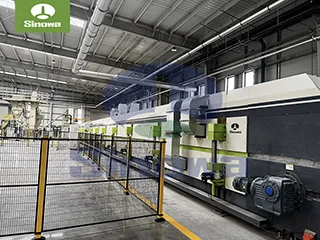
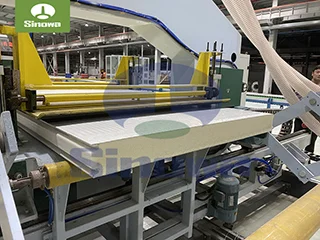
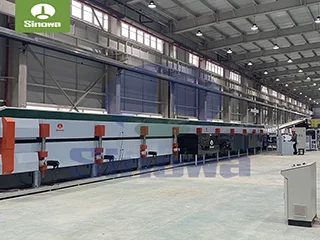
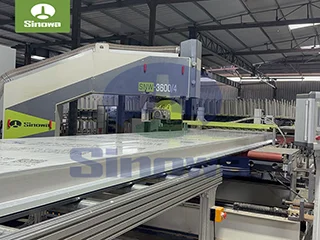
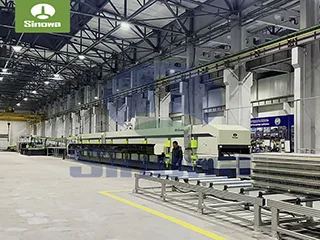
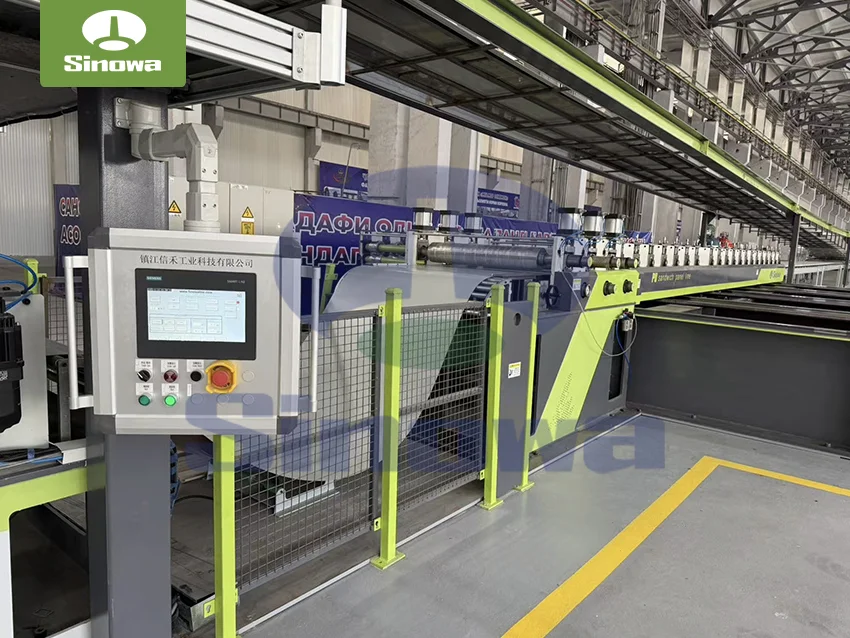
 sandwich panel line
The initial stage of the entire PIR sandwich panel production workflow centers on the scientific preparation and standardized pretreatment of all raw materials involved in production, which lays an indispensable foundation for the subsequent smooth progress of foaming compounding and composite bonding processes and directly determines the adhesion strength and long-term service stability between the panel surface layers and the PIR foam core. The main raw materials consumed in the production process are divided into two core categories: metal surface materials used for the upper and lower outer protective layers of the sandwich panels and liquid chemical raw materials required for the synthesis and foaming of the PIR rigid foam core layer. The metal surface materials commonly used in actual production are mostly continuous coiled metal substrates with surface protective and decorative coatings, which feature good surface flatness, excellent mechanical tensile resistance, and strong environmental corrosion resistance, suitable for long-term outdoor and indoor building enclosure use. Before entering the formal forming and composite processing stage, these coiled metal materials need to be steadily placed on the automatic unwinding equipment configured at the front end of the production line. The unwinding device is equipped with adaptive tension adjustment components, which can effectively avoid material deviation, tensile deformation, and surface scratch damage during the continuous unwinding process of the coiled materials. Stable tension control ensures that the metal sheets conveyed to the subsequent processing units maintain a flat and straight running state without wrinkles or local deformation, which is a basic prerequisite for ensuring the consistent thickness and neat edge structure of the final finished sandwich panels.
After the completion of the unwinding operation, the metal surface materials will be sent to the continuous roll forming processing area through the conveying roller way of the production line. The roll forming unit is composed of multiple groups of precision arranged forming rollers with different structural profiles, and through gradual mechanical rolling and cold bending processing, the flat metal sheets are processed into the required edge closing structures, installation connection grooves, and surface reinforcing rib structures according to the preset production processing standards. The gradual forming processing method adopted by the roll forming process avoids the structural damage and local stress concentration of the metal materials caused by one-time strong bending, effectively maintaining the mechanical structural strength and surface coating integrity of the metal surface layers. Each group of forming rollers in the roll forming unit can be finely adjusted in position and spacing according to different production specification requirements, enabling the production line to switch and process sandwich panel surface materials of different structural profiles without complicated equipment replacement work. After roll forming, the metal surface materials will enter the surface pretreatment and preheating process link. The pretreatment process mainly removes tiny dust, oil stains, and surface attachments generated during the unwinding and roll forming processes through automatic dust removal and surface cleaning components, ensuring that the inner bonding surface of the metal sheets maintains a clean and flat state. The subsequent preheating treatment raises the surface temperature of the metal sheets to the optimal temperature range required for subsequent PIR foam bonding through constant-temperature oven heating and roller conduction heating. Moderate preheating can effectively activate the bonding performance of the metal surface base layer, enhance the adhesion between the PIR foam raw materials and the metal surface layers in the subsequent foaming and composite process, and prevent the problems of poor bonding, hollowing between layers, and peeling and separation of surface layers and core layers in the later use of the sandwich panels.
While the metal surface materials are undergoing unwinding, roll forming, and preheating treatment, the liquid raw material preparation and centralized supply work for the PIR foam core layer is carried out synchronously in the special raw material storage and mixing area of the production line. The PIR foam is formed by the precise mixing and chemical reaction of two main liquid chemical components and a reasonable proportion of auxiliary additives and foaming agents. All liquid raw materials are stored in sealed special storage tanks with constant temperature and pressure maintenance functions, which can effectively avoid the quality changes of chemical raw materials caused by external temperature and humidity changes and ensure the stability of the chemical properties of each component during long-term continuous production. Each storage tank is equipped with an automatic material pumping and flow monitoring device, which can accurately control the output proportion and delivery flow of different liquid raw materials according to the preset production process parameters. The accurate proportioning of raw materials is the core key to determining the foam density, thermal insulation performance, compressive strength, and dimensional stability of the PIR core layer. Any deviation in the proportion of chemical components will directly lead to unqualified foam performance, such as excessive foam brittleness, insufficient bonding activity, or uneven internal pore structure of the foam. Before formal mixing and foaming, all liquid raw materials will be filtered through a precision filtering device to remove tiny impurities and precipitates that may exist in the raw materials, preventing the impurities from blocking the subsequent high-pressure spraying and mixing equipment and affecting the uniformity of foam mixing and foaming effect.
The high-pressure mixing and continuous foaming process is the most critical core link in the entire PIR sandwich panel production equipment, and it is also the processing stage that has the greatest impact on the comprehensive performance of the final finished sandwich panels. The filtered and proportioned PIR liquid raw materials are transported to the high-pressure foaming and mixing equipment through sealed conveying pipelines. Inside the professional mixing head of the equipment, different liquid components are fully and rapidly mixed under high-pressure driving, so that various chemical raw materials can undergo sufficient preliminary chemical reaction in a short time to form a uniform and stable foaming mixed material. After the completion of high-pressure mixing, the foaming mixed material is evenly and continuously sprayed between the upper and lower preheated metal surface materials through the automatic spraying and distributing device. The spraying position and spraying amount of the mixed material are precisely controlled by the intelligent control system of the production line, ensuring that the mixed material can be evenly covered on the inner surface of the metal surface materials without local accumulation or missing spraying areas. The foaming mixed material will quickly undergo chemical foaming and curing reaction after being sprayed between the two layers of metal materials, gradually expanding in volume and forming a continuous and dense rigid foam core structure. During the foaming reaction process, the internal pore structure of the foam is automatically formed and stabilized with the progress of the chemical reaction, forming a fine and uniform closed-cell structure, which endows the PIR sandwich panel with excellent thermal insulation, heat preservation, and sound insulation performance, as well as good compressive bearing capacity.
Immediately after the completion of foam spraying and initial foaming, the upper and lower metal surface materials and the PIR foam core in the foaming reaction state will enter the continuous composite laminating and pressure shaping unit together. The laminating unit is composed of upper and lower sets of parallel conveying pressing rollers and constant-temperature heat preservation components, which can apply stable and uniform pressing force to the composite materials in the foaming and curing stage on the basis of maintaining the continuous conveying state of the materials. The uniform pressing force can effectively control the overall thickness of the sandwich panel, ensure that the foaming core layer forms a consistent thickness structure as required by the production specifications, and at the same time promote the close fitting and firm bonding between the PIR foam and the inner surface of the metal surface materials. During the laminating and pressing process, the equipment maintains a reasonable constant-temperature environment inside, which can continuously provide the temperature conditions required for the complete curing reaction of the PIR foam, accelerate the solidification and shaping speed of the foam core, and avoid the problems of foam deformation, core layer displacement, and inconsistent bonding degree caused by too slow curing reaction speed. The running speed of the laminating rollers and the pressing gap between the upper and lower rollers can be adjusted according to different production requirements such as different panel thicknesses and foam curing speeds, ensuring that the production line can adapt to the production and processing of various specifications of PIR sandwich panels. In this process, the initial composite structure of the metal surface layers and the PIR foam core is fully fixed, and the basic structural integration of the sandwich panel is completed, forming a continuous long-strip composite panel structure.
After leaving the composite laminating unit, the continuous long-strip PIR sandwich panel enters the natural cooling and deep curing conveying area. Although the foam core has completed the initial curing and shaping in the laminating pressing stage, the internal chemical reaction of the foam still needs a certain period of time to be completely finished, and the internal structural stress of the composite panel also needs to be gradually released through natural cooling to ensure the long-term structural stability of the finished panel. The cooling and curing area is equipped with a long-distance horizontal conveying roller way, which allows the continuous sandwich panel to move forward at a constant slow speed and fully contact with the natural circulating air for gradual cooling. The length of the cooling and curing conveying area is scientifically designed according to the production running speed and the foam curing cycle, ensuring that the sandwich panel can fully complete deep curing and stress relief before entering the subsequent cutting process. Sufficient cooling and curing treatment can effectively prevent the finished sandwich panel from bending deformation, core layer shrinkage, and edge warping after being cut into fixed lengths, and ensure that the dimensional stability and structural flatness of each finished panel meet the use requirements. During the cooling and conveying process, the production line is equipped with real-time monitoring sensors, which can track the surface temperature and conveying state of the sandwich panel in real time. Once abnormal temperature fluctuation or material conveying stagnation is detected, the system will automatically adjust the conveying speed and give corresponding prompt signals to ensure the safe and stable operation of the cooling and curing process.
The fixed-length cutting and edge trimming process is an important processing link to standardize the size and neat structure of the finished PIR sandwich panels. After full cooling and deep curing, the continuous integrated long-strip sandwich panel is conveyed to the automatic cutting and edge trimming unit of the production line. According to the preset length parameters required by customer orders and project construction, the high-precision automatic cutting equipment performs fixed-length synchronous cutting on the moving continuous sandwich panel. The cutting equipment adopts a stable cutting mode that matches the production line conveying speed, which can complete the cutting operation without stopping the continuous production line, effectively improving the overall production continuity and operational efficiency. The cutting tool is made of wear-resistant and high-strength materials, which can ensure that the cutting section of the sandwich panel is flat and smooth without burrs, foam shedding, and metal edge deformation. After the completion of fixed-length cutting, the two side edges of the cut single sandwich panel will be finely trimmed and shaped by the edge trimming equipment to remove tiny uneven edges and residual foam burrs generated during the production and cutting process, ensuring that the edge structure of each finished panel is neat and uniform, and facilitating the subsequent on-site installation and splicing construction of the sandwich panels. All cutting and edge trimming parameters are uniformly controlled by the central control system of the production line, and the cutting size and edge trimming range can be quickly adjusted according to different order requirements, realizing flexible switching production of panels of different specifications.
After the completion of cutting and edge trimming, the qualified single PIR sandwich panel finished products will be sent to the finished product inspection, automatic stacking and temporary storage area along the conveying roller way. In the finished product inspection link, the production line is equipped with automatic detection components, which conduct real-time sampling and detection on the dimensional accuracy, surface flatness, bonding tightness between layers, and overall structural integrity of the finished panels. The detection work focuses on checking whether the panel thickness meets the standard requirements, whether there is peeling and hollowing between the metal surface layer and the foam core layer, whether the surface coating is damaged, and whether the edge structure is neat. Unqualified products detected during the inspection process will be automatically screened out and transported to the designated reprocessing area for subsequent unified treatment, while qualified finished panels will be sent to the automatic stacking equipment. The automatic stacking device neatly stacks the qualified sandwich panels according to the standardized stacking mode, realizing orderly arrangement and centralized management of finished products. The stacking process adopts mechanical automatic handling and stacking, which avoids surface damage and structural deformation of the panels caused by manual handling, and at the same time improves the stacking efficiency and neatness of finished products. The stacked finished PIR sandwich panels can be directly transported to the finished product warehouse for temporary storage, waiting for subsequent loading and transportation to construction sites and customer production and processing bases.
The stable and efficient operation of the entire PIR sandwich panel production machine is inseparable from the support and coordination of the intelligent central control system and daily equipment maintenance and operation management work. The central control system integrates all operation parameters and equipment operation status of each functional unit of the production line, including raw material proportioning flow, production conveying speed, preheating and laminating temperature, pressing pressure, cutting size parameters, and real-time operation data of each motor and transmission component. Production operators can monitor the overall production operation status of the entire production line in real time through the centralized control terminal, adjust various process parameters according to actual production conditions and order requirements, and timely discover and deal with minor abnormal problems in the production process. The intelligent control mode reduces the dependence on manual operation experience, realizes standardized and standardized production operation, and ensures the consistency and stability of product quality in the long-term continuous production process. In terms of daily equipment maintenance, regular cleaning, lubrication, fastening, and wear detection of each mechanical transmission component, foaming mixing equipment, cutting tools, and conveying roller ways are required. Timely maintenance and upkeep can reduce equipment wear and failure probability, extend the service life of the production line equipment, and avoid production interruption and product quality fluctuation caused by equipment failure.
In the actual industrial production application process, the PIR sandwich panel production machinery shows strong production flexibility and market adaptability, and can meet the production and manufacturing needs of sandwich panels for different application scenarios by adjusting production process parameters and raw material matching modes. Whether it is sandwich panels for building exterior wall thermal insulation enclosure, roof waterproof and thermal insulation structure, indoor partition wall sound insulation and thermal insulation facilities, or special enclosure panels for industrial factory buildings, cold storage constant temperature spaces, and public building auxiliary facilities, the production line can complete efficient and standardized production and processing. The PIR foam core layer produced by the production line has excellent low-temperature thermal insulation performance and structural stability, and the composite structure formed by bonding with metal surface materials has good wind pressure resistance, impact resistance, and environmental aging resistance. The sandwich panels produced by this production line can effectively reduce the energy consumption of building temperature regulation, improve the overall thermal insulation and energy-saving level of buildings, and shorten the on-site construction cycle of engineering projects due to their lightweight and easy-to-install structural characteristics. With the continuous upgrading of building energy-saving requirements and the continuous expansion of the application scope of prefabricated building components, the application value and market demand of continuous PIR sandwich panel production line in the field of modern building material manufacturing are constantly improving.
In the long-term production and operation practice, the operation and management of the PIR sandwich panel manufacturing line also need to pay attention to the coordination of production efficiency and product quality balance, as well as the optimization and upgrading of production process details. In the actual production process, different raw material batches, ambient temperature and humidity changes, and equipment long-term operation wear will have a certain impact on the foaming effect and composite bonding quality of the sandwich panels. Therefore, production management personnel need to regularly summarize production operation data, continuously optimize raw material proportioning parameters, production temperature and pressure settings, and conveying speed matching modes according to the actual production situation, so as to further improve the qualified rate of finished products and the overall operational efficiency of the production line. At the same time, with the continuous progress of industrial manufacturing technology, the fully automatic PIR sandwich panel production line is also constantly developing towards more intelligent operation, more energy-saving production mode, and more diversified product processing functions. The continuous optimization and upgrading of production line equipment and processes can not only improve the production capacity and product quality level of the production line, but also make the produced PIR sandwich panels better adapt to the higher standard requirements of modern buildings for energy conservation, environmental protection, structural safety, and construction convenience, laying a solid foundation for the long-term stable development of the prefabricated building and building energy-saving material industry.
https://www.cnsinowa.com/sandwich-panel-machines/pir-sandwich-panel-production-line.html