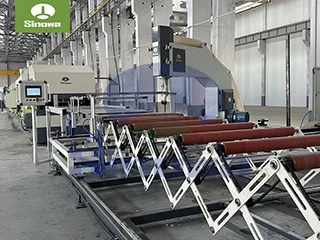
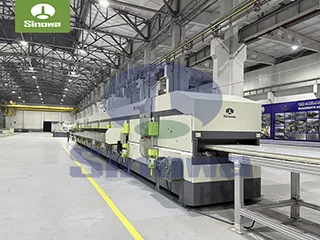
sandwich panel machine
At the core of the operational logic of any custom insulation sandwich panel machine lies the seamless coordination of multiple interconnected mechanical and functional systems, each designed and calibrated during the customization process to match specific material characteristics and panel forming requirements. The entire production workflow starts with the raw material feeding and preliminary processing stage, a foundational phase that directly determines the flatness, structural uniformity, and subsequent bonding quality of the finished sandwich panels. Metal coil materials used for the outer and inner surface layers of the panels, including various metal sheet substrates with different thicknesses and surface treatments, are steadily unwound through dedicated feeding units that are customized with adjustable tension control structures. This adjustable tension management function is essential to avoid material deformation, edge warping, or uneven feeding speed during the unwinding process, issues that would otherwise lead to inconsistent panel dimensions and weak structural bonding in subsequent composite procedures. After unwinding, the metal sheet materials pass through precision leveling and surface conditioning components, which eliminate internal mechanical stress generated during coil winding and smooth out any surface irregularities. This preliminary surface treatment not only enhances the overall appearance flatness of the final panels but also creates an optimal clean and stable surface condition for the subsequent adhesive coating and composite bonding processes, ensuring long-term bonding stability between the metal surface layers and the internal insulation core materials.
Following the preliminary processing of surface layer materials, the custom insulation sandwich panel machine proceeds to the roll forming and edge profiling stage, a key customization link that shapes the external structural shape and assembly connection structure of the sandwich panels. Different construction projects and enclosure application scenarios require sandwich panels with unique edge locking structures, connection groove designs, and surface profiling shapes to ensure tight assembly between panels, effective sealing performance, and overall structural stability after installation. Custom roll forming units are equipped with multiple sets of adjustable forming roller groups, the number, arrangement, and pressing depth of which can be flexibly adjusted according to the required panel cross-sectional shape and edge connection specifications. Each forming roller is precisely processed and treated to maintain long-term forming accuracy and wear resistance, ensuring that the metal sheets undergo gradual and uniform deformation during the rolling process without cracking, surface damage, or dimensional deviation. The customization of this forming system also covers the adjustment of forming speed and roller gap spacing, enabling the equipment to process metal sheets of different thicknesses and hardness levels while maintaining consistent forming quality throughout continuous production. Whether producing flat wall panels, roof panels with special slope structures, or special-shaped enclosure panels with customized edge connection structures, the adjusted roll forming system can stably complete the continuous forming of surface materials, laying a solid structural foundation for the subsequent composite bonding of insulation core materials.
The core material conveying and pretreatment system represents another vital customized module of the insulation sandwich panel production line, directly relating to the thermal insulation performance, fire resistance level, and overall structural thickness uniformity of finished panels. Insulation sandwich panels adopt a variety of core materials to meet different functional needs, including lightweight foamed insulation materials, fiber-based fireproof insulation materials, and composite thermal insulation substrates with high structural strength. Each type of core material has distinct physical characteristics such as density, hardness, compressibility, and thermal conductivity, requiring targeted conveying, cutting, and pre-processing configurations in the production equipment. Custom core material processing units are designed with adjustable cutting mechanisms, variable-speed conveying structures, and material arrangement auxiliary devices, which can accurately cut core materials into specified thicknesses and widths according to customized panel production parameters and synchronously feed the processed core materials into the composite bonding area in a stable and orderly manner. During the customization process, the conveying speed and feeding position of the core material system are precisely synchronized with the operating speed of the surface layer forming system, ensuring that the core material and upper and lower metal surface layers maintain a completely aligned feeding state without offset or misalignment. This synchronous feeding effect is critical to prevent uneven core material distribution inside the panels, local hollow areas, or inconsistent panel thickness, all of which would compromise the thermal insulation and structural performance of the finished products in actual use.
Adhesive coating and composite laminating are the core functional stages that determine the overall bonding firmness and structural integrity of insulation sandwich panels, and these parts of the machine are highly customized to adapt to different adhesive types and composite process requirements. Different core materials and surface layer substrates require matched adhesive materials with specific bonding strength and curing characteristics, and the custom insulation sandwich panel line is equipped with an adjustable automatic glue spraying and coating system that can control the glue application amount, coating uniformity, and spraying range according to production needs. The glue coating system ensures that the adhesive is evenly distributed on the bonding surface between the metal surface layer and the insulation core material, avoiding excessive glue waste or insufficient local glue application that could lead to weak bonding and panel delamination over time. After the completion of adhesive coating, the surface layers and core material enter the composite laminating unit, which features adjustable pressure and temperature control functions customized for different composite materials and curing process requirements. The laminating structure applies stable and uniform pressing force to the composite materials, promoting close fitting and effective bonding between all layers, while the controllable temperature environment accelerates the initial curing of the adhesive and enhances the initial structural stability of the composite panels. The customization of the laminating system includes the adjustment of pressing pressure, laminating distance, and operating speed, enabling the equipment to adapt to the composite processing of panels with different thicknesses and different material combinations, ensuring that each batch of panels achieves consistent bonding quality and overall structural compactness.
After the composite laminating and preliminary curing process, the continuously formed long-size sandwich panels enter the fixed-length cutting and edge trimming stage, a processing link that is customized to meet the diverse dimensional requirements of different engineering projects. Custom cutting and trimming units adopt precision automatic cutting control methods, which can set arbitrary cutting length and edge trimming specifications according to actual order needs, realizing accurate fixed-length cutting and neat edge finishing of continuous panels. The cutting mechanism is designed with high-speed and stable cutting performance, ensuring smooth and burr-free panel cuts without damaging the surface metal layer or internal core material structure during the cutting process. The edge trimming function further trims the uneven edges of the composite panels to ensure consistent overall dimensions and neat assembly edges of each finished panel, facilitating subsequent on-site installation and seamless splicing between panels. In addition to basic cutting and trimming functions, the customized post-processing part of the equipment also includes cooling and shaping auxiliary structures, which allow the freshly composite and cut panels to be naturally cooled and shaped within a certain period, eliminating internal stress generated during the laminating and cutting process and preventing panel deformation or warping after stacking and storage.
One of the most prominent advantages of a custom insulation board production line is its strong production flexibility and market adaptability, which enables panel manufacturers to quickly respond to the constantly changing demands of the construction and industrial material markets. In the current building construction field, different types of projects have completely different performance requirements for insulation sandwich panels: low-temperature cold storage and fresh-keeping warehouse projects focus on ultra-high thermal insulation performance and low thermal conductivity of panels; industrial factory buildings and warehouse enclosure structures require high structural wind resistance and load-bearing capacity; clean workshop and special medical and pharmaceutical production places put forward strict requirements for panel surface flatness, sealing performance, and anti-corrosion and antibacterial properties; and outdoor exterior wall insulation and building renovation projects need panels with good weather resistance and anti-aging performance. Through targeted customization of the insulation sandwich panel machine in terms of material feeding parameters, forming structure, composite process, and post-processing functions, manufacturers can produce sandwich panels with different thermal insulation coefficients, structural strengths, surface styles, and dimensional specifications on the same set of production equipment. This multi-functional production capability avoids the need for enterprises to purchase multiple sets of single-function production equipment for different product production needs, effectively reducing equipment investment costs and production site occupation, and improving the overall utilization efficiency of production equipment.
The structural design and operational control system customization of custom insulation sandwich panel making machine also bring significant advantages in production efficiency and operational stability. Modern customized equipment is equipped with a centralized automatic control system with adjustable parameter settings, which integrates the operation parameters of all links such as feeding, forming, gluing, laminating, cutting, and conveying into a unified control interface. Production operators can complete the switching of different production formulas and parameter adjustments through simple parameter setting operations, realizing rapid switching between the production of different types of sandwich panels without complex mechanical debugging or manual component replacement. The automatic synchronous control function ensures the coordinated operation of all mechanical parts of the equipment, avoiding production failures and product quality problems caused by asynchronous operation of different links. In addition, the customized mechanical structure of the equipment is optimized according to actual production site conditions, including the overall layout of the production line, the occupied space size, and the connection and matching with upstream and downstream production auxiliary equipment. Whether it is a small and medium-sized production site with limited space or a large-scale intensive production workshop pursuing high output, the equipment can be reasonably configured to adapt to the on-site production environment, ensuring smooth production operation and convenient daily operation and maintenance management.
In terms of long-term production operation and later maintenance, custom insulation sandwich panel production machine is designed with practicality and durability as the core customization principles, fully considering the long-term loss and daily maintenance needs of equipment in continuous industrial production environments. All key mechanical components and wearing parts of the equipment are selected and processed according to production intensity and service life requirements, with good wear resistance, pressure resistance, and corrosion resistance, reducing the frequency of component replacement and equipment failure downtime. The structural layout of the equipment fully considers the convenience of daily maintenance and overhaul, with reasonable arrangement of key maintenance parts and simple and quick disassembly and replacement steps for wearing parts. For different production intensities and production cycle requirements of enterprises, the equipment can be customized with enhanced structural stability designs and anti-fatigue operation configurations, ensuring that the equipment can maintain stable and high-quality production operation for a long time under high-intensity continuous working conditions. This reliable long-term operation performance not only improves the continuous production capacity of enterprises but also reduces later equipment maintenance costs and production loss risks caused by equipment failures, creating stable and long-term production benefits for sandwich panel production enterprises.
With the continuous advancement of building energy conservation policies and the continuous upgrading of industrial building enclosure standards, the market demand for high-performance and customized insulation sandwich panels will continue to grow, and the application value and market importance of custom insulation sandwich panel machinery will become increasingly prominent. Traditional standardized panel production equipment can no longer meet the personalized and refined production needs of the industry, and customized production equipment tailored to actual production conditions and product requirements has become an inevitable development trend in the sandwich panel production machinery industry. Custom insulation sandwich panel machines not only meet the diversified product production needs of panel manufacturers but also promote the overall upgrading of the insulation sandwich panel industry, helping to produce higher-quality, more energy-saving, and more applicable building enclosure materials for various construction and industrial projects. In the future, with the continuous innovation of new insulation core materials, new surface protection materials, and new composite bonding processes, the customization direction of insulation sandwich panel machines will be further expanded toward higher production automation, more flexible parameter adjustment, lower energy consumption, and more environmentally friendly production processes, continuously empowering the high-quality development of the construction energy conservation and industrial building materials industry.
https://www.cnsinowa.com/sandwich-panel-machines/custom-insulation-sandwich-panel-machine.html