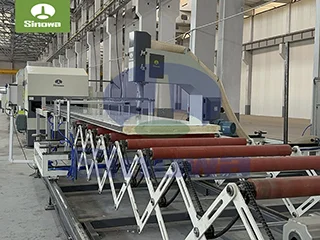
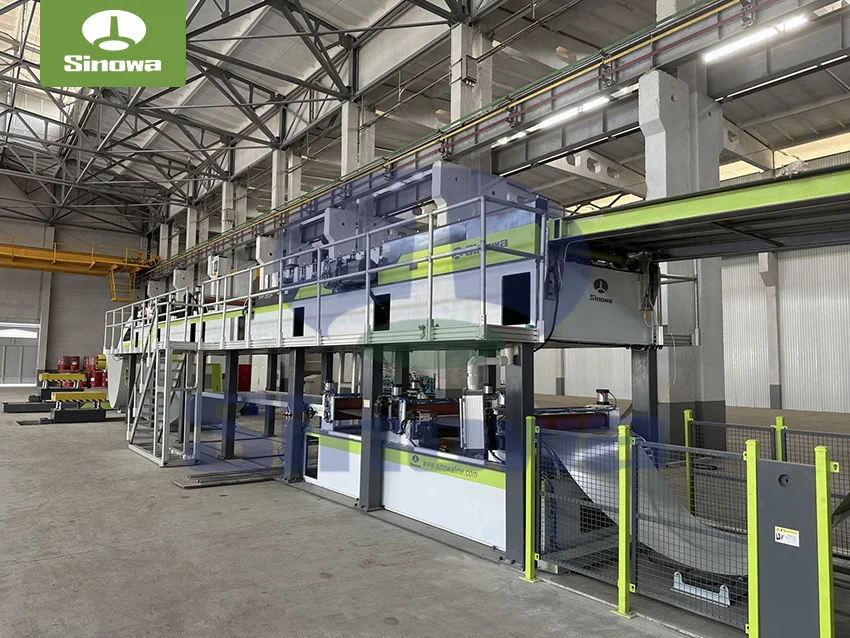
 sandwich panel line
Different from conventional sandwich panel production equipment that consumes energy in a single way and discharges waste heat directly, the upgraded high-efficiency PU sandwich panel production line integrates intelligent energy management, waste heat recycling, and dynamic energy matching technologies throughout the entire production process, realizing the closed-loop utilization of multiple energy sources in panel manufacturing. The entire production process covers material pretreatment, continuous rolling forming, precise foaming and mixing, constant-temperature lamination curing, fixed-length cutting, and finished product conveying and shaping. Each functional link is optimized for energy consumption logic, and the supporting energy recovery system can capture, convert, and reuse the waste heat and residual energy generated during mechanical operation and chemical reaction, fundamentally reducing invalid energy loss and improving the overall energy utilization rate of the production line.
The material pretreatment stage is the initial link of energy optimization and quality control in the entire production flow. Before formal forming and foaming, the metal facing materials and auxiliary base materials need to undergo surface cleaning, leveling, and preheating treatment to remove surface dust, oil stains, and oxide layers that affect bonding performance. Traditional production lines usually use independent heating equipment for unilateral preheating, which not only requires continuous high-power energy input but also causes a large amount of heat to diffuse into the external environment, resulting in serious energy waste. The high-efficiency production line with energy recovery function abandons the independent heating mode, and uses the low-temperature waste heat recovered from the subsequent curing and lamination links to complete the preheating of base materials. The residual heat discharged from the constant-temperature curing chamber is transmitted to the pretreatment working area through a closed heat conduction pipeline, which can stably raise the surface temperature of the facing materials to the optimal process temperature required for bonding and foaming. This not only eliminates the additional energy consumption of independent preheating equipment but also makes full use of low-grade waste heat that would otherwise be wasted, realizing energy saving from the source of production.
The core functional section of the sandwich panel production line lies in the PU foaming, mixing and continuous lamination curing process, which is also the main energy consumption and waste heat generation link of the entire production. The polyurethane foaming reaction itself is a typical exothermic chemical reaction. In the traditional production mode, a large amount of reaction heat generated during the mixing and foaming of polyol and isocyanate is directly dissipated along with the equipment ventilation and heat dissipation system. Meanwhile, the lamination curing chamber needs to continuously consume electric energy or thermal energy to maintain a constant temperature environment to ensure full foaming and uniform curing of the PU core layer, resulting in dual energy waste of reaction heat loss and continuous heating consumption. The optimized high-efficiency production line is equipped with a professional waste heat collection and conversion module for the foaming and curing area, which can centrally collect the exothermic heat of PU chemical reaction and the surface waste heat of the lamination equipment during operation.
The collected waste heat is centrally processed by the intelligent energy management system of the equipment. After filtering temperature and stabilizing heat flow, it is accurately distributed to multiple energy demand links of the production line according to real-time production load changes. Part of the recovered heat is used for constant-temperature heat preservation of the raw material storage and conveying unit. The two core raw materials of polyurethane foam have strict temperature requirements for storage and transportation stability. A constant and appropriate temperature environment can ensure the activity of raw materials, make the subsequent mixing ratio more accurate, and avoid product quality problems such as uneven foaming and incomplete core layer filling caused by temperature fluctuation. Another part of the recovered waste heat is reused for auxiliary heating of the lamination curing chamber. When the ambient temperature is low or the production line is running at low load, the system automatically supplements heat energy through the recovered waste heat to maintain the constant curing temperature in the cavity, reducing the start-up frequency and operating power of the external heating system.
In terms of mechanical operation energy consumption optimization, the high-efficiency PU sandwich panel line adopts dynamic frequency conversion and load matching operation logic for all power components such as driving motors, conveying rollers, and metering pumps. Traditional production equipment usually runs at a fixed power and fixed speed regardless of the production progress and material transmission status, resulting in serious no-load and low-load energy waste. The intelligent control system of the new production line can monitor the operating status of each unit in real time through multi-dimensional sensing data, automatically adjust the operating speed and output power of the motor and conveying system according to the feeding speed, foaming progress, and curing rhythm, and realize low-energy operation under different production loads. When the production line is in standby or intermittent feeding state, the system will automatically reduce the operating power of auxiliary equipment and cut off invalid energy consumption; when continuous high-speed production is required, each unit will operate at matched power to ensure production efficiency, realizing the dynamic balance between production capacity output and energy consumption input.
The continuous lamination and pressure curing system is further optimized in terms of heat preservation and energy loss reduction. The PU sandwich panel machine adopts fully enclosed heat preservation cavity structure and high-performance heat insulation materials to wrap the curing and lamination area, which greatly reduces the heat exchange between the internal high-temperature environment and the outside air, and avoids a large amount of heat loss through equipment gaps and surface heat dissipation. The double-track constant-pressure lamination structure ensures uniform pressure distribution on the upper and lower surfaces of the panel during the curing process, so that the PU foam core layer can be fully filled and stably formed between the upper and lower facing materials at the optimal temperature and pressure. This precise forming environment not only improves the compactness and structural uniformity of the foam core layer, enhances the overall mechanical strength and thermal insulation performance of the finished panel, but also shortens the curing cycle of a single panel, improves the continuous production efficiency of the line, and indirectly reduces the unit energy consumption of products.
The fixed-length cutting and finished product conveying links also incorporate refined energy-saving and energy recovery designs. The flying saw cutting system adopts non-stop tracking cutting technology, which can complete precise fixed-length cutting of cured panels during continuous operation of the production line, avoiding the efficiency loss and repeated start-up energy consumption caused by frequent start and stop of the traditional production line. The cooling and conveying unit after cutting is equipped with a waste heat recovery and air circulation system. The hot air generated by natural cooling of high-temperature finished panels is collected and circulated to the material pretreatment area and raw material preheating area, which further enriches the energy recycling channels and improves the comprehensive utilization rate of waste heat in the production process. All cooling air is circulated in a closed loop, which not only avoids heat loss but also prevents external dust from entering the production cavity, ensuring the surface cleanliness and bonding quality of the panels.
The intelligent energy management center is the core brain supporting the efficient operation and energy cycle of the entire production line. The system collects real-time data such as equipment operating power, internal cavity temperature, waste heat flow, raw material reaction temperature, and polyurethane sandwich panel production line operating speed through high-precision sensors arranged in each functional area. Through independent algorithm analysis and data modeling, it realizes automatic judgment and intelligent scheduling of energy supply and demand. When the waste heat generated by foaming reaction is sufficient, the system preferentially uses recycled heat energy to meet the heating and heat preservation needs of each link, and reduces the operation of external energy supply equipment; when the production load increases and the waste heat supply is insufficient, the system will start the auxiliary energy supply module in a graded manner to avoid excessive energy input. This intelligent scheduling mode completely changes the extensive energy consumption mode of traditional equipment, effectively reducing the comprehensive energy consumption per unit product.
In terms of production efficiency improvement, the overall optimized structural design and intelligent control system enable the polyurethane sandwich panel line to realize long-term stable continuous production. The precise raw material metering and high-pressure uniform mixing technology ensure that the polyurethane foam has consistent density and fluidity in each production cycle, so that the bonding strength, thickness uniformity and thermal insulation performance of each batch of finished panels remain stable, reducing the defective rate and rework rate caused by process parameter fluctuations. The integrated design of feeding, forming, foaming, lamination, curing and cutting realizes seamless connection of each process link, eliminates the waiting time and transmission error rate between discrete processes, and greatly improves the continuous output capacity of the production line. While improving production efficiency, the stable process parameters also reduce the material waste caused by unqualified products, realizing the dual optimization of material utilization rate and energy consumption control.
From the perspective of green production and sustainable operation, the energy recovery type polyurethane sandwich panel machine has obvious industrial advantages. The closed energy circulation system greatly reduces the emission of waste heat and hot air to the external environment, reduces the heat island effect of the production workshop, and improves the on-site production environment. At the same time, the closed raw material conveying and mixing structure avoids the volatilization and leakage of raw material components, reduces the generation of production waste gas and waste residues, and realizes cleaner production. The reduction of comprehensive energy consumption per unit product effectively lowers the carbon emission level in the panel manufacturing process, which conforms to the industrial development trend of low-carbon environmental protection and energy conservation and emission reduction in the manufacturing industry.
In practical industrial application scenarios, this high-efficiency energy-recycling continuous PU sandwich panel line can adapt to the production of PU sandwich panels with different thicknesses, different surface materials and different performance specifications, covering the production needs of building wall insulation panels, roof waterproof and thermal insulation panels, cold chain refrigeration insulation panels, and industrial equipment enclosure panels. The flexible parameter adjustment function of the equipment can quickly respond to the personalized production needs of different industries. Whether it is large-scale mass production of standard panels or small-batch customized production of special panels, it can maintain efficient operation and low energy consumption level, with strong production adaptability and market applicability.
Compared with the traditional ordinary production line, the most prominent advantage of the energy-recycling continuous PU sandwich panel production line is that it breaks the single energy consumption mode of traditional equipment, builds a multi-link and full-process energy closed-loop utilization system, and realizes the organic combination of production efficiency improvement and energy consumption optimization. The efficient recovery and reuse of waste heat energy greatly reduces the dependence on external electric energy and thermal energy, effectively reducing the long-term operation cost of production enterprises. The intelligent dynamic regulation system ensures that the equipment always runs in the optimal energy consumption state under different working conditions, avoiding invalid energy waste caused by fixed parameter operation. The optimized process structure and precise control technology also improve the overall quality stability and production efficiency of products, helping enterprises reduce production costs, improve product competitiveness, and realize sustainable and high-quality production operations.
With the continuous advancement of manufacturing intelligence and green manufacturing technology, the energy recovery and high-efficiency production technology of PU sandwich panel manufacturing line will be further upgraded and popularized. The continuous optimization of waste heat conversion efficiency, the improvement of intelligent energy scheduling algorithms, and the innovation of energy-saving structural designs will further narrow the energy consumption gap of composite panel production, promote the entire PU sandwich panel manufacturing industry to develop in a more efficient, low-carbon and intelligent direction, and provide more reliable and energy-saving production equipment support for the downstream building energy conservation, cold chain logistics and industrial manufacturing fields.
https://www.cnsinowa.com/sandwich-panel-machines/high-efficiency-pu-sandwich-panel-making-line-with-energy-recovery.html