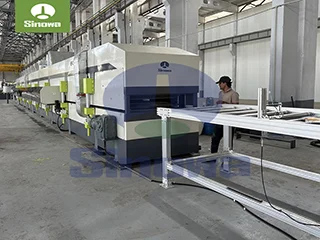
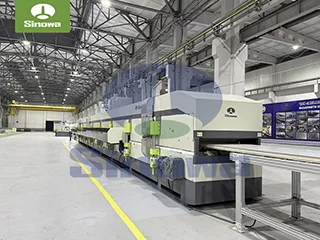
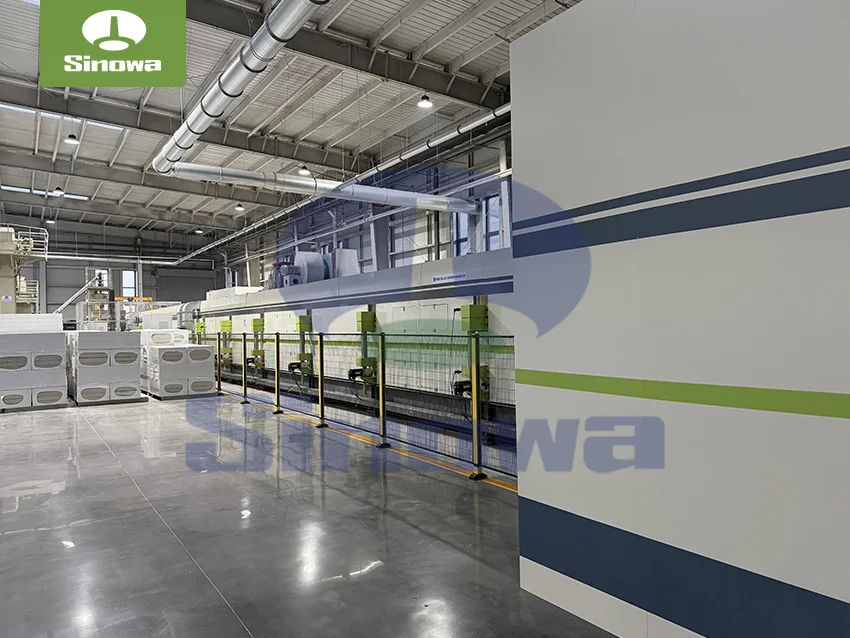
 sandwich panel line
The overall structural design of the polyurethane sandwich panel production line follows modular and synchronized operational logic, with each functional unit closely connected and operating in a coordinated manner to form an uninterrupted production cycle. The entire system covers raw material pretreatment, surface profiling, chemical foaming, composite lamination, constant-temperature curing, fixed-length cutting, finished product sorting and stacking, realizing one-stop molding of industrial roofing panels without excessive intermediate manual intervention. Each functional module is optimized for the structural characteristics and performance requirements of workshop roofing panels, focusing on enhancing the wind resistance, pressure resistance, heat preservation and waterproof properties of finished panels, while ensuring the flatness and structural uniformity of panel surfaces that are essential for roof laying.
The production process starts with the feeding and pretreatment of surface base materials, which are usually high-toughness metal sheets suitable for outdoor industrial roofing. The coiled base materials are stably unwound by automatic decoiling equipment, with built-in leveling mechanisms eliminating subtle wrinkles, deformations and internal stress generated during coil storage and transportation. This pretreatment step is critical for industrial roofing panels, as uneven base materials will directly lead to inconsistent overall stress of the roof panel after molding, affecting the long-term wind and snow load resistance of the entire roof system. After leveling, the flat base sheets enter the roll forming system, where multiple groups of precision roller sets perform gradual cold pressing and bending. The roller gaps and forming angles are finely calibrated to shape the sheets into standardized roof profiles with uniform wave heights and groove structures, which can effectively enhance the mechanical bearing capacity of the panel and improve the fitting tightness between adjacent panels during roof installation.
Before the formal composite molding, the formed upper and lower surface sheets will pass through a preheating unit, a key configuration for improving the bonding stability of PU sandwich layers. Low-temperature and uniform preheating treatment activates the surface activity of the base materials, removing tiny moisture and dust attached to the surface, creating an optimal bonding environment for subsequent polyurethane foaming materials. For industrial workshop roofing panels that need long-term outdoor service, firm integration between the outer protective layer and the inner thermal insulation layer is the core guarantee of service life. Preheating treatment avoids the problems of degumming and layering caused by insufficient bonding strength in later use, and effectively improves the overall structural durability of the panel in complex outdoor temperature change environments.
The foaming and composite molding stage is the core link of the PU sandwich panel production line, determining the thermal insulation performance, structural compactness and overall stability of finished roofing panels. The polyurethane foam used for industrial roof panels is formed by the precise proportional mixing and chemical reaction of two liquid raw materials. The production line is equipped with sealed constant-temperature storage and conveying systems for raw materials, which maintain stable temperature and fluidity of liquid raw materials to ensure the consistency of chemical reaction effects in each production cycle. Precision metering pumps accurately control the mixing ratio of the two raw materials, avoiding performance defects such as insufficient foaming density, uneven pore distribution or excessive expansion caused by ratio deviation.
The uniformly mixed polyurethane liquid is continuously and evenly injected into the closed cavity between the pre-formed upper and lower surface sheets through a mobile high-pressure spraying device. The spraying speed and moving path are intelligently adjusted according to the set panel thickness and width, ensuring that the liquid raw materials fully fill the entire composite space without dead angles or accumulation. After injection, the liquid materials undergo rapid chemical expansion and foaming reaction, gradually filling the gap between the upper and lower plates and forming a dense and uniform cellular thermal insulation structure. During the foaming process, the double-belt laminating device of the PU sandwich panel line applies constant and uniform pressure on the upper and lower surfaces of the panel, limiting the excessive expansion of foam materials and ensuring the consistent thickness and flatness of the whole panel.
Following the foaming and preliminary molding process, the semi-finished panels enter the constant-temperature curing and cooling system for structural stabilization treatment. The curing area maintains a stable temperature gradient, which can accelerate the solidification and molding of polyurethane foam, promote the complete reaction of internal chemical components, and enhance the bonding force between the foam layer and the surface base materials. Slow and uniform curing effectively avoids internal stress concentration inside the panel, prevents the finished product from bending, deforming or cracking after leaving the production line, and ensures the dimensional stability of industrial roofing panels in long-term high and low temperature alternating environments. The graded cooling process after curing gradually reduces the surface and internal temperature of the panel, eliminating the quality hidden dangers caused by rapid temperature change and further optimizing the overall structural compactness of the panel.
After complete curing and cooling, the continuous long-strip composite panels are sent to the automatic cutting unit for fixed-length segmentation. The cutting system supports flexible adjustment of panel length according to actual engineering needs, and the high-precision cutting mechanism ensures flat and burr-free cutting sections, avoiding local stress concentration caused by uneven notches. The precise cutting size also improves the on-site assembly efficiency of industrial roofs, making the splicing between panels more compact and reducing the gap leakage risk of the roof system. After cutting, the finished panels are transported to the sorting and stacking area through the conveying system, where automatic stacking equipment neatly arranges the panels according to specifications, facilitating subsequent transportation, storage and centralized loading.
The systematic and automated design of the polyurethane sandwich panel line endows industrial workshop roofing panels with outstanding comprehensive performance advantages that perfectly match industrial building needs. In terms of thermal insulation, the closed cellular structure of polyurethane foam effectively blocks the transmission of external heat and internal cold air, significantly reducing the temperature fluctuation inside the workshop. For industrial production environments that require constant temperature operation or need to reduce energy consumption for ventilation and temperature regulation, the excellent thermal insulation performance of the panels can greatly reduce the operating load of building environmental regulation equipment and achieve stable energy-saving effects throughout the year.
In terms of structural performance, the composite structure formed by the outer metal profiled sheet and the inner high-density PU foam layer gives the panel high overall rigidity and impact resistance. The integrated molding process eliminates the risk of internal hollowing and layering of traditional composite boards, enabling the panel to withstand certain wind pressure, snow load and external impact, and adapting to the complex outdoor working conditions of factory roofs. At the same time, the lightweight characteristics of the PU sandwich panel reduce the overall dead weight of the roof structure, which can effectively reduce the bearing pressure on the factory building's steel frame and concrete structure, lower the construction threshold of roof renovation and new construction, and improve the safety reserve of the building structure.
Weather resistance is another key advantage of panels produced by this professional PU sandwich panel machine. The standardized production process ensures that the internal foam structure is dense and uniform, with excellent moisture resistance and water impermeability. The integrated composite structure avoids the problem of water seepage caused by poor fitting of traditional layered boards, and can effectively resist rainwater erosion, humid air penetration and ultraviolet aging in outdoor environments. For industrial workshops in different climatic regions, whether it is high-temperature and rainy areas or cold and snowy areas, the finished panels can maintain stable structural performance and appearance integrity for a long time, reducing the frequency of roof maintenance and replacement in the later stage of the factory building.
In terms of production applicability, the modular configuration of the polyurethane sandwich panel machine realizes flexible adjustment of panel specifications. By adjusting the operating parameters of the roll forming system, foaming injection volume and cutting size, the line can produce roofing panels with different thicknesses, widths and profile structures, meeting the personalized construction needs of different types of industrial workshops such as light industrial factories, heavy industrial plants and logistics warehouses. The continuous circulating production mode greatly improves production efficiency, realizes seamless connection between each process link, avoids waiting time between processes in intermittent production modes, and can stably supply large quantities of standardized qualified panels for large-scale industrial plant construction projects.
The intelligent control system equipped with the production line realizes real-time monitoring and fine adjustment of the whole production process. Operators can adjust production parameters through the centralized control terminal to adapt to different raw material characteristics and product specification requirements. The system has automatic error correction and abnormal early warning functions, which can timely identify parameter deviations such as raw material ratio, temperature and pressure in the production process, avoid batch quality problems, and ensure the consistency and stability of each batch of finished panels. The high degree of automation also reduces the dependence on skilled operators, simplifies daily production management, and reduces the unstable factors of manual operation in traditional production modes.
In practical industrial engineering applications, the roofing panels produced by this professional continuous PU sandwich panel production line also show excellent construction adaptability. The standardized size and precise structural design make on-site installation more convenient and efficient, shortening the construction cycle of factory roof projects. The good splicing performance between panels effectively improves the overall sealing of the roof, avoiding common problems such as roof water leakage and air leakage in industrial buildings. In addition, the stable physical and chemical properties of polyurethane materials enable the panels to have good flame retardant and corrosion resistance, which can resist the erosion of chemical gas and humid environment in industrial production workshops and improve the overall safety and service life of the building roof.
With the continuous upgrading of modern industrial building standards, the requirements for the comprehensive performance, dimensional accuracy and structural stability of industrial workshop roofing panels are constantly improving. The professional PU sandwich panel production line for roofing panels keeps optimizing the production process and structural configuration, continuously improving the production precision and product performance of panels. Its automated, standardized and flexible production mode not only meets the current large-scale and high-quality construction needs of industrial factory buildings, but also provides reliable material support for the energy-saving transformation and structural upgrading of old industrial workshops. As a core intelligent equipment for manufacturing high-performance industrial building enclosure materials, this production line plays an irreplaceable role in promoting the standardized development of modern industrial building roofing systems and improving the overall quality of industrial construction projects.
https://www.cnsinowa.com/sandwich-panel-machines/pu-sandwich-panel-production-line-for-industrial-workshop-roofing-panels.html