sandwich panel line
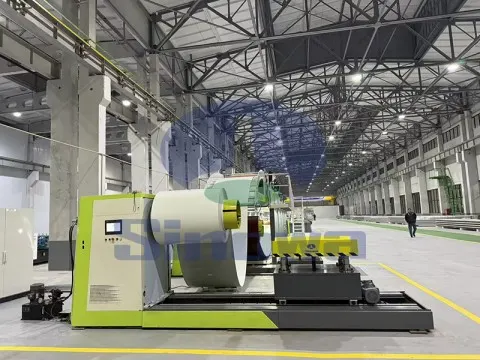
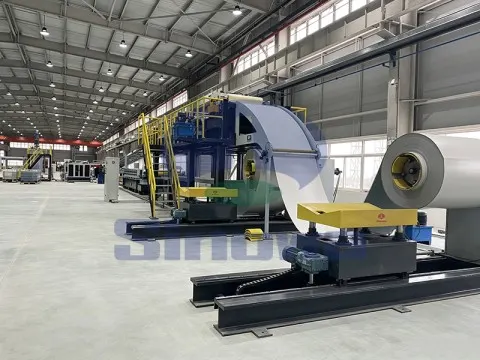
The overall structural composition of the continuous production line follows a sequential production logic, with each functional unit closely connected to form an integrated manufacturing system covering raw material pretreatment to finished product output. The front-end part of the production line is mainly composed of unwinding and leveling mechanisms, which are responsible for bearing and releasing coiled color steel raw materials. The unwinding device is designed with a stable rotating structure to ensure the slow and uniform discharge of steel coils, avoiding material deformation or surface scratch caused by uneven tension during the unwinding process. Subsequent leveling components adopt multi-group roller structures to correct the natural bending and surface wrinkles of color steel plates generated during coil storage. Through repeated rolling and pressure adjustment, the flatness of the steel plate surface is optimized, which is a basic prerequisite for ensuring the tight bonding between the steel plate and the core material in the later stage. Meanwhile, the auxiliary guiding devices installed at the feeding track can accurately limit the moving direction of the steel plate, preventing positional deviation during continuous transmission and reducing the probability of defective products caused by material misalignment.
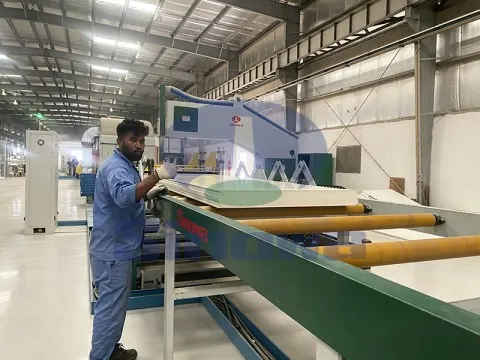
Following the pretreatment of metal surface materials, the production line is equipped with dedicated core material conveying and arranging modules to handle different types of insulation substrates commonly used in sandwich panels. Common core materials applied in production include lightweight foam materials, rock wool and other inorganic thermal insulation materials, each with unique physical characteristics that require targeted conveying control methods. For bulk and flexible foam core materials, the conveying mechanism adopts flexible belt transmission to avoid material crushing and deformation, while dense rock wool substrates are transported through rigid support structures to maintain the integrity of fiber structures. In this section, the production line is fitted with thickness calibration components, which can automatically adjust the feeding height of core materials according to preset production parameters to ensure the uniform thickness of the intermediate insulation layer of finished panels. In addition, the material sorting mechanism can neatly arrange scattered core materials to eliminate gaps and overlapping phenomena between substrates, which effectively enhances the overall structural compactness and thermal insulation performance of composite panels.
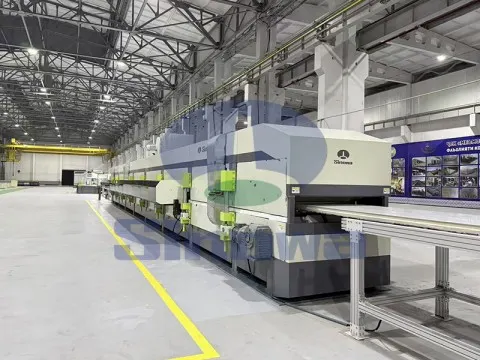
Gluing and composite molding constitute the core functional section of the entire continuous production line, determining the bonding firmness and overall structural stability of color steel sandwich panels. Before composite lamination, an automatic gluing system evenly coats environmentally friendly adhesive materials on the inner surfaces of upper and lower color steel plates and the contact surfaces of core materials. The gluing system adopts quantitative spraying technology to control the adhesive application amount precisely, preventing performance degradation caused by excessive glue overflow or insufficient bonding glue. After the gluing process is completed, the steel plates and core materials are synchronously sent into the thermal compression composite device. This device is built with double-track transmission structures and constant-temperature pressure maintaining systems, which can apply stable and uniform pressure to the composite materials while maintaining a reasonable heating temperature. The synergistic effect of temperature and pressure accelerates the curing reaction of adhesives, enabling the metal plates and insulation cores to form an integrated composite structure in a short time. The internal roller groups of the pressing device are arranged in an orderly gradient pressure mode, which gradually eliminates the air gaps inside the composite layer and ensures no hollow separation between different material layers.
The heating and curing area connected after the composite molding section undertakes the key task of stabilizing the internal structure of semi-finished panels. Although the initial bonding strength of materials is formed in the thermal compression stage, the adhesives still need a continuous constant-temperature environment to complete deep curing and achieve optimal bonding performance. The curing section of the production line adopts a fully enclosed thermal insulation structure, with internal temperature distribution regulated by an intelligent temperature control system to avoid local overheating or insufficient heating. The internal circulation of hot air ensures that the temperature around each semi-finished panel remains consistent, enabling the adhesive to cure evenly without generating internal stress due to temperature difference. Meanwhile, the transmission speed of the curing section matches the operating rhythm of the front-end equipment to ensure that each panel obtains sufficient curing time. For panels with different core materials, the system can autonomously adjust the curing temperature and duration according to material characteristics, so as to adapt to the curing requirements of diverse adhesive formulas and insulation substrates.
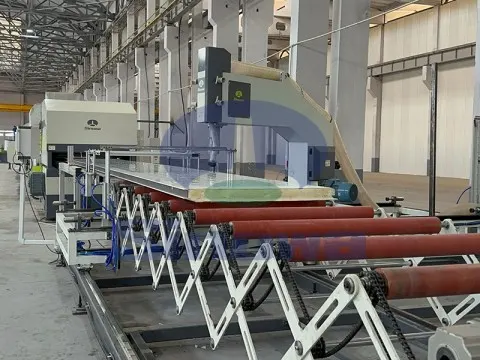
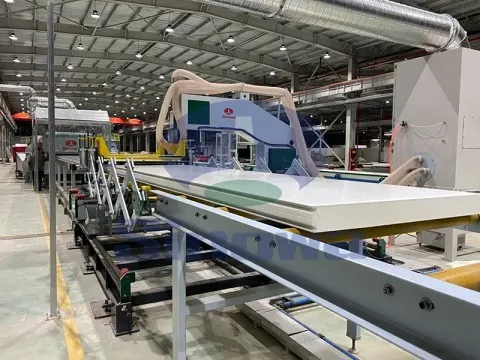
After completing curing and structural shaping, the continuous production line carries out precise shaping and fixed-length cutting operations on the integrated panels. The trimming and shaping mechanism first polishes and modifies the edges of the panels to remove excess adhesive and irregular burrs generated during the composite process, making the edge structure neat and smooth. This processing step not only improves the appearance finish of finished products but also avoids edge cracking and deformation during subsequent stacking and transportation. The fixed-length cutting module adopts dynamic cutting technology that can operate synchronously with the continuous moving track of panels. Without stopping the production line, the cutting tool completes high-speed and accurate cutting according to preset dimensional parameters. The mechanical structure of the cutting device is optimized to ensure flat cutting sections without material chipping, and the dimensional error of finished panels is controlled within a tiny range to meet the unified assembly requirements of building construction. In addition, a dust removal and cleaning device is installed near the cutting part to collect debris and dust generated during processing, maintaining the cleanliness of the production environment.
The final stage of the production line covers finished product inspection, stacking and discharging procedures, forming a closed-loop manufacturing process. The automatic detection system installed at the terminal of the production line conducts real-time non-destructive inspection on the processed panels, focusing on detecting bonding compactness, surface flatness and overall dimensional accuracy. Unqualified products with delamination, surface scratches or dimensional deviation will be automatically marked and separated from qualified products to ensure that only products meeting production standards enter the stacking link. The mechanical stacking device neatly arranges qualified finished panels in a fixed order, with flexible buffer structures to avoid surface abrasion caused by rigid collision between panels. The intelligent discharging mechanism can automatically transport stacked finished products to the designated storage area, facilitating subsequent centralized transportation and warehousing management. The whole terminal operation process minimizes manual participation, effectively reducing labor costs and avoiding product contamination caused by human contact.
The prominent operational advantages of the continuous production line for color steel sandwich panels are reflected in its high automation level and stable production efficiency. The entire production process is controlled by an integrated intelligent control system, which can centrally regulate the operating speed, temperature parameters, feeding volume and cutting dimensions of each functional module. Operators only need to input production parameters on the human-computer interaction interface to complete the switching of different production modes, realizing flexible production of panels with diverse specifications. Compared with discontinuous production equipment, this continuous production mode eliminates frequent equipment start-stop and material handling links, greatly shortening the single-panel production cycle. The coordinated operation of all mechanical modules effectively reduces invalid waiting time in the production process, achieving stable and efficient continuous output. Moreover, the intelligent monitoring system can track the operating status of each component in real time, automatically identifying abnormal fluctuations in temperature, pressure and transmission speed, and triggering early warning prompts to reduce equipment failure rates.
In terms of product performance control, the continuous production line effectively guarantees the uniformity and stability of finished panel quality through standardized mechanical operation. Each processing link follows fixed mechanical parameters and technological processes, avoiding quality differences between batches caused by manual operation errors. The precise gluing system and constant-pressure composite structure ensure that the bonding strength of each material layer remains consistent, and the closed curing environment stabilizes the physical properties of adhesives. The surface treatment process of the production line can maintain the flatness and coating integrity of color steel plates, endowing finished panels with excellent corrosion resistance and weather resistance. In addition, the production line can adjust the production process according to the usage scenarios of panels. For example, it can increase the compaction degree of core materials for panels used in high-humidity environments to enhance moisture resistance, and optimize the composite pressure for load-bearing panels to improve overall structural strength.
From the perspective of production cost and environmental protection benefits, the continuous production line has obvious optimization characteristics. The integrated compact structural design reduces the floor space of production equipment, saving the construction cost of factory workshops. The quantitative feeding and gluing control technology minimizes the waste of raw materials, improving the utilization rate of color steel plates, core materials and adhesives. The intelligent energy-saving system can dynamically adjust the power consumption of heating and transmission components according to production load, reducing ineffective energy consumption during equipment operation. Meanwhile, the fully enclosed production structure effectively collects dust, debris and volatile substances generated in the production process, avoiding environmental pollution caused by material leakage. The automated production mode also reduces the demand for manual labor, lowering the labor management cost and production safety risk of manufacturing enterprises.
With the continuous upgrading of building energy conservation and environmental protection standards, the continuous production line for color steel sandwich panels is constantly optimized and iterated in structural design and technological performance. The modern upgraded production line adopts more lightweight and high-strength mechanical materials, improving the wear resistance and service life of key transmission and pressing components. The optimized transmission track reduces material friction resistance during operation, further lowering the defect rate of panel surface processing. In terms of intelligent upgrading, the production line is equipped with data recording and analysis functions, which can collect production data such as daily output, material consumption and product qualification rate, providing accurate data support for enterprise production scheduling and cost accounting. In addition, the production line has strong compatibility and expansibility, and can be matched with different post-processing auxiliary equipment to realize diversified production functions such as surface embossing and edge sealing reinforcement of panels.
In the industrial application field, the mature and reliable performance of the continuous production line provides strong support for the popularization of color steel sandwich panels. Panels produced by this production line are widely applied in temporary construction buildings, industrial factory buildings, cold storage warehouses and public facility decoration, relying on their excellent thermal insulation, sound insulation, fire resistance and structural stability. The standardized production mode ensures that finished panels have consistent assembly dimensions, which is convenient for rapid splicing and construction on the construction site, shortening the overall construction cycle of buildings. The stable product quality also reduces the maintenance cost of buildings in the later stage, bringing long-term economic benefits to construction projects. Driven by market demand, the continuous production line will further develop towards higher automation, lower energy consumption and stronger compatibility, continuously optimizing the production process of color steel sandwich panels to adapt to the diversified development needs of the modern construction industry.
Sinowa is a professional manufacturer of sandwich panel machine in china, we provide diversified and high-performance sandwich panel production lines, including fully automatic continuous PU sandwich panel line and customized special lines to meet mass production and personalized order demands. These sandwich panel lines support processing multiple foam core materials, such as PU, PIR, mineral wool, rock wool and glass wool, covering different insulation and fireproof standards.
Featuring stable operation, high efficiency, energy saving and easy maintenance, our PU sandwich panel line deliver sandwich panels with excellent thermal insulation, fire resistance, sound insulation and lightweight durability. The finished panels are widely applied in industrial workshops, warehouse roofing and wall cladding, cold storage insulation, serving global construction and industrial insulation markets.
https://www.cnsinowa.com/sandwich-panel-machines/continuous-production-line-for-color-steel-sandwich-panels.html