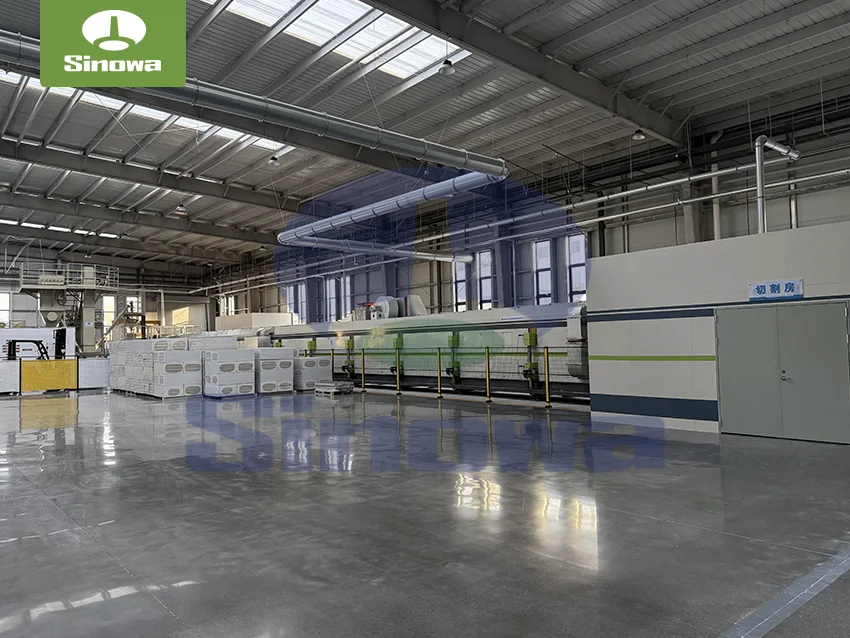
 sandwich panel line
A complete sandwich panel line is a highly integrated mechanical system composed of multiple interconnected functional modules, each undertaking independent production tasks while maintaining synchronous operation with other units to ensure the continuity of the manufacturing process. The basic composition of the production line covers raw material feeding units, surface material pretreatment mechanisms, core material processing systems, composite bonding structures, pressure shaping devices, curing assemblies, cutting and trimming mechanisms, finished product conveying units, and intelligent control systems. Every functional module is designed based on the physical characteristics of sandwich panel raw materials and the molding requirements of finished products, with mechanical parameters adjustable to adapt to diverse production specifications. The external surface materials of sandwich panels processed by such production lines usually include metal sheets and non-metal decorative plates, while the core insulation materials involve porous lightweight substances with excellent thermal resistance. Different combinations of surface and core materials require corresponding adjustments to the operating parameters of each module in the production line, reflecting the strong flexibility and applicability of modern sandwich panel manufacturing equipment.
![Sandwich Panel Line]()
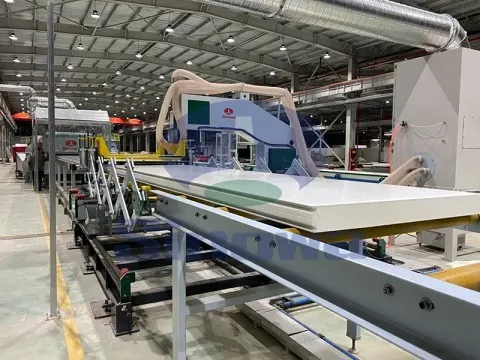
The PU sandwich panel line is a highly automated production system designed for manufacturing polyurethane cored composite panels. This production line adopts continuous foaming and compounding technology, where raw materials such as polyurethane resin and curing agents are accurately proportioned and evenly mixed through professional metering and mixing devices. The mixed raw materials are uniformly coated on the upper and lower surface materials, then sent to the heating molding area for foaming and solidification under constant temperature conditions. The integrated structural design of the production line ensures tight bonding between the core material and surface layers without gaps. The finished panels feature uniform density, stable thermal insulation performance and excellent structural flatness. This production line supports flexible adjustment of panel thickness and production speed, and it requires minimal manual intervention during operation, making it suitable for mass production of insulation panels for warehouses, cold storage and general industrial buildings.
The PIR sandwich panel line is professionally optimized for producing polyisocyanurate sandwich panels, upgraded on the basis of traditional polyurethane production equipment with improved raw material reaction control systems. The production line precisely regulates the temperature and pressure during the chemical reaction of PIR raw materials to promote complete molecular polymerization of the core material. In the continuous molding process, the raw materials form a compact and rigid cellular structure after foaming, which endows the finished panels with better high-temperature resistance and structural stability. Each processing link including feeding, coating, curing and cutting maintains high-precision operation to ensure consistent panel quality. Compared with ordinary PU production lines, this line focuses on enhancing the high-temperature resistance and deformation resistance of panels, and the produced panels are widely applied in building exterior walls and high-temperature resistant enclosure structures.
![Sandwich Panel Line]()
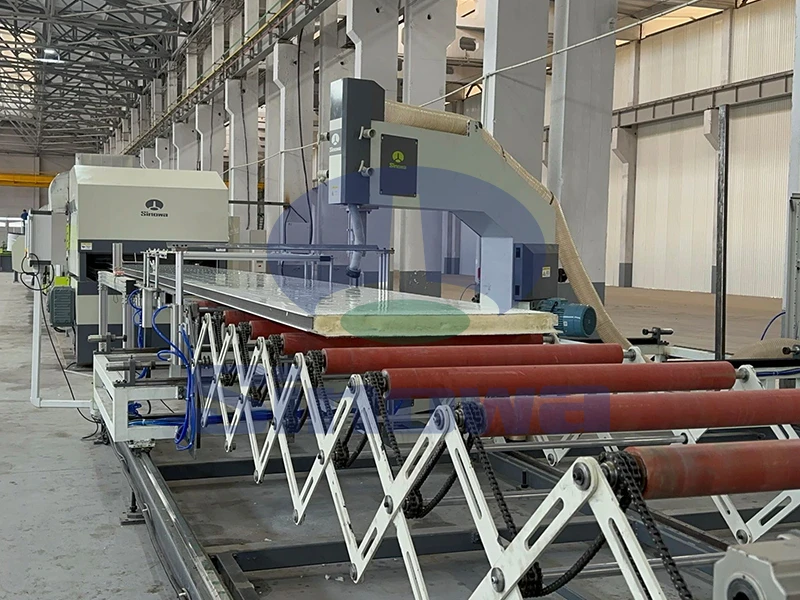
The rock wool sandwich panel line is dedicated to processing hard rock wool into qualified composite sandwich panels, adopting a dry composite production process different from foam panel lines. The production line is equipped with special fiber sorting and arranging equipment to orderly distribute rock wool fibers and maintain uniform fiber density inside the core material. After the rock wool core material is shaped and fixed, automated gluing equipment evenly coats adhesive on both sides, and then the core material is tightly combined with metal or non-metal surface plates through mechanical pressing. The built-in trimming and shaping devices trim the edges of semi-finished products to ensure neat panel outlines. The whole production process focuses on keeping the fibrous structure of rock wool intact, so that the finished panels retain outstanding fire resistance and sound insulation properties, fitting for public buildings and industrial facilities with strict fire prevention requirements.
The mineral wool sandwich panel line is engineered for producing composite panels with mineral wool as the core filler, featuring targeted adjustments in raw material conveying and pressing procedures. Mineral wool raw materials with diverse fiber thicknesses are screened and dispersed by professional equipment inside the line to avoid fiber agglomeration, realizing even distribution of the core material. The production line uses environmentally friendly adhesive materials for composite bonding, and the constant-pressure pressing technology ensures long-term bonding stability between the core material and surface layers. The low-energy heating system accelerates adhesive curing without damaging the internal fiber structure of mineral wool. The production line runs stably with low equipment wear, and the manufactured panels balance fire resistance, thermal insulation and sound absorption, which can adapt to various indoor and outdoor building enclosure scenarios with moderate performance requirements.
The glass wool sandwich panel line is a specialized production system for lightweight glass wool composite panels, focusing on protecting the fragile fiber structure of glass wool during processing. The line is fitted with soft conveying and laying devices to prevent glass wool fibers from breaking or deforming in the production process. The ultra-thin uniform gluing technology is adopted to avoid adhesive penetration that may affect the fiber elasticity of glass wool. After composite molding, the panels go through slow cooling and shaping procedures to maintain the fluffy porous structure of the core material. The production line has a compact mechanical layout and flexible operation, capable of producing low-density and lightweight panels. The finished products have excellent sound absorption and heat preservation effects, and they are commonly used for interior partition decoration, sound insulation engineering and temporary building enclosure structures.
![Sandwich Panel Line]()
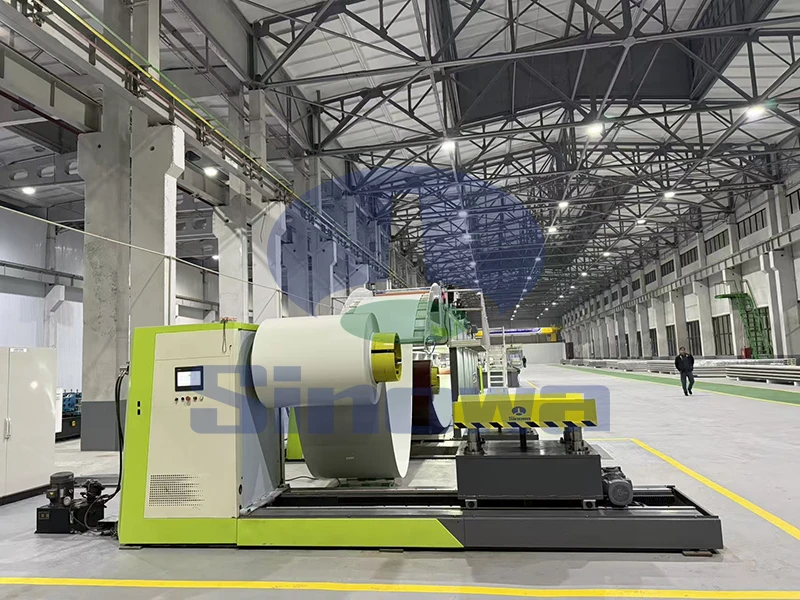
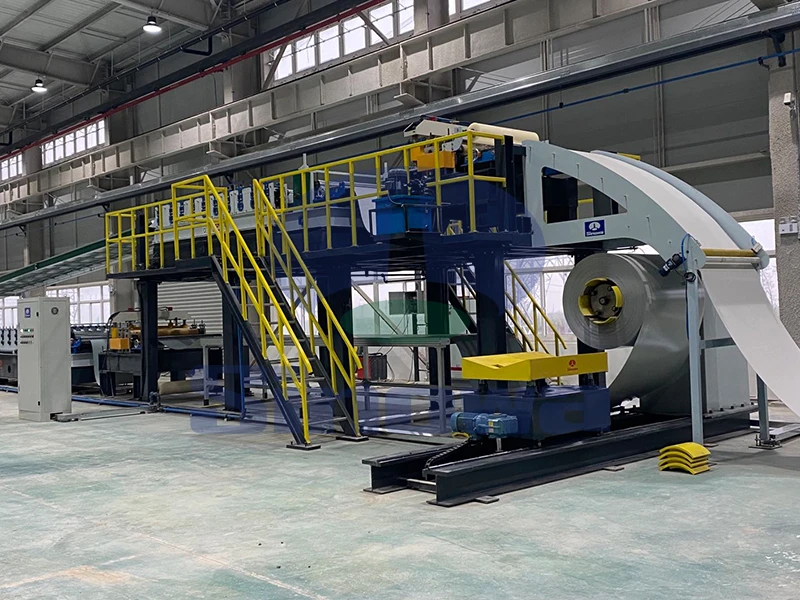
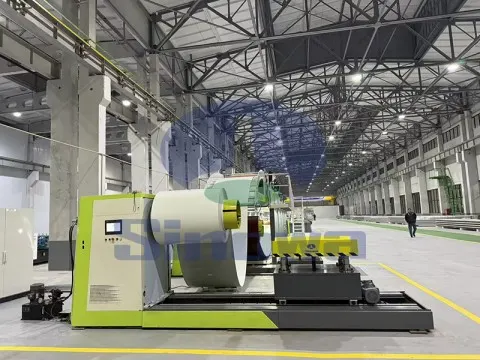
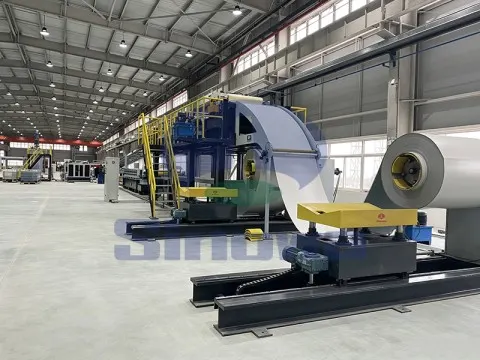
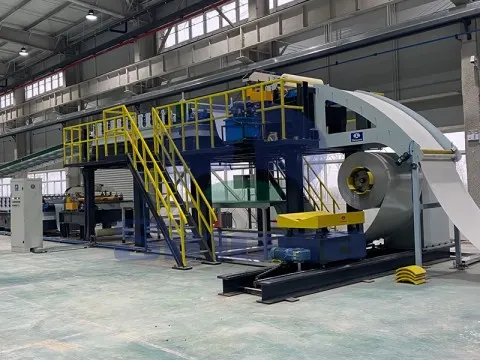
The raw material feeding section acts as the starting terminal of the entire sandwich panel line, undertaking the task of stable and orderly supply of sheet materials and core raw materials. For coiled metal surface materials, this section is equipped with unwinding structures that fix coiled raw materials and achieve steady sheet output through mechanical damping and speed regulation. The internal transmission components of the unwinding device adopt high-strength structural designs to bear the weight of large-volume raw material coils, avoiding material jitter and deviation during the unwinding process. Meanwhile, auxiliary correction structures are installed on both sides of the feeding channel to dynamically monitor the material transmission trajectory and automatically fine-tune the horizontal position of the sheet, ensuring that the surface material maintains a straight feeding state in the subsequent processing links. In terms of core material feeding, the production line is equipped with customized conveying equipment according to the form of core materials. Block-shaped core materials are transported through belt conveying structures with anti-slip textures, while powdered or liquid foaming raw materials rely on sealed pipeline conveying and quantitative metering structures to complete raw material supply. All feeding units are matched with independent power drive components, and the operating speed is synchronized with the overall production rhythm through the central control system to prevent material supply interruption or accumulation.
After completing raw material feeding, the surface materials will enter the pretreatment process, which is a key step to enhance the bonding firmness between surface layers and core materials. The pretreatment module mainly includes surface dedusting, oil stain removal, and surface texture optimization processes. In the dedusting link, high-pressure airflow purification structures and static dust removal devices are used to thoroughly remove floating dust, particulate impurities, and residual sundries on the surface of the sheet. For metal sheets stored for a long time, slight oil stains and oxide layers often exist on the surface; therefore, the production line is equipped with physical cleaning structures that do not damage the sheet substrate to eliminate surface attachments without affecting the flatness and mechanical strength of the sheet. After cleaning, the surface of the sheet will undergo micro-texture treatment through mechanical rolling, forming uniform fine textures on the smooth surface. This treatment effectively increases the contact area between the surface material and the adhesive, improving the adhesion stability of the composite structure and avoiding delamination defects caused by insufficient bonding strength in the later use of sandwich panels. All pretreatment procedures are completed in a fully enclosed space to prevent external dust from secondary contamination of the processed sheets.
![Sandwich Panel Line]()
The core material processing and laying system is one of the most technically sophisticated parts in the sandwich panel line, and its operating mode varies significantly with different types of core materials. For rigid inorganic core materials with fixed shapes such as rock wool and mineral wool, the processing system is equipped with cutting and shaping mechanisms to cut bulk raw materials into standard-sized core blocks that match the surface sheets. The cutting components adopt high-precision blade structures to ensure smooth and flat cutting sections without burrs or fragmentation, maintaining the integrity of the internal fiber structure of inorganic core materials and retaining excellent thermal insulation and fire resistance. For organic foaming core materials, the production line uses sealed foaming and mixing structures. Two or more liquid raw materials are stored in independent material tanks, and precision metering pumps driven by variable frequency motors are used to control the output flow of each raw material. After proportional mixing, the liquid composite materials are evenly sprayed between the upper and lower surface sheets through mobile distribution structures. The chemical foaming reaction occurs in a constant-temperature environment, enabling the raw materials to expand freely and fill the gaps between surface layers to form a continuous and dense foaming core layer.
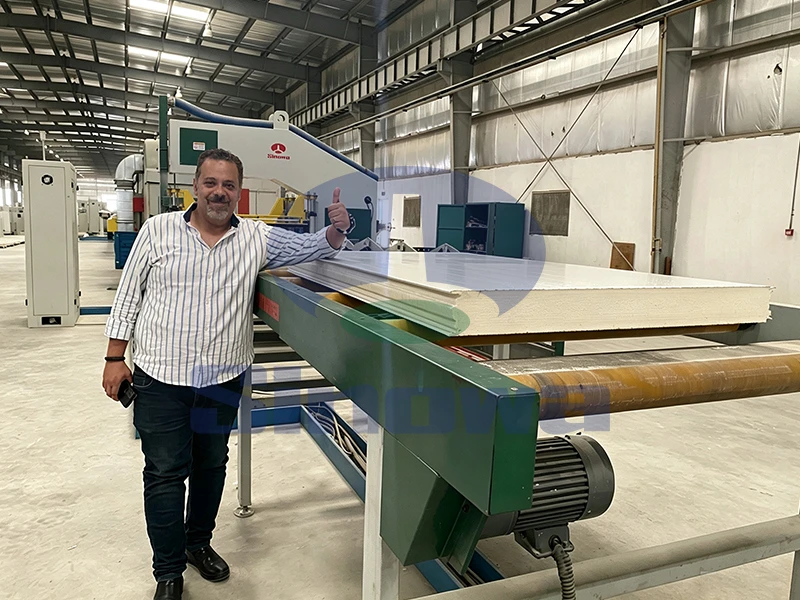
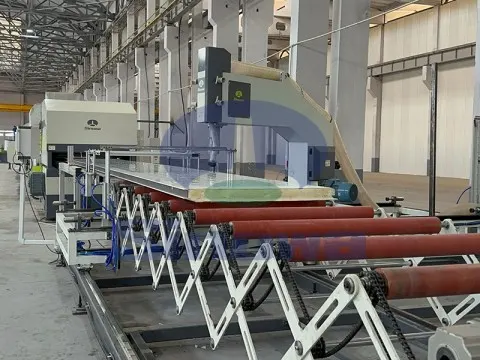
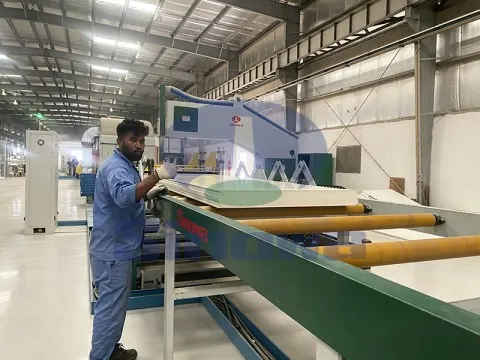
The composite bonding and pressure shaping module constitutes the core functional section of the entire production line, directly determining the overall structural compactness and dimensional accuracy of sandwich panels. Before formal composite pressing, the production line completes uniform adhesive coating on the inner side of the surface sheets. The adhesive coating system uses adjustable roller coating structures, and the coating thickness can be dynamically controlled according to the material characteristics and usage environment of the sandwich panels. The ceramic rollers and silica gel coating components ensure that the adhesive is distributed evenly without accumulation or missing coating, forming a stable adhesive layer between the surface material and the core material. After the completion of glue application and core material laying, the semi-finished panels enter the pressing area composed of multi-group pressing roller sets. The pressing structure adopts a layered mechanical design, and the pressure value can be adjusted intelligently according to the thickness and hardness of the raw materials. During the pressing process, the upper and lower roller sets maintain parallel operation to ensure uniform stress on the panel surface, eliminating internal voids and gaps between layers. Meanwhile, the guiding structures on both sides limit the horizontal expansion range of the raw materials to keep the width of the panel consistent. For sandwich panels requiring high flatness, the pressing area is equipped with fine correction components to eliminate slight bulges and depressions on the panel surface.
![Sandwich Panel Line]()
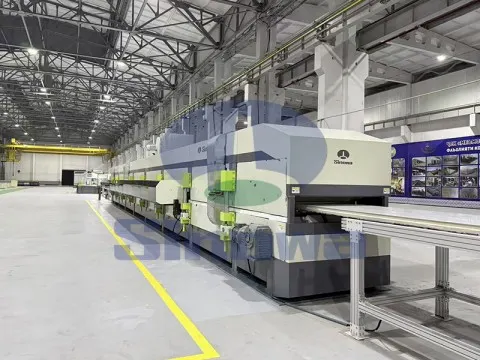
The curing system is an essential functional unit to stabilize the composite structure of sandwich panels and enhance the aging resistance of bonding interfaces. After pressure compounding, the panels enter the constant-temperature curing channel to complete adhesive curing and structural shaping. The internal space of the curing channel adopts a fully insulated closed structure, and the internal temperature is adjusted through distributed heating components. The intelligent temperature sensing elements arranged inside the channel monitor the temperature changes in real time and feed data back to the central control system, which automatically adjusts the heating power to maintain a stable curing temperature range. The curing time is matched with the production line transmission speed to ensure that the adhesive completes chemical cross-linking reactions sufficiently. For foamed core materials, the constant-temperature environment can optimize the internal pore structure of the foam, reduce residual stress generated during the foaming process, and improve the dimensional stability of the core layer. In addition to temperature control, some advanced curing units are equipped with humidity adjustment structures to adapt to the curing requirements of special adhesives and prevent bonding failure caused by excessive dryness or humidity.
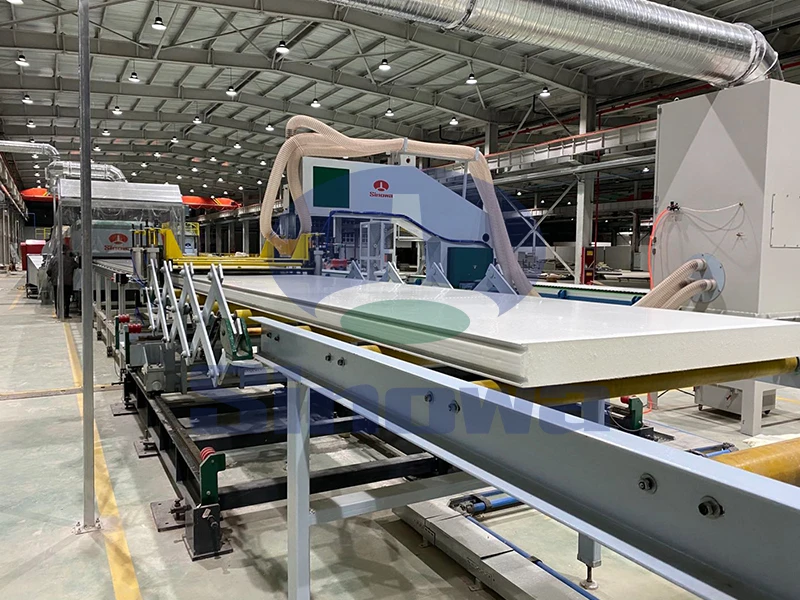
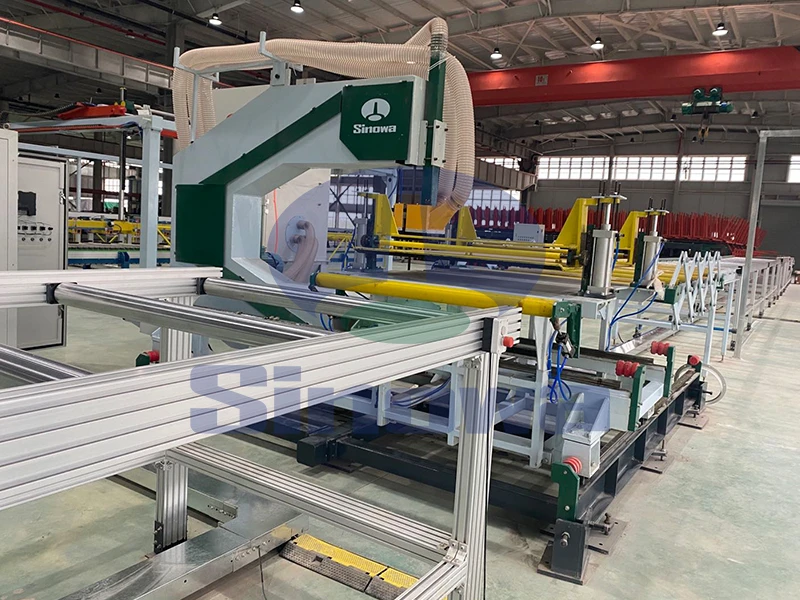
After completing curing and shaping, the continuous long-strip panels are transported to the cutting and trimming module for fixed-length processing and edge finishing. This module integrates high-precision longitudinal trimming and transverse cutting functions. The longitudinal trimming mechanism uses rotating alloy blades to cut off the irregular edges on both sides of the panels, ensuring that the width of each finished panel meets unified specifications. The dust collection structures are installed near the cutting components to collect debris generated during trimming, maintaining the cleanliness of the production environment. The transverse cutting system relies on real-time length measurement sensors to record the transmission distance of panels. When the panels reach the preset cutting length, the mechanical positioning structure locks the panel position instantly, and the high-speed cutting blades complete vertical cutting actions. The cutting process maintains a stable vertical angle to avoid inclined sections. All cutting parameters, including cutting speed and blade clearance, can be adjusted according to panel thickness and material hardness to prevent edge cracking and layer separation. After cutting, the edge smoothing mechanism polishes the panel sections to remove sharp burrs, improving the appearance quality and transportation safety of finished products.
![Sandwich Panel Line]()
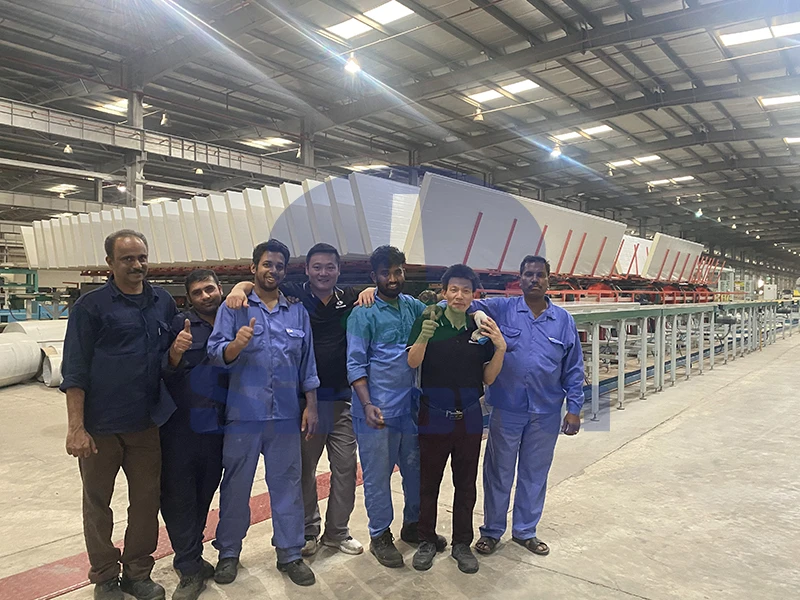
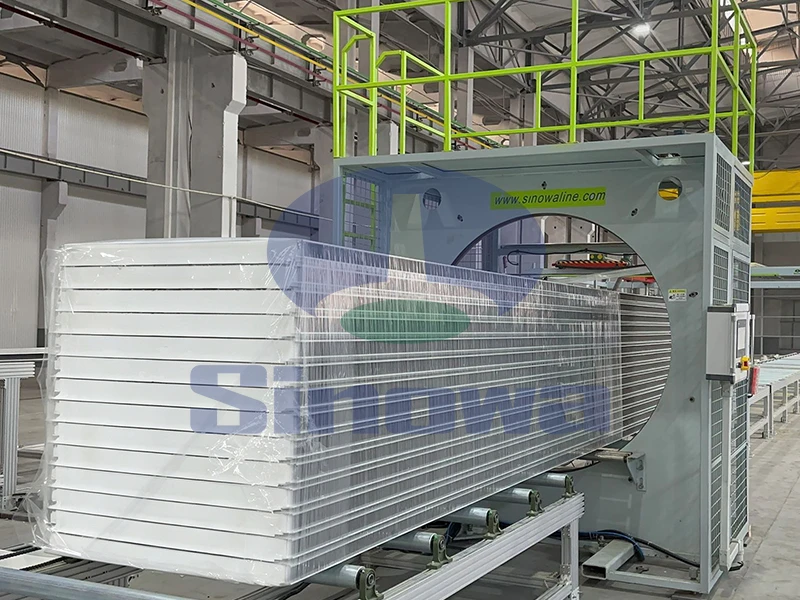
The finished product conveying and stacking system undertakes the subsequent transportation, sorting, and storage work of processed sandwich panels. The cut single panels are transported to the sorting platform through low-speed conveyor belts, and the flexible buffering structures at the connection of conveying units reduce the vibration amplitude during panel movement, avoiding surface scratch damage. The stacking mechanism adopts mechanical arm structures with adjustable clamping force. According to the size and weight of the panels, the clamping components automatically adjust the contact area to firmly grab the panels without squeezing deformation. The stacking process follows neat arrangement rules, and the stacking height is controlled within a safe range to prevent bottom panel deformation caused by excessive pressure. Meanwhile, the finished product area is equipped with temporary storage platforms with anti-pressure structures to facilitate centralized collection and transfer of finished products, providing convenient loading conditions for subsequent transportation. The entire stacking process realizes automated operation, reducing manual contact with finished products and lowering the probability of artificial damage.
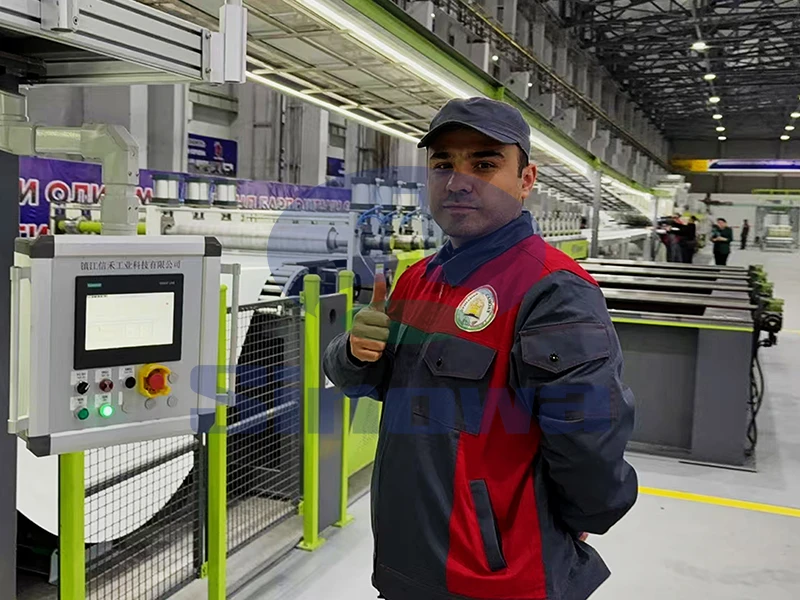
The intelligent control system runs through all functional modules of the sandwich panel line and serves as the brain of the entire production equipment. This system takes programmable logic controllers as the core operation components, and connects sensors, driving motors, and execution structures of each unit through signal transmission circuits. Temperature sensors, pressure sensors, speed sensors, and displacement sensors are distributed at key positions of the production line to collect real-time operating data including processing temperature, mechanical pressure, transmission speed, and material specifications. The collected data is transmitted to the central processing terminal, which compares the actual parameters with the preset standard values. Once parameter deviation occurs, the system automatically sends adjustment instructions to the corresponding execution components to complete dynamic parameter calibration. The human-computer interaction terminal presents the operating status of each module in the form of visual data, allowing operators to view production progress, equipment operating parameters, and fault prompt information in real time. In addition, the control system is equipped with an automatic protection mechanism. When abnormal conditions such as material jamming, excessive temperature, and mechanical failure occur, the system will trigger an emergency stop instruction to cut off the power supply of related components, avoiding equipment damage and safety accidents.
![Sandwich Panel Line]()
Modern sandwich panel lines possess prominent technical advantages in structural design and production performance compared with traditional segmented processing equipment. First of all, the integrated continuous production mode realizes seamless connection between all processing procedures, eliminating the intermediate transportation links of semi-finished products between scattered equipment. This structural optimization shortens the production cycle, reduces manual intervention links, and lowers the labor cost input in the production process. Secondly, the modular design concept enables the production line to have strong compatibility. By replacing individual functional modules and adjusting operating parameters, the same production line can manufacture sandwich panels with different core materials, different surface thicknesses, and different structural specifications, meeting the diversified procurement needs of the market. In terms of processing accuracy, the synchronous control technology of multi-axis mechanical structures ensures that the dimensional error of finished panels is controlled within a tiny range, and the uniform stress of the composite structure effectively avoids quality defects such as local delamination and hollow bulging.
In terms of energy consumption and environmental protection performance, the optimized structural design of sandwich panel lines effectively reduces resource waste and pollutant emission. The sealed raw material conveying and processing structures avoid the diffusion of powdered raw materials and adhesive volatile substances in the production space, improving the air quality of the production workshop. The recycling structures are installed in the raw material supply link to collect excess adhesives and leftover core materials, realizing secondary utilization of residual raw materials and reducing raw material consumption. The driving components of the production line adopt energy-saving motor structures, and the intelligent frequency conversion technology automatically adjusts the operating power according to the production load, avoiding energy waste caused by no-load operation. In the cutting processing link, the centralized debris collection system realizes unified collection and classified processing of production waste residues, which is convenient for subsequent harmless treatment and resource recycling. These environmental protection optimization designs enable the production line to meet the sustainable development requirements of modern manufacturing industries.
![Sandwich Panel Line]()
The application scenarios of products manufactured by sandwich panel lines cover multiple fields of social construction, and the performance differences of panels correspond to diverse usage demands. In industrial construction, sandwich panels are widely used in factory workshops, cold storage enclosures, and storage warehouses. The excellent thermal insulation performance of the core material can reduce the energy consumption of temperature regulation inside the buildings, and the rigid composite structure can withstand external wind pressure and temperature changes, maintaining the stability of building envelopes for a long time. In commercial construction, lightweight and beautifully decorated sandwich panels are applied to shopping malls, exhibition halls, and office partition structures. The diverse surface processing styles can match different architectural decoration designs, and the convenient assembly mode shortens the construction cycle of commercial buildings. In temporary engineering fields such as construction sites and disaster relief resettlement areas, sandwich panels are used to build temporary housing and office facilities due to their simple transportation and quick assembly characteristics. In addition, special customized sandwich panels produced by adjusted production line parameters can adapt to high-temperature, low-temperature, and corrosive special working environments, providing reliable material support for professional engineering construction.
In the actual production and operation process, the daily maintenance and standardized operation of the sandwich panel line are crucial to extending the service life of equipment and maintaining stable production efficiency. Daily maintenance work includes surface cleaning of mechanical components, inspection of transmission structures, and supplementation of lubricating oil. Operators need to regularly remove dust and debris accumulated on the surface of rollers, conveyor belts, and cutting blades to prevent hard impurities from scratching raw materials and affecting processing accuracy. The transmission chains and gear structures shall be inspected periodically for wear and loosening, and lubricating media shall be supplemented to reduce mechanical friction loss. For the temperature control and pressure control components in key processing sections, regular parameter calibration is required to ensure that the operating parameters are always within the standard range. In terms of operation management, production personnel need to set reasonable processing parameters according to the raw material characteristics, avoid overpressure pressing and overheating curing that damage the internal structure of panels, and strictly follow the startup and shutdown sequence of the production line to prevent equipment failure caused by irregular operation.
With the continuous innovation of industrial manufacturing technology and the upgrading of construction material standards, the development direction of sandwich panel lines presents intelligent upgrading, structural optimization, and green manufacturing trends. In terms of intelligent technology, more advanced visual detection elements and data analysis systems will be integrated into the production line. The automatic detection mechanism can identify tiny defects such as surface scratches, internal voids, and uneven bonding of panels in real time, and complete automatic sorting of defective products. The big data analysis platform can record long-term production data, summarize the parameter matching rules of different raw materials, and provide data support for production optimization. In terms of structural optimization, the production line will develop towards compact integration. The space occupancy of functional modules will be reduced through structural optimization design, and the overall operation stability of the equipment will be improved. Meanwhile, the quick disassembly and assembly design of modules will facilitate equipment transportation, installation, and later maintenance.
![Sandwich Panel Line]()
In the field of green manufacturing, future sandwich panel lines will further optimize raw material utilization and pollutant emission control. The adaptive raw material proportioning system will accurately calculate the usage amount of adhesives and core raw materials according to panel specifications, minimizing raw material waste. The closed volatile gas treatment structure will purify the gas generated during adhesive curing and foaming reactions, realizing up-to-standard emission of production waste gas. In addition, the production line will be matched with low-energy consumption driving components and waste heat recovery structures to reuse the residual heat generated in the curing process, reducing comprehensive energy consumption. In terms of product adaptation, the upgraded production line will support the processing of new environmentally friendly composite raw materials, meeting the market demand for low-carbon and pollution-free building materials, and adapting to the global green construction development concept.
In conclusion, the sandwich panel line is a systematic and intelligent industrial production facility integrating mechanical transmission, chemical processing, and automatic control technology. Each functional module of the equipment cooperates closely to complete the whole manufacturing process of sandwich panels, realizing standardized, large-scale, and high-efficiency production of composite building materials. Its unique structural design and adjustable operating performance enable the production line to adapt to diverse raw material combinations and product specifications, and the manufactured sandwich panels have irreplaceable application value in multiple construction fields. With the continuous progress of industrial technology, the production performance, intelligent level, and environmental protection capacity of sandwich panel lines will be further improved. Driven by market demand and technological innovation, such production equipment will continue to promote the upgrading of the composite building material industry, provide high-quality and reliable material support for modern architectural construction, and make important contributions to the efficient development and green transformation of the global construction industry.
Sinowa is a professional manufacturer of sandwich panel machine in china, we provide diversified and high-performance sandwich panel production lines, including fully automatic continuous PU sandwich panel line and customized special lines to meet mass production and personalized order demands. These sandwich panel lines support processing multiple foam core materials, such as PU, PIR, mineral wool, rock wool and glass wool, covering different insulation and fireproof standards.
Featuring stable operation, high efficiency, energy saving and easy maintenance, our PU sandwich panel line deliver sandwich panels with excellent thermal insulation, fire resistance, sound insulation and lightweight durability. The finished panels are widely applied in industrial workshops, warehouse roofing and wall cladding, cold storage insulation, serving global construction and industrial insulation markets.
https://www.cnsinowa.com/sandwich-panel-machines/sandwich-panel-line.html