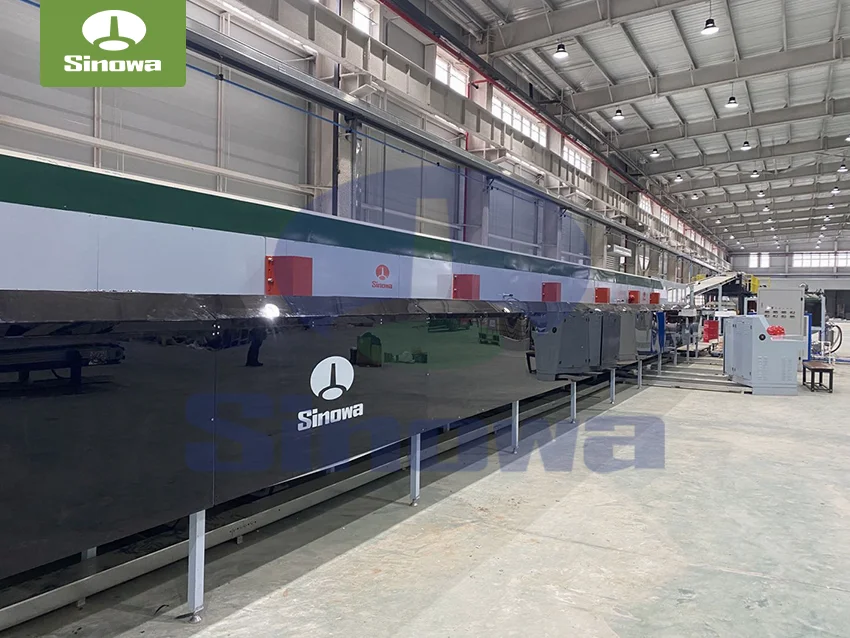
 sandwich panel line
The overall structural design of a complete PUR sandwich panel production line follows the logic of sequential processing and automated circulation, covering multiple functional units from raw material input to finished product output. Each functional unit is closely connected through an intelligent conveying system, forming an integrated production chain with low manual intervention and high operational efficiency. The basic configuration of the production line includes raw material unwinding and pretreatment units, surface layer leveling and processing units, PUR raw material mixing and foaming units, continuous composite pressing units, constant-temperature curing units, fixed-length cutting units, surface finishing units and finished product stacking units. All functional modules are coordinated by a centralized control system, which can dynamically adjust operating parameters according to production specifications and material characteristics to adapt to diversified production requirements. In terms of mechanical structure, the production line adopts a modular assembly design, which facilitates daily maintenance, component replacement and functional expansion. The main frame of the equipment is made of high-strength alloy materials, which can maintain structural stability under long-term continuous operation and avoid production accuracy errors caused by mechanical vibration or structural deformation.
The raw material pretreatment unit is the initial link of the entire production flow, which determines the bonding firmness and surface flatness of the subsequent composite panels. This unit is mainly responsible for the unwinding, cleaning and surface activation of surface base materials. Common surface base materials for PUR sandwich panels include metal color steel plates, aluminum alloy plates and non-metal inorganic plates. These coiled base materials are fixed on the unwinding support mechanism, and the automatic unwinding device releases the base materials at a constant speed under the control of the conveying system. During the unwinding process, the deviation correction sensor installed on the equipment can monitor the material transmission track in real time. Once material deviation is detected, the hydraulic deviation correction mechanism will automatically adjust the material feeding position to ensure the linear transmission of the base materials. After unwinding, the base materials will pass through the surface cleaning mechanism, which removes oil stains, oxide layers and floating impurities on the surface of the plates through physical brushing and low-pressure air blowing. For materials with high surface adhesion requirements, the production line is equipped with a surface roughening device, which forms a fine uneven microstructure on the material surface through mechanical polishing. This treatment can effectively increase the contact area between the base material and the PUR foam layer, thereby enhancing the interfacial bonding strength and avoiding the delamination phenomenon of finished panels in long-term use.
Following the pretreatment process, the base materials enter the leveling and shaping unit to eliminate structural defects generated during coiling and transportation. The leveling mechanism is composed of multiple groups of precision pressing rollers arranged in an orderly manner. The gap between the pressing rollers can be adjusted steplessly according to the thickness and hardness of different base materials. When the bent or wrinkled base material passes through the roller group, it is subjected to uniform vertical pressure and horizontal traction force, so as to restore a flat and smooth surface state. In addition to the basic leveling function, some production lines are equipped with edge trimming mechanisms in this link. The trimming tool cuts off the irregular edges on both sides of the base material to ensure that the width of the raw materials entering the composite link is consistent, which lays a foundation for the dimensional standardization of finished products. The transmission speed of the leveling unit is matched with the operating rhythm of the subsequent foaming and composite units, and the intelligent speed regulation system can realize synchronous acceleration and deceleration of each link, preventing material accumulation or material breakage caused by speed mismatch.
The PUR raw material mixing and foaming unit is the core technological module of the entire production line, which directly determines the thermal insulation performance, density uniformity and structural stability of the sandwich panel core layer. The raw materials used for PUR foaming are mainly composed of two liquid chemical components, which are stored in independent sealed storage tanks respectively. The storage tanks are equipped with constant-temperature heating and stirring devices to maintain the fluidity and chemical activity of the raw materials and prevent component precipitation or chemical inactivation caused by temperature changes. Before foaming, the metering pump with high-precision sensing function extracts the two liquid raw materials according to a fixed proportion. The proportion parameters can be adjusted dynamically through the control system to produce foam core layers with different density grades. The extracted raw materials are transported to the high-pressure mixing head, and the turbulent mixing technology is adopted to realize rapid and uniform fusion of different components. During the mixing process, the sensor monitors the mixing pressure and flow rate in real time to ensure that the chemical reaction degree of the raw materials reaches the optimal state.
After the mixing is completed, the liquid composite raw materials are evenly sprayed between the upper and lower surface base materials through the spraying mechanism. The spraying width and spraying thickness are precisely controlled by the program, so that the liquid raw materials can cover the gap between the base materials without overflow or missing spraying. In the initial stage after spraying, the liquid raw materials undergo rapid chemical foaming reaction, and a large number of tiny and closed bubble structures are generated inside the materials. These bubble structures form the porous thermal insulation core layer of the sandwich panel. In order to ensure the uniformity of foaming, the spraying area is equipped with a closed thermal insulation cover plate, which maintains a stable reaction temperature in the foaming space. A moderate temperature environment can slow down the excessive foaming speed of the raw materials, avoid the generation of large bubbles or hollow structures inside the core layer, and effectively improve the compactness and thermal insulation effect of the foam layer. The whole foaming process is completed in a short time, and the liquid raw materials are quickly converted into semi-solid foam structures with preliminary bonding performance.
The continuous composite pressing unit undertakes the task of bonding the surface base materials with the foam core layer to form an integrated plate structure. This unit is mainly composed of upper and lower circulating pressing belts and hydraulic pressure adjustment components. The semi-finished plates after foaming are sent to the middle of the pressing belts by the conveying mechanism, and the hydraulic system applies stable and uniform vertical pressure to the plates. The pressure value is kept within a reasonable interval to ensure that the foam core layer can be closely bonded to the surface materials without crushing the internal bubble structure. Meanwhile, the pressing area is equipped with an auxiliary heating system, which keeps the pressing temperature in the range suitable for curing reaction. Under the dual action of constant pressure and constant temperature, the bonding agent on the contact surface fully exerts its performance, and the interface between the foam layer and the base material forms a stable molecular bonding structure. The circulating pressing belts operate at a synchronous constant speed, so that each section of the plate can obtain the same pressing time and pressure, ensuring the consistency of bonding strength of different parts of the finished plate.
The constant-temperature curing unit is an indispensable post-composite processing link, which aims to complete the deep chemical curing of the PUR foam layer and further stabilize the internal structural performance of the sandwich panel. The curing unit is designed as a long closed thermal insulation channel, and the internal temperature and humidity are accurately regulated by an intelligent temperature control system. After leaving the pressing unit, the composite plates enter the curing channel at a constant transmission speed. During the slow moving process in the channel, the residual active chemical components inside the foam layer continue to react completely, and the molecular structure of the foam is further cross-linked and solidified. This process can effectively reduce the residual stress inside the plate, avoid structural warping or size shrinkage of the finished plate in the later use process. The length of the curing channel and the transmission speed of the plates can be adjusted according to the thickness and formula of the sandwich panels. Thickened plates with higher density need longer curing time to ensure thorough internal curing.
The fixed-length cutting unit realizes the standardized sizing of continuous composite plates, which is an important link to convert semi-finished long plates into usable finished products. This unit is equipped with an intelligent length measuring sensor and a high-speed hydraulic cutting mechanism. When the plates pass through the measuring area, the sensor records the transmission distance in real time and transmits the data to the control system. Once the transmission length reaches the preset standard size, the conveying mechanism automatically decelerates, and the cutting tool completes the transverse cutting action in an instant. The cutting tool is made of wear-resistant high-hardness materials, which can ensure smooth and burr-free cutting sections without damaging the surface coating of the plates. In addition to fixed-length transverse cutting, some production lines are equipped with longitudinal slitting components, which can cut wide plates into narrow plates of different specifications to meet diversified size requirements of different application scenarios. All cutting actions are automatically completed by the system, with high cutting accuracy and low dimensional error rate.
After the cutting operation is completed, the plates enter the surface finishing unit for detailed optimization treatment. This unit includes edge polishing, surface cleaning and defect detection modules. The polishing mechanism carries out fine grinding on the cutting edges of the plates to eliminate sharp burrs and rough sections, so that the edges of the plates are smooth and flat, which improves the safety of plate installation and use. The surface cleaning module uses static dust removal and low-pressure cleaning technology to remove floating dust, residual foam debris and tiny impurities on the surface of the finished plates, keeping the surface clean and smooth. The built-in visual detection system can conduct real-time scanning on the surface and internal structure of the plates. It can identify tiny defects such as surface scratches, insufficient bonding and local hollowing through image recognition technology. The defective products are automatically marked and sorted into the designated recycling area, which effectively controls the qualification rate of finished products.
The final link of the production line is the finished product stacking and packaging unit. The qualified sandwich panels are transported to the stacking platform by the conveying roller table. The intelligent mechanical arm grabs and stacks the plates in an orderly manner according to the preset stacking sequence. The mechanical arm is equipped with a flexible adsorption fixture, which can avoid surface extrusion scratches on the plates during the grabbing process. After stacking to the specified height, the automatic packaging mechanism wraps the plate stacks with waterproof and dustproof protective materials. The packaging structure can prevent the plates from being affected by moisture, dust and external collision during transportation and storage. At the same time, the system automatically records the production quantity, specification parameters and production time of each batch of products, forming electronic production data files to facilitate subsequent product inventory management and quality traceability.
In terms of operation control, the entire PUR sandwich panel production line adopts a centralized integrated control system. The human-computer interaction touch screen is set in the central control area, and operators can view the operating status of each functional unit in real time, including transmission speed, reaction temperature, working pressure, raw material flow and other core parameters. The control system has an automatic parameter storage function, which can store the production parameter formulas of plates with different specifications. When switching production varieties, the system can call the stored formulas with one click to realize rapid parameter debugging and shorten the production preparation time. In order to ensure the safety of production operation, the production line is equipped with a complete sensor monitoring network. Temperature sensors, pressure sensors, vibration sensors and material shortage sensors are distributed in each key processing link. Once abnormal conditions such as over-temperature, over-pressure, material blockage and raw material shortage occur, the system will automatically send an alarm signal and trigger the emergency shutdown mechanism to avoid equipment failure and production safety accidents.
Compared with the discontinuous intermittent production equipment, the continuous PUR sandwich panel production line has obvious comprehensive advantages in production efficiency and product quality stability. In terms of production efficiency, the continuous circulating processing mode eliminates the intermediate handling and waiting links of semi-finished products, and the hourly output of the production line is far higher than that of traditional intermittent production equipment. The highly automated operation mode greatly reduces the demand for manual operators. A complete production line only needs a small number of employees to complete parameter monitoring and auxiliary feeding work, which effectively reduces labor input costs. In terms of product quality, the precise closed-loop control system ensures that the chemical reaction conditions and mechanical processing parameters of each batch of plates are consistent. The internal bubble structure of the finished plates is uniform, the bonding interface is tight, and the dimensional deviation is controlled within a very small range. The product consistency is significantly better than that of manually assisted intermittent production.
In terms of material performance optimization, the production line can adjust multiple production parameters to realize the diversified production of PUR sandwich panels. By changing the mixing ratio of chemical raw materials and foaming pressure, the production line can manufacture foam core layers with different densities, so as to produce lightweight plates suitable for building enclosure and high-strength plates suitable for load-bearing structures. By adjusting the pressing temperature and curing time, the interfacial bonding strength between the core layer and the surface material can be optimized, so that the plates can adapt to different temperature and humidity environments. In addition, the production line can match different surface coating processes. On the premise of not changing the main structure of the equipment, it can produce corrosion-resistant, fire-retardant and anti-aging modified sandwich panels to meet the differentiated performance requirements of various industries.
PUR sandwich panels manufactured by advanced production lines have a wide range of industrial application scenarios, covering civil construction, industrial plants, cold chain logistics, special environmental protection facilities and other fields. In the field of building construction, these panels are used for the enclosure walls, roof structures and interior partition walls of temporary buildings and permanent industrial workshops. Their lightweight characteristics can reduce the bearing load of building structures, and the excellent thermal insulation performance can effectively reduce the energy consumption of building heating and cooling. In the cold chain logistics industry, the panels are applied to the construction of cold storage warehouses and insulated transport carriages. The closed-cell foam structure can effectively block heat transfer, maintain the low-temperature stability of the internal space, and reduce the operation energy consumption of refrigeration equipment. In addition, the panels can also be used for dust-free purification workshops, chemical anti-corrosion workshops and outdoor temporary facilities, relying on their advantages of corrosion resistance, easy cleaning and convenient installation.
From the perspective of industrial development, the technological upgrading of PUR sandwich panel production lines is closely linked with the development trend of the global new building materials industry. With the continuous improvement of environmental protection requirements in various countries, the production line is gradually optimized in the direction of green and low carbon. The new generation of production equipment adopts low-volatile and environmentally friendly chemical raw material formulas, and is equipped with waste gas collection and purification devices in the foaming link to reduce the emission of harmful gases during production. At the same time, the energy-saving transformation of the equipment is continuously promoted. The circulating heating system and frequency conversion speed regulation technology are used to reduce the energy consumption of mechanical operation, realizing the coordinated development of production efficiency and energy conservation and emission reduction.
In terms of intelligent upgrading, modern PUR sandwich panel production lines are gradually integrated with industrial Internet and data monitoring technology. The production system can automatically collect and sort all production data, including raw material consumption, equipment operation energy consumption, product qualification rate and other information. Through big data analysis, the system can judge the operating state of the equipment, predict component wear failure, and remind the maintenance personnel to carry out regular maintenance. The intelligent scheduling function can also adjust the production rhythm according to the order demand, realize the intelligent allocation of production resources, and further improve the refined management level of production enterprises.
In the process of practical industrial application, the daily maintenance and scientific management of the production line are crucial to prolong the service life of the equipment and maintain stable production capacity. The daily maintenance work includes regular cleaning of material transmission rollers, checking the tightness of connecting parts, replenishing lubricating oil for mechanical moving parts, and calibrating precision sensors. The chemical raw material storage tank and mixing pipeline need to be cleaned regularly to prevent raw material residue from causing pipeline blockage and affecting the mixing accuracy. In addition, the production environment should maintain constant temperature and dryness. Excessively high or low ambient temperature will interfere with the chemical foaming reaction, and humid environment will corrode the metal structure of the equipment. Standardized maintenance management can effectively reduce equipment failure rate, avoid production interruption caused by equipment faults, and create stable economic benefits for production enterprises.
In conclusion, the PUR sandwich panel production line is a comprehensive industrial production system integrating mechanical manufacturing, chemical reaction control, intelligent sensing and automated transmission technology. It realizes large-scale, standardized and high-quality manufacturing of composite sandwich panels through multi-link collaborative processing and precise parameter control. From raw material pretreatment to finished product packaging and storage, each functional unit of the production line has clear division of labor and close connection, forming a mature and efficient production logic. With the continuous expansion of the application market of energy-saving composite building materials, the technological innovation and intelligent upgrading of PUR sandwich panel production lines will be further accelerated. In the future, such production equipment will develop in the direction of higher automation level, lower energy consumption, stronger production flexibility and more perfect environmental protection performance, providing more reliable material production guarantee for the global construction industry, cold chain industry and industrial manufacturing industry, and making important contributions to the development of energy-saving and environmentally friendly modern building systems.
https://www.cnsinowa.com/sandwich-panel-machines/pur-sandwich-panel-production-line.html



