 sandwich panel line
The basic structural composition of a mineral wool sandwich panel manufacturing line is designed around the composite characteristics of mineral wool core materials and metal surface materials, taking into account the physical properties of different raw materials and the bonding and forming requirements in the production process. Unlike single-layer plate processing equipment, this type of production line is a comprehensive integrated production system composed of multiple functional units, each of which undertakes independent production tasks and forms an uninterrupted production chain through automated conveying and linkage control. The main functional modules of the entire production system include raw material unwinding and pretreatment units, surface material roll forming units, mineral wool core material processing and arranging units, automatic adhesive coating and uniform gluing units, composite pressing and laminating units, constant temperature heating and curing units, precise fixed-length cutting and trimming units, finished product conveying and cooling units, as well as finished product sorting and stacking units. In addition, supporting auxiliary facilities such as dust collection and fiber recovery devices, hydraulic power supply systems, electrical frequency conversion control systems and linkage safety protection systems are also essential parts of the production line, providing basic guarantee for the stable, safe and environmentally friendly operation of the entire production process. Each functional unit is arranged in a linear production layout according to the sequential order of production processes, which not only simplifies the material transmission path between processes and reduces the time and energy consumption of material handling, but also facilitates the centralized management and daily maintenance of production equipment by on-site management personnel, and effectively reduces the failure probability caused by excessive cross-operation of equipment.
Raw material preparation and pretreatment is the initial stage of the entire production work of the mineral wool sandwich panel production machine, and also the basic link that determines the foundation of finished panel quality. The main raw materials required for production are divided into two core categories: metal surface materials and mineral wool core materials, supplemented by special environmental protection polymer adhesives required for composite bonding between layers. The metal surface materials used for the upper and lower surfaces of the sandwich panel are usually coiled metal materials with anti-corrosion and anti-rust treatment on the surface. These coiled metal materials are placed on the unwinding equipment of the production line in a fixed installation mode. The unwinding unit is equipped with stable tension adjustment components, which can maintain constant tension output during the slow release of coiled metal materials, avoiding quality problems such as surface wrinkling, uneven stretching and edge warping of metal plates caused by excessive tension fluctuation in the unwinding process. Before entering the subsequent forming process, the metal surface materials will go through a simple pretreatment link, including surface dust removal and flatness correction treatment. The dust removal device can remove floating dust, fine particles and sundries attached to the surface of the metal plate, ensuring that the surface of the metal plate is clean and flat, creating good surface conditions for subsequent adhesive coating and firm bonding. Flatness correction is completed through the leveling roller group inside the pretreatment unit, which can fine-tune the slight bending and deformation of the edge and middle part of the metal coil caused by long-term winding and storage, ensuring that the overall flatness of the metal plate meets the basic production requirements before roll forming processing.
The mineral wool core material, as the core functional layer of the sandwich panel undertaking thermal insulation, sound absorption and fire resistance functions, also needs professional pretreatment and shaping processing before formal composite production. The original mineral wool raw materials are usually supplied in the form of fixed-specification wool slabs or wool rolls, with loose fiber structure and certain compressibility and flexibility. In the production line, the mineral wool core material processing unit is responsible for cutting, shaping, fiber arrangement adjustment and compaction pretreatment of the original mineral wool materials. Since the internal fiber structure of ordinary mineral wool raw materials is mostly horizontally distributed, direct composite pressing will affect the overall structural strength and compression resistance of the finished sandwich panel. Therefore, the production line is equipped with special core material rotating and arranging equipment, which can adjust the fiber arrangement direction of mineral wool through mechanical flipping and staggered arrangement, making the internal fiber structure present a more reasonable vertical or staggered distribution state. This processing method can effectively improve the overall compression resistance, shear resistance and structural stability of the mineral wool core layer, and avoid the core layer deformation, fiber collapse and performance attenuation of the sandwich panel during long-term use. At the same time, a dust collection and fiber recovery device is arranged near the mineral wool core material processing area. A large amount of loose fine fibers will be generated during the cutting and shaping process of mineral wool. The dust collection device can collect these scattered fibers in a centralized manner, which not only keeps the on-site production environment clean and tidy, avoids fiber diffusion affecting the normal operation of other production equipment, but also realizes the recovery and reuse of part of mineral wool raw materials, reducing unnecessary raw material waste in the production process.
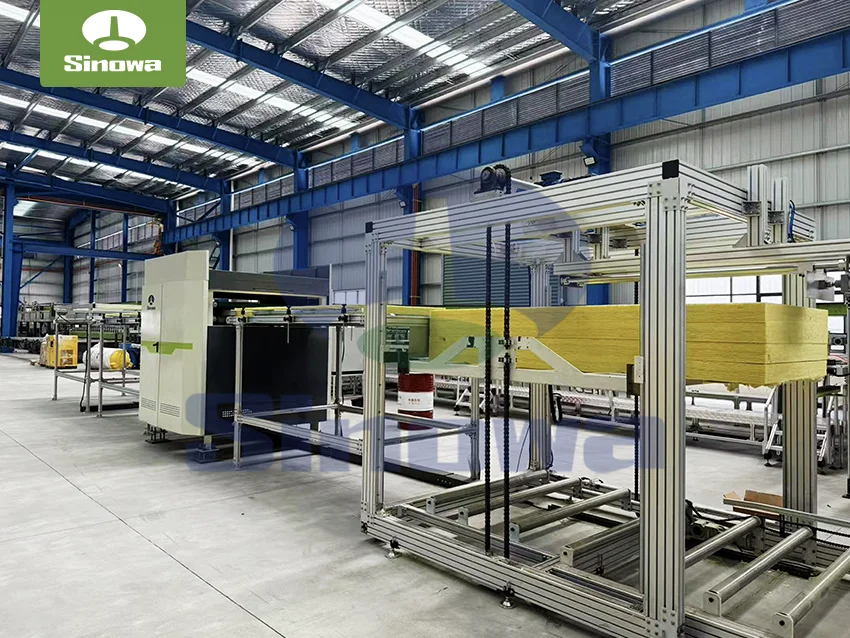
After the completion of raw material pretreatment, the production process enters the roll forming processing link of metal surface materials, which is a key process to shape the flat metal plate into the structural shape required for the edge sealing and assembly of sandwich panels. The roll forming unit of the production line is composed of multiple groups of precision forming roller sets and frequency conversion transmission mechanisms. According to the design requirements of different sandwich panel specifications and application scenarios, the forming roller sets with corresponding groove shapes and structural sizes are configured. When the pretreated flat metal plate is continuously conveyed into the roll forming unit, through the gradual rolling and extrusion of multiple groups of forming rollers, the edge and middle part of the metal plate are gradually pressed into longitudinal grooves, trapezoidal structures or special edge sealing structures. The gradual forming processing mode adopted by the roll forming unit can avoid structural damage, surface coating cracking and edge chipping of the metal plate caused by one-time strong pressing. In the rolling process, the electrical control system of the production line can accurately adjust the conveying speed and rolling pressure of the metal plate in real time according to the production speed and plate specification parameters, ensuring that the size and shape of each formed metal surface material remain consistent. The formed metal surface materials are continuously and stably conveyed backward along the production line, and the upper and lower surface materials are respectively conveyed to the adhesive coating station in a parallel and aligned state, preparing for the subsequent composite bonding operation with the mineral wool core material.
Adhesive application and pre-composite treatment is the core process that determines the bonding firmness between the metal surface material and the mineral wool core material, and directly affects the overall structural stability and service life of the finished mineral wool sandwich panel. The adhesive used in the production line is a high-performance environmentally friendly polymer adhesive, which has the characteristics of fast curing speed, strong bonding performance, good weather resistance and stable chemical properties, and can form a durable and firm bonding layer between metal materials and mineral wool fiber materials. The adhesive coating unit of the production line adopts an automatic spraying and gluing integrated structure, which can uniformly coat the set amount of adhesive on the inner surface of the upper and lower formed metal surface materials. The gluing system is equipped with an automatic proportional mixing and quantitative conveying device, which can accurately control the mixing ratio of the adhesive components and the single coating amount according to the production process parameters and plate thickness specifications. This precise gluing control mode can avoid quality problems such as insufficient bonding strength caused by too little adhesive coating, and panel surface bulging and adhesive overflow caused by too much adhesive coating. After the completion of adhesive coating, the metal surface materials coated with adhesive and the pretreated and shaped mineral wool core material enter the pre-composite positioning unit together. The positioning unit accurately aligns the upper and lower metal surface materials and the middle mineral wool core material through mechanical limiting and servo positioning components, ensuring that the three layers of materials are completely aligned in the horizontal and vertical directions, without deviation or misalignment, laying a solid foundation for the subsequent formal pressing and composite forming.
Composite pressing and laminating forming is an important link to realize the integrated combination of metal surface materials and mineral wool core materials and form the basic outline of the sandwich panel. The pre-positioned three-layer composite material is continuously conveyed into the composite pressing unit of the production line, which adopts a multi-layer roller pressing structure with adjustable pressure and spacing. According to the thickness specification of the produced sandwich panel, the equipment automatically adjusts the gap between the upper and lower pressing rollers and the overall pressing pressure, so that the metal surface materials and the mineral wool core material are closely bonded under the action of uniform mechanical pressure. The pressing process adopts continuous uniform pressure extrusion instead of intermittent strong pressure impact, which can make the adhesive fully infiltrate into the gap between the mineral wool fibers and the inner surface of the metal plate, enhance the bonding tightness between layers, and effectively eliminate the internal gap and hollow phenomenon of the composite panel. During the laminating and pressing process, the production line maintains a stable conveying speed and pressing pressure synchronization state, ensuring that the overall thickness of the continuously produced composite panel is uniform and consistent, and the surface flatness meets the production standard requirements. After the completion of laminating and pressing, the preliminary composite sandwich panel has formed a complete integrated structure, but the adhesive inside the panel has not yet been fully cured and shaped, so it needs to enter the constant temperature heating and curing link for further treatment to enhance the bonding strength and structural stability of the panel.
Constant temperature heating and curing treatment is a key process to promote the rapid curing of the internal adhesive of the sandwich panel and stabilize the overall structural performance of the panel. The curing unit of the production line is a closed constant temperature heating channel with adjustable internal temperature and conveying speed. The preliminary pressed and laminated sandwich panel is continuously conveyed into the curing furnace through the conveyor belt, and moves forward at a constant speed in the closed heating environment. The internal temperature of the curing furnace is adjusted according to the characteristics of the adhesive used and the production environmental conditions, maintaining a reasonable constant temperature range to ensure that the adhesive can complete the chemical curing reaction stably and efficiently. The constant temperature curing environment can make the adhesive evenly cured inside and outside the sandwich panel, avoid the problem of inconsistent curing degree caused by uneven temperature, and effectively improve the overall bonding strength and peeling resistance of the composite panel. The conveying speed of the curing furnace is matched with the curing time required by the adhesive, ensuring that each section of the sandwich panel can obtain sufficient curing time in the heating channel. After the curing treatment, the adhesive inside the panel is completely solidified, the bonding between the metal surface layer and the mineral wool core layer reaches the set strength standard, and the overall structure of the sandwich panel is basically stable, which can resist slight external pressure and structural tension without delamination or deformation.
Precise fixed-length cutting and edge trimming processing is the post-forming processing link to make the continuous composite sandwich panel meet the actual use size and appearance quality requirements. The cured integrated sandwich panel is continuously conveyed to the cutting and trimming unit along the production line. Since the panel produced in the front section is an uninterrupted continuous plate body, it needs to be cut into fixed-length finished panels according to the actual order demand and engineering use specifications. The cutting unit adopts automatic servo fixed-length cutting equipment, which can set the cutting length parameters in advance through the electrical control system. When the continuous panel is conveyed to the set position, the equipment automatically completes the rapid and precise cutting action. The cutting tool is specially designed for mineral wool sandwich panels, which can realize smooth cutting of metal surface layer and mineral wool core layer at one time, without edge burrs, fiber scattering and plate deformation after cutting. After the fixed-length cutting is completed, the edge trimming process is carried out on the two sides of the panel. The trimming equipment trims the uneven edges and excess leftover materials on the two sides of the panel to ensure that the overall dimensional accuracy of the finished panel meets the unified standard, and the edges are neat and smooth, which is convenient for subsequent on-site installation and assembly construction. In the cutting and trimming process, the production line is equipped with a waste recovery device, which can centrally collect the cut leftover materials and waste materials, realizing centralized treatment and resource recycling of production waste.
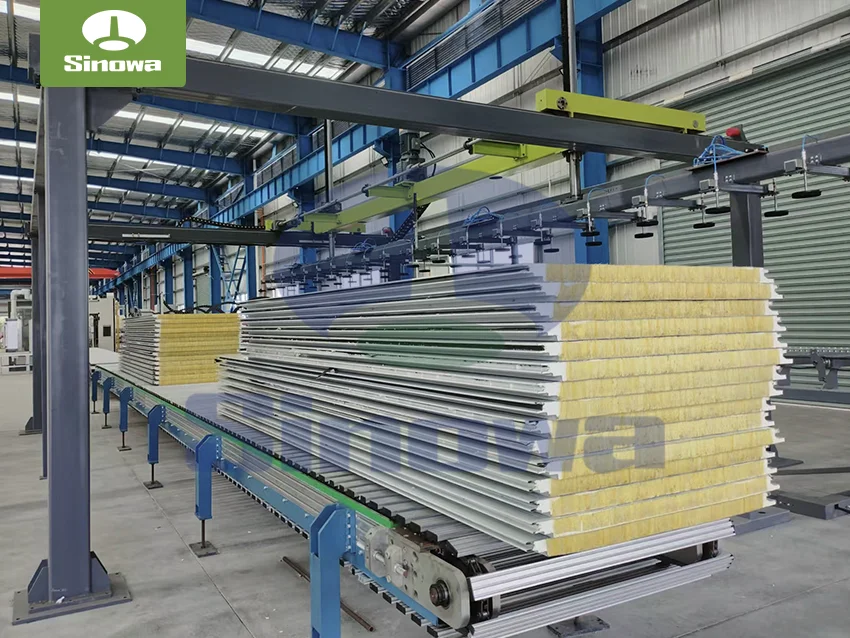
Finished product cooling, sorting and automatic stacking are the final processing and packaging preparation links of the entire mineral wool sandwich panel production machinery. The sandwich panel after cutting and trimming has a certain residual temperature due to the previous constant temperature curing treatment, and the internal structure of the panel needs to be naturally cooled and stabilized to avoid stacking deformation caused by high temperature. The finished product cooling conveyor unit extends the conveying path of the panel, allowing the cut single finished panel to be naturally cooled in the normal temperature environment, so that the internal temperature of the panel gradually returns to the normal temperature state, and the structural performance is further stabilized. After the cooling treatment, the qualified finished panels are conveyed to the sorting and stacking area. The automatic stacking equipment of the production line sorts the panels according to different specifications and production batches, and automatically stacks the qualified finished panels in a fixed area in an orderly manner. The stacking process adopts layered and balanced stacking mode to avoid panel surface scratch, edge damage and structural deformation caused by uneven stacking pressure. After the stacking is completed, the finished panels are manually or mechanically transported to the finished product storage area for temporary storage, waiting for subsequent outbound transportation and engineering delivery. The entire stacking and storage link follows standardized management requirements to ensure that the finished panels are not damaged or affected by the external environment before leaving the factory.
In the daily operation and production process of the mineral wool sandwich panel line, scientific and standardized process parameter control and equipment daily maintenance management are crucial to maintaining stable production efficiency and excellent finished product quality. In terms of production process control, production operators need to reasonably adjust key parameters such as unwinding tension, roll forming pressure, adhesive coating amount, composite pressing pressure, curing temperature and conveying speed according to different raw material batches, panel thickness specifications and external environmental temperature and humidity conditions. Different parameter combinations will directly affect the bonding effect, structural strength, surface flatness and dimensional accuracy of the finished sandwich panel. For example, in the environment of low temperature and high humidity in winter, the curing temperature of the curing furnace needs to be appropriately adjusted and the conveying speed needs to be moderately reduced to ensure that the adhesive can be fully cured; when producing thin-specification sandwich panels, the composite pressing pressure needs to be reduced to avoid excessive pressure causing compression deformation of the mineral wool core layer. At the same time, during the continuous production process, regular sampling inspection of the produced semi-finished and finished panels is required, focusing on checking the bonding tightness between layers, overall dimensional deviation, surface flatness and edge forming quality, and timely adjusting production process parameters once minor quality problems are found to avoid large-scale unqualified product output.

Equipment daily maintenance and regular overhaul work is an important guarantee for the long-term stable and efficient operation of the continuous mineral wool sandwich panel production line. The production line involves a large number of mechanical transmission parts, electrical control components, hydraulic power systems and heating and curing equipment, and long-term continuous operation will inevitably lead to wear and aging of parts and components. Daily maintenance work includes regular cleaning of equipment surface and internal residual dust, mineral wool fibers and adhesive residues, regular lubrication of transmission bearings, rollers and chain parts, daily inspection of electrical circuit connection and hydraulic pipeline sealing status, and timely handling of minor faults such as loose parts and weak circuit contact. Regular overhaul work needs to be carried out according to the operating time of the production line, including checking the wear degree of forming rollers and cutting tools, calibrating the positioning accuracy of servo control components, detecting the operating efficiency of the heating system and dust collection equipment, and replacing severely worn parts and aging components in a timely manner. Good maintenance management can not only effectively reduce the failure shutdown rate of the production line, improve the overall continuous production efficiency, but also extend the service life of production equipment, reduce production and operation costs caused by equipment damage and frequent replacement.
With the continuous upgrading of construction industry standards and the continuous improvement of industrial building environmental protection and energy-saving requirements, the market demand for mineral wool sandwich panels with excellent fire resistance, thermal insulation and environmental protection performance is constantly increasing, which also puts forward higher requirements for the technical upgrading and production capacity optimization of mineral wool sandwich panel production lines. In recent years, the development direction of mineral wool sandwich panel production lines is mainly reflected in the improvement of automation level, the optimization of environmental protection production performance, the diversification of production adaptability and the refinement of quality control. The upgraded new generation production line adopts more advanced digital linkage control technology, realizing the integrated automatic adjustment and synchronous operation of all production links from raw material unwinding to finished product stacking, reducing manual intervention links in the production process, reducing human error factors, and further improving production efficiency and product consistency. In terms of environmental protection production optimization, the production line strengthens the dust and fiber recovery and treatment system in the mineral wool processing link, optimizes the adhesive spraying and gluing process, reduces the volatilization of harmful substances and the generation of production waste, and realizes green and low-carbon production. In terms of production adaptability optimization, the production line can quickly adjust equipment parameters and forming specifications, realizing flexible production of sandwich panels of different thicknesses, shapes and performance types, and meeting the diversified material demand of different construction projects and industrial fields.
In practical industrial production and engineering application scenarios, the operation and production effect of mineral wool sandwich panel production equipment directly affect the construction quality and later use effect of supporting engineering projects. The sandwich panels produced by standardized and standardized production lines have stable fire resistance, good thermal insulation and sound insulation effects, strong structural durability and convenient on-site installation characteristics, and can adapt to various complex building use environments. Whether it is the thermal insulation and fireproof enclosure of industrial factory buildings, the low-temperature insulation needs of cold storage and refrigeration projects, or the safe construction requirements of public buildings and temporary engineering facilities, high-quality mineral wool sandwich panels produced by professional production lines can provide reliable material support. With the continuous development of the construction industry towards energy conservation, environmental protection, safety and high efficiency, the application scope of mineral wool sandwich panels will continue to expand, and the market demand for high-performance and high-efficiency fully automatic mineral wool sandwich panel production lines will also continue to grow. Continuously optimizing the production process of the production line, improving the level of equipment operation and maintenance, and strengthening the refined management of the production process will help production enterprises to maintain stable product quality and market competitiveness in the continuous market development, and also promote the standardized and high-quality development of the entire mineral wool sandwich panel manufacturing industry.
https://www.cnsinowa.com/sandwich-panel-machines/mineral-wool-sandwich-panel-production-line.html






