sandwich panel line
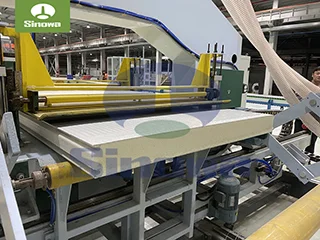
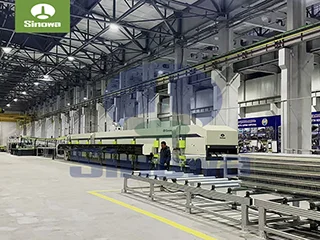
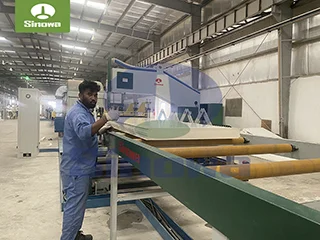
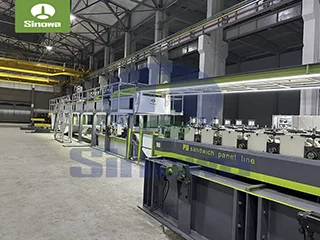
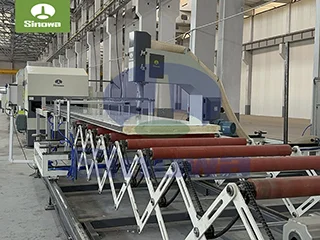
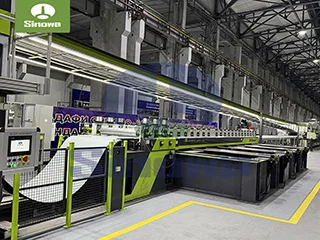
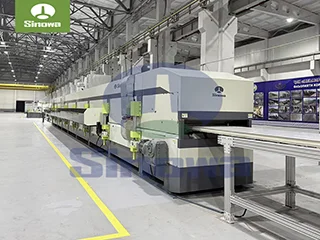
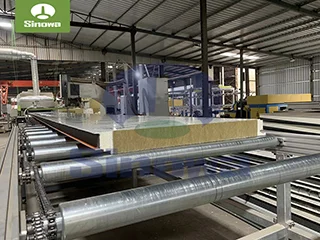
The PIR Sandwich Exterior Wall Panel Line is a combination of equipment specifically designed for producing polyurethane sandwich exterior wall panels.
The PIR Sandwich Exterior Wall Panel Line usually consists of multiple equipment, including raw material pretreatment equipment, mixing foaming equipment, molding equipment, cutting equipment, post-treatment equipment, etc. These devices work together to complete the entire process from raw material preparation to finished product output.
Raw material pretreatment equipment: used for pretreatment of polyurethane raw materials, such as heating, stirring, etc., to ensure the uniformity and stability of the raw materials.
Mixing and foaming equipment: mix the pretreated raw materials in proportion and form polyurethane foam with sandwich layer through foaming process. This step is crucial for the production line and directly affects the insulation performance of the product.
Molding equipment: the polyurethane foam after mixed foaming is combined with panel materials (such as color steel plate, aluminum zinc plate, etc.), and is pressed into shape through the mold. Forming equipment needs to have high precision and stability to ensure the dimensional accuracy and appearance quality of the product.
Cutting equipment: Cut the formed polyurethane sandwich exterior wall panels to meet the requirements of different sizes and specifications. Cutting equipment needs to have high cutting accuracy and efficiency.
Post processing equipment: perform edge treatment, surface cleaning, etc. on the cut products to improve the overall quality and aesthetics of the products.
Characteristics
High degree of automation: Modern PIR Sandwich Exterior Wall Panel Lines usually use automated control systems, which can achieve the full process automation of raw material proportioning, foaming, molding, cutting, and post-processing. This greatly improves production efficiency and reduces labor costs.
High production efficiency: The polyurethane exterior wall panel production line can produce continuously with a short production cycle. An advanced production line can produce hundreds of square meters of polyurethane sandwich exterior wall panels per hour.
Stable product quality: Due to the use of automated control systems and precision processing equipment in the production line of exterior wall sandwich panels, the polyurethane sandwich exterior wall panels produced have the advantages of high dimensional accuracy, good appearance quality, and stable thermal insulation performance.
Energy saving and environmental protection: The polyurethane exterior wall sandwich panel production line can fully utilize raw materials and reduce waste during the production process. Meanwhile, as a green building material, polyurethane sandwich exterior wall panels have excellent thermal insulation properties, which can reduce the energy consumption and carbon emissions of buildings.
Polyurethane sandwich exterior wall panels are widely used for external wall insulation and decoration of various buildings. Due to its lightweight, high strength, and excellent thermal insulation performance, it is particularly suitable for building fields such as cold storage, containers, and mobile rooms that require thermal insulation. In addition, polyurethane sandwich exterior wall panels are widely used for exterior wall decoration and insulation of industrial plants, commercial buildings, residential buildings, and other buildings.
With the transformation and upgrading of the construction industry and the continuous promotion of environmental policies, the demand for polyurethane sandwich exterior wall panels in the market continues to grow. In the future, the PIR Sandwich Exterior Wall Panel Line will pay more attention to technological innovation and product upgrades to meet the market's demand for high-quality and high-performance products. At the same time, industrial chain integration will also become an important trend, and upstream and downstream enterprises will reduce costs and improve efficiency through win-win cooperation.
PIR sandwich exterior wall panels have emerged as one of the most indispensable composite building materials in modern architectural enclosure and structural auxiliary engineering, integrating composite structural design, stable physical performance and versatile construction adaptability to meet the diverse and complex construction needs of various new buildings, renovation projects and temporary permanent architectural spaces. The overall composition of these panels follows a typical sandwich composite structure mode, with a rigid polyisocyanurate foam core layer firmly bonded between two layers of continuous and tough outer facing materials, forming an integrated structural whole through professional composite molding and high-strength bonding processes. This unique structural combination does not simply superimpose the physical characteristics of each single material layer, but produces a synergistic structural effect that surpasses the performance of individual components, enabling the panels to bear various external loads, resist natural environmental erosion, maintain long-term structural stability and achieve excellent functional coordination in the long-term service cycle of buildings. Unlike traditional single-layer wall building materials and ordinary composite wall panels, the structural performance system of PIR sandwich exterior wall panels is systematically classified according to core structural bearing capacity, anti-deformation performance, connection and fixing structural form, environmental adaptation structural stability and overall structural coordination characteristics, and each performance type corresponds to targeted structural design optimization and exclusive application scenarios, realizing the precise matching between building structural design requirements and wall enclosure functional needs. The continuous innovation and upgrading of the PIR sandwich exterior wall panel production line further enriches the structural performance classification system of the products, making these panels no longer limited to basic thermal insulation and enclosure functions, but becoming an important part of the building overall structural stress system and long-term durability guarantee system.
The first major category of PIR sandwich exterior wall panels classified by core structural performance is the conventional load-bearing stable structural type, which is the most widely used basic structural performance model in the entire product line and is designed and optimized for the conventional static load-bearing and daily environmental stress resistance needs of general civil and industrial buildings. The core structural design of this type of panel focuses on balancing basic self-weight bearing capacity, uniform external wind load resistance and slight structural vibration adaptation, with the internal PIR foam core adopting a uniform closed-cell dense structure layout and consistent core layer thickness setting along the entire length and width of the panel. The closed-cell structural characteristics of the PIR core layer endow the panel with excellent overall structural compactness, effectively avoiding internal structural hollowing, local stress concentration and uneven force transmission that often occur in ordinary foam core sandwich panels under long-term static load. The upper and lower outer facing materials adopt rigid and flat structural layout, which can evenly disperse all kinds of vertical and horizontal external loads acting on the wall surface to the internal foam core layer, and then realize uniform force transmission and structural stress dispersion through the integrated bonding structure between the core layer and the facing layers. In terms of structural deformation resistance, this conventional load-bearing stable structural panel has excellent anti-bending deformation and anti-slight shrinkage and expansion performance, and can maintain stable structural shape and overall flatness under the action of conventional wind pressure, building self-weight pressure and small temperature difference changes in the external environment. The internal bonding interface between the core material and the facing material is treated with integrated composite process, which ensures that there is no delamination, cracking or dislocation between different material layers during long-term use, and the overall structural integrity is always maintained. This type of structural performance panel is mainly suitable for the exterior wall enclosure of general industrial plants, ordinary logistics warehouses, simple commercial supporting buildings and conventional office auxiliary buildings. In these application scenarios, the building does not need to bear extreme external loads or face severe extreme environmental conditions, and the basic load-bearing and stable enclosure structural performance can fully meet the daily use and long-term safe operation needs of the building. The structural design characteristics of light self-weight and convenient stress transmission also make the installation and construction of the panel more efficient, effectively shortening the overall construction cycle of the building exterior wall enclosure project, and the stable structural performance can reduce the later maintenance and repair work of the wall structure, maintaining the long-term stable use state of the building exterior wall.
The second important structural performance type of PIR sandwich exterior wall panels is the enhanced wind-resistant and impact-resistant structural type, which is specially developed for buildings located in complex climatic environments, open outdoor areas and places prone to frequent external impact loads, and the core structural optimization focus on improving the panel's ability to resist strong wind dynamic loads, external hard impact and repeated structural fatigue stress. On the basis of retaining the basic composite sandwich structure, this type of panel carries out targeted structural reinforcement design in three key aspects: core layer density optimization, facing material structural toughness enhancement and internal bonding strength upgrading. The density of the internal PIR foam core is appropriately increased and the internal cell structure is refined and compacted, which significantly improves the core's compressive bearing capacity and anti-fatigue structural performance, and can withstand the repeated alternating pressure generated by strong wind gusts and long-term wind vibration without permanent structural deformation or internal structural damage. The outer facing materials adopt thickened and toughened structural design with enhanced surface tensile and impact resistance, which can effectively resist the impact of external flying debris, strong wind-borne objects and occasional human or mechanical external forces, avoiding surface depression, cracking and local structural damage to the wall panel. The bonding process between the core layer and the facing layer is further upgraded to enhance the shear resistance and peel resistance of the composite interface, ensuring that the overall structural integrity of the panel will not be damaged under the action of strong wind shear force and repeated impact vibration, and the coordinated stress-bearing capacity of each structural layer is always maintained. In terms of overall structural performance, the enhanced wind-resistant and impact-resistant structural panel has far higher dynamic load resistance and structural fatigue resistance than conventional structural panels, and can maintain stable structural performance and complete morphological integrity in harsh environments with strong wind, frequent seasonal climate changes and complex external interference. This structural performance type of panel is widely used in the exterior wall construction of large logistics distribution centers, outdoor exhibition halls, sports venues, large industrial production workshops and buildings in coastal open areas. These application scenarios have high requirements on the wind resistance and impact resistance of building exterior walls, and the enhanced structural performance can effectively ensure the structural safety and stable enclosure function of buildings under extreme weather and complex external load conditions, avoiding structural safety hazards and wall damage problems caused by insufficient structural performance of ordinary panels.
The third typical structural performance classification of PIR sandwich exterior wall panels is the temperature deformation adaptive structural type, which is designed for buildings in areas with large seasonal temperature differences, frequent day and night temperature changes and long-term high and low temperature alternating environments, and its core structural advantage lies in excellent thermal expansion and contraction deformation coordination and temperature stress resistance. The structural design of this type of panel fully considers the structural deformation differences between the PIR foam core material and the outer facing material under different temperature conditions, and optimizes the internal composite structure layout and material matching ratio to realize the synchronous and coordinated deformation of each structural layer during temperature changes, effectively avoiding structural cracking, interface delamination and local deformation damage caused by inconsistent thermal expansion and contraction coefficients of different materials. The internal PIR core layer adopts a flexible and rigid balanced structural design, which not only maintains sufficient structural bearing capacity at conventional temperatures, but also has appropriate micro-deformation adjustment space under high and low temperature alternating conditions, buffering the temperature stress generated by thermal expansion and contraction of the panel structure. The outer facing material is treated with temperature deformation stabilization process to reduce the linear expansion and contraction rate of the panel surface, and the edge connection structure of the panel is optimized with a flexible adaptive structural design, which can adapt to the tiny dimensional changes of the panel caused by temperature changes without generating excessive structural restraint stress. The overall structural performance of this type of panel ensures that the wall will not produce obvious deformation, cracking or water seepage gaps due to temperature changes in the long-term use process, and the structural stability and enclosure tightness of the exterior wall are always maintained. The temperature deformation adaptive structural PIR sandwich exterior wall panels are mainly used in the exterior wall enclosure of cold storage and refrigeration warehouses, constant temperature production workshops, food processing factories, northern cold region buildings and southern high-temperature seasonal alternating buildings. These buildings have strict requirements on the constant temperature control of the internal space and the structural stability of the exterior wall, and the temperature adaptive structural performance can effectively avoid the damage of the wall structure caused by temperature stress, ensure the stable operation of the internal constant temperature environment, and prolong the overall service life of the building exterior wall structure.
The fourth special structural performance type of PIR sandwich exterior wall panels is the hidden connection integrated structural type, which takes the overall structural integrity of the building wall and the aesthetic coordination of the exterior facade as the core design goal, and focuses on optimizing the panel connection and fixing structural form on the basis of stable basic structural bearing performance. Different from the conventional exposed fixed structural panels, this type of structural panel adopts a hidden embedded connection structural design at the edge and joint positions, with no exposed fasteners on the outer surface of the wall after installation, and all connection and fixing structures are hidden inside the panel joint and the building steel structure keel. The internal structure of the panel is locally reinforced at the hidden connection parts, with enhanced local compressive and shear structural performance, ensuring that the connection parts can bear all the structural loads of the panel without local stress concentration and structural damage. The matching gap between panels is designed with a closed structural lap joint form, which not only realizes seamless and flat connection on the outer surface, but also maintains the overall structural continuity and stress transmission uniformity of the wall after installation. The overall structural performance of the hidden connection integrated structural panel not only retains the basic load-bearing, wind-resistant and thermal insulation structural advantages of PIR sandwich panels, but also improves the overall structural integration of the building exterior wall, reducing the structural weak points and potential water seepage hidden dangers at the panel connection joints. In terms of practical use, this type of structural panel takes into account both excellent structural performance and beautiful architectural facade effect, and is widely used in the exterior wall decoration and enclosure of high-grade commercial buildings, office buildings, exhibition centers, municipal public buildings and high-end prefabricated modular buildings. These architectural projects have high requirements on the aesthetic appearance of the exterior wall while ensuring structural safety, and the hidden connection integrated structural design can meet the dual needs of structural stability and architectural aesthetic effect, making the building exterior wall overall neat and beautiful without affecting the long-term structural safe use.
The fifth practical structural performance type of PIR sandwich exterior wall panels is the lightweight seismic-resistant structural type, which is developed for prefabricated steel structure buildings, temporary permanent buildings and buildings in seismic active areas, and its core structural characteristics are ultra-light overall self-weight and excellent seismic structural coordination performance. The structural design of this type of panel adopts a thin-core high-strength composite optimization scheme, reducing the overall self-weight of the panel on the premise of ensuring basic structural bearing capacity, and the light-weight structural characteristics can effectively reduce the overall dead load of the building wall, thereby reducing the seismic inertia force of the whole building in the event of earthquake vibration. The internal PIR foam core has good buffer energy-absorbing structural performance, which can effectively absorb and buffer the seismic vibration energy transmitted by the building main structure during an earthquake, reduce the structural vibration amplitude of the exterior wall panel, and avoid the overall collapse and local falling off of the wall panel caused by seismic vibration. The bonding structure between the panel layers has good flexible connection performance, which can adapt to the tiny structural displacement and deformation of the building main structure during an earthquake, without structural delamination and cracking of the panel itself. The overall structural coordination performance enables the panel to work synchronously with the building steel structure main body, improving the overall seismic resistance of the whole building. This lightweight seismic-resistant structural PIR sandwich exterior wall panel is mainly used in prefabricated modular residential buildings, temporary construction activity rooms, steel structure light industrial buildings and various architectural projects in seismic protection key areas. These buildings have high requirements on seismic safety and rapid construction, and the lightweight seismic-resistant structural performance can not only ensure the structural safety of the building in seismic events, but also realize rapid transportation and installation of the panels, improving the construction efficiency of the project and reducing the overall structural load of the building.
In the actual architectural engineering application and structural design process of PIR sandwich exterior wall panels, the selection of different structural performance types needs to be comprehensively determined according to the main structural characteristics of the building, the environmental conditions of the construction area, the functional use requirements of the building and the overall structural design goals of the project. Different structural performance types have their own unique structural design focuses and core performance advantages, and each can targeted meet the differentiated structural stress and enclosure protection needs of different architectural scenarios. The continuous improvement of the PIR sandwich exterior wall panel production line and the continuous optimization of structural design technology further enhance the matching degree between various structural performance panels and architectural engineering needs, making these panels play an increasingly important role in modern building energy conservation, structural safety protection, rapid construction and long-term building operation maintenance. With the continuous development of modern architectural engineering towards high efficiency, energy saving, safety and modularization, the structural performance classification system of PIR sandwich exterior wall panels will be further enriched and improved, and the continuous upgrading of structural design and composite molding technology will make these composite wall panels more adaptable to complex architectural construction needs, providing reliable structural guarantee and efficient enclosure solutions for all kinds of new buildings and building renovation projects.
https://www.cnsinowa.com/sandwich-panel-machines/pir-sandwich-exterior-wall-panel-line.html