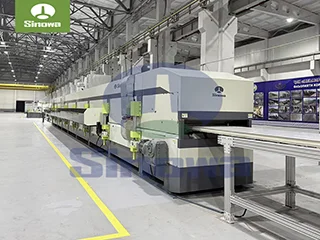
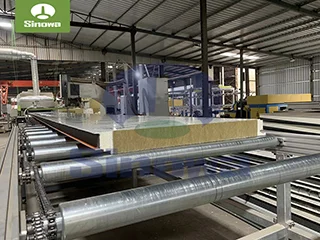
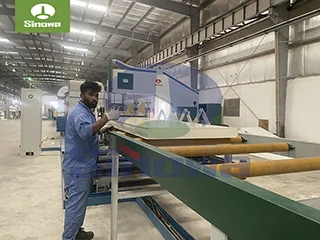
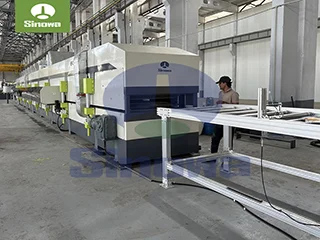
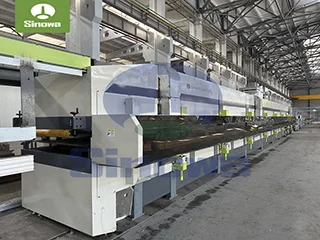
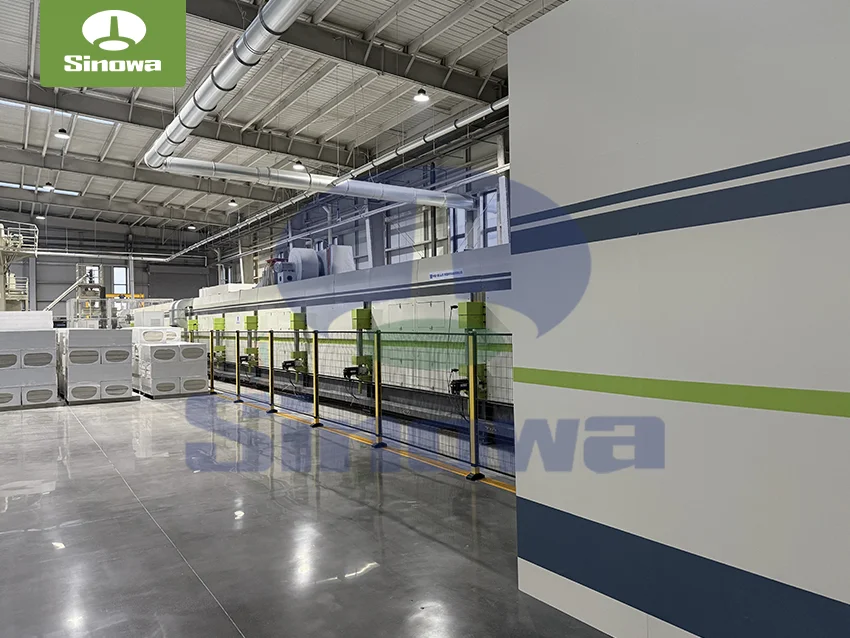
 sandwich panel line
The operational logic of the automatic sandwich panel production line is based on the precise coordination of chemical reaction principles and mechanical automatic control. Foam formation essentially relies on the cross-linking reaction and foaming expansion of multiple raw materials under specific temperature, pressure, and proportion conditions. The entire production process follows a closed-loop automated operation mode, covering raw material storage, proportional metering, high-precision mixing, continuous foaming, constant-temperature curing, fixed-size shaping, automatic cutting, and finished product conveying. Each link is interconnected and restricted, with no excessive manual intervention required, ensuring the continuity and stability of the production process. The core advantage of the system lies in its ability to digitize and refine all production parameters that originally depend on manual experience, including raw material ratio, mixing speed, reaction temperature, foaming time, and curing intensity, so as to form standardized production standards and lay a foundation for the consistency of batch products.
Raw material pretreatment and proportional metering are the primary key links of the foam core sandwich panel line, which directly determine the basic performance of finished foam products. The production line is equipped with independent sealed storage units for different raw materials, which can classify and store liquid and solid raw materials required for foaming, and maintain constant temperature and sealing conditions inside the storage units to prevent raw material deterioration, volatilization, or impurity mixing caused by external environmental interference. In the production process, the intelligent metering system automatically extracts raw materials according to preset production formulas. Driven by high-precision servo pumps and sensing devices, the system can accurately control the feeding amount of each raw material within a tiny error range, completely avoiding the proportion deviation caused by manual feeding. Different foam products require different raw material formulas and component ratios, and the production line can store multiple sets of production formulas in the control system. Operators only need to switch the formula mode through the human-machine interaction interface to complete the rapid adjustment of raw material proportioning, realizing flexible production of different types of foam products, including flexible soft foam, rigid hard foam, and semi-rigid composite foam.
After the completion of raw material metering, the materials are automatically transported to the high-speed mixing unit for full integration and reaction pretreatment. The mixing unit adopts a closed stirring structure, which can avoid the overflow of chemical materials and the volatilization of harmful gases during the mixing process, improving the safety and environmental protection of production. The system can adjust the stirring speed, stirring time, and mixing pressure in real time according to the characteristics of different raw materials and production requirements. For raw material combinations with high viscosity differences and slow fusion speed, the variable-frequency speed regulation mode is adopted to realize staged stirring, ensuring that all components are evenly fused at the molecular level without local agglomeration or uneven mixing. Uniform raw material mixing is the premise of forming a uniform foam pore structure. Insufficient mixing will lead to inconsistent foaming degree of products, local density difference, and even hollow and crack defects, while the automated mixing system completely eliminates such quality risks through standardized parameter control.
The continuous foaming and expansion stage is the core process of foam product molding, and also the most critical link that determines the structural performance of finished products. The fully mixed raw materials are automatically injected into the foaming chamber or continuous conveying mold through the high-pressure injection system. In the closed foaming space, with the cooperation of preset constant temperature and micro-positive pressure environment, the foaming agent in the raw materials undergoes thermal decomposition and chemical reaction to generate stable gas. The gas gradually expands and forms uniform and dense micro-pore structures inside the material matrix. The entire foaming expansion process is dynamically monitored by real-time sensing devices. The system can capture subtle changes in temperature, pressure, and expansion rate in the foaming space in real time, and automatically adjust heating power and pressure parameters to ensure that the foaming speed matches the material curing speed. This synchronous control mode ensures that the internal pore size of the foam is uniform, the pore wall thickness is consistent, and the overall structure is compact and stable, effectively improving the compression resistance, resilience, heat insulation, and sound insulation performance of the foam products.
Constant-temperature curing and shaping follow the foaming expansion process, which aims to fix the temporary porous structure formed by foaming into a stable physical structure and avoid product deformation, shrinkage, or structural collapse in the subsequent processing and use process. The continuous sandwich panel production line is equipped with a segmented constant-temperature curing channel, which sets different temperature gradients according to the thickness, density, and material characteristics of different foam products. The gradual curing mode from inside to outside enables the internal chemical cross-linking reaction of the foam to be fully completed, realizing the solidification and stabilization of the overall structure. Compared with the natural curing mode of traditional production processes, the automated constant-temperature curing system shortens the curing cycle, improves production efficiency, and avoids product quality differences caused by seasonal temperature changes and environmental humidity fluctuations. After curing, the foam semi-finished products enter the shaping unit, which uses mechanical calibration and flat pressing technology to correct the overall flatness and dimensional accuracy of the products, eliminating surface unevenness and edge warping problems generated in the foaming process.
The automatic cutting and finishing system realizes the final sizing and shaping of foam products, adapting to the diversified size requirements of downstream industries. Equipped with high-precision servo cutting devices and intelligent positioning systems, the continuous sandwich panel line can automatically identify the specifications of semi-finished foam products and complete fixed-length cutting, edge trimming, and surface finishing according to preset dimensional standards. The cutting speed and precision can be adjusted intelligently according to the product thickness and hardness, ensuring smooth and flat cutting sections without burrs, cracks, or material collapse. The automated cutting process replaces manual cutting and mechanical positioning cutting in traditional processes, greatly improving product dimensional accuracy and batch consistency. Meanwhile, the system is equipped with a waste recycling and processing device, which can automatically collect leftover materials generated in the cutting process, realizing resource recycling and reducing raw material waste in the production process.
The intelligent control and real-time monitoring system runs through the sandwich panel machine, which is the core guarantee for the automated and stable operation of the equipment. The system takes programmable logic controllers as the core, cooperating with multiple temperature sensors, pressure sensors, flow sensors, and visual monitoring devices to form a full-process data monitoring network. All operation parameters in the production process, including raw material feeding flow, mixing speed, foaming temperature, curing time, and cutting size, are displayed in real time on the human-machine operation interface and automatically stored in the system database. During the production operation, once any parameter deviates from the preset standard range, the system will automatically trigger early warning prompts and carry out intelligent parameter correction. For abnormal faults that cannot be adjusted automatically, the equipment will stop running safely and lock the fault location, providing accurate maintenance guidance for operators. This intelligent monitoring and self-correction function greatly reduces the failure rate of production equipment and the probability of defective products, realizing unmanned stable operation of the production line for a long time.
In terms of production performance, the automatic foaming manufacturing line has obvious advantages over traditional production equipment in efficiency, quality, and cost control. In terms of production efficiency, the continuous operation mode realizes uninterrupted production, breaks the production bottleneck of intermittent operation of traditional equipment, and greatly improves the single-shift output. The whole production process only requires a small number of operators to conduct routine inspection and parameter setting, which reduces the dependence on skilled workers and solves the production capacity limitation caused by insufficient labor and uneven worker proficiency. In terms of product quality, standardized digital parameter control makes the density, pore structure, mechanical properties, and dimensional accuracy of each batch of foam products highly consistent, effectively reducing the defective rate and improving the overall qualification rate of products. In terms of production cost, the precise metering and feeding system avoids raw material waste caused by manual operation errors, and the automated streamlined process reduces energy consumption in the production process. Meanwhile, the long-term stable operation of the equipment reduces maintenance costs and downtime losses, bringing significant cost optimization benefits for enterprises.
In terms of production safety and environmental protection, the optimized structural design of the automatic foaming sandwich panel production line meets the current industrial green production standards. The entire production process adopts a fully closed structure for material transportation, mixing, and foaming, which effectively prevents the volatilization and leakage of chemical raw materials, reduces the emission of harmful substances, and improves the on-site production environment. The equipment is equipped with perfect safety protection interlock devices, which can realize automatic power-off and shutdown protection in case of equipment overload, material blockage, and abnormal temperature, avoiding production safety accidents caused by equipment failure. In addition, the intelligent energy-saving control system can automatically adjust the operating power of each unit according to the production load, avoiding invalid energy consumption during equipment idling, realizing energy conservation and emission reduction in the production process, and conforming to the development trend of green manufacturing in modern industry.
The automatic foaming sandwich panel line has a wide range of industrial adaptability and can meet the production needs of foam products for multiple fields. In the construction industry, it can produce high-efficiency thermal insulation foam materials, which are widely used in building exterior wall thermal insulation, roof heat preservation, and cold storage insulation engineering, relying on their excellent heat insulation and weather resistance. In the automotive industry, the flexible foam products produced by the line are used for automotive seat cushions, interior ceiling fillers, and door body sound insulation layers, with good resilience, shock resistance, and sound insulation effects. In the furniture and home furnishing industry, high-density soft foam is applied to mattresses, sofas, and cushion products, improving the comfort and durability of home products. In the packaging industry, lightweight buffer foam products can provide effective anti-collision and shock-absorbing protection for electronic products, precision instruments, and fragile goods. In addition, the automatic insulation panel production line can also produce special functional foam materials such as flame-retardant, antibacterial, and waterproof foam by adjusting production formulas and process parameters, meeting the customized production needs of special scenarios in different industries.
With the continuous upgrading of industrial manufacturing intelligence and the continuous improvement of market requirements for foam product performance, the automatic foaming insulation board production line is also developing in the direction of higher precision, stronger flexibility, and smarter integration. The new generation of production lines further optimizes the parameter control accuracy of the foaming process, realizing micro-adjustment of foam pore structure and precise control of product density, which can produce high-precision foam products with more stable performance. At the same time, the flexible production capacity of the equipment is further enhanced, which can quickly switch between the production of foam products of different materials, specifications, and functions, meeting the personalized and customized production needs of the market. In addition, with the integration of industrial Internet technology, the sandwich panel machinery can realize remote data monitoring, equipment operation analysis, and production process traceability, helping enterprises realize refined production management and further improve the level of intelligent manufacturing.
In the current industrial development environment, the transformation and upgrading of the foam manufacturing industry is an inevitable trend, and automated and intelligent production equipment is the core driving force for industrial upgrading. The automatic foaming production line effectively makes up for the many deficiencies of traditional manual and semi-automatic production modes, realizes the dual improvement of production efficiency and product quality, reduces production costs and safety risks, and provides strong technical support for the standardized, large-scale, and high-quality development of the foam industry. In the future, with the continuous progress of material technology and mechanical intelligence technology, the performance of automatic foaming sandwich panel manufacturing machine will be further optimized, the scope of applicable products and industries will continue to expand, and it will play a more important role in promoting the high-quality development of downstream manufacturing industries, becoming an important part of the modern intelligent manufacturing system.
https://www.cnsinowa.com/sandwich-panel-machines/supply-automatic-foaming-production-line.html