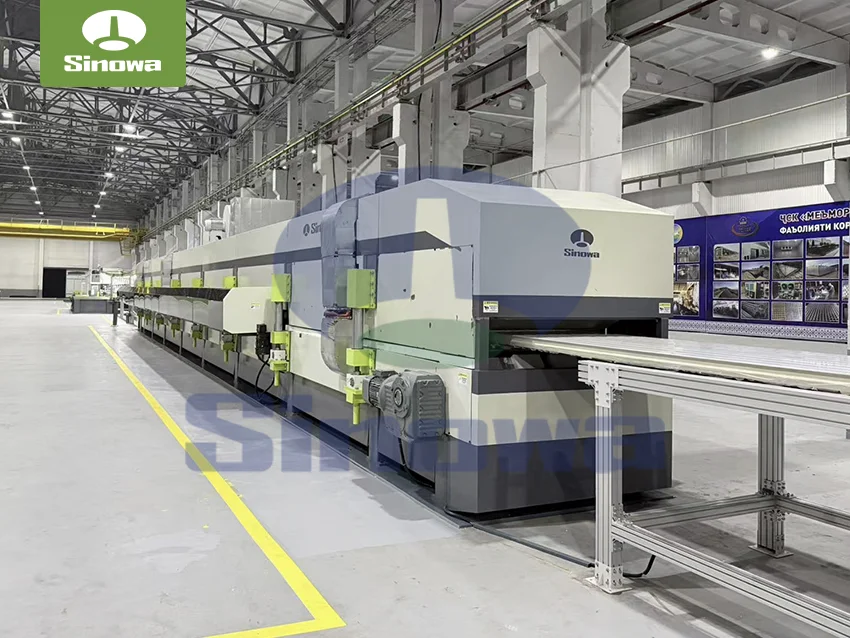
 sandwich panel line
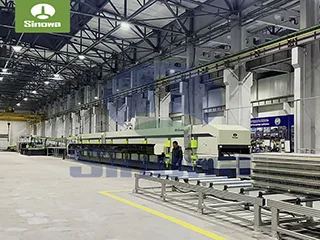
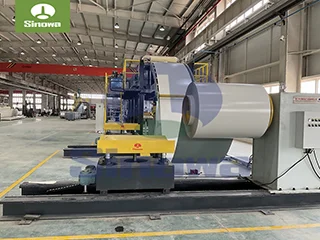
The core strength of a custom-shaped continuous PU sandwich panel manufacturing line lies in its modular design and integrated control system, which work in tandem to enable seamless customization without compromising production efficiency. At the heart of the production process is the precise coordination of multiple components, each playing a critical role in ensuring that the final panels meet the exact specifications of the custom design. The process typically begins with the preparation of the facing materials, which can include a variety of options such as galvanized steel, aluminum, non-woven fabrics, kraft paper, or aluminum foil, depending on the application requirements. These facing materials are fed into the line through decoilers, which are equipped with advanced tension control and alignment systems to ensure that the materials are fed smoothly and evenly, a crucial factor in maintaining the quality of the final product, especially when dealing with custom shapes that require precise material positioning.
After decoiling, the facing materials undergo a preheating process, which is essential for optimizing the adhesion between the facing materials and the PU core. The preheating temperature is carefully controlled based on the type of facing material and the specific requirements of the custom design, as different materials have different thermal properties and bonding characteristics. This preheating step not only improves the bond strength but also helps to ensure that the PU foam cures uniformly, enhancing the overall structural integrity of the panel. Following preheating, the facing materials are guided into the foaming and lamination zone, which is the core of the continuous production process.
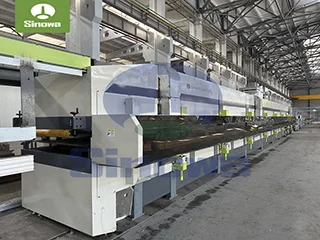
In the foaming zone, the PU foam components—typically polyol, isocyanate, foaming agent, catalyst, and other additives—are precisely metered and mixed in the correct proportions by high-pressure mixing heads. The accuracy of this metering and mixing process is critical, as even slight deviations can affect the properties of the PU foam, such as its density, thermal conductivity, and compressive strength. The mixed foam is then continuously deposited onto the lower facing material through a cloth head that can be adjusted to accommodate different custom shapes and sizes. The upper facing material is then brought into contact with the foam, and the entire assembly is fed into a double-belt lamination machine, where it is subjected to controlled temperature and pressure to facilitate the foaming and curing process. The double-belt machine plays a key role in shaping the panels, especially for custom shapes, as the belts can be customized with specific profiles or adjusted to apply varying pressure across different areas of the panel, ensuring that the foam fills all the required spaces and forms the desired shape.
One of the key innovations that enable the production of custom-shaped panels is the advanced cutting system integrated into the continuous production line. Unlike traditional lines that use fixed-length cutting, these custom lines are equipped with servo-controlled tracking saws that can follow complex paths and cut the panels into a wide range of shapes, including curved, angled, and irregular forms, while the production line continues to operate continuously. This eliminates the need for secondary cutting processes, which not only improves production efficiency but also reduces material waste and ensures greater precision in the final shape of the panels. The cutting parameters, such as the cutting speed, path, and depth, are controlled by a computerized system that is programmed with the custom design specifications, allowing for quick and easy adjustments between different custom orders.
Another important aspect of custom-shaped continuous PU sandwich panel manufacturing lines is their ability to adjust the thickness and density of the PU core to meet specific performance requirements. The thickness of the core can be adjusted by modifying the gap between the double belts in the lamination machine, allowing for panels with core thicknesses ranging from a few millimeters to several hundred millimeters, depending on the application's insulation and structural needs. Similarly, the density of the PU foam can be adjusted by varying the proportions of the foam components, enabling the production of panels with different compressive strengths and thermal insulation properties. This flexibility in core thickness and density, combined with the ability to produce custom shapes, makes these lines highly adaptable to a wide range of applications, from thin, lightweight panels for interior partitioning to thick, high-density panels for heavy-duty industrial applications.
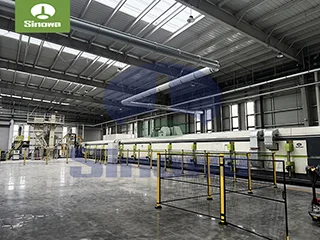
The modular design of these manufacturing lines also contributes significantly to their customizability and versatility. The line is composed of a series of modular components that can be easily reconfigured or combined in different ways to accommodate different production requirements. For example, additional modules can be added to handle specialized facing materials, or the foaming system can be modified to produce different types of PU foam, such as rigid foam for insulation or flexible foam for sound absorption. This modular approach not only makes it easier to adapt the line to new custom orders but also simplifies maintenance and upgrades, as individual modules can be serviced or replaced without disrupting the entire production line. Additionally, the modular design allows for scalability, enabling manufacturers to increase production capacity by adding more modules as their business grows.
The advantages of using continuous PU sandwich panel manufacturing lines for custom shapes extend beyond just customization and efficiency. These lines also offer significant improvements in product quality and consistency compared to traditional production methods. The continuous production process ensures that the panels are produced under uniform conditions, with consistent foam density, bond strength, and shape accuracy across the entire production run. This consistency is particularly important for custom shapes, where any variation in dimensions or properties can lead to fitting problems during installation. Furthermore, the automated nature of the production line reduces the reliance on manual labor, minimizing the potential for human error and ensuring that the panels meet the exact specifications of the custom design every time.
Energy efficiency is another notable benefit of these advanced manufacturing lines. Modern continuous production lines are designed with energy-saving features, such as closed-loop heating systems, high-efficiency motors, and insulation around the lamination and curing zones, which help to reduce energy consumption. The use of environmentally friendly foaming agents, such as pentane, instead of traditional chlorofluorocarbons (CFCs) or hydrochlorofluorocarbons (HCFCs), also makes the production process more sustainable, aligning with global efforts to reduce greenhouse gas emissions and protect the environment. This combination of energy efficiency and environmental sustainability makes custom-shaped continuous PU sandwich panel manufacturing lines an attractive option for manufacturers looking to reduce their carbon footprint and operating costs.
The applications of custom-shaped PU sandwich panels produced by these continuous lines are diverse and wide-ranging, spanning across the construction, automotive, logistics, and agricultural industries, among others. In the construction industry, custom-shaped panels are used for a variety of purposes, including curved roof panels for stadiums and exhibition halls, angled wall panels for modern architectural designs, and specialized insulation panels for cold storage facilities and clean rooms. The exceptional thermal insulation properties of PU foam make these panels ideal for cold storage applications, where maintaining a consistent temperature is critical, and the ability to produce custom shapes allows for a perfect fit in irregularly shaped cold rooms.
In the automotive and transportation industry, custom-shaped PU sandwich panels are used in the production of refrigerated truck bodies, trailers, and container vans. The lightweight nature of the panels helps to reduce the overall weight of the vehicle, improving fuel efficiency, while their excellent insulation properties ensure that the cargo is kept at the required temperature during transportation. The ability to produce panels in custom shapes allows manufacturers to design truck bodies and trailers that maximize cargo space while maintaining structural integrity.
In the agricultural industry, custom-shaped PU sandwich panels are used for the construction of livestock barns, greenhouses, and storage facilities. The panels' durability, weather resistance, and thermal insulation properties make them suitable for use in harsh agricultural environments, where they can help to maintain a comfortable environment for livestock and protect crops from extreme temperatures. Custom shapes allow for the construction of barns and greenhouses with unique designs that optimize natural light and ventilation, improving the efficiency of agricultural operations.
The logistics and warehousing industry also benefits from custom-shaped PU sandwich panels, which are used in the construction of modular warehouses, distribution centers, and temporary storage facilities. The quick and easy installation of these prefabricated panels helps to reduce construction time, allowing for faster deployment of storage facilities to meet changing market demands. Custom shapes enable the design of warehouses with specialized features, such as mezzanines, loading bays, and custom-sized partitions, to optimize the use of available space.
Looking to the future, the continuous PU sandwich panel manufacturing lines for custom shapes are expected to undergo further innovations and improvements, driven by advancements in technology and increasing demand for more sustainable and efficient production methods. One area of development is the integration of artificial intelligence (AI) and machine learning into the production process, which could enable real-time monitoring and adjustment of production parameters, further improving product quality and efficiency. AI could also be used to optimize the design of custom panels, helping to reduce material waste and improve the structural performance of the panels.
Another area of potential development is the use of more sustainable and renewable materials in the production of PU sandwich panels. Researchers are exploring the use of bio-based polyols derived from renewable resources, such as vegetable oils and agricultural waste, as a replacement for traditional petroleum-based polyols. This could further reduce the environmental impact of the production process and make the panels more sustainable. Additionally, advancements in recycling technology could make it easier to recycle PU sandwich panels at the end of their service life, further improving their environmental credentials.
In conclusion, the continuous PU sandwich panel manufacturing line for custom shapes represents a significant advancement in composite material production, offering a unique combination of efficiency, flexibility, and quality. By enabling the production of panels in a wide range of custom shapes and sizes, these lines have expanded the applications of PU sandwich panels across numerous industries, from construction and automotive to agriculture and logistics. The modular design, advanced control systems, and energy-efficient features of these lines make them a sustainable and cost-effective solution for manufacturers looking to meet the growing demand for custom-shaped composite panels. As technology continues to advance, these lines are expected to become even more efficient, sustainable, and versatile, playing an increasingly important role in the global composite materials industry.
https://www.cnsinowa.com/sandwich-panel-machines/continuous-pu-sandwich-panel-manufacturing-line-for-custom-shapes.html