sandwich panel machine
The production of rock wool sandwich panels for cold rooms starts with the processing of raw materials, and the equipment involved in this stage lays the foundation for the performance of the final product. The main raw material for the core layer of rock wool sandwich panels is natural basalt, which needs to be melted at high temperatures to form a molten state suitable for fiber formation. The melting system consists of a high-temperature melting furnace, a feeding device, and a temperature control system. The automatic batching and feeding equipment accurately conveys the basalt and other auxiliary materials into the melting furnace according to the preset proportion, ensuring the stability of the raw material composition. The high-temperature melting furnace uses gas or other energy sources to heat the raw materials to a temperature of over 1500 degrees Celsius, making them fully melted into a uniform molten state. The temperature control system monitors the temperature inside the furnace in real time through high-precision sensors, and adjusts the energy supply in a timely manner to avoid quality problems in the subsequent fiber formation process caused by excessive or insufficient temperature. In addition, the melting system is also equipped with an exhaust gas treatment device to purify the exhaust gas generated during the melting process, reducing environmental pollution.
After the raw materials are fully melted, they enter the fiber formation stage, which is a key link in determining the performance of the rock wool core material. The fiber formation equipment mainly includes a high-speed centrifuge and a blowing system. The molten basalt is poured into the high-speed centrifuge, which rotates at a high speed of thousands of revolutions per minute. Under the action of centrifugal force, the molten material is thrown out through the small holes on the centrifuge wall, forming primary fibers. At the same time, the blowing system blows high-temperature and high-pressure air to the primary fibers, stretching and refining them into thin and long rock wool fibers. The performance of the high-speed centrifuge directly affects the fineness and uniformity of the rock wool fibers. Advanced centrifuges are equipped with precision balancing devices to ensure stable operation during high-speed rotation, avoiding fiber unevenness caused by equipment vibration. The blowing system adjusts the air pressure and temperature according to the production requirements to control the length and diameter of the fibers, ensuring that the rock wool fibers have good thermal insulation performance and mechanical strength.
The formed rock wool fibers need to be collected and initially shaped to form a rock wool mat. The collection and shaping equipment mainly includes a cotton collector and a pendulum cotton machine. The cotton collector uses negative pressure to draw the rock wool fibers onto the conveyor belt, forming a loose rock wool mat. The negative pressure system of the cotton collector is precisely adjusted to ensure that the fibers are evenly distributed on the conveyor belt, avoiding local density differences. The pendulum cotton machine then performs reciprocating pendulum movements on the initial rock wool mat, making the fibers cross and interweave in multiple directions. This cross-laying method can significantly improve the density and mechanical strength of the rock wool mat, making the subsequent processed rock wool core material more stable in performance. During the collection and shaping process, a certain amount of binder is also sprayed onto the rock wool fibers through the glue spraying system. The binder can make the fibers bond to each other, enhancing the integrity and strength of the rock wool mat. The glue spraying system uses a precision metering pump to control the amount of binder sprayed, ensuring that the bonding effect meets the requirements while avoiding excessive binder use that may affect the thermal insulation performance of the rock wool.
After the initial shaping of the rock wool mat, it enters the curing stage to enhance its strength and stability. The curing equipment mainly includes a curing furnace and a temperature and humidity control system. The rock wool mat is conveyed into the curing furnace, where it is heated and cured at a specific temperature. The curing temperature is usually controlled between 180 and 220 degrees Celsius, and the curing time is adjusted according to the thickness of the rock wool mat and the type of binder. The temperature and humidity control system in the curing furnace ensures uniform temperature distribution inside the furnace, avoiding local over-curing or under-curing of the rock wool mat. Over-curing may make the rock wool brittle and reduce its toughness, while under-curing may lead to insufficient bonding strength of the fibers, affecting the overall performance of the core material. After curing, the rock wool mat has sufficient strength and hardness, laying a good foundation for the subsequent compounding with the surface layer materials.
The compounding stage is to bond the rock wool core material with the surface layer materials (usually color steel plates) to form the final rock wool sandwich panel. This stage involves a variety of equipment, including uncoiling machines, glue coating machines, roller pressing machines, and edge trimming machines. The uncoiling machine is used to uncoil the coiled color steel plates, and the plate guiding device ensures that the color steel plates are smoothly conveyed to the next process. The glue coating machine applies a uniform layer of adhesive to the inner surface of the color steel plates. The glue coating amount and coating uniformity are strictly controlled, as they directly affect the bonding strength between the color steel plates and the rock wool core material. Advanced glue coating machines use roller coating or spray coating technology, equipped with precision adjustment devices to adapt to different thicknesses of color steel plates and production speeds.
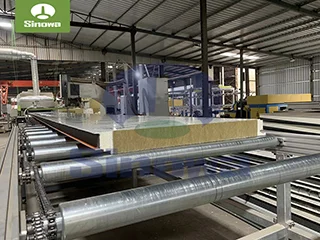
After the color steel plates are coated with glue, they enter the composite roller pressing stage together with the cured rock wool mat. The composite roller pressing equipment is composed of multiple groups of roller presses arranged in sequence. The first group of roller presses (primary roller pressing) gradually bends the color steel plates to fit the shape of the rock wool mat, and initially bonds the color steel plates to the upper and lower surfaces of the rock wool core material. The angle of the roller presses in the primary roller pressing stage is adjusted step by step to ensure that the color steel plates are smoothly bent without creases or cracks. The second group of roller presses (secondary roller pressing) further compacts the composite board, enhancing the bonding tightness between the color steel plates and the rock wool core material. The pressure of the secondary roller pressing is precisely controlled to avoid excessive pressure that may damage the rock wool core material or insufficient pressure that may cause delamination. During the roller pressing process, the conveyor system keeps the composite board moving at a stable speed, ensuring uniform pressure on each part of the board.
After the composite roller pressing, the composite board needs to be edge-trimmed and cut to the required specifications. The edge trimming machine trims the uneven edges of the composite board, ensuring the flatness and aesthetics of the board edges. The cutting equipment mainly includes a longitudinal cutting machine and a transverse cutting machine. The longitudinal cutting machine cuts the composite board into strips of the required width according to the production requirements, while the transverse cutting machine cuts the strips into panels of the required length. Advanced cutting equipment uses high-precision cutting tools and numerical control systems to ensure that the cutting size error is within a small range, meeting the installation accuracy requirements of cold room construction. During the cutting process, the dust removal system collects the dust and debris generated, keeping the production environment clean and protecting the health of workers.
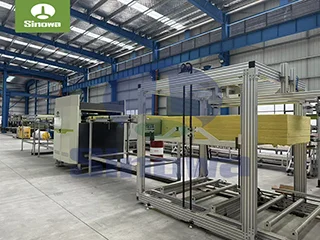
In addition to the above main production equipment, the rock wool sandwich panel production line for cold rooms also includes a series of auxiliary equipment to ensure the smooth progress of the production process. The waste edge recycling system collects and crushes the edge trimmings generated during the cutting process, and the crushed materials can be reused as raw materials for rock wool production, improving resource utilization and reducing production costs. The automatic stacking machine stacks the cut rock wool sandwich panels neatly according to a certain number and specifications, facilitating subsequent packaging and transportation. The packaging equipment wraps the stacked panels with waterproof and moisture-proof packaging materials to prevent damage or moisture absorption during transportation and storage. The electrical control system is the "brain" of the entire production line, integrating PLC control, touch screen operation and other functions. It realizes the automatic control of the entire production process, including the coordination of various equipment, the adjustment of production parameters and the monitoring of production status. Operators can set production parameters and monitor the operation of the equipment through the touch screen, and the system will automatically alarm when an abnormality occurs, ensuring the safety and stability of production.
The production equipment of rock wool sandwich panels for cold rooms has the characteristics of high automation, high precision and strong stability. High automation reduces manual intervention, improves production efficiency, and avoids quality problems caused by human factors. High precision ensures that the size and performance of the products meet the strict requirements of cold room applications. For example, the thermal conductivity of the rock wool sandwich panel produced by advanced equipment can be stably controlled between 0.033 and 0.041 W/m·K, which has excellent thermal insulation performance and can effectively reduce the heat transfer between the inside and outside of the cold room, reducing the energy consumption of the refrigeration equipment. The strong stability of the equipment ensures continuous and efficient production, meeting the large demand for rock wool sandwich panels in cold room construction.
In the application process of cold rooms, the rock wool sandwich panels produced by advanced equipment show excellent performance. Their good fire resistance ensures that in case of fire, the spread of the fire can be effectively prevented, providing a safe guarantee for the goods stored in the cold room and the personal safety of the staff. The sound insulation performance can reduce the noise generated by the operation of the refrigeration equipment, creating a quiet working environment. The light weight of the rock wool sandwich panel reduces the load on the cold room structure, and the convenient installation performance shortens the construction period. In addition, the rock wool sandwich panel has good corrosion resistance and weather resistance, and can maintain stable performance in the low-temperature and high-humidity environment of the cold room for a long time, extending the service life of the cold room.
With the continuous improvement of cold room construction standards and the increasing demand for energy conservation and environmental protection, the production equipment of rock wool sandwich panels for cold rooms is also constantly developing and innovating. On the one hand, the equipment is developing towards higher automation and intelligence. The integration of technologies such as industrial Internet of Things and big data makes the production line realize real-time monitoring, remote control and intelligent diagnosis, further improving production efficiency and reducing maintenance costs. On the other hand, the equipment is constantly optimizing in terms of energy conservation and environmental protection. The adoption of efficient energy-saving heating systems, waste gas and waste water treatment technologies makes the entire production process more environmentally friendly, in line with the requirements of sustainable development. At the same time, the equipment is also developing towards stronger versatility, which can produce rock wool sandwich panels of different specifications and types to meet the diverse needs of cold room construction.
In conclusion, the production equipment of rock wool sandwich panels for cold rooms is a complex and sophisticated system, which involves multiple links such as raw material melting, fiber formation, collection and shaping, curing, compounding, and cutting. Each piece of equipment and each link are closely connected and mutually restrictive, jointly determining the quality and performance of the final product. Advanced production equipment can not only improve production efficiency and reduce production costs, but also ensure that the rock wool sandwich panels have excellent thermal insulation, fire resistance and other properties, providing a reliable material guarantee for the construction and operation of cold rooms. With the continuous development of the cold chain industry, the production equipment of rock wool sandwich panels for cold rooms will continue to innovate and upgrade, making greater contributions to the high-quality development of the cold storage industry.
https://www.cnsinowa.com/sandwich-panel-machines/rock-wool-sandwich-panel-production-equipment-for-cold-room.html