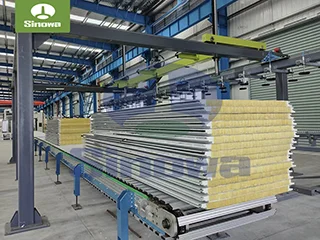
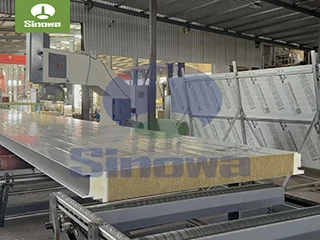
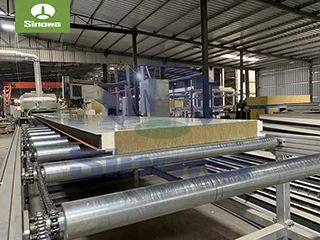
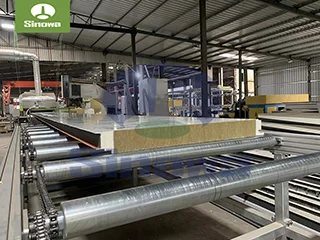
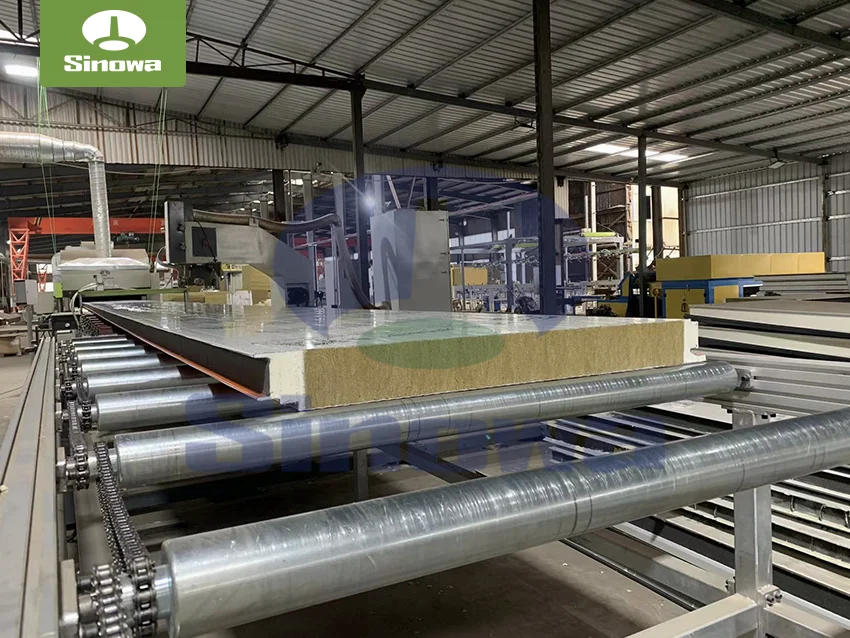
 sandwich panel machine
The front-end part of the rock wool board production line is the raw material pretreatment and batching equipment module, which undertakes the basic processing and proportional distribution of raw materials and lays a decisive foundation for subsequent melting and fibrosis effects. Natural mineral raw materials used for rock wool production often contain particle impurities, uneven particle sizes and trace moisture, which need standardized pretreatment before entering the high-temperature melting stage. The crushing and screening equipment in this module crushes bulk raw materials into uniform particle sizes and screens out irregular impurities and oversized particles to ensure the consistency of raw material particle state. Supporting drying equipment is equipped to treat raw materials with excessive moisture, removing internal residual moisture through low and medium temperature circulating air drying to avoid gas expansion, fiber breakage and structural defects caused by moisture vaporization during high-temperature melting. After pretreatment, the automatic batching and feeding system accurately mixes different types of mineral raw materials according to fixed material ratios. This system adopts intelligent metering and continuous feeding structures, with stable material storage silos and conveying devices that ensure uniform and continuous material supply. The optimized silo cone angle design effectively prevents material accumulation and blockage, realizing stable and quantitative material transportation and avoiding quality fluctuations caused by uneven raw material ratios in subsequent production.
High-temperature melting equipment is the core thermal processing device in the entire rock wool sandwich panel production line, responsible for converting solid mineral raw materials into homogeneous molten liquid, which is the key prerequisite for forming qualified rock wool fibers. The mainstream melting equipment in industrial production adopts closed high-temperature furnace bodies, which can stably maintain a high-temperature environment ranging from 1400℃ to 1600℃. The furnace body is equipped with high-efficiency thermal insulation and heat preservation structures, which reduce internal heat loss while ensuring stable high-temperature operation, improving overall thermal energy utilization efficiency. Raw materials are continuously sent into the furnace body through an automatic feeding mechanism, and under the action of sustained high temperature, the mineral raw materials undergo complete physical melting and structural reorganization, forming smooth and uniform molten magma. The internal temperature control system of the furnace can realize real-time monitoring and fine adjustment of temperature parameters, effectively avoiding insufficient melting caused by low temperature or raw material decomposition and effective component loss caused by excessive temperature. The closed furnace body structure isolates external air interference, ensures the stability of the molten material state, and provides consistent and high-quality raw materials for the subsequent fibrosis process.
Fiber forming equipment is the key functional unit that determines the fineness, uniformity and toughness of rock wool fibers, and its operating state directly defines the basic physical properties of rock wool boards. The high-speed centrifugal fibrosis equipment is the mainstream processing device in modern rock wool production. The molten magma flows evenly to the surface of high-speed rotating centrifugal rollers, and under the action of strong centrifugal force generated by high-speed rotation, the liquid magma is stretched and thrown into ultra-fine inorganic fibers with uniform diameter. The rotating speed of the centrifugal device is precisely controlled within a stable range, which can stably produce fibers with uniform thickness and good flexibility, avoiding the problems of uneven fiber thickness, brittle texture or excessive fiber particle impurities caused by unstable rotating speed. In the working process of centrifugal fibrosis, the matched atomizing and spraying device evenly sprays quantitative adhesive components on the surface of newly formed fibers. The adhesive can form uniform bonding points between scattered fibers, enhance the overall bonding performance of the fiber layer, and lay a foundation for the subsequent integral molding of rock wool boards. The whole fibrosis process is carried out in a relatively closed space, which not only ensures the stability of fiber forming environment but also realizes effective control of production environment cleanliness.
The fiber collection and uniform laying equipment system undertakes the transition function from scattered fiber raw materials to preliminary plate blank molding, which is crucial for the uniformity of rock wool board density and structural flatness. The negative pressure cotton collection device collects the dispersed fibers after fibrosis and adhesive spraying through stable negative pressure air flow, evenly adsorbs the fibers on the surface of the conveying mesh belt, and initially forms a loose and uniform fiber cotton layer. The negative pressure system maintains stable air flow pressure and air volume, ensuring consistent fiber adsorption thickness in each area and avoiding local density deviation of the preliminary fiber layer. Subsequently, the pendulum laying equipment conducts reciprocating uniform laying treatment on the initially formed fiber layer. Through the stable reciprocating swing of the mechanical structure, the fibers are stacked in multiple layers in an orderly manner, which significantly improves the three-dimensional structural uniformity of the fiber layer, eliminates the phenomenon of fiber accumulation and sparse gaps, and enables the internal structure of the rock wool board to form a uniform and crisscross fiber network. This layered laying mode effectively enhances the overall structural stability and mechanical strength of the finished product, making the tensile and compressive properties of the rock wool board more balanced in all directions.
Pre-pressing and curing molding equipment is the core device to realize the fixed molding of rock wool board blanks and stabilize product structural performance. The loose fiber cotton layer after laying is sent to the pre-pressing equipment through the conveying system, and the pre-pressing mechanism carries out constant-pressure and uniform compression on the fiber layer according to the preset density parameters. By adjusting the compression stroke and pressure value, the equipment can precisely control the thickness and density of the preliminary plate blank, and squeeze out the residual gap air inside the fiber layer to make the fiber structure more compact and orderly. The pre-pressed plate blank enters the constant-temperature curing furnace for integral curing and shaping. The internal environment of the curing furnace maintains stable and uniform temperature and air circulation conditions, which can rapidly activate the activity of the internal adhesive of the fiber layer, promote the full cross-linking and curing of the adhesive, and firmly bond the scattered fibers into an integral plate structure. The circulating hot air system inside the furnace ensures uniform heating of all parts of the plate blank, avoids local incomplete curing or excessive curing, and realizes stable molding of rock wool boards with consistent hardness, density and structural strength. After curing, the initial rock wool board products have stable structural performance, fixed shape and basic mechanical properties that meet industrial use standards.
Cooling and shaping auxiliary equipment is an indispensable part to ensure the dimensional stability and surface flatness of finished rock wool boards. The high-temperature plate blank discharged from the curing furnace has a certain residual temperature, and the internal fiber structure and adhesive layer are still in a slightly unstable state. The automatic cooling conveying equipment adopts a layered circulating air cooling mode, which slowly and uniformly reduces the temperature of the rock wool board through continuous and stable air flow, avoiding product deformation, warping or internal structural stress concentration caused by rapid temperature change. The cooling system realizes gradual cooling from the surface to the inside of the plate body, ensuring that the internal structural stress of the rock wool board is fully released, and the dimensional accuracy and flatness of the product are further stabilized. At the same time, the cooling conveying process is equipped with a flat correction mechanism, which fine-tunes the local flatness of the plate body during the conveying process to ensure that the surface of the finished rock wool board is smooth and free of obvious protrusions and depressions.
Precision cutting and trimming equipment is responsible for finishing the final dimensional shaping of rock wool board products to meet standardized application requirements. The cooled and shaped rock wool board is stably conveyed to the cutting workstation, and the automatic cutting system completes fixed-length cutting and edge trimming according to preset dimensional parameters. The cutting equipment adopts high-precision transmission and positioning structures, which can realize accurate cutting of plate bodies with different thicknesses and widths, ensuring consistent dimensional tolerance of each batch of products. The high-speed cutting tool runs stably, with neat and smooth cutting sections, no burrs, fiber pulling and edge collapse phenomena, which effectively guarantees the appearance quality and assembly accuracy of finished products. In addition, the supporting edge trimming and waste cutting device can automatically remove the irregular edges on both sides of the plate body and cut off unqualified local parts, further standardizing the overall size of the product and improving the uniformity of batch products. The cutting process is fully automated and connected with the front-end production process, realizing uninterrupted continuous production and effectively improving production efficiency.
The final link of the rockwool slab production equipment is finished product conveying and packaging equipment, which realizes the standardized storage and transportation protection of qualified rock wool board products. The sorted qualified rock wool boards are conveyed to the packaging station through the automatic conveying device, and the stacking equipment neatly stacks the plates according to fixed specifications to form regular finished product stacks. The automatic packaging device carries out integral wrapping and sealing treatment on the stacked products, which can effectively isolate external dust, moisture and mechanical collision damage during transportation and storage. The packaging process is matched with stable transmission and positioning functions, ensuring neat and compact packaging of each stack of products, no loose deformation, and good overall protection performance. At the same time, the production line is equipped with a waste recycling and processing device, which collects and processes the cutting waste and unqualified products generated in the production process, and after crushing and screening, the waste materials can be reused in the raw material batching link, realizing efficient utilization of production resources and reducing resource waste in the production process.
The overall operation advantage of the modern rock wool sandwich panel machine system lies in its high integration and intelligent linkage. All equipment units are connected through a unified automatic control system, realizing synchronous operation and parameter coordination of each production link. The system can monitor the operating parameters of melting temperature, centrifugal rotating speed, laying frequency, curing temperature and time, cutting size and other key links in real time, and automatically adjust the operating state of the equipment according to the production feedback data, so as to ensure the long-term stable operation of the production line and the consistent quality of batch products. Compared with traditional decentralized production equipment, the integrated production line reduces manual intervention links, effectively avoids product quality fluctuations caused by human operation errors, and significantly improves production efficiency and product qualification rate. In addition, the optimized structural design of the equipment effectively reduces energy consumption in the production process, improves the utilization rate of thermal energy and mechanical energy, and realizes energy-saving and efficient production while ensuring product quality stability.
The performance optimization of rockwool board production equipment directly promotes the improvement of product comprehensive performance. The precise control of high-temperature melting equipment ensures the full activation of effective components of mineral raw materials, making the formed fibers have better toughness and structural stability. The efficient centrifugal fibrosis equipment ensures the fineness and uniformity of fibers, endowing rock wool boards with excellent thermal insulation, sound absorption and fire resistance. The uniform laying and curing molding equipment makes the internal fiber network of the product more uniform and compact, significantly improving the mechanical strength, compression resistance and dimensional stability of the product. The perfect cooperation of the whole set of equipment enables the rock wool board products to maintain stable physical and chemical properties in complex application environments, and have long-term service stability, which can well meet the application requirements of building external wall insulation, industrial pipeline thermal insulation, equipment fire prevention and sound insulation engineering.
With the continuous upgrading of industrial production technology, rock wool slab production equipment is developing towards higher automation, finer control and more energy-saving operation. The continuous optimization of raw material pretreatment and batching accuracy further improves the uniformity of raw material proportioning; the upgrading of high-temperature furnace body structure and temperature control system reduces energy consumption while improving melting stability; the intelligent adjustment of centrifugal and laying equipment can realize flexible switching of product specifications and meet the production requirements of rock wool boards with different densities and thicknesses. The continuous innovation and improvement of sandwich panel machinery not only improves the overall production level of the industry, but also promotes the continuous optimization of rock wool board product performance, making this inorganic thermal insulation and fireproof material more adaptable to diverse industrial and civil application scenarios, and providing reliable equipment support for the high-quality development of the thermal insulation material industry.
https://www.cnsinowa.com/sandwich-panel-machines/rock-wool-slab-production-equipment.html