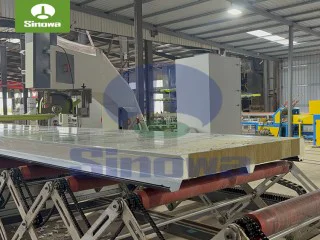
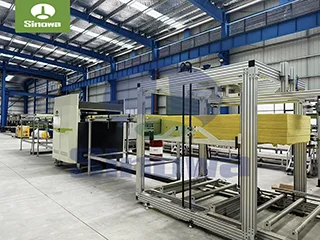
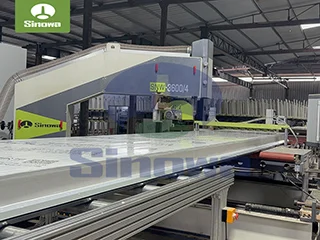
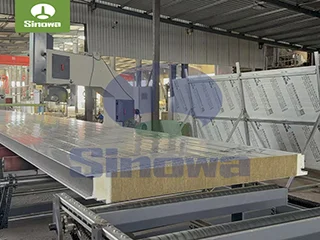
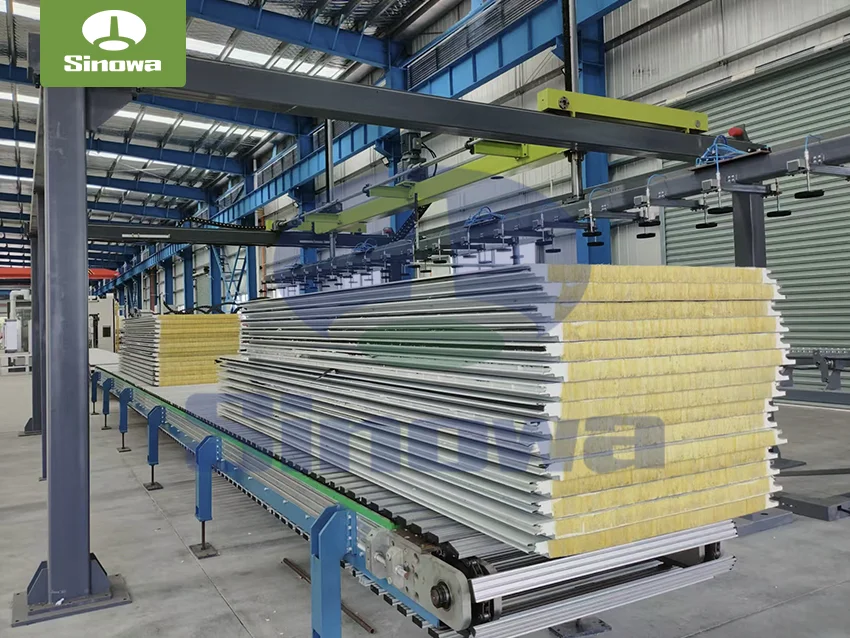
 sandwich panel machine
The entire production system starts with raw material pretreatment equipment, which undertakes the primary processing of natural mineral raw materials such as basalt, dolomite and other volcanic rocks, as well as matched auxiliary materials. Raw materials mined from natural sources often contain particle impurities, uneven block sizes and residual foreign substances, which will affect the melting effect and fiber forming quality in subsequent processes if not treated in advance. The pretreatment equipment mainly includes crushing, screening and quantitative batching modules. The crushing unit breaks bulk raw ores into uniform small particles through mechanical extrusion and impact, eliminating oversized materials that cannot fully melt in high-temperature environments. The screening device further removes fine impurities and unqualified particles to ensure the purity of raw materials. After purification, the automated batching system conducts precise proportional deployment of different raw materials according to the preset production formula. Relying on electronic metering and automatic conveying structures, this rock wool borad production line realizes continuous and stable raw material supply, avoiding quality fluctuations caused by manual batching errors and laying a standardized foundation for the entire production process.
High-temperature melting equipment serves as the core thermal processing unit in rock wool board production, determining the basic physical properties of subsequent rock wool fibers. The rock wool sandwich panel production line adopts closed high-temperature furnace structures that can create a stable extreme temperature environment ranging from 1400℃ to 1600℃. Different from traditional open heating devices, the closed design effectively reduces heat loss, improves thermal energy utilization efficiency, and avoids external interference to the internal melting environment. After the proportioned raw materials are transported into the furnace through a fully automatic feeding system, they undergo continuous high-temperature heating until the solid mineral particles are completely converted into homogeneous liquid magma. During the melting process, the internal temperature of the furnace is dynamically adjusted through intelligent temperature control components to maintain a constant molten state of the magma. Sufficient high-temperature melting eliminates the internal stress and heterogeneous structure of natural ores, completely changing the physical form of raw materials and enabling the formation of fine and uniform inorganic fibers in the subsequent fibrosis process. The stable operation of melting equipment directly affects the fineness, toughness and uniformity of rock wool fibers, which is the key link to determine the thermal insulation and structural stability of finished rock wool boards.
Fiberization equipment is the key functional unit that converts molten magma into micro inorganic fibers, and it is the core equipment to realize the fundamental performance characteristics of rock wool materials. The mainstream fibrosis technology adopted by modern rock wool sandwich panel machine is high-speed centrifugal fiber forming. The core component of this equipment is a high-speed rotating centrifugal roller group, which can maintain a stable ultra-high rotating speed during operation. When the high-temperature liquid magma flows evenly onto the surface of the rotating roller, it is instantly thrown out under the action of powerful centrifugal force and stretched into ultra-fine fibers with uniform diameter. The structural design of the centrifugal roller group ensures that the magma is evenly dispersed during the throwing process, avoiding fiber agglomeration, breakage or uneven thickness. In the working process, the equipment is also matched with a micro air supply system, which uses stable airflow to further sort and refine the newly formed fibers, remove residual non-fibrous particles and tiny slag balls, and improve the purity and uniformity of fiber finished products. The fiber diameter formed by this equipment is controlled within a reasonable micro range, which endows rock wool materials with excellent porous structure, thus realizing efficient thermal insulation and sound absorption functions. Compared with traditional intermittent fiber forming equipment, the modern integrated fiberization unit realizes continuous feeding and continuous fiber forming, greatly improving production efficiency while ensuring consistent fiber quality in batch production.
After fiber forming, the fiber collection and cotton laying equipment undertakes the task of orderly arranging loose rock wool fibers into uniform wool felt blanks. This set of equipment mainly includes negative pressure cotton collectors and pendulum cotton laying machines, which cooperate to complete the orderly accumulation and paving of fibers. The negative pressure cotton collector generates stable negative pressure airflow inside the equipment, which can evenly adsorb the floating fine fibers generated by the fiberization system on the mesh conveyor belt, realizing preliminary collection and uniform distribution of fibers. The pendulum cotton laying machine further adjusts the paving state of fibers through reciprocating swing operation, superimposing multi-layer fibers in a cross direction. This cross laying mode effectively optimizes the internal fiber structure of the wool felt, makes the fiber arrangement more three-dimensional and uniform, and significantly improves the overall structural toughness and dimensional stability of the blank. The operating speed and swing range of the cotton laying equipment can be adjusted according to the required thickness and density of finished products, realizing flexible production of rock wool blanks with different specifications. In this process, the equipment maintains a fully closed operating environment, which not only avoids fiber leakage and environmental pollution, but also ensures that no external impurities are mixed into the wool felt, maintaining the purity of the product matrix.
In order to enhance the bonding performance and structural firmness of fibers, the rock wool sandwich panel line is equipped with precise binder spraying and permeation equipment. After the fibers are collected and paved, the uniform binder spraying system sprays a quantitative inorganic binder on the surface of the wool felt. The equipment adopts atomization spraying technology to disperse the binder into ultra-fine mist particles, which can evenly penetrate into the gaps between internal fibers of the wool felt, avoiding local excessive or insufficient bonding. The spraying volume and spraying range are intelligently controlled according to the fiber density and blank thickness, ensuring that each fiber can be effectively bonded while maintaining the porous structure of the wool felt. This treatment does not change the inherent inorganic characteristics of rock wool fibers, but significantly improves the overall molding performance of the blank, making the loose fibers form a preliminary integrated structure, which is convenient for subsequent curing and shaping processing. The efficient operation of the spraying equipment ensures the uniformity of binder distribution, effectively preventing the problems of local loose structure or excessive hardening of finished boards, and balancing the flexibility and structural stability of rock wool boards.
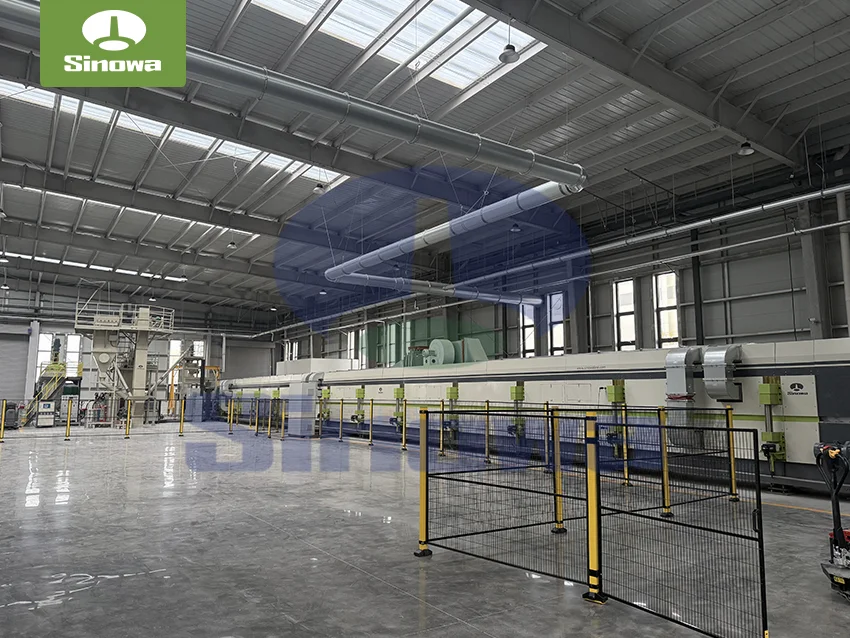
Curing and molding equipment is the core unit to finalize the structural shape and physical properties of rock wool boards, which completes the fixed molding of wool felt blanks through constant temperature drying and pressure stabilization treatment. The curing equipment adopts a long tunnel-type constant temperature furnace body structure, which can form a stable and uniform high-temperature drying space inside. After the pre-bonded wool felt enters the curing furnace with the conveyor system, it is treated with continuous high-temperature hot air circulation. The internal hot air circulation system of the equipment realizes three-dimensional uniform heating, which can quickly evaporate the residual moisture in the wool felt and fully cure the binder. In the curing process, the matched pre-pressing equipment applies stable and uniform micro-pressure to the wool felt, which promotes the closer combination of internal fibers, eliminates internal gaps caused by uneven fiber accumulation, and makes the overall density of the board more uniform. The temperature, running speed and pressing pressure of the curing equipment can be adjusted in real time according to product specifications, so as to adapt to the production of rock wool boards with different densities, thicknesses and hardness requirements. After curing, the loose wool felt is completely shaped into a rigid board structure with stable size, uniform texture and excellent structural strength, and the overall performance of thermal insulation, compression resistance and deformation resistance is fully finalized.
Cooling and shaping equipment is an indispensable post-processing unit to ensure the dimensional stability of finished products. The high-temperature rock wool boards discharged from the curing furnace have a certain residual temperature, and the internal structure is in a slightly unstable state. Direct subsequent cutting and processing may cause thermal deformation and size deviation. The cooling equipment adopts a layered circulating air cooling structure, which delivers normal temperature circulating air to the surface and interior of the boards through uniform air outlets, realizing gradual and balanced cooling. The gradual cooling mode avoids the quality problems such as board cracking and structural warping caused by rapid temperature change. During the continuous conveying and cooling process, the internal molecular structure and fiber bonding state of the rock wool board tend to be stable, and the dimensional accuracy and flatness of the board surface are further improved. The fully automatic cooling system operates synchronously with the front-end curing equipment, realizing seamless connection of the production process and ensuring the continuity and efficiency of the entire production line.
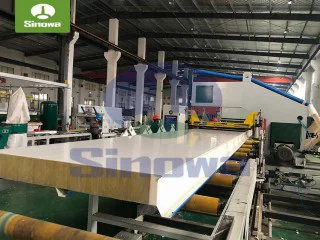
Precision cutting and trimming equipment is responsible for finishing the final size shaping of rock wool boards. After cooling and shaping, the continuous whole-board material is sent to the cutting unit through the conveyor system. The equipment adopts multi-group synchronous cutting structures, including longitudinal trimming and transverse cutting modules. The longitudinal trimming device cuts off the irregular edges on both sides of the board to ensure the straightness and uniformity of the board width. The transverse cutting module performs fixed-length cutting according to the preset size parameters to complete the production of standard-sized rock wool boards. All cutting actions are controlled by an intelligent numerical control system, which can accurately control the cutting size and incision flatness. The high-speed and stable cutting operation ensures smooth and neat board incisions without burrs, cracks or fiber scattering. In addition, the cutting equipment is matched with an automatic waste recycling structure, which collects the edge materials and leftover materials generated in the cutting process, and transports them back to the raw material pretreatment link for secondary utilization, realizing efficient resource recycling and reducing material waste in the production process.
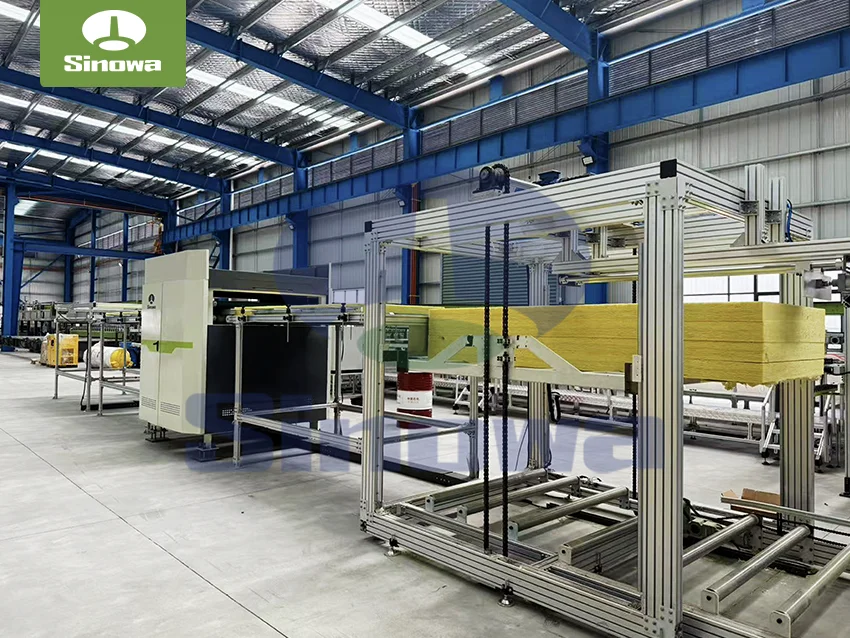
The auxiliary supporting systems of rock wool board production line also play a vital role in ensuring the stable operation of the entire production line, mainly including intelligent electrical control system, dust removal and purification system and automatic conveying system. The intelligent control system is the brain of the entire production line, which centrally controls the operating parameters, operating speed and coordination rhythm of all equipment units. It can realize real-time monitoring of temperature, pressure, rotating speed and material transmission state in each production link, and automatically adjust operating parameters according to production conditions, ensuring the stable and consistent operation of the production process. The dust removal and purification system conducts closed collection and purification on the fine fiber dust and tiny impurities generated in the production process, maintaining the cleanliness of the production environment while avoiding fiber waste. The full-line automatic conveying system connects all independent equipment units in series to realize the automatic transmission of raw materials, semi-finished products and finished products from feeding to finished product output, reducing manual intervention, improving production continuity and avoiding product quality fluctuations caused by manual operation errors.
Modern rockwool sandwich panel production line has obvious advantages in structural design and technical performance compared with traditional single machines. The highly integrated unit design realizes the integration of raw material processing, high-temperature melting, fiber forming, molding and finishing processes, eliminating the intermediate handling links of semi-finished products and greatly improving production efficiency. The full-process automated control mode reduces the dependence on manual operation, realizes standardized and standardized production, and ensures the consistency of product quality in large-scale batch production. In terms of energy consumption control, the optimized furnace body structure and circulating heat utilization design effectively reduce heat loss, improve energy utilization efficiency and realize energy-saving production. At the same time, the closed production structure of the entire equipment system effectively avoids the leakage of fibers and dust, reduces the impact on the production environment, and meets the requirements of clean production.
The continuous upgrading and optimization of rock wool panel manufacturing plant has continuously expanded the application performance and application scope of rock wool board products. Through the precise control of each equipment link, the produced rock wool boards have uniform fiber structure, stable density, excellent thermal insulation performance, good sound absorption and noise reduction effect, and outstanding structural durability. The flexible adjustment performance of the equipment enables the production of diversified products with different thicknesses, densities and structural strengths, which can meet the usage needs of different scenarios such as building exterior wall insulation, interior sound insulation, industrial equipment thermal insulation and pipeline anti-freezing. With the continuous progress of mechanical manufacturing technology and intelligent control technology, rock wool board production equipment is developing towards higher automation, higher precision, lower energy consumption and stronger integration, providing more reliable technical equipment support for the high-quality development of inorganic thermal insulation material industry.
https://www.cnsinowa.com/sandwich-panel-machines/rock-wool-panel-manufacturing-plant.html