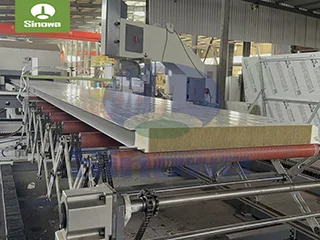
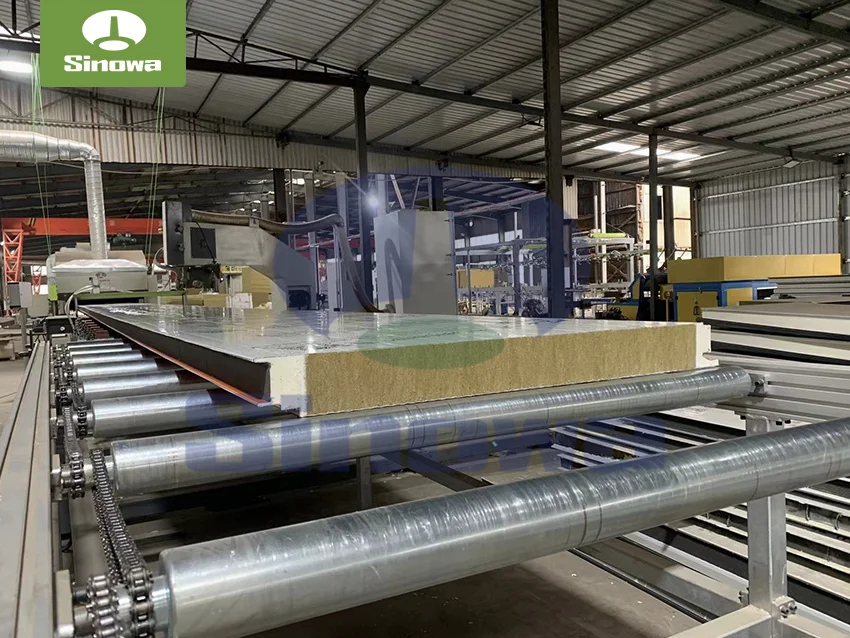
 sandwich panel line
The overall structural layout of the composite sandwich panel production line follows a scientific modular design concept, which can be divided into three core functional areas: raw material pretreatment and feeding area, composite molding and curing area, and post-processing and finishing area. Each functional module is precisely matched in operating speed and processing accuracy, forming a closed-loop production system that covers all procedures from raw material input to finished product output. This systematic layout not only optimizes production efficiency but also simplifies daily equipment maintenance and later technical upgrading, ensuring the long-term stable operation of the production line in high-intensity industrial production scenarios. The mechanical transmission and control systems of the entire line adopt synchronous linkage design, which can coordinate the operation rhythm of each unit, avoid processing errors caused by asynchronous operation, and lay a solid foundation for the dimensional accuracy and structural uniformity of finished panels.
The raw material pretreatment and feeding stage is the initial link that determines the basic quality of composite panels, mainly responsible for the finishing and quantitative feeding of outer surface materials and core insulation materials. For the outer metal facing materials, the composite sandwich panel line is equipped with automatic uncoiling and leveling devices, which can smoothly unfold coiled metal materials and eliminate the internal stress and surface wrinkles generated during coiling and storage. After uncoiling, the metal sheets pass through a multi-group roller leveling structure to achieve flat and smooth surface conditions, and then undergo precise trimming treatment to remove irregular edges and ensure consistent width of the outer panels. In order to avoid surface abrasion and damage during subsequent high-pressure composite processing, the system is also equipped with an automatic film-laminating mechanism, which attaches a protective film to the surface of metal sheets, effectively maintaining the surface integrity and aesthetic degree of finished products.
The pretreatment of rock wool core materials is equally critical to the overall performance of sandwich panels. The rockwool sandwich panel production line is equipped with a special rock wool material sorting and laying system, which can break up and sort bulk rock wool raw materials to remove agglomerated blocks and impurities, ensuring the uniformity of core material density. Through directional fiber arrangement and cross-butted laying technology, the rock wool core material forms a seamless and integral filling structure between the upper and lower outer panels, which effectively avoids the hollowing and local performance attenuation caused by gaps in the core material. The automated quantitative feeding device can accurately control the laying thickness and weight of rock wool materials according to production parameters, realizing standardized production of core materials and ensuring the consistency of thermal insulation, sound insulation and fire resistance of each batch of panels.
Glue spraying and interface treatment is a key procedure to enhance the bonding strength between the outer panel and the rock wool core material. The rock wool sandwich panel production line adopts an automatic high-precision glue spraying system, which can evenly coat high-performance adhesive on the inner surface of the pretreated metal panels. Different from manual glue spraying or simple mechanical glue application, the system can adjust the glue application amount and spraying range in real time according to the panel specification and production speed, forming a uniform and dense adhesive layer on the bonding interface. This precise glue spraying mode not only improves the bonding tightness between materials but also avoids excessive glue accumulation or insufficient glue coating, which helps to optimize the interface bonding state and reduce the residual stress inside the composite structure. Before formal composite molding, the panels will go through a preheating process to activate the activity of the adhesive, creating optimal bonding conditions for the subsequent high-pressure compounding process.
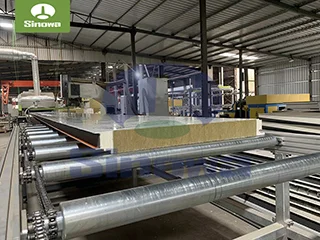
The composite molding and constant-temperature curing stage is the core working link of the entire rockwool board production line, which directly determines the structural stability and service life of the finished sandwich panels. The pretreated upper and lower metal panels and rock wool core materials are accurately aligned and sent into the double-belt composite pressing device through the synchronous conveying system. The double-belt pressing structure can provide uniform and continuous pressure on the composite materials, ensuring that the rock wool core material and the outer panels are closely fitted without relative displacement or local separation. In the closed constant-temperature curing channel, the composite semi-finished products undergo a period of fixed-temperature and fixed-pressure curing reaction, which enables the adhesive to complete physical and chemical cross-linking reactions, forming a high-strength integrated bonding structure between layers.
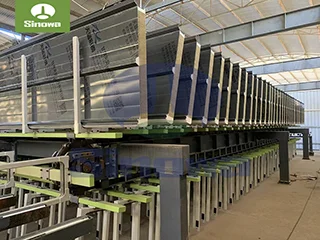
The curing process parameters are intelligently adjusted according to the thickness of the panel, the type of adhesive and the production speed. The stable temperature field and pressure environment inside the curing channel eliminate the problems of incomplete adhesive curing and insufficient bonding force existing in traditional room-temperature bonding processes. After continuous curing, the layered structure of the sandwich panel forms an integral stress system, which greatly improves the overall structural rigidity, compression resistance and peel resistance of the product. The rock wool core material is firmly fixed in the middle of the panels, maintaining stable spatial structure and functional performance, and will not produce deformation or loose layering under conventional external force and temperature changes.
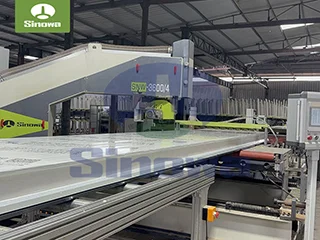
The post-processing and finishing system undertakes the final shaping, cutting and sorting work of the cured composite panels. Equipped with a high-precision servo fixed-length cutting system, the rock wool sandwich panel machine can complete fixed-size cutting according to preset parameter settings. The flying saw cutting mechanism adopts high-hardness cutting tools, which can realize fast and smooth cutting without burrs, cracks or edge deformation on the cutting surface. The servo control system ensures that the cutting error is controlled within a tiny range, realizing high-precision sizing production of panels and meeting the standardized size requirements of modern building construction.
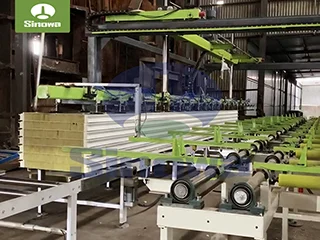
After cutting and shaping, the finished panels will go through automatic edge trimming and glue cleaning procedures to remove residual adhesive and tiny burrs on the edges, further optimizing the appearance quality and assembly accuracy of the products. The automated stacking device orderly arranges the processed finished panels according to fixed specifications, realizing automatic stacking and output of finished products. The entire post-processing process is highly automated, which not only improves production efficiency but also avoids product damage and size errors caused by manual operation, ensuring the uniformity and consistency of batch products.
The intelligent control system runs through the entire production process of the line, realizing integrated management of parameter setting, operation monitoring, fault diagnosis and data statistics. Operators can complete the switching of different panel specifications and the adjustment of production parameters through the central control terminal. The system has real-time monitoring functions for key links such as feeding speed, glue spraying volume, curing temperature, pressing pressure and cutting size. Once abnormal parameters or equipment failures occur, the system will automatically trigger early warning prompts and perform adaptive adjustment or emergency shutdown protection, effectively reducing the rate of defective products and equipment failure losses. The modular control design also facilitates daily parameter debugging and later production optimization, making the production process more flexible and controllable.
In terms of production performance and product advantages, the partition wall composite rock wool sandwich panel line achieves organic integration of structural stability and functional diversity of products through continuous high-pressure composite molding technology. The rock wool core material with stable fiber structure endows the panel with excellent thermal insulation performance, which can effectively block heat transfer and reduce building energy consumption. At the same time, the porous fiber structure of rock wool has outstanding sound absorption and noise reduction effects, which can weaken sound wave transmission and improve the indoor acoustic environment of buildings. In terms of structural performance, the integrated composite structure formed by high-temperature and high-pressure curing enables the panel to have good compression resistance, bending resistance and impact resistance, which can adapt to the complex stress environment of building partition walls and maintain long-term structural stability.
The products produced by this sandwich panel production line have excellent construction adaptability, featuring light overall weight, convenient transportation and quick on-site assembly. Compared with traditional brick and concrete partition walls, rock wool sandwich partition panels do not need complex wet construction procedures, which can greatly shorten the construction cycle of building interior partition projects. The standardized and integrated product structure avoids the problems of hollowing, cracking and poor overall consistency caused by on-site decentralized construction. In addition, the stable physical and chemical properties of rock wool materials enable the panels to have good aging resistance and weather resistance, and can maintain stable use performance in different temperature and humidity environments, reducing the frequency of later maintenance and replacement of building partition structures.
In the context of the rapid development of modern prefabricated buildings and energy-saving buildings, the partition wall composite rock wool sandwich panel production machine has important industrial application value. Its continuous and automated production mode adapts to the large-scale and standardized production needs of modern building materials, and the produced panels can be widely used in interior partition projects of industrial plants, commercial buildings, public facilities and civil buildings. The multi-functional advantages of fire resistance, thermal insulation, sound insulation and light weight make the product effectively solve the pain points of single performance, heavy weight and poor energy-saving effect of traditional partition wall materials.
From the perspective of production economy, the highly integrated and automated design of the rock wool board production line reduces the demand for on-site operators, lowers labor costs in the production process, and the continuous production mode improves the utilization rate of raw materials, reducing material waste. The stable product quality controlled by the intelligent system greatly reduces the generation of defective products and rework costs, improving the overall production benefit. At the same time, the modular equipment structure is convenient for daily maintenance and parts replacement, reducing the operation and maintenance cost of the production line in the whole life cycle.
With the continuous upgrading of building energy-saving standards and construction industrialization level, the market demand for high-performance prefabricated partition wall panels is constantly improving. The partition wall composite rock wool sandwich panel production line, with its mature continuous composite process, intelligent control system and stable product output capacity, can continuously provide high-quality standardized building partition materials for the construction industry. Its technical advantages in integrated molding, precise control and efficient production make it an important supporting equipment for the upgrading and development of modern building energy-saving materials, and it also provides a reliable technical guarantee for the realization of green, efficient and standardized construction of modern buildings.
https://www.cnsinowa.com/sandwich-panel-machines/partition-wall-composite-rock-wool-sandwich-panel-line.html