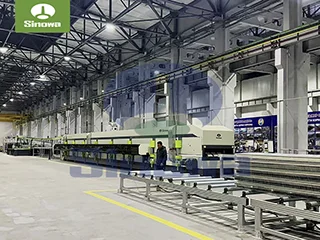
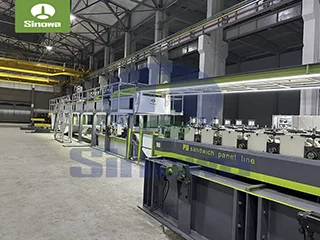
sandwich panel line
The emergence and popularization of polyurethane sandwich panel lines are closely linked to the performance advantages of polyurethane foam materials and the market demand for lightweight composite panels. Polyurethane foam has unique physical characteristics such as low thermal conductivity, high compression resistance, good chemical stability and excellent adhesion strength, making it an ideal core material for thermal insulation and structural composite panels. In the early stage of the industry development, the production of polyurethane sandwich panels mostly adopted intermittent mold pressing processes. The production mode of single-piece mold closing and curing had obvious limitations in production efficiency, product dimensional consistency and batch production capacity. The manual intervention links in the intermittent production process were complicated, and the differences in raw material mixing ratio and curing environment were easy to cause unstable product quality. To solve these industry pain points, continuous polyurethane sandwich panel lines have been gradually developed and popularized. Through integrated mechanical design and automatic control systems, the equipment realizes uninterrupted feeding, mixing, foaming, compounding, curing and cutting, fundamentally improving the production efficiency and product qualification rate of sandwich panels. At present, this kind of production line has become the mainstream production equipment in the composite panel manufacturing industry, covering the production needs of different specifications of panels for construction, cold storage, industrial purification and other fields.
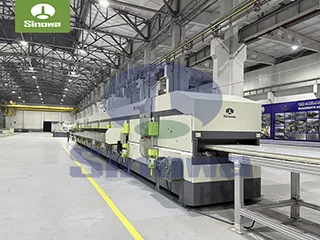
A complete polyurethane sandwich panel line is composed of multiple interconnected functional units, and each unit bears independent production tasks while maintaining synchronous operation logic to ensure the continuity and coordination of the overall production process. From the perspective of functional partition, the entire production line can be divided into surface material feeding unit, raw material metering and mixing unit, continuous foaming and coating unit, double-belt pressing and curing unit, trimming and shaping unit, fixed-length cutting unit, finished product conveying and stacking unit, and supporting electrical control and hydraulic transmission systems. Each structural unit has precise mechanical design and parameter adjustment functions, which can adapt to the production requirements of surface materials with different thicknesses and textures and polyurethane core layers with different densities. The overall layout of the production line follows the linear production logic, and the materials are transported along a fixed horizontal track from the feeding end to the finished product stacking end. The compact and reasonable spatial layout effectively reduces the material transmission distance, avoids material waste caused by intermediate handling, and optimizes the overall production space utilization rate.
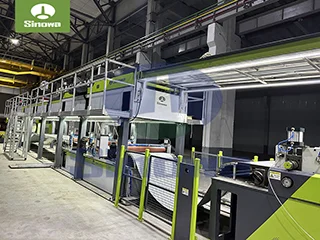
The surface material feeding unit is the starting part of the entire production line, which undertakes the task of continuous and stable supply of upper and lower surface materials of sandwich panels. Common surface materials include metal color steel plates, aluminum alloy plates, non-metal fiber plates and other sheet materials with certain tensile strength and surface flatness. This unit is mainly equipped with material unwinding rollers, tension adjusting mechanisms, surface flattening devices and dust removal assemblies. The unwinding rollers are used to place coiled surface materials, and the rotating speed is matched with the overall operating speed of the production line through servo driving components to ensure synchronous feeding without material accumulation or shortage. The tension adjusting mechanism is a key component to prevent surface material deformation. In the process of continuous feeding, the tension sensor monitors the stretching state of the sheet in real time, and the hydraulic adjusting device automatically fine-tunes the roller spacing to keep the surface material in a flat and low-tension conveying state, avoiding wrinkles, stretching deformation and offset deviation of the sheet. The built-in dust removal assembly uses high-pressure air flow and static elimination structures to remove surface floating dust, metal debris and other impurities, ensuring that the bonding interface between the surface material and the polyurethane foam core layer is clean, which helps to improve the composite adhesion of the panel and avoid hollowing and delamination defects in the later use stage.
The raw material metering and mixing unit is the core functional component that determines the foaming quality of the polyurethane core layer. Polyurethane foaming raw materials are mainly composed of two kinds of liquid chemical materials with different properties, which need to be mixed in an accurate proportion to complete the chemical foaming reaction. This unit is equipped with independent raw material storage tanks, filter assemblies, metering pumps and high-speed mixing heads. The storage tanks are designed with sealed heat preservation structures to maintain the constant temperature of liquid raw materials, prevent the viscosity change of chemical materials caused by ambient temperature fluctuation, and ensure the stability of subsequent metering and mixing effects. The filter assemblies are installed at the outlet of the storage tanks to intercept impurity particles in the raw materials, avoiding the blockage of precision metering pumps and mixing pipelines. The metering pumps driven by servo motors have extremely high flow control accuracy, which can accurately control the output of different raw materials according to the preset proportion parameters. The mixed raw materials enter the high-speed mixing head, and the turbulent flow generated by high-speed rotation realizes uniform blending of multiple components. The fully mixed liquid materials have stable reaction activity, which lays a foundation for uniform foaming and dense internal structure of the core layer. In order to adapt to the production requirements of panels with different thermal insulation strength and hardness, the staff can adjust the raw material ratio and mixing speed through the control terminal to change the density and mechanical properties of polyurethane foam.
The continuous foaming and coating unit connects the raw material mixing structure and the surface material conveying structure, realizing the uniform pouring and spreading of polyurethane mixed materials on the lower surface material. This unit is equipped with a reciprocating distributing nozzle and a flow guiding adjusting baffle. The distributing nozzle moves horizontally at a constant speed along the width direction of the surface material, and the liquid polyurethane materials are evenly coated on the flat lower surface material in a strip shape. The flow guiding baffle can adjust the spreading range and thickness of the liquid materials, so that the raw materials can be evenly distributed in the width direction of the sheet, avoiding the problems of excessive local material accumulation or sparse distribution. In the initial stage after coating, the polyurethane materials start a slow chemical foaming reaction, and the volume gradually expands to fill the space between the upper and lower surface materials. The whole foaming process is carried out at normal temperature with mild reaction conditions. The equipment is equipped with a gas circulation structure to discharge the trace gas generated in the reaction process in time, maintaining the safety and environmental protection of the production workshop. The reasonable structural design of the foaming and coating unit ensures that the foaming initiation time of each position of the core layer is consistent, which effectively prevents the quality defects such as uneven core layer thickness and inconsistent foaming density.
The double-belt pressing and curing unit is the key area for the composite forming and structural curing of sandwich panels, and it is also the part with the highest requirement for temperature and pressure control in the entire production line. This unit consists of upper and lower circulating steel belts, constant temperature heating plates, hydraulic pressure adjusting components and conveying track structures. The upper and lower surface materials with polyurethane foaming raw materials enter the closed space between the double steel belts, and the hydraulic system applies stable and uniform vertical pressure to the steel belts. The pressure value can be adjusted according to the hardness requirement of the finished panel. For soft composite panels, low-pressure pressing is adopted to avoid core layer compression and deformation; for rigid building insulation panels, medium and high-pressure pressing is used to enhance the compactness of the composite structure. The built-in heating plates of the steel belts maintain a constant curing temperature in the pressing area, which accelerates the polymerization and solidification reaction of polyurethane foam. Under the dual action of constant pressure and constant temperature, the foaming materials complete volume expansion and structural shaping, and closely bond with the upper and lower surface materials to form an integrated composite structure. The circulating steel belts run synchronously with the feeding speed, realizing continuous feeding and uninterrupted curing. The length of the curing area is scientifically designed according to the foaming reaction cycle of polyurethane materials, ensuring that the foam core layer completely completes the curing reaction before leaving the pressing unit, and the internal molecular structure is stable without secondary deformation.
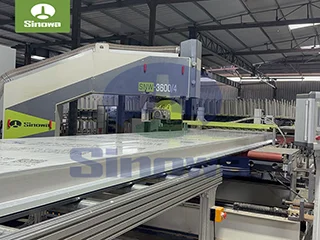
After completing composite curing, the semi-finished panels enter the trimming and shaping unit to remove redundant edge materials and standardize the overall dimensional specification. In the continuous composite forming process, a small amount of overflowing foaming raw materials and edge excess surface materials will appear on both sides of the panel. The trimming unit is equipped with high-speed rotating cutting tools and positioning detection sensors. The sensors automatically identify the edge contour of the panel, and the cutting tools symmetrically trim the redundant parts on both sides along the preset track. The trimming speed is synchronized with the panel conveying speed to ensure flat and smooth cutting sections without burrs and cracks. For panels requiring special edge structures such as sealing and bending, the unit is also equipped with edge folding and pressing components, which can complete edge reinforcement and shaping at one time to improve the assembly convenience of subsequent panel installation. The trimmed waste materials are automatically collected through the conveying pipeline, which is convenient for centralized harmless treatment and resource recycling, reducing the material loss rate of the production process.
The fixed-length cutting unit realizes the segmented cutting of continuous long plates according to the customized size requirements of customers. This unit adopts tracking and cutting technology, and the cutting tool is installed on a movable sliding rail. The high-precision length measuring sensor monitors the conveying distance of the panel in real time. When the panel reaches the preset cutting length, the sliding rail drives the cutting tool to move synchronously with the panel to complete horizontal cutting. The servo control system ensures that the cutting error is controlled within a tiny range, and the flatness and verticality of the cutting section meet the industrial manufacturing standards. Compared with the traditional fixed cutting mode, the tracking cutting structure avoids the pause of the production line during the cutting process, maintains the continuity of the overall production rhythm, and effectively improves the production efficiency. In addition, the cutting unit is equipped with a shock absorption structure to reduce the vibration generated during cutting, preventing the vibration from causing micro cracks on the surface of the panel and the internal foam layer, and ensuring the structural integrity of the finished product.
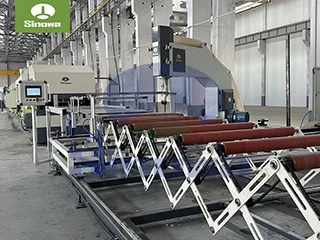
The finished product conveying and stacking unit is the terminal link of the production line, responsible for the transportation, temporary storage and automatic stacking of cut qualified panels. This unit is composed of a low-speed conveying roller table, a surface detection platform and a hydraulic stacking manipulator. The cut panels are transported to the detection platform through the roller table, and the staff can visually inspect the surface flatness, bonding state and cutting quality of the panels. The automated detection auxiliary device can identify tiny surface scratches, depressions and other defects to screen out unqualified products. Qualified finished panels are grabbed by the manipulator and stacked neatly on the material rack. The stacking height and spacing can be adjusted according to the panel thickness and storage requirements. The manipulator is equipped with a flexible anti-collision structure to avoid surface abrasion and corner damage during the grabbing and stacking process. The orderly stacked finished products are convenient for subsequent packaging, transportation and warehousing management, realizing the seamless connection between production and storage links.
The stable operation of the entire polyurethane sandwich panel line relies on the coordinated operation of the electrical control system and the hydraulic transmission system. The electrical control system takes the programmable logic controller as the core, and integrates multiple sensor modules such as temperature, pressure, speed and displacement. All operation parameters of each functional unit are uniformly displayed on the human-computer interaction terminal. The staff can set parameters such as feeding speed, raw material ratio, curing temperature, pressing pressure and cutting length through the terminal. The system has an automatic correction function. When the sensor detects parameter deviation during operation, it will automatically fine-tune the operating state of each component to keep the production parameters within the preset stable range. The hydraulic transmission system provides power support for tension adjustment, pressing forming and mechanical grabbing. The hydraulic station is designed with a heat dissipation and noise reduction structure to maintain stable oil pressure output during long-term continuous operation, reduce equipment vibration and operating noise, and improve the operating comfort of the production workshop. In addition, the control system is equipped with an emergency protection mechanism. When abnormal conditions such as material blockage, equipment overload and temperature overrun occur, the system will automatically trigger an alarm and stop the operation of key components to avoid equipment damage and production safety accidents.
In the daily production and operation process, standardized maintenance and parameter control are crucial to prolong the service life of the polyurethane sandwich panel line and maintain stable product quality. In terms of daily operation, the staff need to preheat the equipment before starting up, check the tightness of each connecting pipeline, the flexibility of moving parts and the residual amount of raw materials, and eliminate potential hidden dangers such as pipeline blockage and component jamming. During the formal production process, it is necessary to regularly observe the mixing state of raw materials, the foaming uniformity of the core layer and the bonding effect of the composite interface, and dynamically adjust the production parameters according to the slight changes of ambient temperature and humidity. After the production is completed, the residual raw materials in the mixing pipeline and the sundries on the surface of the conveying roller should be cleaned in time to prevent the chemical raw materials from solidifying and adhering to cause equipment corrosion and pipeline blockage.
In terms of regular maintenance, the transmission gears, bearings and other wearing parts need to be regularly coated with lubricating oil to reduce mechanical friction loss; the sealing rings of the hydraulic pipeline should be inspected regularly to avoid oil leakage; the temperature sensor and pressure sensor need to be calibrated periodically to ensure the accuracy of monitoring data; the cutting tools should be polished regularly to maintain cutting sharpness. For the aging parts that have been used for a long time, they should be replaced in a timely manner according to the wear degree to avoid affecting the overall operating accuracy of the equipment. Scientific maintenance management can not only reduce the failure rate of the production line and extend the service life of mechanical components, but also maintain the long-term stability of product forming quality and reduce the production cost caused by equipment failure and defective products.
Polyurethane sandwich panels produced by continuous production lines have comprehensive performance advantages such as light weight, low thermal conductivity, high structural strength, good weather resistance and convenient installation, so they are widely used in multiple industrial and civil fields. In the building construction industry, this kind of panel is used as wall and roof enclosure materials for industrial plants, temporary buildings and public buildings. The excellent thermal insulation performance can effectively reduce the energy consumption of building temperature regulation, and the lightweight structural characteristics reduce the bearing load of the building foundation. In the cold storage and fresh-keeping industry, the high-density polyurethane foam core layer can block the external heat transfer, maintain the low-temperature stability inside the cold storage, and reduce the operating energy consumption of refrigeration equipment. In the purification engineering field, the smooth and flat surface of the panel is not easy to accumulate dust, and the sealed composite structure can resist the erosion of corrosive gases, which is suitable for the construction of dust-free workshops in pharmaceutical, food and electronic processing industries.
In addition, the panel also has good sound insulation and fire-retardant modified performance. By adjusting the formula of polyurethane raw materials, the fire resistance grade of the core layer can be improved, which meets the safety requirements of high-risk buildings. In the transportation and packaging industry, lightweight and shock-resistant sandwich panels can be used to make insulation carriage plates and protective packaging lining plates. The stable chemical structure can resist the erosion of external humid air and corrosive substances, and maintain the structural stability in complex transportation environments. With the continuous improvement of environmental protection requirements in various industries, the recyclable characteristics of polyurethane sandwich panels also make them gradually replace traditional high-energy-consuming building materials, conforming to the development trend of green and low-carbon industry.
With the continuous progress of industrial intelligent manufacturing technology, polyurethane sandwich panel lines are evolving towards higher automation, intelligent control, energy saving and environmental protection. In terms of technological upgrading, more production lines have introduced intelligent sensing and digital modeling technology. The system can record the production data of each batch of panels in real time, form a production parameter database, and optimize the production logic through data analysis to improve the utilization rate of raw materials. In terms of structural optimization, the equipment adopts lightweight and high-strength alloy materials to reduce the self-weight of the production line, optimize the transmission structure, and reduce the energy consumption of mechanical operation. The improved raw material mixing pipeline reduces the residual amount of chemical raw materials, realizes efficient utilization of raw materials, and reduces production waste.
In terms of environmental protection improvement, the new generation of production lines is equipped with waste gas purification and waste material recovery devices. The trace volatile gas generated in the foaming reaction process is purified and then discharged up to the standard, and the trimmed edge waste is crushed and recycled for secondary processing, realizing the cyclic utilization of resources. In terms of intelligent operation, the production line realizes remote monitoring and fault diagnosis. The staff can view the operating status of the equipment in real time through the remote terminal, and the system can automatically judge the fault location and give maintenance suggestions when abnormal conditions occur, which greatly improves the maintenance efficiency of the equipment. In addition, the production line is developing towards multi-functional composite production. A single production line can meet the production requirements of panels with different surface materials and core layer densities, realizing flexible switching of production varieties and adapting to the diversified customized market demand.
In the context of the global emphasis on energy conservation, emission reduction and green building development, the market demand for high-performance polyurethane sandwich panels will continue to grow, which will further drive the technological innovation and industrial upgrading of polyurethane sandwich panel lines. In the future, such production equipment will break through the limitations of traditional production processes in terms of high-efficiency foaming, low-carbon raw material application and intelligent seamless production. The optimization of raw material formula will make the foam core layer have higher thermal insulation performance and environmental protection characteristics. The upgrading of mechanical structure will further improve the operating speed and forming accuracy of the production line. The deep integration of artificial intelligence and production equipment will realize fully unmanned automatic production, reduce manual intervention costs, and improve the overall intelligent manufacturing level of the industry.
At the same time, with the improvement of industrial supporting facilities, the matching degree between polyurethane sandwich panel lines and downstream processing equipment will be further enhanced. The integrated production mode of production, processing and packaging will simplify the production process chain, reduce intermediate logistics links, and lower the comprehensive production cost of products. In terms of market application, with the popularization of prefabricated buildings, cold chain logistics and purification engineering, the application scenarios of polyurethane sandwich panels will continue to expand, and the technical requirements for production lines in terms of diversification, customization and environmental protection will also be continuously improved. The continuous iterative optimization of production line technology will feed back the upgrading of the composite panel industry, promote the standardized and high-quality development of the entire industrial chain, and provide reliable material guarantee for the construction of energy-saving buildings and the development of modern industrial manufacturing.
To sum up, the polyurethane sandwich panel line is a highly integrated and automated composite material production equipment, which completes the efficient manufacturing of high-quality sandwich panels through the coordinated operation of multiple functional units and precise process control. From the feeding of raw materials to the stacking of finished products, each production link has rigorous mechanical logic and technological principles. The reasonable structural design and standardized operation management ensure the stable production efficiency and excellent product quality of the equipment. Relying on the performance advantages of polyurethane composite panels, this kind of production line has important application value in many industries. Driven by intelligent manufacturing and green environmental protection technology, polyurethane sandwich panel lines will continue to carry out technological innovation, continuously optimize production performance, reduce energy consumption and waste discharge, and adapt to the changing market demand. In the future industrial development, this production equipment will remain an important supporting force in the field of composite building materials, making continuous contributions to the popularization of energy-saving and environmentally friendly building materials and the high-quality development of the manufacturing industry.
https://www.cnsinowa.com/sandwich-panel-machines/polyurethane-sandwich-panel-line.html