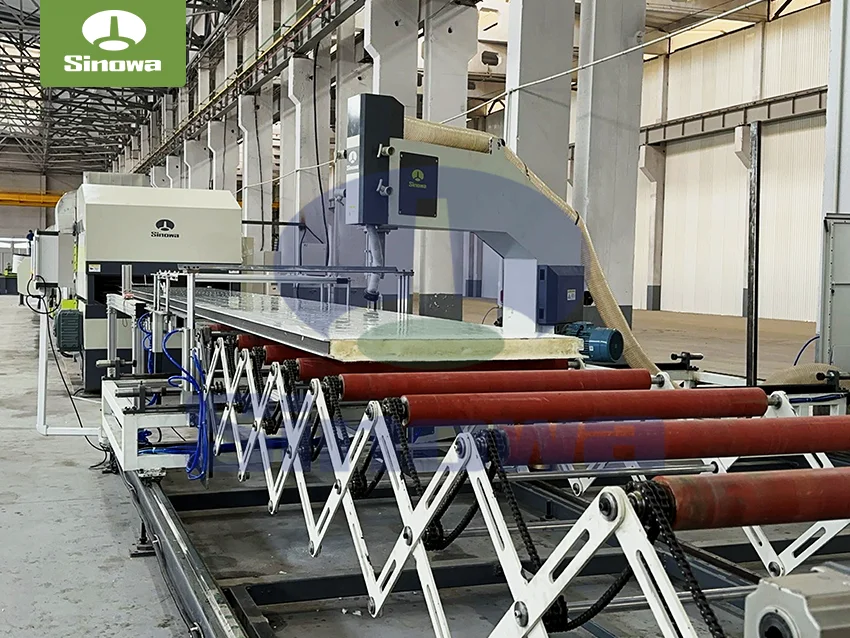
 sandwich panel machine
The overall structural design of the double-layer sandwich panel machine follows the principles of mechanical stability, operational coordination and convenient maintenance, with each functional component closely connected and matched in operating rhythm to ensure the smooth progress of the entire continuous production process. The main frame of the equipment is constructed with high-strength thickened steel materials processed through integrated welding and stress relief treatment, which can maintain long-term stable structural rigidity under the long-term cyclic operation of high load and continuous vibration, effectively avoiding equipment deformation, component displacement and operating accuracy attenuation caused by long-time high-frequency work. At the front end of the equipment is the automatic raw material feeding area, which is responsible for the orderly placement and stable conveying of upper and lower double-layer metal base plates and different types of thermal insulation core materials. The feeding part adopts a servo-driven automatic feeding and transferring structure, which can accurately and stably transport coiled metal plates and strip-shaped core materials to the subsequent forming and composite processing stations at a constant speed without manual repeated feeding and position correction work. The feeding mechanism is equipped with an automatic material arrangement and deviation correction function, which can fine-tune the material conveying track in real time according to the running state of the materials, ensuring that the upper and lower metal plates and the middle core material are always kept in a centered and aligned state during the conveying process, avoiding product quality problems such as uneven edge sealing and inconsistent plate thickness caused by material deviation and position dislocation in the subsequent composite process.
After the raw material feeding link is completed, the materials will enter the precision rolling and pre-forming station inside the double-layer sandwich panel machine, which is a key link to determine the appearance shape and dimensional accuracy of the final sandwich panel. This station is composed of multiple groups of precision rolling shafts and synchronous transmission assemblies, and through orderly rolling and pressing treatment, the flat metal base plates on both upper and lower layers are pressed into the required special plate shapes and structural radian according to the production and use requirements, including common wall panel flat structures and roof panel corrugated structural shapes. All rolling shafts in the forming station are processed with high-precision finishing and surface anti-wear treatment, which can ensure long-term stable rolling forming effect, no surface scratch damage to the metal plate during processing, and maintain the uniformity and consistency of the plate forming effect in each batch of production. The transmission system between the rolling shafts adopts a synchronous linkage design, realizing the consistent operating speed and coordinated pressing force of each group of rolling shafts, preventing plate deformation, wrinkling and thickness deviation caused by asynchronous operation and uneven pressing force in the forming process. At the same time, the pre-forming station is matched with a flexible thickness adjustment mechanism, which can adapt to the forming processing requirements of metal base plates of different thicknesses and core materials of different densities, realizing rapid switching of production specifications without complex disassembly and replacement of mechanical parts, and effectively improving the flexible production capacity of the equipment to meet the diversified product production needs of manufacturers.
The thermal insulation core materials applicable to the double-layer sandwich panel machine cover a variety of mainstream building thermal insulation and fireproof materials on the market, including rock wool, glass wool, extruded polystyrene, polyurethane foam and other different types of core materials, and the equipment structure and operating parameters can be adaptively adjusted according to the physical characteristics of different core materials such as density, hardness and thermal conductivity. In the actual production process, the core material automatic laying and positioning mechanism inside the equipment can accurately fill the gap between the upper and lower formed metal plates with the core material, ensuring uniform core material distribution, no hollow gaps and uneven filling inside the panel, which directly determines the thermal insulation performance, fire resistance performance and overall structural stability of the finished sandwich panel. For rigid core materials with high hardness and good compression resistance, the equipment adopts a gentle pressing and fitting mode to avoid core material crushing and structural damage; for flexible soft core materials, it adopts a uniform tensioning and shaping structure to ensure the flatness and compactness of core material laying, so that the composite structure of the entire sandwich panel can reach the optimal bonding and fitting state. This diversified adaptive design enables the double-layer sandwich panel machine to cope with the production and processing needs of sandwich panels for different application scenarios, whether it is thermal insulation panels for low-temperature storage buildings, fireproof enclosure panels for industrial production workshops, or weather-resistant decorative panels for outdoor public buildings, all of which can be produced efficiently and stably through this equipment.
The composite bonding and pressure fixing station is the core functional area of the double-layer sandwich panel machine, undertaking the key process task of firmly combining the upper and lower metal plates and the middle thermal insulation core material into an integrated whole plate structure. This station relies on the coordinated action of constant temperature heating and balanced pressure pressing technology to activate the adhesive materials between the metal plates and the core material, and complete the permanent composite bonding of all parts of the panel under the action of stable pressure and suitable temperature. The heating system adopts uniform and distributed heating layout, which can ensure that the temperature of each position of the composite plate surface is consistent, avoid local overheating leading to adhesive aging and core material deformation, or local low temperature leading to insufficient adhesive activation and weak bonding firmness. The pressure pressing part uses a balanced hydraulic linkage structure to provide uniform and stable pressing force for the composite panel, ensuring that the bonding gap between the metal plate and the core material is tightly fitted, no bulging, warping and degumming defects occur on the plate surface, and the overall structural firmness and service durability of the finished sandwich panel are effectively guaranteed. All pressure and temperature parameters in the composite process can be independently adjusted and precisely controlled according to the material characteristics and production process requirements, realizing targeted process parameter setting for different product specifications, and ensuring that each batch of produced sandwich panels meets the unified production quality standards.
Equipped with an intelligent centralized control system, the double-layer sandwich panel machine realizes one-button start and automatic operation of the entire production line, simplifying the daily operation and management work of production personnel to the greatest extent. The core of the control system adopts programmable control logic matched with an intuitive human-machine interaction interface, and all production parameters including feeding speed, forming pressure, composite temperature, pressing time and cutting length can be directly set and adjusted on the operation interface. The equipment has a built-in real-time parameter monitoring and automatic early warning function, which can continuously detect the operating status of each mechanical component, the stability of operating parameters and the production progress in the production process. Once abnormal conditions such as parameter deviation, component operation failure and material conveying blockage occur, the system will automatically send prompt signals and take corresponding protective measures such as automatic shutdown and fault locking, avoiding equipment damage caused by abnormal operation and unqualified product quality caused by process parameter deviation. The simple and clear operation logic enables ordinary operating personnel to quickly master the equipment use and daily basic operation skills without complex professional technical training, effectively reducing the technical threshold of equipment operation and the labor cost of enterprise production and operation. In addition, the control system supports production data statistics and production parameter memory functions, which can store the process parameters of conventional product production specifications, realizing rapid switching of subsequent production of different products and greatly improving production scheduling efficiency.
The automatic cutting and final shaping station at the rear of the double-layer sandwich panel machine is responsible for cutting the continuously produced integrated composite sandwich panels according to the preset length specifications and completing the final edge trimming and shaping treatment of the panels. The cutting mechanism adopts high-precision synchronous cutting design, which can realize fixed-length accurate cutting without stopping the production line, ensuring the flat and smooth cutting section of the panel, no burrs, no plate deformation and edge cracking, and the dimensional error of each finished panel is controlled within a very small range to meet the precise installation and construction requirements of subsequent engineering projects. The edge trimming and shaping part can trim the redundant materials at the edges of the composite panel and fine-tune the flatness of the plate edges, ensuring that the overall appearance of the finished sandwich panel is neat and the structural dimensions are standardized, which is convenient for subsequent stacking, transportation and on-site assembly and installation. After the cutting and shaping process is completed, the finished sandwich panels will be automatically transported to the finished product stacking area through the automatic discharging and conveying mechanism at the rear of the equipment, realizing automatic stacking and arrangement of finished products, reducing the manual handling and stacking work link, further improving the overall automation level of the entire production line, and realizing seamless connection from raw material input to finished product output.
The application advantages of the double-layer sandwich panel machine in actual industrial production are very prominent, first reflected in the significant improvement of production efficiency compared with traditional decentralized production equipment. The equipment integrates all production processes required for sandwich panel manufacturing into one continuous production line, realizing uninterrupted cyclic production without multiple transfers and repeated processing of semi-finished products, greatly shortening the single-panel production cycle and effectively improving the daily output and annual production capacity of the production line. For large-scale building material production enterprises that need mass supply of sandwich panels for engineering projects, the efficient continuous production capacity of the equipment can fully meet the market large-order delivery demand, shorten the production and delivery cycle, and improve the market competitiveness of enterprises. Secondly, the equipment effectively ensures the stability and consistency of product quality, and all production processes are completed by mechanical automatic operation and precise parameter control, avoiding human errors and quality fluctuations caused by manual operation in traditional production modes. The thickness, bonding firmness, appearance flatness and dimensional accuracy of each batch of produced sandwich panels are kept highly consistent, reducing the rate of defective products and rework products in the production process, effectively saving raw material consumption and production rework costs for enterprises, and improving the economic benefits of production and operation.
In terms of production operation cost control, the double-layer sandwich panel machine also has obvious practical advantages, adopting integrated and optimized mechanical structure design and energy-saving power configuration, which can effectively reduce the energy consumption of unit product production compared with multiple sets of separate production equipment working together. The equipment has a compact overall structural layout, occupying a small production workshop space, which reduces the site use cost of production enterprises and is convenient for reasonable planning and layout of the production workshop. At the same time, the high degree of automation of the equipment reduces the number of on-site production operators required, realizing that only a small number of personnel can complete the daily production operation and equipment patrol inspection work, reducing enterprise labor input and labor management costs. In addition, the key components of the equipment are made of wear-resistant and durable materials with optimized structural design, which reduces the frequency of equipment failure and daily maintenance and replacement of parts, extends the long-term stable service life of the equipment, and reduces the later equipment maintenance and operation comprehensive costs for enterprises. Whether it is a small and medium-sized building material processing enterprise with initial production investment or a large-scale standardized production enterprise with long-term development planning, this equipment can match the production scale and cost control needs of different enterprises.
Daily maintenance and scientific maintenance are important prerequisites to ensure the long-term stable operation and efficient production performance of the double-layer sandwich panel machine, and the equipment is designed with convenient maintenance and maintenance structural features, making the daily management work of production enterprises simpler and more efficient. The key transmission parts, rolling forming parts and hydraulic pressure parts of the equipment are designed with open maintenance windows and detachable structural components, which are convenient for maintenance personnel to regularly check the operating wear of internal parts, add lubricating oil and clean production dust and material residues accumulated inside the equipment. Regular standardized maintenance can effectively reduce the wear and aging speed of mechanical parts, avoid equipment operation failure caused by long-term dust accumulation and insufficient lubrication, and ensure that the equipment always maintains the optimal production operating state. The wearing parts of the equipment adopt standardized and generalized design, which is convenient for enterprises to purchase and replace in time, without long-term shutdown waiting for customized parts processing, ensuring the continuity and stability of production work. At the same time, the intelligent control system of the equipment can record the equipment operation status and fault history data in real time, which is convenient for maintenance personnel to quickly grasp the equipment operation condition, timely find potential hidden dangers of equipment operation, and carry out pre-maintenance and troubleshooting, avoiding long-term production shutdown losses caused by sudden equipment failures.
With the continuous development and upgrading of prefabricated construction industry and green building materials concepts, the future development direction of double-layer sandwich panel machines will be more inclined to intelligent upgrading, green production and multi-functional integrated expansion. With the continuous improvement of market requirements for building energy conservation, environmental protection and structural safety, the equipment will further optimize the internal composite process and energy-saving power system, reduce production energy consumption and environmental pollution in the production process, and adapt to the development requirements of green and low-carbon building material production. The intelligent control level of the equipment will be further improved, realizing more precise automatic parameter matching, intelligent fault diagnosis and remote operation and management functions, reducing manual intervention in the production process in an all-round way, and realizing fully intelligent and unmanned continuous production. At the same time, the equipment will develop towards multi-functional compound processing, which can not only produce conventional standard sandwich panels, but also meet the production and processing needs of special-shaped panels, ultra-thick panels and special fireproof and thermal insulation customized panels, further expanding the product production coverage of the equipment and helping building material production enterprises adapt to the increasingly diversified and personalized market demand for building enclosure materials. As a key core equipment in the field of sandwich panel production, the double-layer sandwich panel machine will always accompany the development of prefabricated construction industry, continuously carry out technical optimization and structural upgrading, and provide solid equipment support for the high-quality and efficient development of the entire building material production and construction engineering industry.
https://www.cnsinowa.com/sandwich-panel-machines/double-layer-sandwich-panel-machine.html






