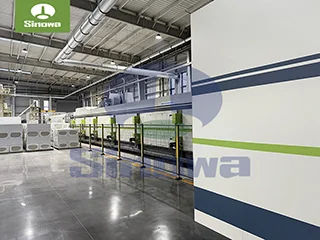
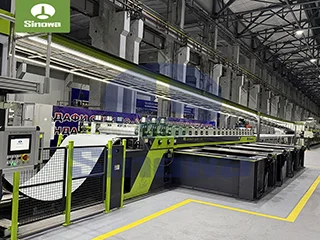
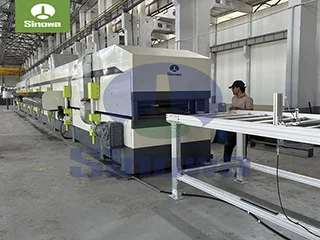
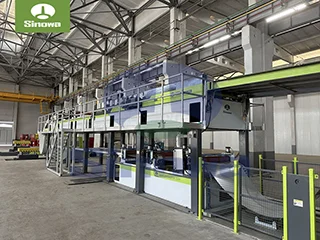
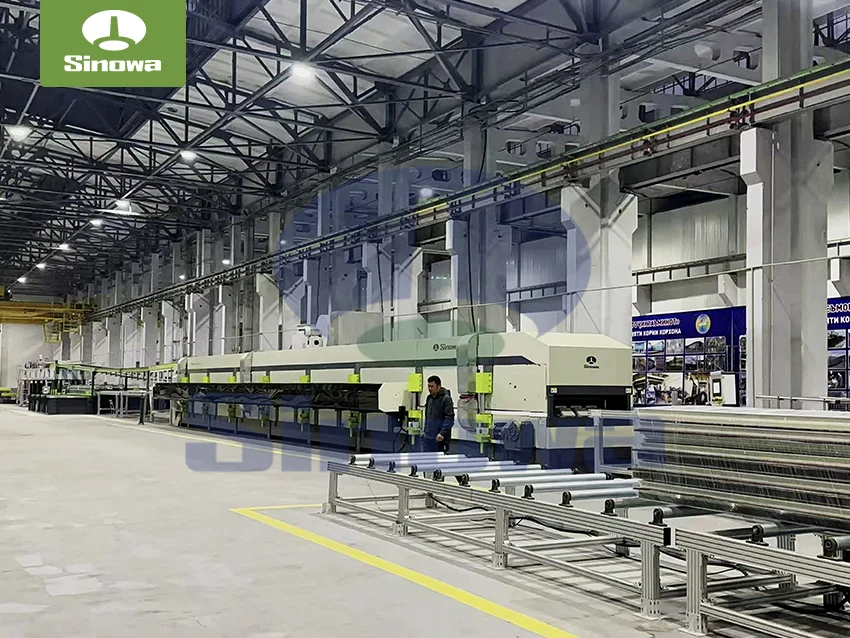
 sandwich panel machine
The core design philosophy behind every high-speed sandwich panel machine centers on the perfect balance between rapid production rhythm and rigorous product quality control, two core indicators that determine the practical application value of the equipment in actual factory operation. Many conventional sandwich panel processing equipment on the market prioritize simple structural design and low initial input cost, often resulting in obvious deficiencies in operational continuity and processing precision; such equipment can only maintain low to medium production speeds during operation, and long-term high-load operation is prone to mechanical vibration, structural deformation, inconsistent composite pressure, and uneven temperature control, all of which directly lead to defective products such as inconsistent panel thickness, weak bonding between surface layers and core materials, edge warping, and surface wrinkles. In contrast, the high-speed sandwich panel machine adopts an overall reinforced structural frame design, with key load-bearing and operating components processed with high rigidity and precision to effectively absorb micro-vibrations generated during high-speed cyclic operation. This structural reinforcement design ensures that every mechanical action from raw material feeding to finished product cutting maintains accurate positioning and stable force transmission, avoiding deviations in the composite process caused by equipment vibration or structural displacement even when the machine runs at a sustained high production rhythm. Every structural detail of the equipment is optimized around long-term high-frequency operation, with wear-resistant and anti-fatigue treatment applied to easily worn moving parts, extending the overall service life of the equipment and reducing the frequency of mechanical maintenance and downtime production losses for manufacturing enterprises.
The entire production operation process of the high-speed sandwich panel production line follows a fully automated closed-loop logic, requiring minimal manual participation throughout the whole process and only needing basic parameter setting and daily operational monitoring by on-site operators to complete the entire production sequence of sandwich panels. At the initial stage of production, various raw materials required for panel processing, including metal surface sheets, non-metal protective veneers, and different types of lightweight core materials, are placed in the automatic feeding area of the equipment. The feeding unit of the machine adopts a servo-driven precise conveying structure, which can stably and continuously transport surface layer raw materials to the pretreatment station at a constant and adjustable speed. The pretreatment link is an indispensable part of ensuring the firm bonding of subsequent composite materials, where the equipment completes surface dust removal, oil stain cleaning, and uniform glue coating treatment on the inner side of the surface sheets. The glue coating structure is designed with an independent driving and pressure regulating system, enabling uniform glue application across the entire width of the surface material without local excessive glue accumulation or missing coating problems, laying a solid foundation for tight lamination between the surface layer and the core material in the later stage. After the pretreatment and glue coating processes are completed, the surface materials are automatically conveyed to the core material laying station, where the equipment accurately arranges and fixes the core insulation and support materials according to the preset panel specification requirements, ensuring the core material is evenly distributed without offset, gaps, or stacking deviations within the panel structure.
The composite pressing and shaping stage is the core functional link of the high-speed sandwich panel line and the key process that directly determines the structural firmness and overall flatness of finished sandwich panels. This core working section adopts a multi-roller balanced composite pressing structure equipped with a precision pressure regulation system, which can maintain uniform and stable pressing force across the entire processing width during high-speed operation. Different from the simple single-roller pressing structure of traditional equipment that is prone to uneven pressure distribution on both sides and the middle of the panel, the multi-roller matching design of the high-speed model realizes synchronous force application and balanced pressure output, ensuring that each position of the composite panel receives consistent pressing force. Meanwhile, the equipment is equipped with a constant temperature control system for the composite working area, which maintains the optimal temperature environment required for glue curing and material composite bonding through precise temperature adjustment. The intelligent temperature control module can stabilize the working temperature within a reasonable fluctuation range, avoiding insufficient bonding strength caused by low temperature and material deformation or glue aging caused by excessive high temperature. In the continuous high-speed production state, the composite and shaping process proceeds synchronously with the material conveying speed, realizing one-time integrated forming of surface layers and core materials without the need for secondary pressing or repeated curing, greatly shortening the production cycle of a single panel and improving the overall production efficiency of the entire line.
After the composite pressing and preliminary curing shaping are completed, the semi-finished continuous sandwich panels enter the automatic cooling and traction conveying link of the equipment. The cooling unit adopts a circulating air cooling design with uniform air supply on both upper and lower sides, which can evenly dissipate heat from the surface and interior of the newly composited panels, accelerating the stable shaping of the panel structure and avoiding panel deformation or internal stress accumulation caused by rapid temperature difference changes. The traction conveying mechanism adopts a closed-loop tension control system, which always maintains stable material conveying tension during the high-speed moving process of the panels, preventing panel stretching, shrinkage, or position deviation caused by unstable tension. This precise tension control technology is particularly critical for high-speed continuous production, as it ensures that the size and specification of each section of the continuously produced panels remain consistent, eliminating dimensional errors between front and rear panels that often occur in low-speed production equipment. After stable cooling and tension maintaining, the continuous integrated panels are accurately cut to fixed lengths by the automatic cutting unit of the equipment according to the preset production specifications. The cutting structure is driven by high-precision power components, realizing fast and smooth cutting without burrs, edge collapses, or cutting deviations, ensuring the neatness and standardization of the edge size of each finished sandwich panel.
The final stage of the entire production process is automatic finished product stacking and discharging, a functional link that further improves the automated production level of the high-speed sandwich panel production machine and reduces manual labor intensity. The stacking unit adopts a synchronous stacking action design, which can automatically and neatly stack the cut qualified finished panels in a fixed area in an orderly manner. This automatic stacking method effectively avoids the problems of panel surface scratches, edge damage, and messy stacking order caused by manual handling and stacking in traditional production modes. Neatly stacked finished panels are more convenient for subsequent packaging, transportation, and storage operations, optimizing the overall production and post-processing workflow of the enterprise. The entire production process from raw material feeding to finished product stacking is completed in a fully automated continuous cycle, with all mechanical actions and process parameter adjustments coordinated by the integrated intelligent control system of the equipment. Operators only need to set basic parameters such as panel width, thickness, length, and production speed on the control terminal before production, and the equipment can automatically complete all subsequent production links, realizing truly unmanned continuous production and greatly reducing the labor cost and manual management pressure of manufacturing enterprises.
In addition to outstanding high-speed production capacity and fully automated operation advantages, the high-speed sandwich panel manufacturing machine also has excellent multi-scenario production adaptability, capable of meeting the processing and production needs of sandwich panels with different material combinations and different performance requirements. In actual building material production and industrial manufacturing applications, sandwich panels need to match different surface layer materials and core materials according to different use environments and engineering needs. The equipment can flexibly adapt to the processing of various metal and non-metal surface veneers, as well as different types of lightweight insulation core materials, and can quickly adjust production parameters such as composite pressure, processing temperature, conveying speed, and cutting size according to different material characteristics and panel performance requirements. This strong production flexibility enables a single high-speed sandwich panel machine to meet the diversified product production needs of enterprises, avoiding the need to configure multiple sets of different processing equipment for producing different types of sandwich panels, effectively saving factory production space and equipment investment costs. Whether it is common thermal insulation sandwich panels for ordinary factory buildings, high-strength structural sandwich panels for special industrial facilities, or lightweight decorative sandwich panels for commercial buildings, the equipment can complete high-speed and high-quality production and processing, with strong market applicability and production flexibility.
Energy saving and green production are also important inherent advantages of the high-speed sandwich panel making machine, conforming to the current global manufacturing industry's general trend of energy consumption reduction and green and low-carbon development. The equipment is optimized in terms of power drive and heat energy utilization structure, adopting efficient drive components and circulating heat energy recovery design, which can effectively reduce unnecessary energy consumption during high-speed operation. The thermal energy generated during the heating and curing process of the composite link is recycled and reused through the circulating hot air system, avoiding the waste of heat energy directly discharged by traditional equipment, effectively reducing the overall energy consumption per unit of produced panels. At the same time, the optimized mechanical transmission structure reduces mechanical friction loss during equipment operation, lowering power consumption while reducing wear and tear of mechanical parts. In the long-term continuous production process, the energy-saving design of the high-speed sandwich panel machine can help manufacturing enterprises effectively reduce production energy costs, realize green and environmentally friendly production modes, and avoid excessive energy consumption and resource waste while ensuring high production efficiency. This energy-saving and efficient operation feature not only improves the economic benefits of enterprise production but also meets the development requirements of modern industrial manufacturing for environmental protection and energy conservation.
For manufacturing enterprises engaged in sandwich panel production, choosing a high-speed sandwich panel manufacturing line means obtaining a production solution that integrates high efficiency, high stability, low operating cost, and strong adaptability. In the fiercely competitive building materials market, production efficiency and product quality stability are the core competitiveness of enterprises. The high-speed operation capability of the equipment enables enterprises to quickly complete large-scale order production tasks, shorten product delivery cycles, and improve market response speed. The precise processing and stable composite performance ensure that all finished sandwich panels have consistent quality, few defective products, and low product rework and scrap rates, effectively reducing enterprise production waste and quality management costs. The fully automated production mode reduces the enterprise's reliance on skilled production workers, alleviates the pressure of labor recruitment and management, and realizes standardized and standardized production management. The durable structural design and convenient later maintenance characteristics ensure that the equipment can maintain long-term stable high-load operation, reduce equipment downtime maintenance time, and improve the overall production continuity and production capacity of the factory.
With the continuous upgrading of building engineering standards and the continuous expansion of application scenarios for sandwich panel products, the market requirements for the production quality, production efficiency, and performance diversity of sandwich panels are constantly improving, which also promotes the continuous technological optimization and functional upgrading of high-speed sandwich panel machine. The modern high-speed sandwich panel machine is no longer a single mechanical processing equipment, but a comprehensive integrated production system integrating mechanical transmission, intelligent control, precise pneumatic and hydraulic regulation, and automatic detection and feedback technology. In the future development process, such equipment will further develop in the direction of higher operation speed, stronger intelligent control level, more diversified production adaptation, and lower energy consumption and maintenance cost, continuously adapting to the changing market demand and building material production standards. For all types of sandwich panel production enterprises, investing in and applying high-speed sandwich panel machinery is an important measure to realize production upgrading, efficiency improvement, and quality stabilization, helping enterprises maintain stable operation and sustainable development in the increasingly competitive building material manufacturing market, and providing high-quality and standardized sandwich panel products for various construction and industrial engineering projects.
https://www.cnsinowa.com/sandwich-panel-machines/high-speed-sandwich-panel-machine.html