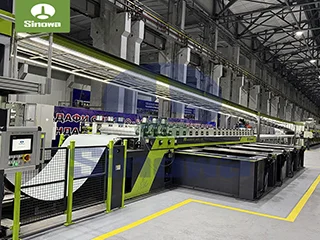
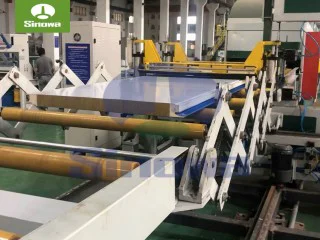
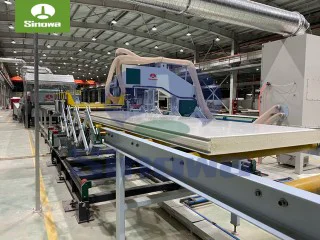
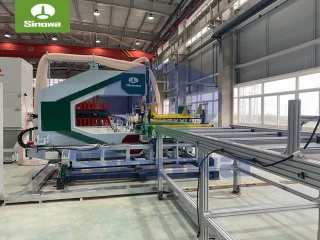
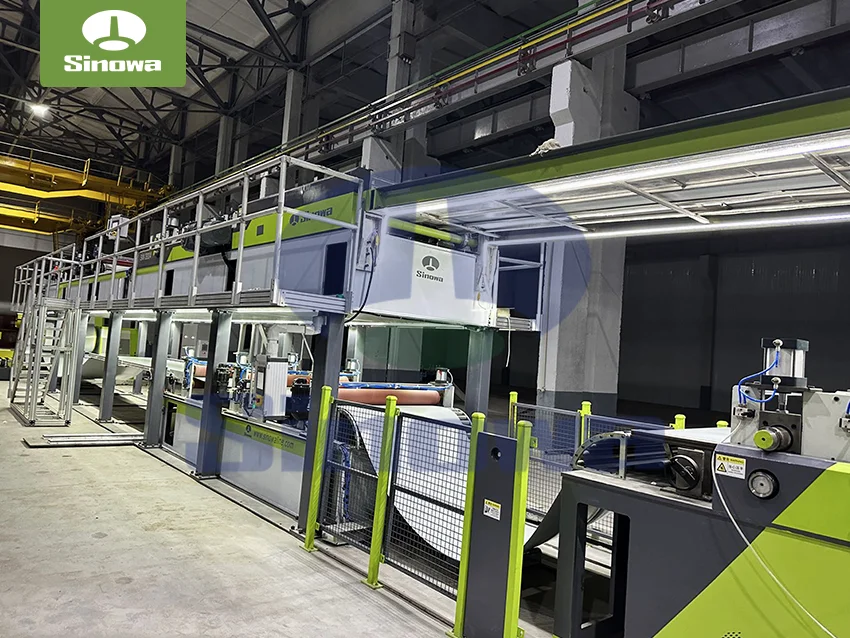
 sandwich panel machine
The operational logic of the cold roll forming sandwich panel machine is based on progressive mechanical deformation and integrated composite molding. The entire production process starts with the feeding of metal coiled materials and core insulation materials, and each processing link is closely coordinated through a synchronous linkage system to ensure consistent production rhythm and stable product quality. The metal surface materials used in production are usually galvanized steel sheets, color-coated steel sheets or aluminum alloy sheets with good ductility and weather resistance. These coiled metal materials are loaded into the feeding mechanism and undergo preliminary leveling and tension adjustment before entering the forming system, eliminating internal stress and surface unevenness generated during coiling and storage. This preprocessing step is critical to avoid local deformation, warping or size deviation of the finished panels in subsequent forming and compounding processes, laying a foundation for the flatness and structural uniformity of the final products.
The core functional module of the equipment lies in its multi-station cold roll forming system, which consists of dozens of precision roller sets arranged in an orderly gradient. Each group of rollers adopts customized contour design, and through step-by-step micro-bending and compression deformation, the flat metal sheet is gradually shaped into various preset cross-sectional profiles, including trapezoidal, corrugated, ribbed and flat edge-closed structures. Different from one-time stamping forming, the progressive rolling method of cold roll forming disperses the deformation force on the metal surface, effectively avoiding material cracking, coating peeling and stress concentration problems that are prone to occur in instantaneous high-pressure forming. The spacing, gap and rotation speed of each roller set can be adaptively adjusted according to the thickness, hardness and ductility of different metal materials, enabling the equipment to process metal sheets of multiple specifications and produce panels with diverse structural forms to meet the differentiated needs of different building scenarios.
While completing the cold forming of the upper and lower metal surface layers, the sandwich panel equipment synchronously carries out the conveying and laying of the core insulation material, which is another key link to realize the integration of sandwich panels. Common core materials processed by the machine include polyurethane foam, rock wool, glass wool and other thermal insulation and fireproof materials, each with unique physical characteristics that require the equipment’s feeding and compounding system to have adaptive adjustment capabilities. For flexible foam core materials, the equipment is equipped with a precise metering and uniform distributing structure, which can evenly distribute the foaming raw materials between the upper and lower formed metal sheets and complete micro-pressure foaming and filling in a closed space. For rigid fiber core materials such as rock wool and glass wool, the automatic cotton laying and positioning mechanism can accurately arrange the core materials in layers, ensuring uniform density and no gaps inside the panel, and avoiding hollowing or local thinning that affects thermal insulation and mechanical properties.
The composite pressing and curing system is the key functional unit that determines the bonding strength and overall rigidity of sandwich panels. After the metal surface layers and core materials are aligned and assembled in place, they enter the constant-temperature and constant-pressure composite area of the sandwich panel production equipment. Through stable mechanical pressure and mild temperature regulation, the adhesive coated between the metal and core materials undergoes uniform curing reaction, forming a tight integrated composite structure. The equipment’s pressure control system maintains balanced stress on the entire panel surface during the compounding process, preventing deviation in bonding thickness and local debonding. The temperature control module realizes real-time monitoring and fine adjustment of the curing environment, adapting to the curing characteristics of different adhesives and core materials, ensuring that the bonding interface achieves optimal tensile and shear strength, and enabling the finished panels to have excellent overall structural stability and anti-separation performance.
Following the composite curing process is the fixed-length cutting and finishing stage, which realizes the final sizing and shaping of continuous strip panels. The high-precision tracking and cutting system of the equipment can automatically identify the running speed of the sandwich panel production line and complete synchronous cutting without stopping the machine, effectively avoiding size errors caused by production line jitter or speed fluctuation. The cutting tool adopts wear-resistant structural design, which can maintain smooth and burr-free cutting sections during long-term continuous operation, eliminating subsequent manual trimming procedures. After cutting, the finished panels are automatically conveyed to the sorting and stacking mechanism, which completes orderly stacking and arrangement according to set specifications, reducing manual handling links and avoiding surface scratches and deformation caused by human operation.
The overall structural design of the cold roll forming sandwich panel machine fully embodies the integration and modularization concept of modern industrial equipment. The whole sandwich panel line is composed of multiple independent functional modules including uncoiling and leveling module, roll forming profiling module, core material feeding and distributing module, composite pressing curing module, fixed-length cutting module and automatic stacking module, and all modules are centrally coordinated by a synchronous control system. The modular structure not only simplifies the overall layout of the equipment and saves production space, but also facilitates daily maintenance, component replacement and functional upgrading. Operators can independently adjust and debug a single module according to production requirements without affecting the normal operation of the whole line, which greatly improves the flexibility and fault tolerance of production.
In terms of operational performance, the sandwich panel machinery has significant advantages in production stability and product consistency compared with traditional processing equipment. The full-process automated control mode reduces human intervention to the greatest extent, avoiding product quality fluctuations caused by manual operation errors. The closed-loop tension control system installed in the feeding link can automatically adjust the feeding speed and tightening state according to the material state, maintaining constant material stress throughout the forming process and ensuring the consistency of panel profile size and surface flatness in batch production. The entire production process is carried out at normal temperature, without high-temperature heating and cooling links, which not only avoids material performance changes caused by high temperature, but also reduces energy consumption and thermal pollution in the production process, conforming to the energy-saving and environmentally friendly development direction of modern industrial production.
The cold roll forming sandwich panel production machine also shows strong adaptability in product diversification and production flexibility. By adjusting the parameter settings of the roll forming system and replacing simple roller accessories, the equipment can quickly switch between different panel profiles and structural specifications, realizing flexible production of multi-style and multi-size sandwich panels on one line. This flexible production capability enables manufacturers to respond quickly to market demand changes, meet the personalized customization needs of different engineering projects, and effectively reduce the equipment investment pressure caused by single production function. Whether it is thin and lightweight decorative insulation panels for civil buildings or thick and high-strength load-bearing enclosure panels for industrial plants, the equipment can complete standardized and high-quality production through parameter optimization.
In practical industrial application, the equipment's continuous production mode greatly improves the production efficiency of sandwich panels and shortens the production cycle of building enclosure materials. The integrated processing from raw material feeding to finished product output realizes uninterrupted continuous production, breaking the production bottleneck of traditional segmented processing equipment. The finished sandwich panels produced by this machine have uniform structural stress, stable thermal insulation performance, good weather resistance and bending resistance, and can adapt to complex outdoor environments such as high temperature, low temperature and strong wind. The integrated bonding structure makes the panels have excellent overall rigidity, not easy to deform and crack during installation and use, effectively extending the service life of building enclosure structures.
With the continuous upgrading of building industrialization and green building standards, the technical performance of cold roll forming sandwich panel machines is also constantly optimized and iterated. Modern equipment is gradually upgrading in the direction of higher precision, higher automation and stronger intelligence. The intelligent monitoring system can realize real-time collection and analysis of production data such as forming size, bonding pressure, curing temperature and production speed, automatically early warning of abnormal conditions such as material deviation, tool wear and parameter drift, and effectively reduce the rate of defective products. The optimized mechanical structure further reduces equipment operation noise and vibration, improves the stability of long-term high-load operation, and reduces equipment failure rate and maintenance cost.
In the field of engineering application, the sandwich panels produced by cold roll forming sandwich panel machine are widely used in industrial factory buildings, logistics warehouses, cold storage and fresh-keeping warehouses, public building enclosures, temporary construction facilities and other scenarios. In industrial plant construction, the high-strength and thermal insulation properties of the panels can meet the needs of large-span building enclosure and indoor constant-temperature production environments. In cold chain storage facilities, the excellent thermal insulation and sealing performance of the panels effectively reduce energy consumption for refrigeration and improve the operational efficiency of cold chain equipment. In rapid construction projects such as temporary buildings and mobile facilities, the standardized and modular finished panels can realize rapid assembly and construction, greatly shortening the project construction cycle and improving construction efficiency.
From the perspective of industrial development, the cold roll forming sandwich panel manufacturing machine is an important equipment carrier for the upgrading of the building materials industry towards industrialization, standardization and greening. It changes the traditional backward production mode of building materials with low efficiency, poor consistency and high resource consumption, and realizes precise control of the production process and stable guarantee of product quality. The normal-temperature cold processing technology avoids material performance loss and energy waste caused by high-temperature processing, and the efficient continuous production mode improves the utilization rate of raw materials, reduces production waste, and meets the green and low-carbon development requirements of the modern construction industry. With the continuous progress of construction technology and the continuous expansion of the application scope of sandwich panels, the market demand for high-performance cold roll forming sandwich panel machines will continue to grow, and the equipment will further develop in the direction of intelligent linkage, multi-functional integration and energy-saving efficiency improvement, providing more solid technical support for the high-quality development of the global construction and building materials industry.
https://www.cnsinowa.com/sandwich-panel-machines/cold-roll-forming-sandwich-panel-machine.html