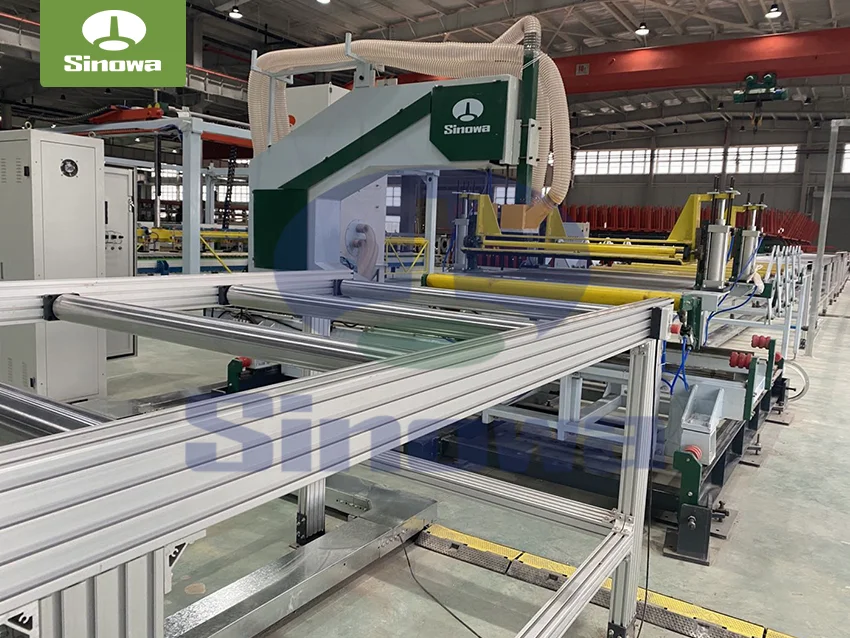
 sandwich panel line
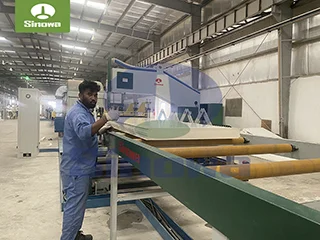
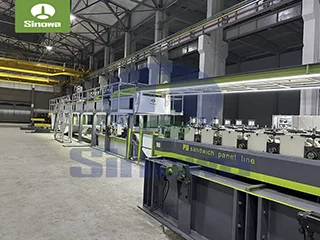
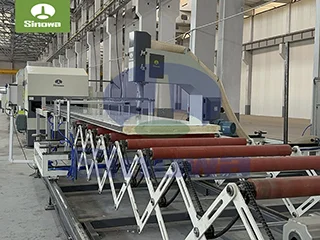
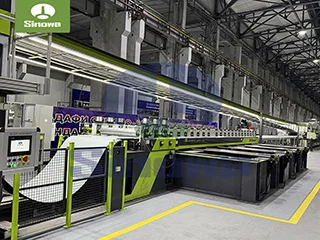
The overall structural design of a complete PIR air duct panel production line follows the concept of integrated modularization, combining multiple independent processing units into an interconnected production system. Each functional module maintains an independent mechanical operation logic while realizing synchronous coordination through a centralized control system, effectively reducing intermediate handling links and material transfer intervals in the production process. The front-end part of the production line is mainly responsible for raw material feeding and preliminary pretreatment, including raw material unwinding, surface leveling and impurity removal mechanisms. The raw materials required for production include organic foam substrates and composite protective layers, which are transported to the processing station through automatic conveying equipment. The leveling structure eliminates subtle deformation and wrinkles on the surface of raw materials, ensuring the flatness of subsequent composite processing and laying a foundation for the uniform thickness and stable structure of finished panels. The middle section serves as the core processing area, undertaking foaming, composite pressing and constant-temperature curing procedures, which directly determine the thermal insulation performance and structural firmness of PIR panels. The rear-end modules focus on fixed-size cutting, edge trimming and surface finishing, turning cured semi-finished products into standard duct panels that meet engineering application specifications. The scientific layout of each module minimizes the space occupancy of the production line while shortening the overall production cycle of a single panel.
Raw material pretreatment is the initial key link in the operation of the PIR air duct panel production line, and the refined treatment of raw materials effectively avoids product quality fluctuations caused by raw material defects. Before formal processing, various raw materials are placed in designated feeding areas according to production formulas, and the automatic feeding system quantitatively conveys different raw materials to the mixing station at a stable rate. The foam raw materials undergo precise ratio mixing under the action of mechanical stirring equipment, and the mixing speed and stirring duration are dynamically adjusted according to the ambient temperature and humidity to ensure the uniform fusion of different chemical components. Uneven mixing will lead to inconsistent foam density inside the panel, resulting in local differences in thermal insulation effect and structural hardness of finished products. Meanwhile, the surface of the protective layer raw materials is cleaned and dedusted by electrostatic adsorption and air blowing structures to remove floating dust and tiny impurities. This pretreatment measure enhances the bonding tightness between the protective layer and the foam substrate, preventing delamination and warping during the long-term service of the air duct panel. All parameters in the pretreatment stage are recorded by the control system in real time to provide data support for subsequent production parameter adjustment.
Foaming and composite molding are the core technological stages of the entire production line, which determine the core physical properties of PIR air duct panels. After the raw materials are evenly mixed, the liquid foam mixture is evenly sprayed on the surface of the lower protective layer through an intelligent spraying device. The spraying mechanism adopts multi-group parallel spray heads to realize linear and uniform feeding, controlling the spraying thickness within a stable range to ensure the consistency of panel thickness. Immediately after spraying, the upper protective layer is closely attached to the foam raw material, and the composite body is sent to the pressing and curing equipment. The internal temperature of the pressing equipment is kept within a constant temperature range through a circulating heating system, which accelerates the foaming and curing reaction of polyisocyanurate materials. During the pressing process, the hydraulic pressure system provides stable and uniform pressure to eliminate internal gaps generated in the preliminary composite stage. The slow pressure maintaining process enables the foam molecules to fully cross-link and form a compact and uniform cellular structure inside the panel. This dense microscopic structure endows the panel with low thermal conductivity, effectively blocking heat transfer and reducing energy loss in the ventilation pipeline. The composite molding process strictly controls the reaction time to avoid performance degradation caused by insufficient curing or excessive aging of foam materials.
The automated control system acts as the intelligent core of the PIR air duct sandwich panel production line, realizing synchronous scheduling and precise regulation of all processing links. The system adopts a human-computer interaction interface to complete parameter setting and operation monitoring, and operators can adjust processing parameters such as feeding speed, foaming temperature and pressing pressure according to production requirements. Built-in sensing components are distributed in each processing module to collect real-time data including temperature, pressure and material transmission speed. Once abnormal data such as excessive temperature or material blockage is detected, the system will automatically trigger early warning prompts and execute emergency protection actions to prevent equipment failure and unqualified products. The programmable control logic realizes the linkage operation of multiple equipment modules, eliminating the time difference caused by manual coordination. In addition, the system has a data storage function to record the parameter information of each production batch. The stored data can be used for production process optimization and product quality tracing, helping production personnel summarize processing experience and eliminate potential quality hazards. The intelligent control mode reduces the dependence on manual operation, lowers the labor intensity of operators, and stabilizes the daily production output of the production line.
After the completion of curing and molding, the semi-finished panels enter the post-processing stage for finishing and sizing treatment. The continuous conveying structure sends the integral composite board to the cutting area, and the laser positioning technology accurately marks the cutting position according to the preset size parameters. The high-speed cutting equipment processes the integral board into standard panels of different specifications, and the smooth cutting section avoids burrs and cracks that may affect subsequent installation. The edge trimming module polishes and seals the edges of the cut panels to prevent moisture penetration from the edge gaps and avoid internal foam aging caused by long-term exposure to humid air. Some panels used in special environments will undergo surface reinforcement treatment in the post-processing link, and the surface coating structure enhances the corrosion resistance and scratch resistance of the panel surface. After finishing, the finished panels are transported to the inspection area through the conveying track. Simple manual sampling and mechanical detection are carried out to check the flatness, thickness uniformity and bonding firmness of the panels. Qualified products are stacked neatly by the automatic stacking device to facilitate subsequent transportation and storage, while unqualified products are screened out and sent to the reprocessing link.
Compared with traditional manual and semi-mechanical processing methods, the modern PIR air duct sandwich panel line has prominent advantages in production efficiency and product stability. The highly integrated mechanical structure eliminates redundant intermediate links in the production process, greatly shortening the production cycle of a single panel and improving the overall production capacity. The fully enclosed processing environment reduces the impact of external temperature and humidity on material reaction, ensuring that the physical properties of each batch of finished panels remain stable. The precise mechanical control effectively avoids product errors caused by manual operation, and the consistency of panel size and performance meets the unified assembly requirements of engineering construction. In terms of material utilization, the intelligent feeding and cutting system calculates the raw material consumption reasonably, reducing the generation of leftover materials and lowering the production consumption cost. In addition, the production line is equipped with a noise reduction and dust removal structure, which reduces noise pollution and dust emission during mechanical operation, making the production process more in line with modern industrial environmental protection standards.
In actual industrial production, the daily maintenance and standardized operation of the PIR air duct panel production line are crucial to prolonging the service life of equipment and maintaining stable production quality. Daily maintenance work includes cleaning residual raw materials on the surface of conveying rollers and spray heads, checking the tightness of connecting parts of hydraulic components, and calibrating the detection accuracy of sensing elements. Regular lubrication of transmission parts reduces mechanical friction loss and avoids equipment jamming caused by long-term operation. The internal circulation pipeline of the heating system needs to be cleaned regularly to prevent pipeline blockage caused by material precipitation, which affects the constant temperature control effect. Operators need to master standardized operation procedures, avoid parameter modification without authorization, and conduct trial production debugging before mass production to confirm the normal operation of each module. Scientific maintenance and operation management can reduce equipment failure rate, avoid production interruption caused by mechanical faults, and create a stable production condition for long-term batch processing.
With the continuous development of the construction industry and the improvement of energy-saving standards, the application scope of PIR air duct panels is expanding day by day, covering commercial buildings, public facilities, industrial plants and other scenarios. Different application scenarios have put forward differentiated requirements for panel thickness, surface hardness and thermal insulation performance, which promotes the continuous iterative upgrading of air duct panel production lines. Modern production lines have begun to develop towards flexible production, realizing the switching production of panels with multiple specifications through simple parameter adjustment and module debugging. The optimized foaming formula and composite process further enhance the fire resistance and weather resistance of finished panels, enabling the panels to adapt to high temperature, humidity and other harsh use environments. Meanwhile, the energy-saving transformation of the production line itself is also advancing. The optimized heating circulation system and power distribution structure reduce energy consumption in the production process, realizing low-carbon and environmentally friendly manufacturing.
Looking into the future, the PIR air duct panel production line will integrate more intelligent manufacturing technologies to further improve the automation level and production intelligence. The introduction of intelligent monitoring algorithms will realize real-time analysis and automatic optimization of production data, predict potential equipment faults in advance, and realize predictive maintenance of production equipment. The lightweight transformation of mechanical structures will reduce the space occupancy of the production line and improve the flexibility of factory layout. In terms of product optimization, the production line will be compatible with more new composite materials to develop air duct panels with higher comprehensive performance, meeting the increasingly stringent engineering construction standards. Driven by technological innovation, the PIR air duct panel production line will continue to consolidate its important position in the thermal insulation building materials manufacturing industry, provide high-quality and low-consumption basic materials for the global ventilation system engineering, and contribute to the energy-saving and sustainable development of the construction industry.
https://www.cnsinowa.com/sandwich-panel-machines/pir-air-duct-panel-production-line.html