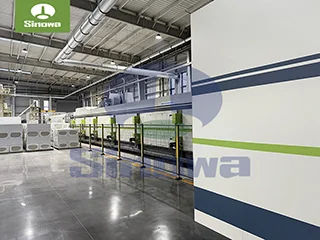
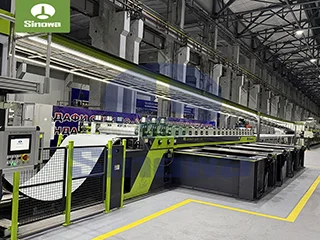
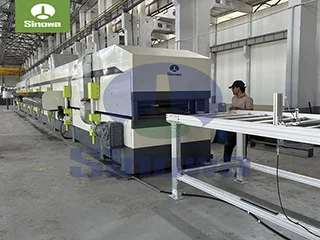
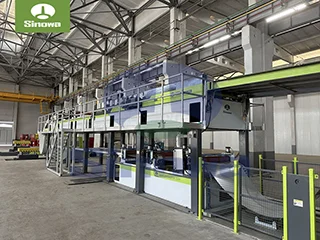
sandwich panel machine
Compared with traditional manual production methods, fully automated pu sandwich panel production lines have significant advantages such as high production efficiency, stable product quality, low labor intensity, and high utilization of raw materials. A standard production line can produce 150-300 square meters of sandwich panels per hour, which is 10-15 times higher than manual production, and the product quality is uniform and consistent, fully meeting the strict requirements of modern construction industry for material performance.
Open book system
The unwinding system is the starting point of the polyurethane sandwich panel production line, usually including:
Dual station unwinding machine: capable of non-stop roll changing and improving production efficiency
Automatic correction device: Ensure that the centering accuracy of the metal coil is within ± 1mm
Preprocessing unit: including cleaning, passivation and other processing techniques to enhance the bonding strength between the panel and the core material
Forming system
The forming system is responsible for processing flat metal coils into the required plate shape:
Multi roll continuous forming machine: using 16-24 composition roller wheel progressive forming
Hydraulic servo system: precise control of forming pressure and speed
Quick mold changing device: capable of switching between different plate types within 30 minutes
Bubbler System
The core foaming system consists of the following units:
High pressure foaming machine: The working pressure is usually in the range of 120-200 bar
Temperature control unit: Accurately control the temperature of raw materials within ± 0.5 ℃ range
Mixing head: Adopting a self-cleaning design, the mixing efficiency reaches over 98%
Measurement system: Flow accuracy can reach ± 1.5%
Composite system
The composite system achieves the perfect combination of panel and core material:
Double track press: pressure evenly adjustable (0.1-0.3MPa)
Temperature control platform: maintain the optimal foaming temperature environment
Online thickness gauge: Real time monitoring of sheet thickness (accuracy ± 0.2mm)
Cutting system
The fully automatic cutting system includes:
Flying saw cutting unit: cutting accuracy ± 1mm
Automatic stacker crane: maximum stacking height can reach 2 meters
Waste recycling device: realizing automatic recycling and utilization of scrap materials
Control system
The intelligent control system is the brain of the polyurethane sandwich panel production line:
PLC+Industrial PC Dual Control System
Human Machine Interface (HMI) Operating Platform
Remote monitoring and fault diagnosis function
Production Data Automatic Collection and Analysis System
Core technical parameters of automatic pu sandwich panel machine
Production line speed: 3-12 meters/minute (adjustable)
Product width: 800-1200mm (standard), special specifications can be customized
Board thickness: 30-200mm
Panel thickness: 0.3-0.8mm
Density range: 35-60kg/m ³
Thermal conductivity: 0.018-0.024W/(m · K)
Compressive strength: ≥ 150kPa
Fire rating: up to B1 level (adjusted according to formula)
Production process flow of automatic pu sandwich panel machine
Panel pretreatment: uncoiling → cleaning → passivation → drying
Forming processing: forming the required plate shape through multiple roller presses
Injection foaming: precise measurement and injection of polyurethane mixture
Composite curing: foaming and bonding process completed under controlled environment
Fixed length cutting: automatically cut according to the set length
Finished product stacking: automatic stacking and packaging
Technical advantages and innovation points of automatic pu sandwich panel machine
Energy saving and environmentally friendly design:
Thermal energy recovery system can save 15-20% energy
Closed loop foaming process reduces VOC emissions
The waste recycling rate is over 95%
Intelligent control system:
Adaptive PID Temperature Control Algorithm
Quality Inspection System Based on Machine Vision
Big data analysis optimizes production processes
Modular design:
Quick replacement mold system
Scalable production line configuration
Easy to maintain structural design
Advanced foaming technology:
High voltage impact mixing technology
Nano modified polyurethane formula
Low temperature foaming process
The products produced by automatic pu sandwich panel machines are widely used in:
Industrial plants and storage facilities
Cold storage and cold chain logistics center
Cleanrooms and pharmaceutical factories
Commercial buildings and mobile homes
Agricultural greenhouse and special buildings
Suggestions for the selection and maintenance of automatic pu sandwich panel machines
Selection considerations:
Capacity demand and product specifications
Equipment energy consumption and environmental indicators
Supplier's technical support capability
Equipment upgrade and expansion possibilities
Daily maintenance points:
Regularly inspect the hydraulic and pneumatic systems
The foaming system is thoroughly cleaned every week
Quarterly electrical system testing
Annual comprehensive maintenance and calibration
Operator training:
Equipment operation specifications
Safety protection knowledge
Emergency handling of faults
Optimization of process parameters
With the continuous improvement of building energy-saving requirements and the rapid development of intelligent manufacturing technology, automatic pu sandwich panel machines are evolving towards higher efficiency, intelligence, and environmental friendliness, providing high-quality insulation solutions for the modern construction industry. Choosing appropriate production line equipment and mastering scientific operating methods will significantly enhance the market competitiveness and economic benefits of enterprises.
In the modern manufacturing and construction sectors, the automatic PU sandwich panel machine stands as a cornerstone of efficient composite panel production, streamlining the fabrication of high-performance polyurethane core sandwich panels that have reshaped standards for thermal insulation, structural durability, and versatile material usage across global industries. Unlike semi-automated or manual production setups, this fully automated equipment integrates multiple sequential processes into a single, synchronized production line, eliminating manual handling gaps, reducing production errors, and scaling output to meet the growing demand for lightweight, energy-efficient composite panels in commercial, industrial, and residential applications. Designed to merge rigid outer facing materials with a dense, closed-cell polyurethane foam core, the machine executes a seamless workflow that transforms raw coil materials and liquid chemical components into finished sandwich panels with consistent quality, precise dimensions, and uniform core density, making it an indispensable asset for manufacturers specializing in building envelope solutions, cold chain infrastructure, and specialized industrial insulation products. Every aspect of the machine’s design is engineered to balance operational efficiency, structural stability, and production flexibility, with each modular component working in tandem to maintain continuous production flow while adapting to varying panel specifications, core thicknesses, and facing material types without extensive reconfiguration.
The structural composition of the automatic PU sandwich panel machine is a meticulously engineered assembly of modular, interlocking systems, each assigned a specific function in the panel production cycle, with no single component operating independently to ensure full process automation. At the upstream end of the line lies the material feeding and uncoiling system, which accommodates large coils of facing materials—most commonly metal sheets such as galvanized steel, aluminum, or color-coated steel, as well as non-metal facing options for specialized applications. This system features heavy-duty uncoilers with tension control mechanisms to prevent material warping, wrinkling, or misalignment during unwinding, paired with precision straightening rollers that flatten any minor deformations in the raw coil material before it enters the forming stage. Following the uncoiling and straightening section is the roll forming module, a series of calibrated rolling stands that progressively shape the flat facing sheets into predefined profiles, ranging from simple flat panels to corrugated, trapezoidal, or interlocking edge profiles designed for easy on-site assembly. The roll forming stands are constructed with high-strength alloy rollers and durable frame structures to withstand continuous production pressure, with adjustable settings to accommodate different facing material thicknesses and profile designs, ensuring that both top and bottom facing sheets are formed to identical specifications for perfect alignment later in the process.
Positioned at the center of the machine’s structure is the core injection and foaming system, the heart of the entire production line that governs the quality and performance of the PU foam core. This system consists of sealed storage tanks for the two primary liquid chemical components that form polyurethane foam—polyol and isocyanate—equipped with temperature control units to maintain optimal chemical reactivity, high-pressure precision pumps that meter the two components at a fixed, accurate ratio, and a dynamic mixing chamber that blends the chemicals uniformly to initiate the foaming reaction. The mixed liquid foam is injected continuously and evenly into the cavity between the pre-formed top and bottom facing sheets as they move through the line, with specialized nozzles that prevent foam leakage and ensure full, consistent filling across the entire width and length of the panel, avoiding voids, uneven density, or core separation that could compromise panel performance. Directly adjacent to the injection system is the curing and laminating section, a temperature-controlled conveyor tunnel that facilitates the complete expansion, cross-linking, and solidification of the PU foam, while simultaneously bonding the foam core firmly to both facing sheets to create a single, integrated composite structure. The curing tunnel features adjustable temperature zones and controlled conveyor speed, allowing operators to tailor the curing cycle to match foam density requirements and panel thickness, ensuring full curing without overheating or under-curing that could affect structural integrity.
Downstream of the curing section lies the precision cutting and finishing module, which automates the process of trimming the continuous panel strip into fixed, standardized lengths or custom sizes as required by end-use applications. The cutting system employs high-precision servo motors and sharp, durable cutting blades that operate seamlessly with the conveyor speed to ensure clean, burr-free cuts with tight dimensional tolerance, eliminating the need for manual trimming and reducing material waste. Additional auxiliary structural components include a centralized control cabinet equipped with an intuitive touchscreen interface, which serves as the nerve center of the entire machine, allowing operators to set and monitor all production parameters—including line speed, foam injection ratio, curing temperature, cutting length, and material tension—from a single point. The control system is integrated with real-time sensors that track production progress, detect operational anomalies such as material jams, inconsistent foam flow, or temperature fluctuations, and trigger automatic alerts to prevent production downtime and maintain consistent panel quality. The machine also includes a sturdy steel frame foundation that supports all modules, vibration-dampening components to stabilize operation during high-speed production, and safety enclosures that protect operators from moving parts and chemical exposure while maintaining easy access for routine maintenance and component replacement.
The performance capabilities of the automatic PU sandwich panel machine are what distinguish it from lower-efficiency production equipment, with key performance metrics centered on production efficiency, product consistency, operational stability, and adaptability to diverse production needs. One of the most prominent performance advantages is its continuous, high-speed production capacity, which enables uninterrupted panel fabrication for extended operational hours, significantly boosting daily output compared to batch-type or manual production methods. The machine maintains a steady production speed that can be adjusted to match production demands, with consistent speed regulation across all modules to prevent misalignment between facing sheets and foam core, even at maximum operational speed. Precision is another core performance attribute, with the machine delivering tight dimensional accuracy for panel width, thickness, and length, as well as uniform PU foam density throughout every panel produced. This uniformity is critical for ensuring consistent thermal insulation performance, structural load-bearing capacity, and weather resistance across all finished products, eliminating variations that can occur with manual mixing or injection processes.
In terms of material compatibility, the machine exhibits exceptional versatility, capable of processing a wide range of facing materials with varying thicknesses and strengths, from thin, lightweight metal sheets to thicker, heavy-duty industrial-grade panels, as well as specialized non-metal facings for specific industrial applications. It can also accommodate adjustable PU foam core thicknesses, ranging from thin insulation panels for interior use to thick, heavy-duty cores for cold storage and structural applications, with quick parameter adjustments that minimize changeover time between different product specifications. The machine’s operational stability is enhanced by its robust structural design and high-quality internal components, which reduce mechanical wear and tear, minimize the need for frequent repairs, and ensure reliable performance even under heavy, continuous production loads. Energy efficiency is also a key performance feature, with optimized heating systems for the curing tunnel, energy-saving motors for conveyor and roll forming operations, and closed-loop foam injection systems that reduce chemical waste, lowering overall production costs and aligning with sustainable manufacturing practices. Additionally, the machine’s fully automated design reduces reliance on manual labor, minimizing human error, improving workplace safety, and streamlining production workflow by reducing the number of operators required to oversee the entire line.
Beyond core production performance, the machine offers reliable long-term durability, with wear-resistant components and a modular design that simplifies part replacement and maintenance, extending the service life of the entire equipment. The centralized control system supports programmable production recipes, allowing manufacturers to store and recall settings for frequently produced panel types, further reducing setup time and improving operational efficiency. The machine also produces minimal noise and dust during operation, creating a cleaner, safer working environment compared to older, less advanced production equipment, and it generates minimal material waste through precise cutting, accurate foam injection, and optimized material feeding, contributing to more sustainable and cost-effective manufacturing operations. Whether producing small-batch custom panels or large-volume standardized products, the machine maintains consistent performance levels, making it suitable for both small-scale manufacturing facilities and large industrial production plants with high-volume output requirements.
Automatic PU sandwich panel machines are categorized into distinct types based on production configuration, application specialization, and operational design, each tailored to meet specific manufacturing needs and end-use panel requirements, with no overlap in core functionality that would compromise their targeted performance. The most common classification is based on production continuity, dividing machines into continuous automatic production lines and discontinuous or batch-type automatic machines. Continuous automatic PU sandwich panel machines are the most widely used in large-scale industrial production, featuring a single, uninterrupted conveyor line that carries materials through every process from uncoiling to finished panel output, ideal for high-volume, standardized panel production with minimal downtime. These machines are designed for 24/7 operation and are preferred by manufacturers supplying large construction projects, cold chain infrastructure developers, and mass-produced building material distributors. Discontinuous automatic machines, by contrast, operate in a semi-continuous batch mode, with shorter conveyor systems and modular stations that process materials in smaller batches, making them suitable for smaller manufacturing facilities, custom panel production, or facilities with limited floor space, offering greater flexibility for low-volume, high-variety production runs.
Another key classification is based on the type of sandwich panel produced, with machines specialized for standard insulated building panels, cold storage and refrigeration panels, and specialized industrial insulation panels. Standard building panel machines are designed for general-purpose PU sandwich panels used in wall and roof construction, featuring moderate foam density settings and standard profile forming capabilities, optimized for balance between insulation performance and structural strength. Cold storage-specific machines are engineered to produce panels with higher-density PU foam cores and enhanced bonding strength, with stricter temperature control in the curing system to ensure closed-cell foam structure that delivers superior thermal insulation and moisture resistance, critical for maintaining stable low-temperature environments in cold rooms, refrigerated warehouses, and food processing facilities. Specialized industrial insulation machines are adapted to produce panels with unique specifications, such as fire-resistant foam cores, sound-dampening properties, or chemical resistance, with modified foam injection systems and curing parameters to meet the stringent requirements of industrial manufacturing plants, power generation facilities, and sound-sensitive commercial buildings.
Machines can also be categorized by their level of automation and control functionality, ranging from fully automatic integrated lines to semi-automatic models with partial manual oversight, although fully automatic variants dominate modern industrial use due to their efficiency and consistency. Fully automatic machines require minimal operator intervention, with automated material loading, foam ratio adjustment, curing control, cutting, and panel stacking, while semi-automatic models may require manual material loading or occasional parameter adjustments, suitable for facilities with lower production demands or limited investment capacity. Additionally, machines are classified by panel width and thickness capacity, with standard-sized machines for common panel dimensions and custom heavy-duty machines for extra-wide or extra-thick panels used in large-scale industrial and infrastructure projects. Each type is designed with targeted structural and performance adjustments to optimize output for its intended application, ensuring that manufacturers can select a machine that aligns perfectly with their production volume, product specifications, and operational space constraints.
The applications of automatic PU sandwich panel machines and the finished panels they produce span a vast range of industries, driven by the unique combination of lightweight construction, exceptional thermal insulation, structural rigidity, and quick installation offered by PU sandwich panels. The construction industry is the largest end-user sector, with panels used extensively for exterior wall cladding, roof insulation, partition walls, and facade systems in commercial buildings, industrial warehouses, factory facilities, residential complexes, and prefabricated modular buildings. These panels reduce building energy consumption by minimizing heat transfer, improve indoor temperature stability, and speed up construction timelines due to their lightweight design and easy interlocking installation, eliminating the need for heavy structural support and reducing on-site labor costs. In the cold chain and refrigeration industry, the machine’s high-performance cold storage panels are essential for constructing refrigerated warehouses, food processing plants, cold storage rooms, refrigerated transportation containers, and pharmaceutical storage facilities, where precise temperature control and minimal thermal leakage are critical to preserving perishable goods and sensitive medical supplies.
In agricultural applications, PU sandwich panels produced by these machines are used to construct climate-controlled livestock barns, greenhouses, agricultural storage facilities, and aquaculture operations, maintaining stable internal temperatures and protecting crops, livestock, and agricultural products from extreme weather conditions. The panels’ resistance to moisture, corrosion, and pest infestation makes them ideal for agricultural environments, where durability and low maintenance are key requirements. The industrial sector relies on these panels for specialized insulation in power plants, chemical processing facilities, manufacturing workshops, and warehouse storage units, providing effective thermal insulation, sound dampening, and fire resistance for industrial operations that require controlled environmental conditions. Additionally, the panels are used in temporary construction projects, emergency shelters, and portable building units, thanks to their lightweight portability, quick assembly, and reusable properties, offering a cost-effective and sustainable solution for short-term building needs.
Beyond these core sectors, PU sandwich panels manufactured by automatic machines are increasingly used in transportation and infrastructure projects, including insulated vehicle bodies, shipping containers, and sound barriers along highways and railway lines, leveraging their sound-dampening and insulation properties to improve transportation efficiency and reduce environmental noise pollution. The versatility of the machine itself allows manufacturers to adapt panel specifications to meet niche market demands, such as fire-resistant panels for public buildings, anti-corrosion panels for coastal construction, and ultra-lightweight panels for portable construction units. As global demand for energy-efficient, sustainable building materials continues to rise, the automatic PU sandwich panel machine remains a vital piece of manufacturing equipment, enabling the mass production of high-quality composite panels that support green building initiatives, reduce carbon emissions, and meet the evolving needs of modern infrastructure development across every corner of the industrial and construction landscape. Its combination of advanced structural design, consistent performance, diverse type options, and wide-ranging applications solidifies its role as a key driver of innovation in composite material manufacturing, with ongoing technological advancements continuing to enhance its efficiency, versatility, and sustainability for future industrial needs.
https://www.cnsinowa.com/sandwich-panel-machines/automatic-pu-sandwich-panel-machine.html