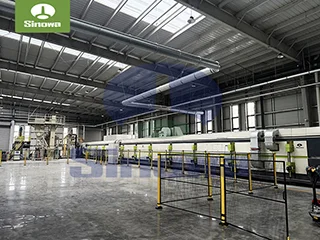
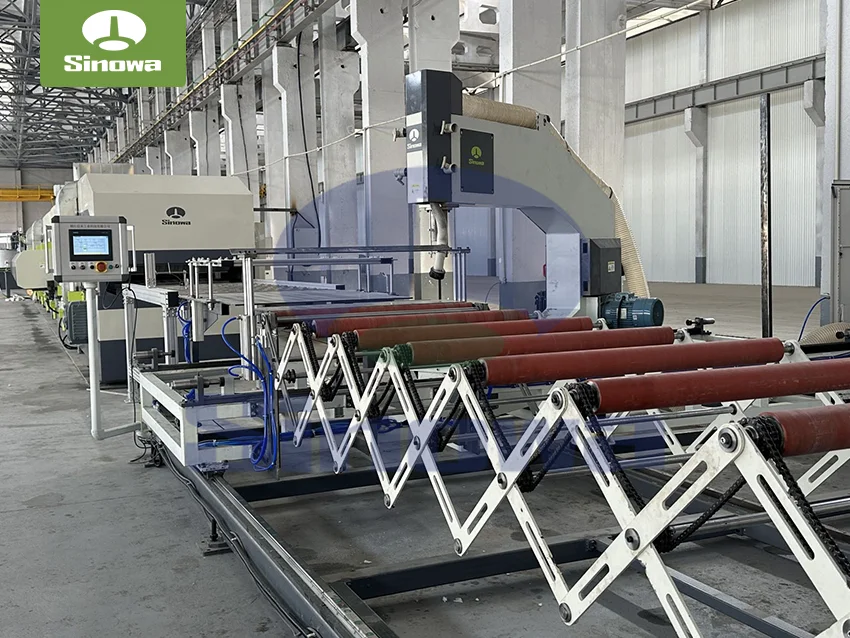
 sandwich panel line
The complete operational framework of the external wall composite insulation board production line consists of multiple interlocking functional modules, each undertaking unique and irreplaceable production tasks. The entire system mainly covers raw material feeding and proportioning unit, precision mixing and stirring unit, composite molding and laminating unit, constant-temperature curing unit, fixed-size cutting and trimming unit, automatic conveying unit and central intelligent control unit. All modules are arranged in a linear production sequence, realizing seamless connection of each production link and forming a closed-loop continuous production process. The collaborative operation of each functional module not only improves the overall production efficiency but also ensures that every production link is implemented in accordance with unified process standards, avoiding product quality fluctuations caused by inconsistent manual operation standards in traditional production modes.
Raw material processing and feeding is the initial and foundational link of the entire production process, which directly determines the uniformity and stability of subsequent finished products. This unit is mainly responsible for the pretreatment, quantitative proportioning and automatic conveying of various raw materials required for composite insulation boards. The raw materials involved in production include inorganic thermal insulation base materials, polymer bonding materials, auxiliary functional additives and other composite components. Before formal mixing, bulk raw materials will undergo necessary screening and crushing treatment to remove impurity particles and unqualified large-particle materials, ensuring the uniformity of raw material particle size. The fully automated dosing device adopts precise metering control logic to complete the proportioning of different raw materials according to preset process parameters. Compared with manual proportioning, the automated dosing mode can accurately control the mixing ratio of each component, effectively avoiding product performance differences caused by proportion deviation. After proportioning, the closed conveying system will transport all raw materials to the mixing equipment in a sealed state, which not only reduces raw material waste but also avoids dust diffusion and maintains a clean production environment.
The mixing and stirring unit is the core link that determines the internal structural uniformity and basic performance of composite insulation boards. After entering the professional mixing equipment, the proportioned raw materials will undergo high-efficiency circulating stirring and fusion treatment. The equipment is equipped with adjustable stirring speed and timing control functions, which can adapt to the mixing requirements of different material formulas. In the stirring process, solid base materials and liquid bonding auxiliaries are fully fused through high-speed shear and low-speed kneading alternately, so that each component is evenly distributed at the microscopic level, forming a homogeneous composite mixture with stable viscosity and activity. The internal temperature of the mixing chamber is kept within a reasonable range through the constant-temperature auxiliary system during operation, which prevents the premature failure of active components in the raw materials due to excessive temperature and avoids insufficient bonding effect caused by low temperature. Sufficient and uniform mixing ensures that the finished insulation boards have consistent thermal insulation performance, structural compactness and bonding strength, eliminating local performance defects such as hollowing and uneven heat conduction.
Composite molding and laminating is the key process to shape the external wall composite insulation board and form its layered composite structure. The uniformly mixed composite materials are evenly paved on the base plate through the automatic paving device of the molding unit, and then the surface protective layer and functional composite layer are accurately laid according to the process design. The entire lamination process adopts flat pressing and shaping technology under stable pressure conditions. Through adjustable mechanical pressure and linear paving speed, the composite materials and base layers are closely bonded without gaps, forming a complete layered composite structure. The molding unit has flexible parameter adjustment capabilities, which can adapt to the production of insulation boards with different thicknesses and structural layers by adjusting paving thickness and pressing parameters. In the molding process, the equipment can automatically correct the offset of plate materials to ensure the flatness and dimensional regularity of the initial molded plates, laying a good foundation for subsequent curing and finishing processing. The integrated molding technology realizes one-time composite forming of multi-layer materials, simplifies the production process, and effectively improves the structural firmness of finished products.
The constant-temperature curing system is an indispensable functional unit for stabilizing the structural performance and mechanical strength of composite insulation boards. The initially molded composite plates have not yet completed the solidification and cross-linking reaction of internal bonding components, and their structural stability and overall strength are insufficient, requiring a specific temperature and humidity environment for curing treatment. The curing unit adopts a fully enclosed structural design with graded temperature control and uniform air circulation systems inside, which can maintain a constant and balanced curing environment in the entire curing space. According to the material characteristics and plate thickness specifications, the system can automatically adjust the curing temperature and standing time to ensure that the internal chemical cross-linking reaction of the composite materials is fully completed. During the curing process, the internal stress of the plates is gradually released, the bonding layers are tightly solidified, and the overall compactness, tensile strength and weather resistance of the plates are significantly improved. Reasonable curing treatment can effectively avoid quality problems such as plate deformation, layer separation and poor structural stability in later use, and ensure that the insulation boards can adapt to complex external wall service environments.
The fixed-size cutting and trimming unit is responsible for finishing and sizing the cured semi-finished plates to meet the unified specification standards of finished products. After the curing process is completed, the continuous integral plates are stably transported to the cutting area by the conveying system. The high-precision cutting equipment adopts automatic positioning and numerical control cutting technology, which can complete fixed-length cutting and edge trimming according to preset dimensional parameters. The cutting tool has high wear resistance and cutting precision, which can ensure smooth and flat cutting sections without burrs, cracks or edge collapse defects. In addition to fixed-length cutting, this unit also completes the trimming of irregular edges on both sides of the plates to ensure that the overall dimensions of each batch of finished plates are consistent and meet the installation and construction requirements of external wall engineering. The automated cutting system has strong flexibility, which can quickly switch cutting parameters to adapt to the production and processing of plates with different specifications, and meets the diversified size needs of different building exterior wall designs. The waste materials generated during cutting are automatically collected through the matching recovery device, realizing effective utilization of resources and reducing production costs.
The automatic conveying and sorting system runs through the entire insulation panel production line, undertaking the material transfer tasks of all production links. It connects raw material feeding, mixing, molding, curing, cutting and finished product output into an uninterrupted production chain. The conveying equipment adopts stable frequency conversion speed regulation technology, which can match the operating speed of each functional unit to avoid material accumulation or production disconnection. In the conveying process, the equipment is equipped with stable anti-offset and anti-slip structures to ensure that the plates are always in a stable state during transmission, preventing position deviation and plate damage. After the completion of cutting and finishing, the qualified finished plates are automatically sorted and stacked by the stacking device, realizing orderly collection of finished products and facilitating subsequent handling and storage. The full-process automatic conveying mode completely replaces manual handling, reduces the risk of plate damage caused by manual operation, and greatly improves the continuity and efficiency of the entire production.
The central intelligent control unit is the brain of the entire insulated sandwich panel production line, responsible for the unified scheduling, parameter adjustment and operation monitoring of all functional modules. The system adopts integrated programming control technology, which can centrally set and adjust all process parameters such as raw material proportioning, stirring speed, molding pressure, curing temperature and cutting size. During the continuous production process, the control system can monitor the operating status of each equipment module in real time, automatically identify abnormal operating parameters, and trigger early warning prompts for abnormal conditions such as equipment overload, parameter deviation and material shortage. Operators can complete the overall scheduling and fine-tuning of production through a simple human-computer interaction interface, which greatly reduces the difficulty of equipment operation. The intelligent control mode realizes standardized and digital production management, ensures that each batch of products is produced under consistent process conditions, and fundamentally improves the stability and consistency of product quality. At the same time, the system can record production data in real time, providing effective data support for production optimization and process improvement in the later stage.
Compared with traditional intermittent production equipment, the external wall composite insulation sandwich panel machine has significant advantages in production efficiency, product quality and production management. In terms of production efficiency, the fully continuous automated production mode realizes uninterrupted operation of the whole process, with shorter single-cycle production time and larger continuous output, which can fully meet the bulk material supply needs of large-scale construction projects. In terms of product quality, the full-process digital parameter control avoids the uncertainty of manual operation, making the thermal insulation performance, structural stability and dimensional accuracy of finished products always maintained at a high level. The composite structure formed by integrated molding and constant-temperature curing has stronger bonding firmness and weather resistance, and can maintain stable thermal insulation and structural performance in long-term outdoor complex environments such as high temperature, low temperature and humid weather.
In terms of production safety and environmental protection, the insulation sandwich panel production line adopts fully closed production design in key links such as raw material conveying and mixing, which effectively suppresses dust and volatile substance diffusion, reduces environmental pollution in the production process, and improves the on-site working environment. The equipment is equipped with perfect safety protection mechanisms, with automatic stop and overload protection functions in all operating links, which can effectively avoid equipment failure and safety accidents caused by abnormal operation. In addition, the centralized control mode reduces the number of on-site operators, reduces labor input, and lowers the operational risk of production activities. The resource recovery device matched with the cutting link realizes the recycling of production waste, reduces material waste, and makes the production process more economical and environmentally friendly.
With the continuous development of building energy-saving technology, the performance requirements for external wall thermal insulation materials in the construction industry are constantly improving, which also promotes the continuous upgrading and optimization of external wall composite insulation board production lines. Modern production lines are gradually developing towards higher automation, stronger intelligence and more flexible production. The optimized structural design enables the equipment to adapt to the production of multi-type composite insulation materials, realizing the diversified production of thermal insulation boards with different thermal conductivity, fire resistance and structural strength. The upgraded intelligent monitoring system can realize more refined process control, further improve the uniformity and stability of product performance, and make the produced insulation boards more adaptable to different climatic zones and building types.
In practical industrial application, the external wall composite insulation board produced by this sandwich panel manufacturing line has excellent comprehensive performance, with good thermal insulation, sound insulation, fire resistance and weather resistance. The stable composite structure enables the boards to be closely attached to the external wall base during construction, effectively reducing building energy consumption, improving the thermal comfort of buildings, and prolonging the service life of building exterior wall structures. The standardized and unified product specifications greatly simplify the on-site construction process, improve the efficiency of external wall insulation construction, and reduce the difficulty of on-site quality control. As a key supporting equipment for building energy-saving materials production, this automated production line plays an important role in promoting the standardized development of the building thermal insulation industry and popularizing energy-saving building technologies.
In conclusion, the external wall composite insulation board production machinery is a highly integrated, efficient and stable modern industrial production system. Through the collaborative operation of multiple functional modules such as precise batching, uniform mixing, integrated molding, constant-temperature curing and intelligent control, it realizes standardized, large-scale and high-quality production of external wall composite insulation boards. Its excellent production stability, high production efficiency and good environmental protection performance make it the core equipment for the production of modern building energy-saving insulation materials. With the continuous advancement of green building and energy-saving emission reduction policies, this type of production line will be further popularized and applied in the construction material industry, and continuously drive the technological upgrading and high-quality development of the building thermal insulation field, providing reliable material guarantee for the sustainable development of the modern construction industry.
https://www.cnsinowa.com/sandwich-panel-machines/external-wall-composite-insulation-board-production-line.html