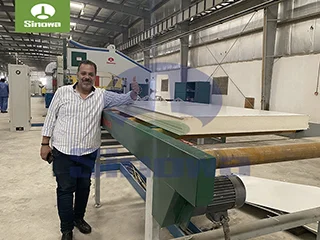
sandwich panel machine
Sandwich panels produced by automated production lines are typical composite structural materials composed of upper and lower surface layers and a lightweight core material. Common core materials include polyurethane foam, rock wool, glass wool, and polystyrene foam, all of which possess excellent thermal insulation, sound insulation, and fire-resistant properties. The surface layers usually adopt high-strength metal materials with good weather resistance and structural stability, enabling the finished panels to integrate load-bearing, heat preservation, fire prevention, and decoration functions. Compared with traditional single-layer building boards, composite sandwich panels have obvious advantages such as light weight, high strength, convenient installation, and strong environmental adaptability. The performance advantages of finished panels are largely determined by the precision, stability, and technological maturity of the production equipment, making the automatic sandwich panel making machine a key factor in controlling the comprehensive quality of sandwich panel products.
The overall structural design of the automatic sandwich panel making machine follows the principles of continuous production, modular combination, and intelligent control. The entire production line consists of multiple interconnected and coordinated functional subsystems, each undertaking independent production tasks while maintaining precise synchronous operation to ensure the continuity and stability of the whole production process. The core functional modules cover raw material pretreatment and feeding system, automatic metering and mixing system, surface layer material unwinding and leveling system, core material laying and compounding system, constant-temperature pressure molding system, continuous traction conveying system, precision fixed-length cutting system, and finished product automatic stacking system. All modules are centrally regulated by an integrated intelligent control system, which can automatically adjust operating parameters according to different raw material characteristics and production process requirements, realizing unmanned continuous operation of the entire production process.
The raw material pretreatment and feeding system is the starting link of the automatic sandwich panel production line, undertaking the task of stable and orderly supply of all production raw materials. For bulk core materials such as rock wool and glass wool, this system is equipped with special material sorting and conveying devices, which can disperse stacked and agglomerated core materials to ensure uniform material density in the subsequent laying process and avoid local hollowing or uneven thickness of finished panels. For foaming core materials, the system realizes sealed conveying of raw materials to prevent external dust and impurities from mixing in, ensuring the purity and foaming uniformity of core materials. The surface layer metal materials are placed on the automatic unwinding device of the system, which adopts constant-tension unwinding technology to avoid tension fluctuation problems such as material stretching and wrinkling during the unwinding process. At the same time, the system is equipped with a surface leveling and deviation correction mechanism, which can dynamically monitor the conveying position of surface materials in real time and automatically correct deviations to ensure the alignment accuracy of upper and lower surface layers in the subsequent compounding process, laying a foundation for the flatness and dimensional accuracy of finished panels.
The automatic metering and mixing system is a key module to ensure the uniformity and stability of core material performance, especially suitable for the production of chemical foaming core materials. This system adopts high-precision automatic metering devices to realize accurate proportional conveying of various raw materials, effectively avoiding performance differences of core materials caused by manual metering errors. The internal mixing mechanism is designed with a multi-layer stirring structure, which can fully mix different raw materials in a sealed environment to form a uniform composite material matrix. The system can automatically adjust the mixing speed and raw material ratio according to the set production process parameters, adapting to the production requirements of core materials with different densities and performance indicators. In addition, the system is equipped with a real-time material monitoring function, which can automatically alarm and adjust parameters when abnormal material flow or uneven mixing is detected, ensuring the continuous stability of material quality in the production process and avoiding batch quality problems of finished panels caused by raw material mixing errors.
The surface layer compounding and core material laying system completes the key composite molding process of sandwich panels. After leveling and deviation correction, the upper and lower surface layer materials are conveyed to the composite station at a constant speed, and the uniformly mixed core materials are evenly laid between the two surface layers through an automatic spreading device. For fibrous core materials such as rock wool and glass wool, the system adopts layered uniform laying technology to ensure that the core material is densely and evenly distributed in the composite gap, eliminating gaps and cavities inside the panel. For foaming core materials, the system realizes synchronous foaming and filling in the composite state, making the core material closely bonded with the surface layer materials and forming an integrated composite structure. The entire compounding process maintains a stable conveying speed and uniform material laying thickness, which effectively guarantees the consistency of panel thickness and internal structural uniformity, and improves the overall structural stability and mechanical properties of finished sandwich panels.
The constant-temperature pressure molding system is the core functional module that determines the bonding strength and overall flatness of sandwich panels. After compounding, the preliminary formed sandwich panel blank enters the constant-temperature molding device, which adopts a double-track closed pressing structure to provide stable and uniform molding pressure for the panel. The internal temperature control system can accurately adjust the molding temperature according to the characteristics of different core materials, creating a constant-temperature curing environment suitable for core material molding and interface bonding. Stable pressure and temperature conditions enable the core material to fully cure and bond tightly with the surface layer materials, effectively improving the interface bonding strength of the composite panel and avoiding quality problems such as delamination and cracking during subsequent use. The molding track adopts a high-rigidity structural design, which can maintain stable operating accuracy during long-term continuous operation, ensuring that the flatness and thickness tolerance of each batch of panels are controlled within a reasonable range and realizing standardized production of products.
The continuous traction conveying system undertakes the task of stable transmission of panel blanks in the molding process. It adopts variable-frequency speed regulation technology to realize synchronous matching with the operating speed of each front-end module, ensuring the continuity and coordination of the entire production line. The traction device is designed with anti-slip and uniform force application structure, which can stably convey panel blanks without causing surface scratch, extrusion deformation or position deviation. The system can automatically adjust the traction speed according to different panel thicknesses and production process requirements, realizing flexible switching of production speeds and meeting the production needs of different specification products. At the same time, the closed-loop speed regulation function of the system can dynamically compensate for speed errors caused by long-term operation of the equipment, ensuring the consistency of production speed and further stabilizing product quality.
The precision fixed-length cutting system is responsible for the final sizing and shaping of finished sandwich panels. After molding and curing, the continuous panel blank is conveyed to the cutting station, and the system automatically identifies the set panel length through a high-precision positioning detection device. The cutting mechanism adopts high-speed and stable cutting technology, which can complete fixed-length cutting in an instant without causing edge warping, burrs or uneven cuts on the panel section. The system supports flexible setting of cutting dimensions, which can meet the production requirements of panels with different lengths and widths, and has strong production flexibility. In addition, the cutting system is equipped with an automatic chip removal device, which can timely clean up the debris generated during cutting, keep the cutting station clean, avoid debris affecting the flatness of panel surface and cutting accuracy, and ensure the appearance quality and dimensional precision of finished panels.
The finished product automatic stacking system is the terminal link of the continuous sandwich panel line, realizing automatic collection and sorting of cut finished panels. The system adopts mechanical automatic grabbing and stacking technology, which can stably and neatly stack qualified panels according to the set rules, replacing traditional manual stacking operations. It is equipped with a panel protection mechanism to avoid surface scratch and corner damage during the grabbing and stacking process, effectively protecting the appearance integrity of finished products. The automatic stacking function greatly reduces manual labor investment, improves the neatness and uniformity of finished product stacking, and facilitates subsequent storage, transportation and loading operations. At the same time, the system can count finished products in real time, providing accurate production data statistics for production management.
The intelligent control system runs through the continuous sandwich panel production line and is the brain core of realizing automated and intelligent production. The system adopts integrated programmable control technology, which can centrally control and dynamically monitor all functional modules of the production line. Operators can complete parameter setting, process adjustment, equipment start-stop and operation monitoring through a simple human-computer interaction interface. The system has automatic fault detection and early warning functions, which can real-time monitor the operating status of key components such as motors, transmission parts and temperature control devices. When equipment failure, parameter deviation or abnormal material supply occurs, the system will automatically send early warning prompts and record fault information, and can even execute automatic shutdown protection according to the fault level, effectively avoiding equipment damage and batch product quality problems caused by abnormal operation. In addition, the system supports production data storage and query, which can record daily production output, product specifications, equipment operating parameters and other data, providing effective data support for production scheduling, process optimization and equipment maintenance.
Compared with traditional semi-automatic and manual production modes, the automatic sandwich panel machine has extremely prominent technical and production advantages. First of all, it achieves a high degree of production automation, realizing unmanned continuous operation from raw material feeding to finished product stacking, which greatly reduces the dependence on manual labor, cuts down labor costs in the production process, and avoids product quality fluctuations caused by manual operation errors. Secondly, the equipment has high production precision and stable product quality. All production links such as raw material metering, material laying, molding pressure and cutting sizing are precisely controlled by the system, which effectively controls the dimensional error and performance difference of finished panels, and ensures the consistency and reliability of batch products.
In terms of production efficiency, the continuous production mode of the automatic production line completely breaks the intermittent production limitation of traditional equipment. It can realize long-term uninterrupted production, greatly improve the unit time output of sandwich panels, and meet the large-scale production needs of modern building material enterprises. In addition, the equipment has strong production compatibility and can adapt to the production of sandwich panels with different core materials, different thicknesses and different surface layer specifications. By simply adjusting system parameters and replacing a small number of auxiliary parts, it can switch production specifications flexibly, meeting the diversified product production needs of enterprises and improving the comprehensive utilization rate of production equipment.
In terms of production cost control, the automatic sandwich panel production machine has obvious energy-saving and material-saving advantages. The precise raw material metering and uniform material laying technology effectively reduces raw material waste in the production process and improves the utilization rate of production materials. The optimized mechanical transmission structure and variable-frequency speed regulation technology reduce the energy consumption of equipment operation, realizing low-energy and high-efficiency production. At the same time, the stable operation performance of the equipment reduces the failure rate and maintenance cost in the production process, and the long-term stable production capacity brings higher economic benefits for production enterprises.
From the perspective of production safety and environmental protection, the automated sandwich panel line adopts closed production design in key links such as raw material conveying, mixing and molding, which effectively avoids dust overflow and material leakage, reduces production pollution, and improves the on-site production environment. The intelligent fault early warning and automatic protection functions reduce the occurrence of production safety accidents and improve the safety level of production operations. In addition, the high-precision production process enables the finished sandwich panels to have stable thermal insulation, fire resistance and environmental protection performance. The produced panels do not contain harmful substances, meet the environmental protection standards of modern construction projects, and can be widely used in various high-standard construction scenarios such as indoor buildings and clean workshops.
The application scenarios of sandwich panels produced by automatic production equipment cover multiple fields of modern construction engineering. In industrial construction, such panels are widely used in the roof and wall enclosure structures of factory buildings, workshops and logistics warehouses. Their light weight and high strength can reduce the self-weight of building structures, lower the foundation construction cost, and their excellent thermal insulation performance can reduce the energy consumption of building operation. In cold storage and constant-temperature warehouse construction, the high-efficiency thermal insulation core material of sandwich panels can form a stable constant-temperature space, effectively reducing the energy consumption of refrigeration equipment and maintaining the internal temperature stability of the warehouse, which is an ideal enclosure material for cold storage buildings.
In the field of clean workshops and medical buildings, sandwich panels have the advantages of smooth surface, dust prevention, easy cleaning and stable fire resistance, which can meet the high environmental standards of pharmaceutical workshops, laboratory buildings and medical treatment spaces. In modular buildings and temporary construction projects, the standardized and prefabricated characteristics of sandwich panels are fully utilized. The panels produced by automated production lines have unified specifications and stable quality, which can realize rapid assembly and construction of buildings, greatly shorten the construction cycle of projects, and are widely used in prefabricated houses, emergency rescue buildings and temporary office buildings. In addition, such panels are also applied in public buildings such as stadiums, exhibition halls and shopping malls, playing the roles of building heat preservation, sound insulation and decoration.
With the continuous improvement of modern building energy-saving standards and the gradual promotion of prefabricated building policies, the market demand for high-performance standardized sandwich panels continues to grow, which also puts forward higher requirements for the performance and intelligence level of automatic sandwich panel making machines. The future development trend of such equipment is mainly reflected in intelligent upgrading, green production and flexible customization. In terms of intelligence, the equipment will be further combined with Internet of Things technology to realize remote equipment monitoring, fault intelligent diagnosis, production data cloud management and unmanned intelligent scheduling, improving the overall intelligent level of production line operation.
In terms of green production, the equipment will further optimize the production process, adopt more energy-saving transmission structures and environmental protection production technologies, realize lower energy consumption and zero pollution discharge in the production process, and adapt to the development trend of green manufacturing in the building materials industry. In terms of flexible production, the equipment will realize more rapid specification switching and personalized production functions, which can meet the customized production needs of special-sized and special-performance sandwich panels in the market, and improve the market adaptability of the equipment.
Daily maintenance and scientific operation are crucial to ensuring the long-term stable operation and service life of the automatic sandwich panel machinery. In the daily production process, operators need to conduct regular inspection and maintenance of key components such as transmission parts, metering devices, temperature control systems and cutting mechanisms. It is necessary to regularly clean the dust and debris accumulated inside the equipment to avoid affecting the operation accuracy and heat dissipation performance of the equipment. The lubrication maintenance of transmission gears, bearings and other moving parts should be done regularly to reduce mechanical wear and ensure the stability of mechanical transmission. At the same time, the operating parameters of the control system should be checked regularly to ensure the accuracy of metering, temperature control and speed regulation parameters, and avoid product quality problems caused by parameter deviation.
Enterprises need to formulate standardized equipment operation and maintenance management systems, strengthen professional training for operators and maintenance personnel, ensure that personnel can proficiently master equipment operation specifications and fault handling methods, and avoid equipment damage and production accidents caused by irregular operation. Regular comprehensive equipment debugging and performance testing should be carried out to timely discover and eliminate potential equipment faults, maintain the optimal operating state of the production line, and ensure the long-term stable and high-efficiency operation of the equipment.
In conclusion, the automatic sandwich panel making machine is a highly efficient, intelligent and environmentally friendly modern building material production equipment, which integrates multiple advanced technologies and realizes standardized, large-scale and high-quality production of composite sandwich panels. Its excellent production performance and wide application value make it a key equipment for the upgrading and development of the modern prefabricated building materials industry. With the continuous progress of construction industrialization and manufacturing intelligence, such automated production equipment will play a more important role in the field of building material production, continuously promote the technological progress and industrial upgrading of the construction industry, and provide more high-quality and efficient material support for the construction of modern green buildings.
https://www.cnsinowa.com/sandwich-panel-machines/automatic-sandwich-panel-making-machine.html